
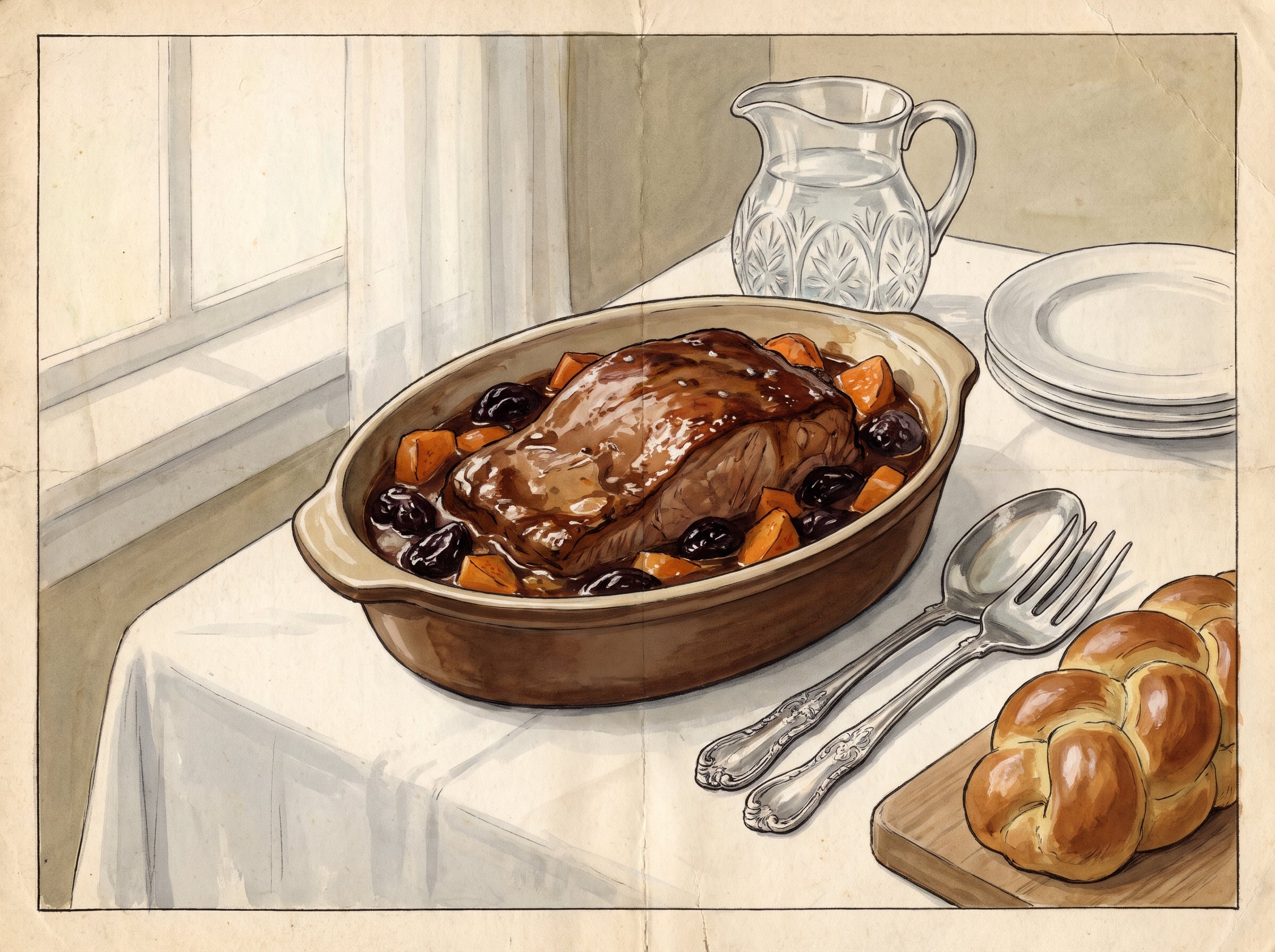
In 1919 a New York cookbook printed a recipe with a name as plain as a grocery list: Plums, Sweet Potatoes and Meat. Ashkenazi Jewish cooks had a better name for it, tzimmes, the slow, sweet stew of the holiday table. This version calls for a pound of fatty brisket, half a cup of sugar and a lump of something called sour salt.
Please note that some of the images in this article were created with the assistance of AI.
From The International Jewish Cook Book (second edition), 1919
The Story Behind This Recipe
A kosher cookbook from New York
The full title takes a breath to say: The International Jewish Cook Book: 1600 Recipes According to the Jewish Dietary Laws with the Rules for Kashering. Bloch Publishing Company brought out this second edition in New York in 1919. Its author, Florence Kreisler Greenbaum, appears on the title page as an ‘Instructor in Cooking and Domestic Science.’ That line is most of what the book tells us about her, and we’d rather leave the rest blank than fill it in with guesses.
Her recipes say plenty about her readers, though. Greenbaum assumes they can wash and boil fruit, tell when brisket has gone tender, and recognize ‘nicely browned’ without a second hint. There is no hand-holding here, just a cooking teacher trusting a room full of capable cooks.
A stew with a reputation
Tzimmes slipped into English sideways. To ‘make a big tzimmes’ means to make a big fuss, perhaps because of all the slicing, mixing and stirring the dish asks of whoever makes it. The word itself is Yiddish, and the Oxford English Dictionary suggests it may trace back to the Middle High German imbīz, meaning ‘meal.’
In Ashkenazi Jewish kitchens, tzimmes usually means carrots and dried fruit such as prunes or raisins, often joined by other root vegetables, yams included. Some cooks add beef, usually flanken or brisket. Everything cooks slowly over low heat with honey or sugar, sometimes with cinnamon or other spices. It often appears at Rosh Hashanah, when sweet, honey-flavored dishes are traditional and the sweetness stands for the hope of a sweet new year. Her recipe never mentions a holiday. She simply lists what goes in the pot.
No carrots, plenty of brisket
The first surprise is what’s missing. Greenbaum skips carrots altogether and hands their job to five medium sweet potatoes, pared and cut small. Alongside them go a pound of prunes or plums and a pound of brisket ‘or any fat meat.’ The order matters. Fruit and meat simmer together first, the sweet potatoes join once the meat is tender, and the meat is laid on top before the covered pot goes into the oven.
The sweet-sour balance rests on two things: half a cup of sugar and ‘a piece of sour salt (citric acid).’ After that, the instructions get wonderfully brief. Cover it, bake until browned, and if the gravy cooks away, add some warm water. One modern tzimmes recipe names a 350°F oven, a 9×13 baking dish and about an hour and a half under foil. In 1919, the cook’s own eyes were the timer.
1910s
What Our Readers Say
- When Piaci Pizza readers loved a food photo and tapped a reason, comfort was the top pick at 30%, with nostalgia also among the leading reasons at 16%.
From Piaci Pizza reader polls and votes.
Notes From the Era
The recipe · 1919
Plums, Sweet Potatoes and Meat
From The International Jewish Cook Book (second edition) by Florence Kreisler Greenbaum (1919). Every word of the recipe below is as printed.
Ingredients
- one pound of prunes or plums
- one pound of brisket of beef or any fat meat
- five medium-sized sweet potatoes
- one-half cup of sugar
- a piece of sour salt (citric acid)
- some warm water
Method
-
Boil the fruit and meat, then add sweet potatoes
Wash one pound of prunes or plums and put on to boil with one pound of brisket of beef or any fat meat; when the meat is tender add five medium-sized sweet potatoes which have been pared and cut in small pieces.
-
Top with meat, sugar and sour salt
Place the meat on top, add one-half cup of sugar and a piece of sour salt (citric acid).
-
Cover and bake
Cover and bake until nicely browned.
-
Add water if needed
If gravy should cook away add some warm water.
Our notes
Reading It Today
Sour salt. Sour salt is citric acid sold as crystals, which is why the recipe asks for ‘a piece’ instead of a spoonful. Its tartness offsets the half cup of sugar.
Prunes or plums, by the pound. The heading says plums, but the method allows ‘prunes or plums,’ so dried or fresh fruit would both work. A pound is 16 ounces, or about 450 grams, for both the fruit and the meat. ‘Medium-sized’ sweet potatoes are left to the cook’s judgment.
What to expect in the pot. Judging from the ingredients, this would be tender brisket and soft pieces of sweet potato in a sweet-sour gravy, flavoured by the fat from the meat. With sugar and fruit in the pot, the top is meant to bake until nicely browned.
Not your usual sweet potato side. Here the sweet potatoes aren’t served on the side. They share a pot with beef and bake into a one-pot dish, where sugar, fruit and a sharp hit of citric acid sit right alongside the meat.
Source: Florence Kreisler Greenbaum, The International Jewish Cook Book (second edition) (Bloch Publishing Company, New York, 1919). Read the 1919 book at Project Gutenberg.
Sources for the history
The original recipe text is from a work published in 1919 and is in the public domain in the United States. The history, notes and illustrations are Piaci Pizza’s own. Brand names that appear in historic recipes are mentioned as historical fact only. Illustrations are AI-generated in a vintage style. The recipe is shown exactly as it was published in 1919; we have not photographed a test batch.