
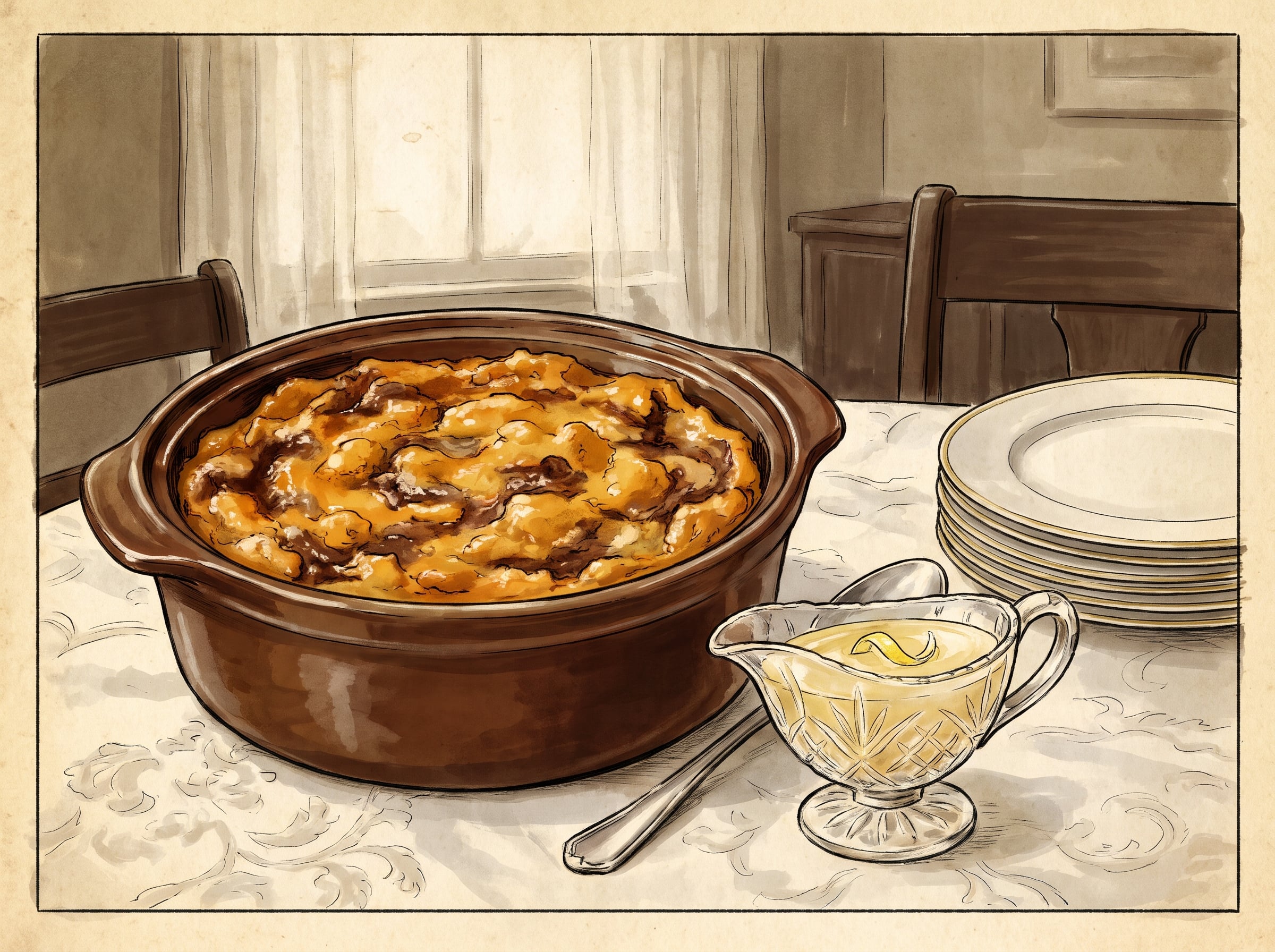
Most recipes tell you to keep the oven door shut. This 1913 sweet potato pudding wants it opened at least three times, so the brown crust on top can be broken up and stirred back in. It’s a small, strange instruction, and it shows how an old Southern dish was still changing in the 1910s.
Please note that some of the images in this article were created with the assistance of AI.
From Dishes & Beverages of the Old South, 1913
The Story Behind This Recipe
The Old South, printed in New York
In 1913 a New York publisher, McBride, Nast & Company, brought out a cookbook whose title looked firmly backward: Dishes & Beverages of the Old South, by Martha McCulloch-Williams. That word "Old" does a lot of work. This is Southern home cooking remembered and written down from a distance.
The book has had a quiet afterlife. A Library of Congress food-history piece cites it, under the slightly scrambled title "Dishes from the Old South" and a date of 1919, among the books showing that candied sweet potatoes had spread across the country by the 1910s. By then the sweet potato was hardly news on American tables. For part of its long history here, it wasn’t even called a sweet potato.
When "potato" meant this one
Here is a fact worth bringing to the holiday table: the sweet potato is the original potato. According to the Library of Congress, it was grown and eaten before the white, or Irish, potato. Columbus carried it to Spain, and Europeans called it simply "the potato." American colonists only began adding "sweet" after the 1740s, when they needed a way to tell it from the white kind. So an old recipe for "potato" pudding may well mean the sweet one.
The Folger Shakespeare Library holds just such a recipe, "to make a potato puding," in a manuscript collection kept by the Grenville family from about 1640 to 1750. It never says which potato. For its modern version the Folger chose sweet potatoes, boiled and mashed with butter, then mixed with sherry, cinnamon and eggs.
Grated, plain and stirred
Mary Randolph’s Virginia Housewife of 1827, as reprinted by Colonial Williamsburg, shows how dressed up the pudding could get. Her potatoes were boiled very tender and rubbed through a colander while still hot. Then came eggs, sugar, butter, nutmeg, lemon peel and a glass of brandy, all baked in a pastry crust. Colonial Williamsburg’s foodways staff call the 18th-century pudding a near twin to pumpkin pie, and say the Southern sweet potato pie "took its cue" from it.
McCulloch-Williams strips most of that away. Her potato goes in raw and grated. There’s no pastry, just a deep earthen dish, and no spice or liquor in the pudding itself. She even explains why: it is "best not to flavor the pudding proper," so the browned crust stirred through it comes through at full strength. The lemon and wine move to the sauce. Her pudding also came just ahead of a new fashion. In 1917 an Angelus Marshmallows booklet printed the first documented recipe for mashed sweet potatoes baked under marshmallows.
1910s
What Our Readers Say
- When Piaci Pizza readers loved a food photo and tapped a reason, comfort came out on top at 30%, with ingredients and nostalgia also among the most common answers.
From Piaci Pizza reader polls and votes.
Notes From the Era
The recipe · 1913
Sweet Potato Pudding
From Dishes & Beverages of the Old South by Martha McCulloch-Williams (1913). Every word of the recipe below is as printed.
Ingredients
- four eggs
- four cups sugar
- one cup creamed butter
- a cupful of very rich milk
- one pint of raw grated sweet potato
- wine sauce or a rich sugar and butter sauce, flavored with lemon
Method
-
Beat the eggs, sugar and butter
Beat four eggs very light with four cups sugar and one cup creamed butter.
-
Add milk and sweet potato
Add a cupful of very rich milk, mix smooth, then add one pint of raw grated sweet potato.
-
Pour into the dish and bake
Mix well, pour into a deep earthen dish and set in hot oven.
-
Stir down the crust
As soon as a brown crust forms on top, stir it down. Repeat this three times at least.
-
Serve with sauce
Serve hot, with either wine sauce or a rich sugar and butter sauce, flavored with lemon. It is best not to flavor the pudding proper, so one may get undiminished the zest of the brown crust stirred through it.
Our notes
Reading It Today
A pint, a cupful and "creamed" butter. A pint is 2 cups, so the recipe calls for 2 cups of grated sweet potato. "Creamed butter" means butter beaten until soft and pale, the way you would start a cake. "Very rich milk" points to milk with plenty of cream in it, so whole milk, or milk mixed with some cream, is the nearest modern match.
"Set in hot oven" and watch. The recipe gives no temperature and no baking time. The cook judged doneness by the crust: let it brown, stir it down, and do that at least three times. For comparison, when Colonial Williamsburg adapted Mary Randolph’s older pudding for modern kitchens, they set it at 375°.
What the ingredients suggest. Four cups of sugar to two cups of potato makes this a very sweet dish. Eggs, butter and rich milk make it something like a baked custard, with tender shreds of sweet potato through it rather than a smooth purée. Each round of stirring folds the toasty, caramelized top back into the soft middle. That browned flavor is the point, which is why nothing is added to compete with it.
Not the marshmallow casserole. The mashed sweet potatoes baked under marshmallows that arrived in 1917 start from a mash. This one uses raw grated potato, no spice and no topping. It is served hot, with wine sauce or a lemony butter-and-sugar sauce on the side.
Source: Martha McCulloch-Williams, Dishes & Beverages of the Old South (McBride, Nast & Company, New York, 1913). Read the 1913 book at Project Gutenberg.
Sources for the history
- Martha McCulloch-Williams, Dishes & Beverages of the Old South (McBride, Nast & Company, New York, 1913), Project Gutenberg
- Sweet Potato Pudding, Colonial Williamsburg Historic Foodways
- A Sweet Potato History, by Jennifer Harbster, Library of Congress (reprinted by Italian Sons and Daughters of America)
- Recipe: How to make a sweet potato pudding, Folger Shakespeare Library, Shakespeare & Beyond
The original recipe text is from a work published in 1913 and is in the public domain in the United States. The history, notes and illustrations are Piaci Pizza’s own. Brand names that appear in historic recipes are mentioned as historical fact only. Illustrations are AI-generated in a vintage style. The recipe is shown exactly as it was published in 1913; we have not photographed a test batch.