
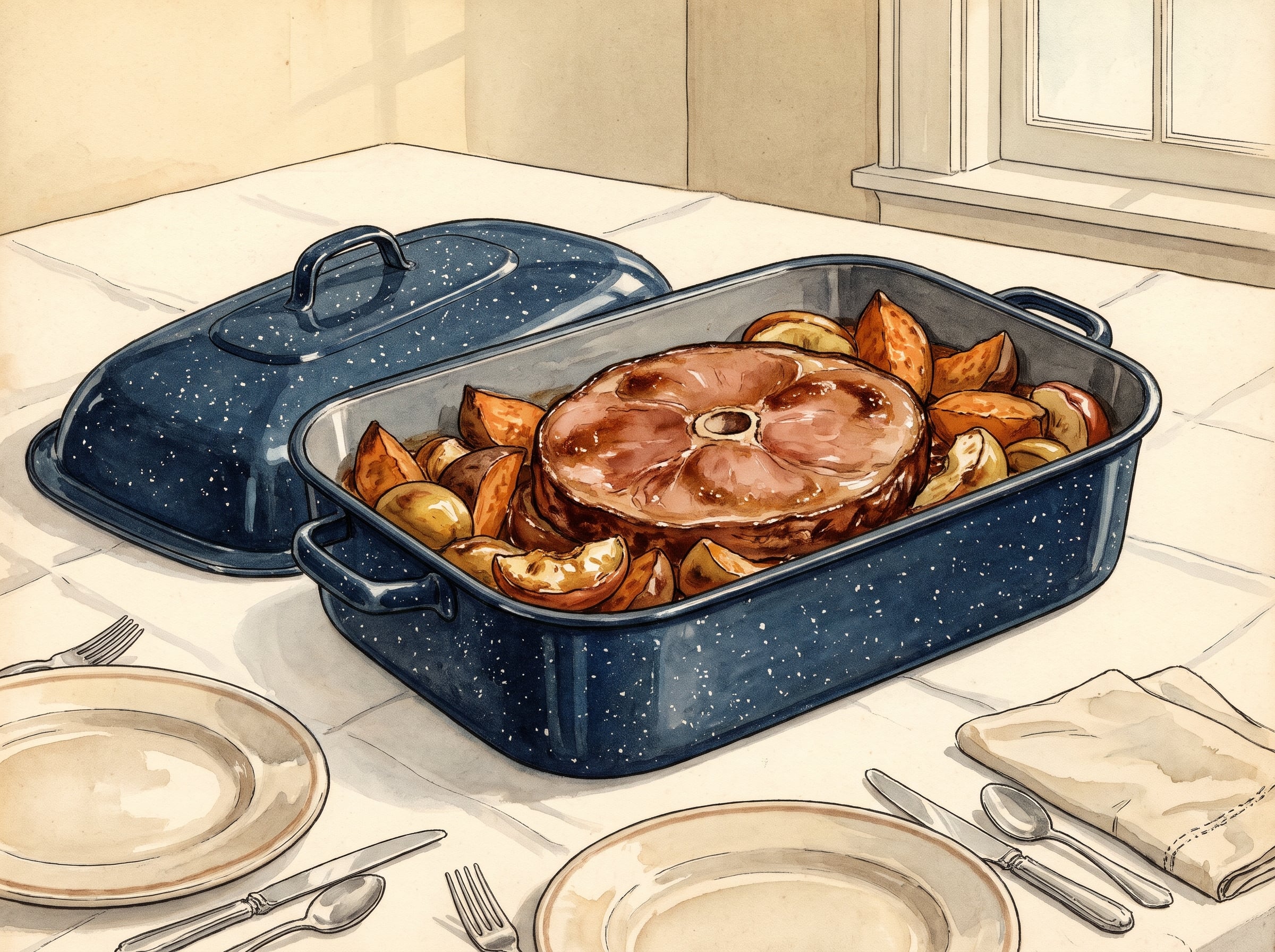
Here is a holiday ham that fits on a single slice. A 1916 Cincinnati cookbook tells the cook to trim off the fat, grind it, and spread it back over the meat like a blanket, then add brown sugar, a wine-glass of sherry, and a pan full of sweet potatoes and apples. The book appeared the very year a big meatpacker began telling Americans that ham belonged on the holiday table.
Please note that some of the images in this article were created with the assistance of AI.
From The Community Cook Book, 1916
The Story Behind This Recipe
A cookbook with no name on the cover
The Community Cook Book came out in 1916 from Powell & White of Cincinnati, and nobody signed it. We looked for an account of who gathered the recipes, or why, and found nothing. So we’ll leave that mystery alone rather than invent a compiler to fill it.
The title does tell us something about the company the book wanted to keep. The Library of Congress describes community cookbooks as collections put together by women to raise money for a cause. It also notes that these books lack the single, authoritative voice of a mainstream cookbook. Instead they are crowded with many cooks at once. Whether or not this book was made that way, it borrowed a name that promised a busy, neighborly kitchen.
From spring feasts to Christmas dinner
Ham has been party food for a very long time. Historian Bruce Kraig told The Boston Globe that Easter ham goes back at least to sixth-century Germany. Pigs slaughtered in autumn were among the few meats still on hand when the spring festival arrived. The Christmas ham is thought to descend from a Germanic pagan custom of sacrificing a wild boar.
In the United States, ham started appearing as a Christmas dish around 1900. Then, in 1916, Armour & Company began promoting the holiday ham to sell its new quick-cured hams, which were less salty than the old kind. The sweet potatoes in the pan have a long American story of their own. Food historians trace candied sweet potatoes to enslaved cooks, who combined the French habit of sugaring vegetables with their own cooking. Before 1900 the country grew two main kinds: moist ones tied to the South and dry ones from northern farms. The smooth orange variety later sold as a "yam" didn’t exist until Louisiana State University developed it in the early 1930s.
Sugar, sherry and one covered pan
This recipe catches the ham glaze in the middle of a change. Until the 1880s, a glazed ham was usually finished with stock, not sugar, and nobody connected it with Christmas. The clove-studded, sugar-glazed baked ham most of us picture arrived later, in the 1930s. A blanket of brown sugar and sherry over ground ham fat sits right between the two.
It is also a neat bit of thrift. One half-inch slice stands in for a whole ham. The trimmed fat goes back on top instead of being thrown away. The whole dinner shares a single covered roasting pan: fifteen minutes for the ham alone, then forty-five more once the apples and sweet potatoes join it. The book makes its case plainly, calling the dish "delicious and savory" and "so substantial that little else is required for a meal." That makes it a main course that looks like a holiday but could just as easily turn up on an ordinary Tuesday.
1910s
What Our Readers Say
- When Piaci Pizza readers loved a food photo and tapped a reason, comfort came first at 30%, followed by ingredients, nostalgia and simply looking good.
From Piaci Pizza reader polls and votes.
Notes From the Era
The recipe · 1916
Blanketed Ham with Sweet Potatoes and Apples
From The Community Cook Book by Anonymous (Powell & White) (1916). Every word of the recipe below is as printed.
Ingredients
- a slice of ham one-half inch thick
- one-half cup of brown sugar
- wine-glass of sherry
- four large sweet potatoes
- four large apples
Method
-
Trim the fat from the ham
Cut off the fat close to the edge of a slice of ham one-half inch thick.
-
Chop the fat and top the ham
Put fat through meat chopper, spread on top of ham, then sprinkle one-half cup of brown sugar and wine-glass of sherry over it.
-
Prepare the sweet potatoes and apples
Peel and quarter four large sweet potatoes and four large apples.
-
Start roasting the ham
Put ham in oven in covered roasting pan.
-
Add the fruit and potatoes and finish cooking
After it has cooked a quarter of an hour add apples and sweet potatoes. Now cook all of it three-quarters of an hour.
-
Serve
This makes a delicious and savory dish, and is so substantial that little else is required for a meal.
Our notes
Reading It Today
A wine-glass of sherry. Before standard measuring cups, cooks measured with whatever was in the cupboard. Older wine glasses were much smaller than today’s and held about a quarter cup (2 ounces). That makes this a modest splash of sherry, not a full modern pour.
The meat chopper and the timing. Putting the fat "through the meat chopper" means grinding it in a meat grinder, which turns it into a soft paste that spreads easily over the ham. A quarter of an hour is 15 minutes and three-quarters of an hour is 45, so the dish bakes for an hour in total. The recipe gives no oven temperature.
What the sweet potatoes would be like. Judging from the ingredients, the quartered sweet potatoes and apples would cook in the covered pan’s steam and drippings: melted ham fat, brown sugar and sherry. That should leave them soft and savory-sweet, with a salty edge from the ham. The apples would likely slump and turn tender around them.
How it differs from a sweet potato side today. These sweet potatoes aren’t a separate dish. They cook alongside the meat and pick up its flavor, and their extra sweetness comes from sugar running off the ham rather than from a candied coating of their own. The 1916 sweet potato may also have been paler or drier than the orange kind sold now, which wasn’t bred until the 1930s.
Source: Anonymous (Powell & White), The Community Cook Book (Powell & White, Cincinnati, 1916). Read the 1916 book at Project Gutenberg.
Sources for the history
- The Community Cook Book (Powell & White, Cincinnati, 1916), Project Gutenberg
- Community Cookbooks: An Online Collection (1862-1929): Introduction, Library of Congress
- Christmas ham, Wikipedia
- Eating ham at Easter dates back to at least sixth-century Germany, The Boston Globe
- The Deep and Twisted Roots of the American Yam, The Ringer
- 11 Old School Cooking Measurements And What They Really Mean, Chowhound
- Gas stove, Wikipedia
The original recipe text is from a work published in 1916 and is in the public domain in the United States. The history, notes and illustrations are Piaci Pizza’s own. Brand names that appear in historic recipes are mentioned as historical fact only. Illustrations are AI-generated in a vintage style. The recipe is shown exactly as it was published in 1916; we have not photographed a test batch.