
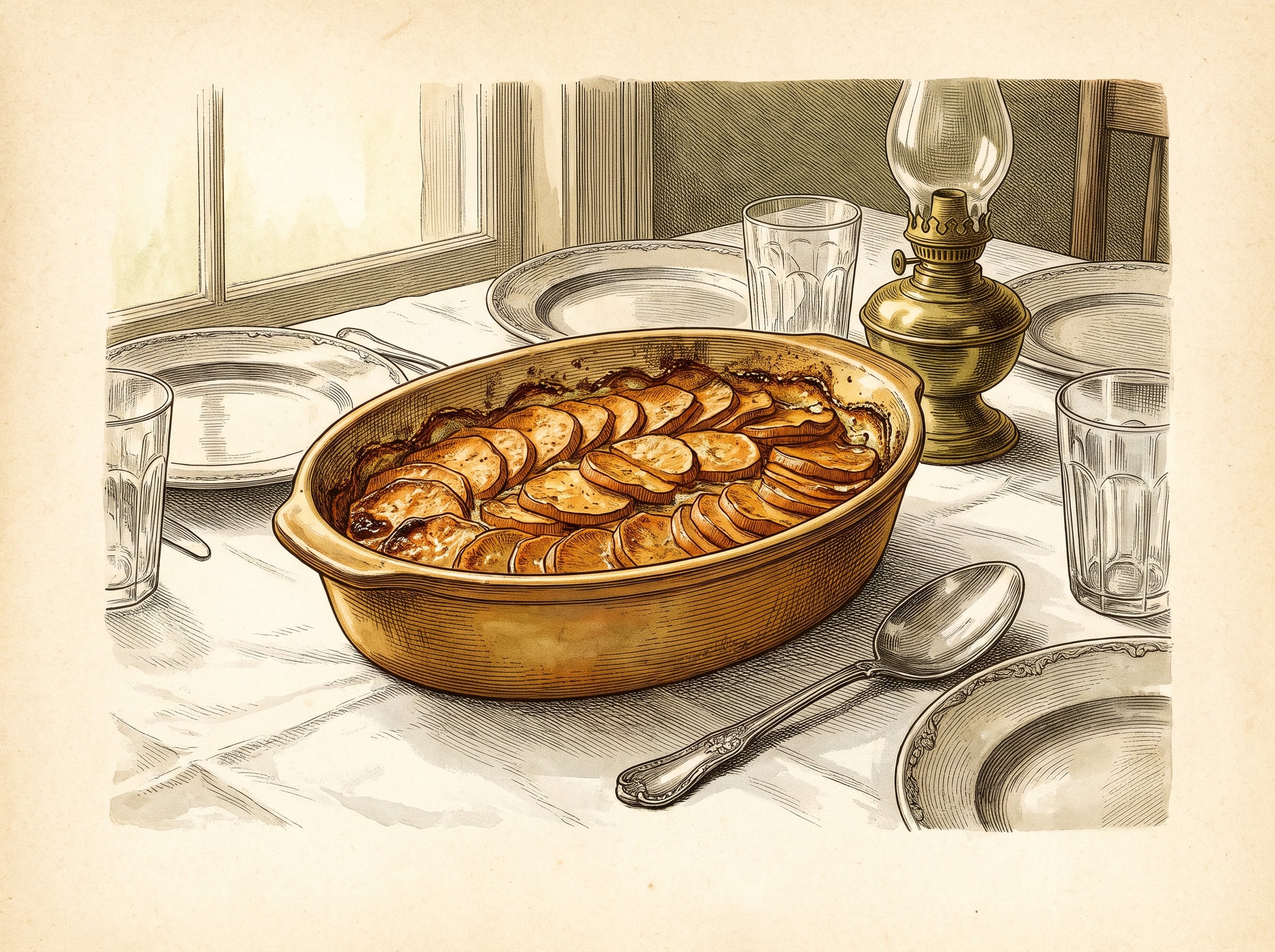
The whole recipe takes only a few lines, and it ends with a signature: "Mrs. Dr. P. C." A Virginia cook sent in her way of baking yams with sugar, butter and cream, and it was printed under her initials in a book meant to preserve the region’s household cooking after the Civil War. What she described is an early cousin of the candied yams still passed around holiday tables, about forty years before anyone thought to add marshmallows.
Please note that some of the images in this article were created with the assistance of AI.
From Housekeeping in Old Virginia, 1878
The Story Behind This Recipe
A cookbook with 250 signatures
Marion Cabell Tyree of Lynchburg, Virginia, had a famous grandfather, Patrick Henry, and an unusual plan for a cookbook. Rather than write one, she gathered one. Her recipes came from what she called "two hundred and fifty of Virginia’s noted housewives," and she printed their names alongside their dishes. That was the selling point. Every recipe arrived with a household behind it, the way a letter of introduction arrives with a respectable name at the bottom. Tyree framed the project as a response to changes in upper-class white households after the war.
That brings us to Mrs. Dr. P. C. Her initials, along with her husband’s title, were her credentials, and readers were expected to find them reassuring. The book never says who she was. We know her only through this recipe and the confidence of its final instruction. The book is usually dated to 1877. The copy we’re reading is the 1878 printing from John P. Morton & Co. of Louisville.
The yam that wasn’t
Start with the name, because it isn’t quite accurate. The "yams" here were almost certainly sweet potatoes, and the two are different plants altogether. True yams belong to the genus Dioscorea and grow mostly in the tropics. Sweet potatoes are roots from the morning glory family. Enslaved Africans in the United States called the soft, orange-fleshed sweet potatoes "yams" because they looked like the yams of their home continent. Growers later borrowed the word to separate those soft kinds from the firm, white-fleshed ones, and the name never went away.
The vegetable itself was an old Virginian. Sweet potatoes were growing in what is now Virginia as early as 1648, and they became a staple across the South, where cooks preferred the moist, orange types. The names shifted over the years too. Europeans first called the sweet potato simply "the potato," and American colonists didn’t start saying "sweet potato" until after the 1740s.
Candied yams before the marshmallow
Nobody has pinned down the first candied sweet potato. A Library of Congress researcher who traced the dish concluded that by 1880, Americans "were enjoying some sort of variation of candied sweet potatoes." In 1896 Texas Farm and Ranch published Sweet Potato Culture for Profit, which included glazed sweet potatoes, and in the early 1900s candied versions appeared in cookbook after cookbook. Our 1878 recipe sits near the front of that line, and it is pleasingly plain: yam, sugar, butter, repeat, then milk or cream and into the oven. No cinnamon, no nutmeg, nothing on top.
The marshmallows were still decades off, and they began as a sales pitch. In 1917 Angelus Marshmallows hired Janet McKenzie Hill, founder of the Boston Cooking School Magazine, to create recipes for its candy, and one of them topped mashed sweet potatoes with marshmallows. In 1919 a Barrett Company booklet suggested putting them on candied yams. How sweet potatoes reached the Thanksgiving table at all is less clear. Some historians credit Sarah Josepha Hale, the editor whose letter persuaded President Lincoln in 1863 to support a national holiday. Mrs. Dr. P. C. never mentions a holiday, but set her dish beside a modern Thanksgiving side and the family resemblance is plain.
1870s
What Our Readers Say
- When Piaci Pizza readers loved a food photo and tapped a reason, comfort came out on top at 30%, with nostalgia picked by 16%.
From Piaci Pizza reader polls and votes.
Notes From the Era
The recipe · 1878
To Dress Yams
From Housekeeping in Old Virginia by Marion Cabell Tyree (editor) (1878). Every word of the recipe below is as printed.
Ingredients
- yam
- sugar
- some lumps of butter
- milk or cream
Method
-
Steam, peel and slice the yams
Steam them till done, peel and slice them.
-
Layer yam, sugar and butter
Put in a buttered baking-dish a layer of yam, on which put sugar and some lumps of butter.
-
Fill, add milk or cream and bake
Fill up the dish in this way, and when full, pour over it milk or cream, and bake brown.–Mrs. Dr. P. C.
Our notes
Reading It Today
Yams means sweet potatoes. When this recipe says yams, read soft, orange-fleshed sweet potatoes. The confusion lives on: today USDA rules require produce labeled "yam" to say "sweet potato" as well when that’s what is being sold.
No numbers, on purpose. "Till done" means steamed until tender all the way through. "Some lumps of butter" means small pieces dotted over each layer. "Bake brown" means bake until the top colors. The amount of sugar, the oven heat and the timing were all left to the cook’s judgment, so a modern cook has to make those choices too.
What the dish would be like. Judging from the ingredients, this would be tender slices of sweet potato in a sweet, buttery sauce, with the milk or cream mixing with the melting sugar and butter as it bakes. The top layer would brown and probably caramelize at the edges, while the slices underneath stay soft.
How it differs from today’s version. Later candied yams often add spices or a topping, marshmallows most famously. This one has neither, just sliced sweet potatoes layered with sugar and butter. The milk or cream makes it closer to a sweet gratin than to a sticky glazed side.
Source: Marion Cabell Tyree (editor), Housekeeping in Old Virginia (John P. Morton & Co., Louisville, 1878). Read the 1878 book at Project Gutenberg.
Sources for the history
- Marion Cabell Tyree (editor), Housekeeping in Old Virginia (John P. Morton & Co., Louisville, 1878), Project Gutenberg
- Marion Cabell Tyree – Wikipedia
- What’s the Difference Between Sweet Potatoes and Yams? – Britannica
- A Sweet Potato History – Inside Adams, Library of Congress (Jennifer Harbster)
- Sweet Potato: A Thanksgiving Tradition – University of Missouri Integrated Pest Management (David Trinklein)
The original recipe text is from a work published in 1878 and is in the public domain in the United States. The history, notes and illustrations are Piaci Pizza’s own. Brand names that appear in historic recipes are mentioned as historical fact only. Illustrations are AI-generated in a vintage style. The recipe is shown exactly as it was published in 1878; we have not photographed a test batch.