
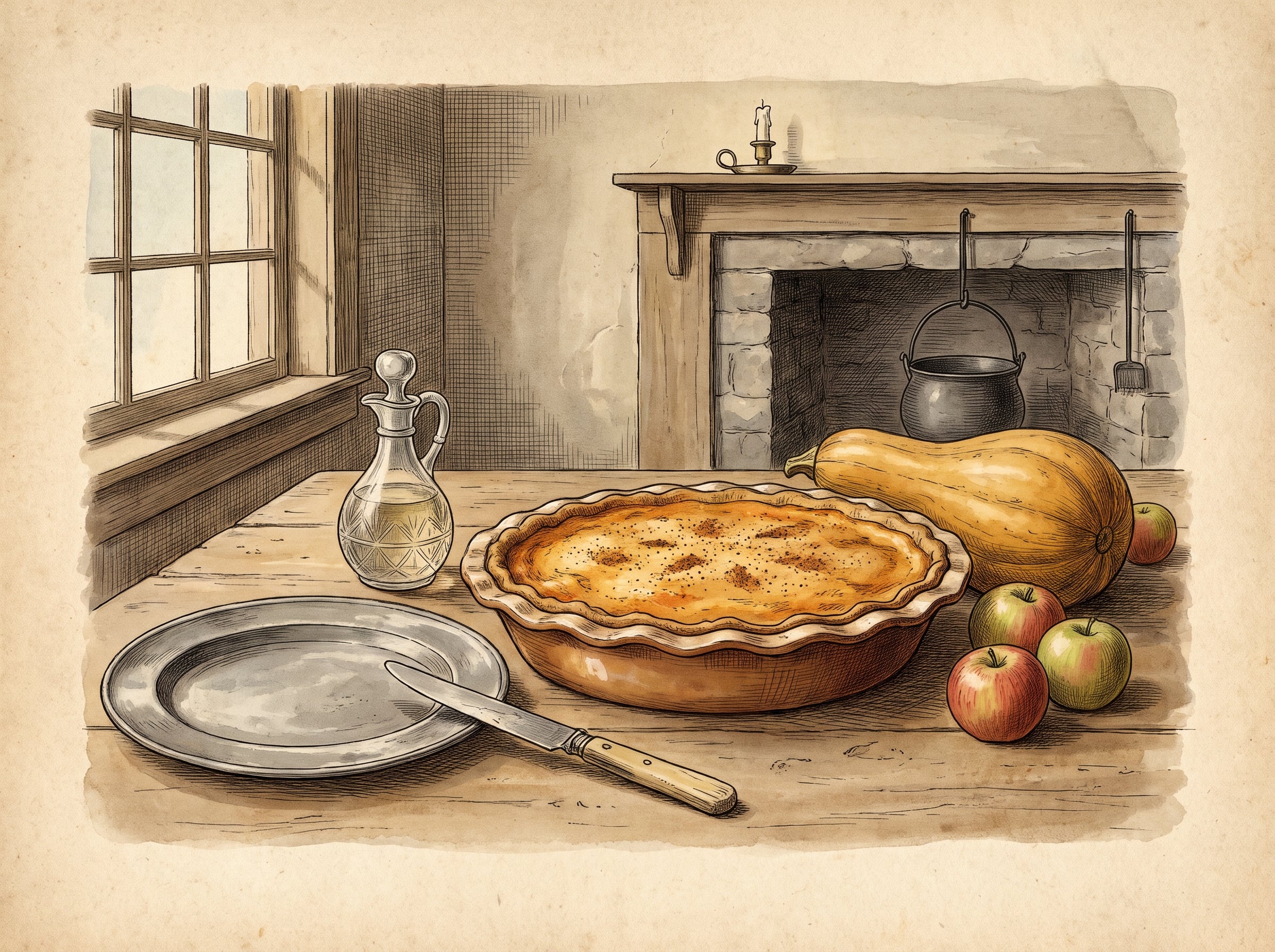
The woman who wrote America’s first homegrown cookbook described herself on its title page with just three words: "An American Orphan." Tucked inside her slim 1796 book is a squash pudding that is English in method and American in its main ingredient, with a closing note that says it works just as well with potatoes or yams.
Please note that some of the images in this article were created with the assistance of AI.
From American Cookery, 1796
The Story Behind This Recipe
An orphan, a printer and a grudge
The title page tells us nothing about the woman herself, only a label: "An American Orphan." Beyond what her book tells us, that is about all anyone knows of Amelia Simmons. Her preface mentions orphaned young women "reduced to the necessity of going into families in the line of domestics," and historians suspect she was describing her own working life. She admitted she lacked the schooling to ready the manuscript for print, and she knew whom to blame when things went wrong. An errata page accuses the person who prepared the first edition of trying to harm her book, and her second preface grumbles about its "egregious blunders."
That first edition ran just 47 pages of text, printed in Hartford, Connecticut, by Hudson & Goodwin, the firm behind bestsellers by Noah Webster and Jedidiah Morse. The words "For the Author" suggest she paid the printer herself. A longer, revised edition came out in Albany before the year was over. Her origins are still a puzzle. Her Dutch-flavored vocabulary, including the first "cookey" in print, points some scholars to the Hudson Valley. The historian Karen Hess added a clue from the pantry: Simmons called for pearlash, refined from potash, and the Albany area was a center of potash making.
An English pudding with a squash inside
Take out the squash and an English cook would have known this dish at a glance: beaten eggs, milk or cream, fine breadcrumbs, rosewater, wine, nutmeg and sugar, baked together. Before 1796, American kitchens ran on English cookbooks, and none had been written by an American for Americans. Simmons promised one "adapted to this country, and all grades of life." Hess summed up her approach as native American products joined to English traditions. Simmons borrowed freely, lifting whole chapters from Susannah Carter’s The Frugal Housewife and copying some English recipes, like her creams and syllabubs, outright. She also brought in American staples like cornmeal, pumpkins and molasses.
This pudding follows the same pattern. It names the crookneck squash outright, and its closing note offers the same "receipt" for "Pompkins, Potatoes or Yams," with dried whortleberries scattered into the potato and yam versions. Hess noted that sweet and white potatoes had both appeared in English cookbooks before 1800, so the recipe sits right where the two traditions meet. It also has a famous relative: Smithsonian writers credit this book with the first printed custard-style pumpkin pie.
Plain and fancy on one page
American Cookery mixes two kinds of cooking. One page has a Queen’s Cake scented with half a teacup of rosewater. Another has johnnycake and Indian slapjacks, cooked "before the fire" or on a griddle. This pudding has something of each. Squash, apples and dry bread are thrifty farmhouse food. Rosewater, wine, nutmeg and the optional Lisbon currants dress it up.
The book found readers in New England, New York and the Midwest and went through 13 known editions by 1831. It was pirated too. In 1808 Lucy Emerson copied most of it word for word and called it The New-England Cookery. Mary Tolford Wilson later called it "another declaration of American independence," and in 2012 the Library of Congress named it one of 88 "Books That Shaped America." We’re presenting this pudding as a holiday dessert, but that is our choice. The sources don’t say when Simmons’s readers served it.
1790s
Notes From the Era
The recipe · 1796
What Our Readers Say
- When Piaci Pizza readers loved a food photo and tapped a reason, comfort came first at 30%, while nostalgia drew 16%, level with simply looking good.
From Piaci Pizza reader polls and votes.
A Crookneck, or Winter Squash Pudding
From American Cookery by Amelia Simmons (1796). Every word of the recipe below is as printed.
Ingredients
- a good squash
- 6 large apples, pared, cored, and stewed tender
- 6 or 7 spoonsful of dry bread or biscuit, rendered fine as meal
- half pint milk or cream
- 2 spoons of rose-water
- 2 do. wine
- 5 or 6 eggs beaten and strained
- nutmeg
- salt and sugar to your taste
- one spoon flour
Method
-
Prepare the squash and apples, mix and bake
Core, boil and skin a good squash, and bruize it well; take 6 large apples, pared, cored, and stewed tender, mix together; add 6 or 7 spoonsful of dry bread or biscuit, rendered fine as meal, half pint milk or cream, 2 spoons of rose-water, 2 do. wine, 5 or 6 eggs beaten and strained, nutmeg, salt and sugar to your taste, one spoon flour, beat all smartly together, bake.
-
Variations with pumpkins, potatoes or yams
The above is a good receipt for Pompkins, Potatoes or Yams, adding more moistening or milk and rose water, and to the two latter a few black or Lisbon currants, or dry whortleberries scattered in, will make it better.
Our notes
Reading It Today
Bruize, do. and a half pint. "Bruize" means to crush or mash the cooked squash. "Do." is short for ditto, so "2 do. wine" means two spoons of wine. A half pint is 1 cup (8 fl oz). Simmons doesn’t say what size her spoons are, and her baking instruction is the single word "bake," with no temperature or time.
Whortleberries and Lisbon currants. Whortleberry is an old name for small dark berries in the bilberry and huckleberry family. Simmons wants them dried, like raisins. Currants here are small dried fruit. She suggests scattering either kind into the potato and yam versions, where they add little bursts of tart sweetness.
What the sweet potato version would be like. Judging from the ingredients, it would be a soft, spoonable custard of mashed sweet potato and stewed apple, held together by eggs and fine crumbs. It would taste of nutmeg and wine, with a floral note from the rosewater. For pumpkins, potatoes and yams Simmons calls for extra milk and rosewater, so there would be more liquid in the mix and the rosewater would come through even more.
How it differs from today’s casserole. A typical modern sweet potato casserole leans on brown sugar, butter and cinnamon, often under marshmallows or pecans. This pudding has no topping and lists no butter, and you add sugar "to your taste." Apples, wine, rosewater and nutmeg do the flavoring that vanilla and cinnamon do now. It is closer to a crustless pie filling than a side dish.
Source: Amelia Simmons, American Cookery (Hudson & Goodwin, Hartford, 1796). Read the 1796 book at Project Gutenberg.
Sources for the history
The original recipe text is from a work published in 1796 and is in the public domain in the United States. The history, notes and illustrations are Piaci Pizza’s own. Brand names that appear in historic recipes are mentioned as historical fact only. Illustrations are AI-generated in a vintage style. The recipe is shown exactly as it was published in 1796; we have not photographed a test batch.