
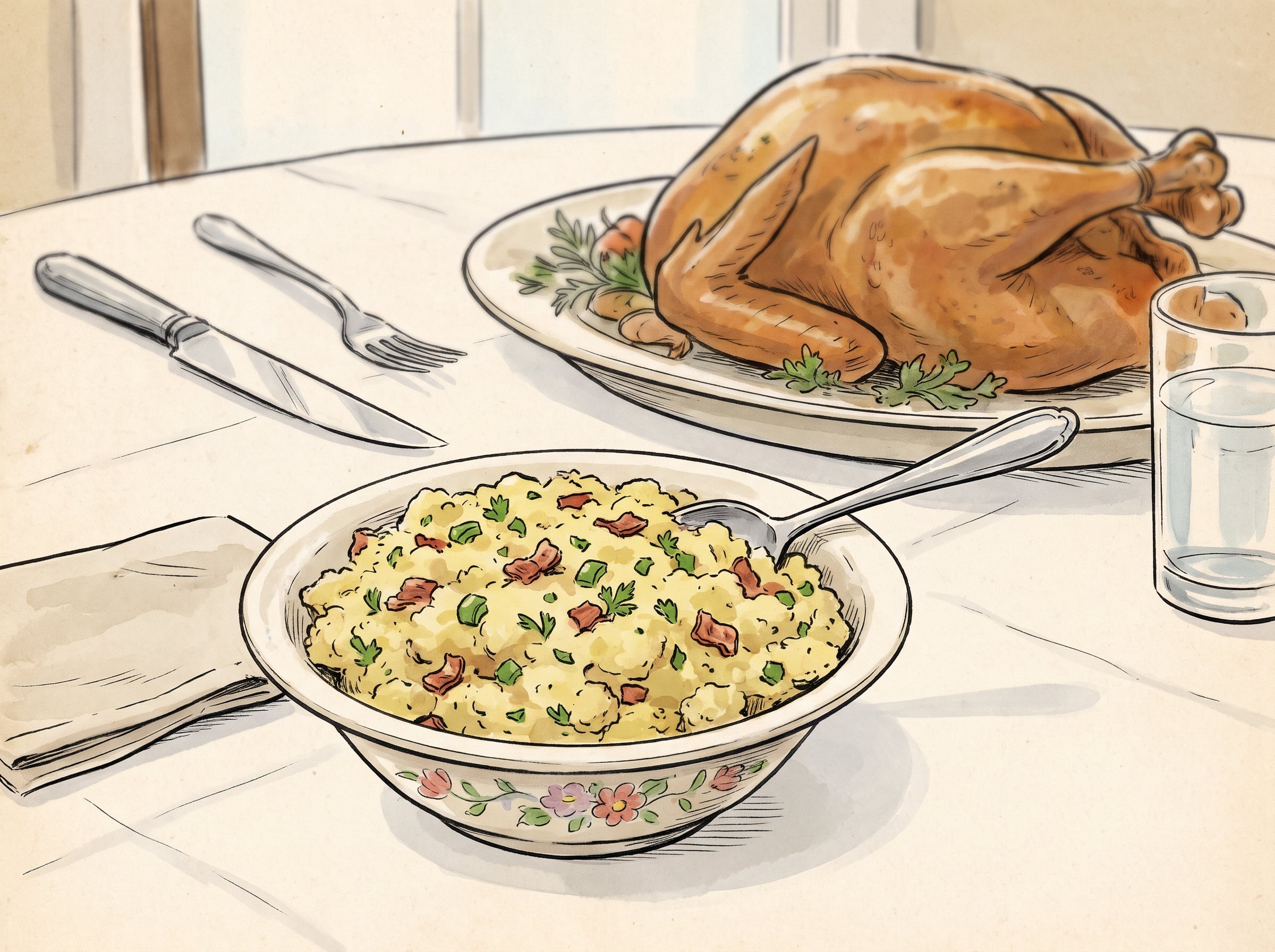
In 1920 a Philadelphia cooking teacher told her readers to push four bananas through a sieve, stir in bacon and green pepper, and pack the whole lot into a chicken. It sounds unusual now, but at the time it made good sense. Bananas were among the cheapest fruits in the market, and Mrs. Wilson could not stand to waste a crust of bread or a spoonful of fat.
Please note that some of the images in this article were created with the assistance of AI.
From Mrs. Wilson’s Cook Book, 1920
The Story Behind This Recipe
Mrs. Wilson of Philadelphia
Mary A. Wilson’s title page reads like a résumé with nothing left off. It names her as head of Mrs. Wilson’s Cooking School in Philadelphia, Instructor of Cooking for the U.S. Navy, a former domestic science instructor at the University of Virginia Summer School and, most grandly, onetime cuisinière to Queen Victoria. Those claims are hers, and we haven’t found records that confirm them. What is certain is that J. B. Lippincott published the book in Philadelphia in 1920, under a subtitle that got straight to business: ‘Numerous New Recipes Based on Present Economic Conditions.’
Plenty of Philadelphians already knew her voice. Her column in the Evening Public Ledger offered menus and recipes, and it answered cooking questions that readers mailed in. The book keeps that friendly tone on purpose. In the preface she calls these her best recipes, worked out over years of teaching and lecturing. She promises a chat between housewife and author instead of ‘the heavy cook-book style.’ She had little use for nostalgia, either, and wondered why anyone would cook from the recipes of the horse-car days.
From farce to filling
Stuffed birds go back further than anyone can pin down. The oldest written proof is the Roman cookbook of Apicius, which stuffs chicken, hare, pig and even dormouse. English kept renaming the mixture. It was ‘farce’ around 1390, ‘stuffing’ by 1538 and ‘forcemeat’ by 1688, and from about 1850 Americans also called it ‘dressing.’
Mrs. Wilson used yet another word, ‘filling.’ Her book offers an Olive Filling, a Dry Filling, a New England Filling and Grandma Perkins’s Spicy Filling. Take the bananas out of this one and underneath is her usual savory base of bacon, fine bread crumbs, thyme and egg. Her baked green peppers are filled with almost exactly the same mix.
Why bananas?
Bananas were newcomers. They were officially introduced to Americans at the 1876 Centennial Exhibition, held in Philadelphia, Mrs. Wilson’s own city. By about 1920 the banana was the country’s best-selling fruit, at half the price of apples. Shipments from tropical America climbed from 8.4 million bunches in 1912 to a record 29 million in 1929. A fruit that cheap and filling was bound to wander off the dessert plate. In 1914 Mary Chambers suggested topping a Salisbury steak with a broiled banana, and Chicken Maryland is traditionally garnished with them. Through the 1920s and ’30s, home economists and food manufacturers ran with the idea. Mrs. Wilson gave the fruit a whole run of recipes: fritters, custard pie, ice cream, muffins, pancakes, and this stuffing, where the bananas are sieved to a smooth pulp. There is no butter at all, so the bacon supplies the fat.
She never says which holiday this stuffing was meant for, but stuffed birds do turn up in her festive menus. Her Christmas suggestions include Baked Chicken with Spicy Filling, Brown Gravy and Cranberry Jelly. Her Thanksgiving pages ask cooks to save ‘every morsel of bread crumbs’ for the birds, ‘even though it is just the war bread.’ Eggs, she reminded readers, no longer cost twenty-five cents a dozen, and butter no longer cost thirty cents a pound.
1920s
Notes From the Era
The recipe · 1920
What Our Readers Say
- When Piaci Pizza readers loved a food photo, the top reason they tapped was comfort at 30%, with nostalgia and ingredients tied next at 17% each.
- When our readers disliked a food photo, the top reason was simply “not for me” at 39%, followed by the ingredients at 29%.
From Piaci Pizza reader polls and votes.
Banana Stuffing for Chicken
From Mrs. Wilson’s Cook Book by Mary A. Wilson (1920). Every word of the recipe below is as printed.
Ingredients
- four bananas
- One-half grated onion
- One green pepper, chopped fine
- Three tablespoons of finely chopped parsley
- Four slices of bacon chopped fine
- One and one-quarter cups of bread crumbs
- Pinch of thyme
- One egg
- One teaspoon of salt
- Stuffing cooked inside the bird must reach 165°F / 74°C in the center, as it contains raw egg, raw bacon and chicken juices.
Method
-
Sieve the bananas
Pare and rub through a sieve four bananas.
-
Add the remaining ingredients
Place in a bowl and add One-half grated onion, One green pepper, chopped fine, Three tablespoons of finely chopped parsley, Four slices of bacon chopped fine, One and one-quarter cups of bread crumbs, Pinch of thyme, One egg, One teaspoon of salt.
-
Mix, stuff and roast
Mix thoroughly and then fill into the chicken and roast in the usual manner.
Our notes
Reading It Today
Pare and rub through a sieve. ‘Pare’ simply means peel. Rubbing the bananas through a sieve presses the soft fruit through the mesh and leaves a smooth purée with no lumps or strings. Mashing with a fork would give a coarser result. The bananas of her day were most likely the Gros Michel, not the Cavendish sold today.
Roast in the usual manner. That phrase sends you to her own Roast Chicken recipe, which calls for a moderate oven at twenty minutes to the pound. She defined a moderate oven as 350 to 375°F. Her measures are always level, and her cup is the standard half-pint, or 8 fl oz, the same as a modern cup.
What the filling would be like. Judging from the ingredients, this would be soft and moist, not crumbly. The banana pulp would bring sweetness and body, and the bacon would add smoke and salt. Onion, green pepper, parsley and thyme would keep it on the savory side, and the egg would bind everything into a loose, tender mass as it cooked inside the bird.
How it differs from today’s stuffing. Most modern stuffings start with plenty of bread, then add butter and broth for moisture. Here the bread is only a cup and a quarter, the bananas provide the moisture, and bacon replaces butter entirely. The flavor would be fruitier and sweeter than a typical sage-and-onion dressing.
Source: Mary A. Wilson, Mrs. Wilson’s Cook Book (J. B. Lippincott Company, Philadelphia, 1920). Read the 1920 book at Project Gutenberg.
Sources for the history
- Mrs. Wilson’s Cook Book by Mary A. Wilson (Project Gutenberg catalog page)
- Mrs. Wilson’s Cook Book, full HTML text (Project Gutenberg)
- Today in 1920: Mrs. Wilson’s Cheese Sauce (Rooted in Foods)
- Stuffing (Wikipedia)
- Going bananas! (CBS News Sunday Morning)
- Modern History of the Banana (UC Santa Cruz)
- Beef with bananas was faddish in 1920s, ’30s (Post and Courier)
- Chicken Maryland (Wikipedia)
The original recipe text is from a work published in 1920 and is in the public domain in the United States. The history, notes and illustrations are Piaci Pizza’s own. Brand names that appear in historic recipes are mentioned as historical fact only. Illustrations are AI-generated in a vintage style. The recipe is shown exactly as it was published in 1920; we have not photographed a test batch.