
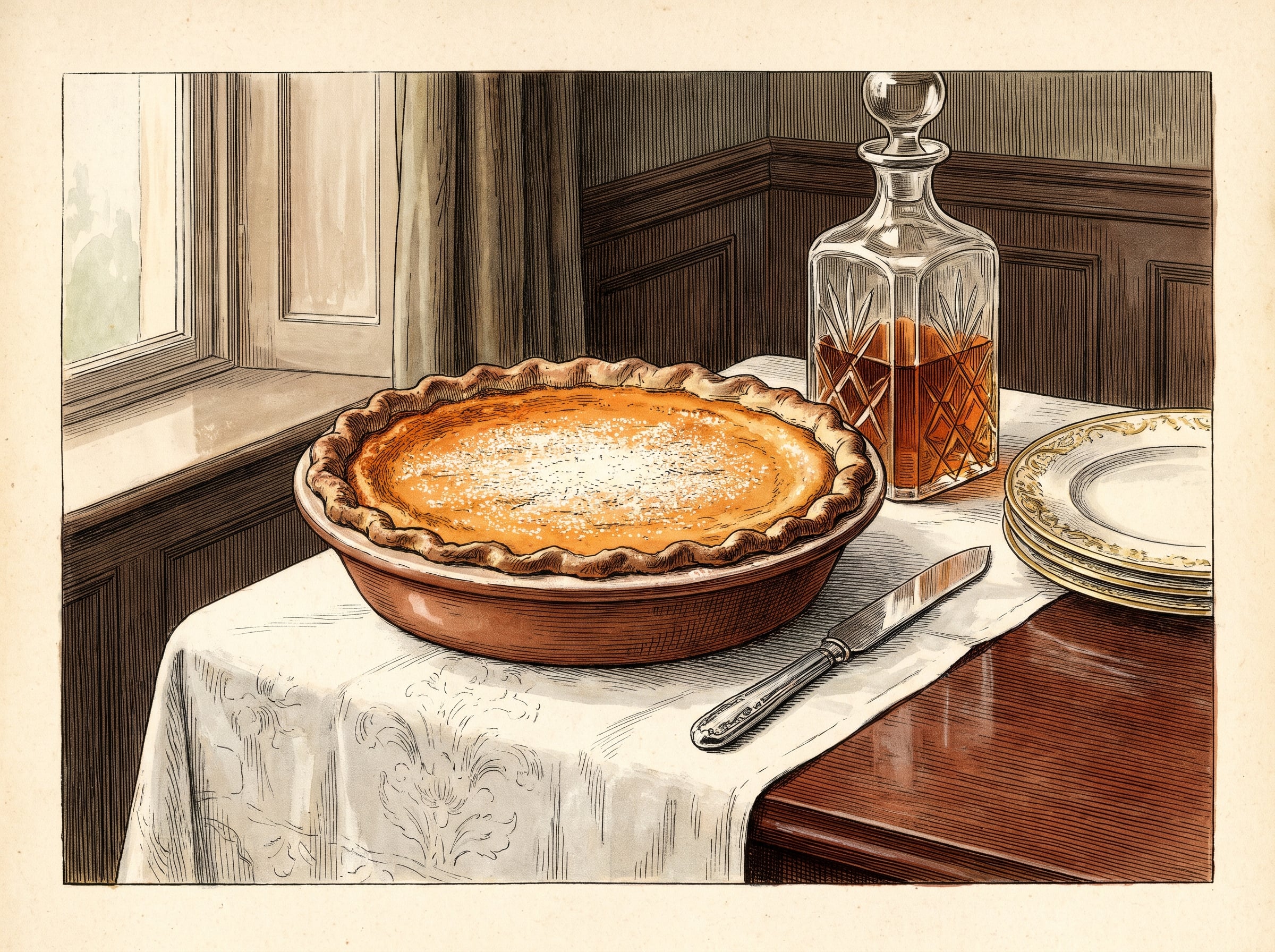
In 1885 a newspaperman who had once gone broke running a cheap restaurant published a book of New Orleans recipes, and one of them is this sweet potato pudding baked in a crust. It looks like a Creole specialty, but almost the same recipe had been printed in Virginia nearly sixty years earlier. Its story runs through the city’s first cookbooks and through the cooks those books left unnamed.
Please note that some of the images in this article were created with the assistance of AI.
From La Cuisine Créole, 1885
The Story Behind This Recipe
The reporter who ran a restaurant for three weeks
On March 2, 1879, an eating house called The Hard Times opened at 160 Dryades Street in New Orleans, billed as the "cheapest eating house in the South." It closed on March 22. Its owner was Patrick Lafcadio Hearn, born on the Greek island of Lefkas in 1850 to a Greek mother and an Irish army doctor, both of whom left him. He became a reporter in Cincinnati, came to New Orleans in 1877, and wrote for the Daily City Item and the Times Democrat, and later for national magazines like Harper’s. One Louisiana encyclopedia calls him "a primary force" in creating a mythic New Orleans for readers across the country. He ended up in Japan, where he taught English, took the name Koizumi Yakumo, and died in 1904.
La Cuisine Créole appeared in 1885 without his name on it. It has a French title but is written in English, and its subtitle credits "leading chefs and noted Creole housewives." The same year, the Christian Woman’s Exchange published The Creole Cookery Book, and the two are often called the city’s first cookbooks. Historians at the Hermann-Grima + Gallier Historic Houses explain why the city waited so long for cookbooks of its own. From colonial days to the Civil War, much of the city’s cooking was done by enslaved people of African descent, who carried their recipes in memory. Many white households still relied on Black cooks after the war. The cookbooks of the 1880s drew on that spoken knowledge, usually without credit.
A Virginia pudding with a New Orleans address
Hearn calls this "a Southern dish," and he is right. Colonial Williamsburg’s foodways staff describe sweet potato pudding as "the classic 18th-century pudding." They say the Southern sweet potato pie "took its cue" from it, and that it could pass for a twin of pumpkin pie. Their source is Mary Randolph’s The Virginia Housewife, in its 1827 edition. Put her recipe next to Hearn’s and they match closely: a pound of boiled sweet potato pressed through while hot, six well-beaten eggs, three-quarters of a pound of butter, lemon peel, brandy, a "paste" in the dish, and sugar sprinkled over the finished top.
The differences show a few later choices. Hearn raises the sugar in the filling to a full pound. He leaves out Randolph’s nutmeg and the bits of citron she scattered on top. Her "glass of brandy" becomes "a little brandy," and her colander becomes a sieve, "the finer the better." New Orleans did not invent this pudding. It came from an older Southern tradition and was included in the city’s first cookbooks.
A pudding that wore a crust
Today a sweet filling baked in pastry is called a pie. In Hearn’s day it could still be a pudding, and "paste" was the crust laid around the dish first. At the Hermann-Grima House in the French Quarter, the cooking was done at an open hearth in a separate building that also housed enslaved workers. Pressing the potato through a sieve was done by hand, while the potato was still hot. Hearn’s "one pound or a pint" let the cook either weigh the potato or measure it in a pint measure.
Recipes also traveled from far away. Before 1885, New Orleans papers advertised housekeeping guides from other states and overseas. In 1881 Abby Fisher, born into slavery, published What Mrs. Fisher Knows About Old Southern Cooking in San Francisco, with recipes taken down from her dictation. We found no period source that ties this pudding to a particular holiday. Hearn did say what he thought of it: "fit to grace the table of an epicure." With all that butter, sugar and brandy, it was clearly a rich dessert.
1880s
Notes From the Era
The recipe · 1885
What Our Readers Say
- When Piaci Pizza readers loved a food photo and tapped a reason, comfort came first at 30%, followed by ingredients at 18% and nostalgia at 16%.
From Piaci Pizza reader polls and votes.
Sweet Potato Pudding
From La Cuisine Créole by Lafcadio Hearn (1885). Every word of the recipe below is as printed.
Ingredients
- one pound or a pint of hot boiled sweet potato
- six eggs well beaten
- three-fourths of a pound of butter
- a pound of sugar
- grated lemon rind
- a little brandy
- a paste
- finely pulverized sugar
- The filling contains raw eggs, so bake until the center is set and reaches 160°F / 71°C.
Method
-
Sieve the hot sweet potato
Take one pound or a pint of hot boiled sweet potato, pass it hot through a sieve–the finer the better.
-
Mix in eggs, butter, sugar and flavorings
To this add six eggs well beaten, three-fourths of a pound of butter, and a pound of sugar; flavor with grated lemon rind, and a little brandy.
-
Line the dish, fill and bake
Make a paste around the dish, pour in the sweet potato mixture, and bake.
-
Dust with sugar
Sprinkle finely pulverized sugar over the surface of the pudding. This is a Southern dish, and fit to grace the table of an epicure.
Our notes
Reading It Today
"Paste" means crust. Make a paste around the dish means line the baking dish with pastry dough before pouring in the filling. The finished dish works like a single-crust pie.
Translating the amounts. A pint of mashed sweet potato is 2 cups. Three-quarters of a pound of butter is 1½ cups, or three sticks. A pound of granulated sugar is about 2 cups. "Finely pulverized sugar" was sugar ground to a fine powder, close to our powdered sugar.
What the ingredients suggest. With six eggs and no milk or cream, this should bake into a dense, custard-like filling. The fine sieving would make it smooth. From the amounts listed, it would be very sweet and buttery, with lemon and brandy as the main flavors.
Next to today’s sweet potato pie. Most modern sweet potato pies use milk or evaporated milk, much less butter, and warm spices such as cinnamon and nutmeg. This recipe has no spices at all, and its lemon and brandy give it a brighter flavor. It is also much richer.
Source: Lafcadio Hearn, La Cuisine Créole (F. F. Hansell & Bro., New Orleans (second edition), 1885). Read the 1885 book at Project Gutenberg.
Sources for the history
- Lafcadio Hearn, La Cuisine Créole (F. F. Hansell & Bro., New Orleans, second edition, 1885), Project Gutenberg
- Lafcadio Hearn – 64 Parishes (Louisiana Endowment for the Humanities)
- Lafcadio Hearn – Wikipedia
- Recipes from a Hungry Man – Southern Foodways Alliance
- The Books and Cooks of Nineteenth-Century Creole Cuisine – Hermann-Grima + Gallier Historic Houses
- Sweet Potato Pudding – Colonial Williamsburg
The original recipe text is from a work published in 1885 and is in the public domain in the United States. The history, notes and illustrations are Piaci Pizza’s own. Brand names that appear in historic recipes are mentioned as historical fact only. Illustrations are AI-generated in a vintage style. The recipe is shown exactly as it was published in 1885; we have not photographed a test batch.