
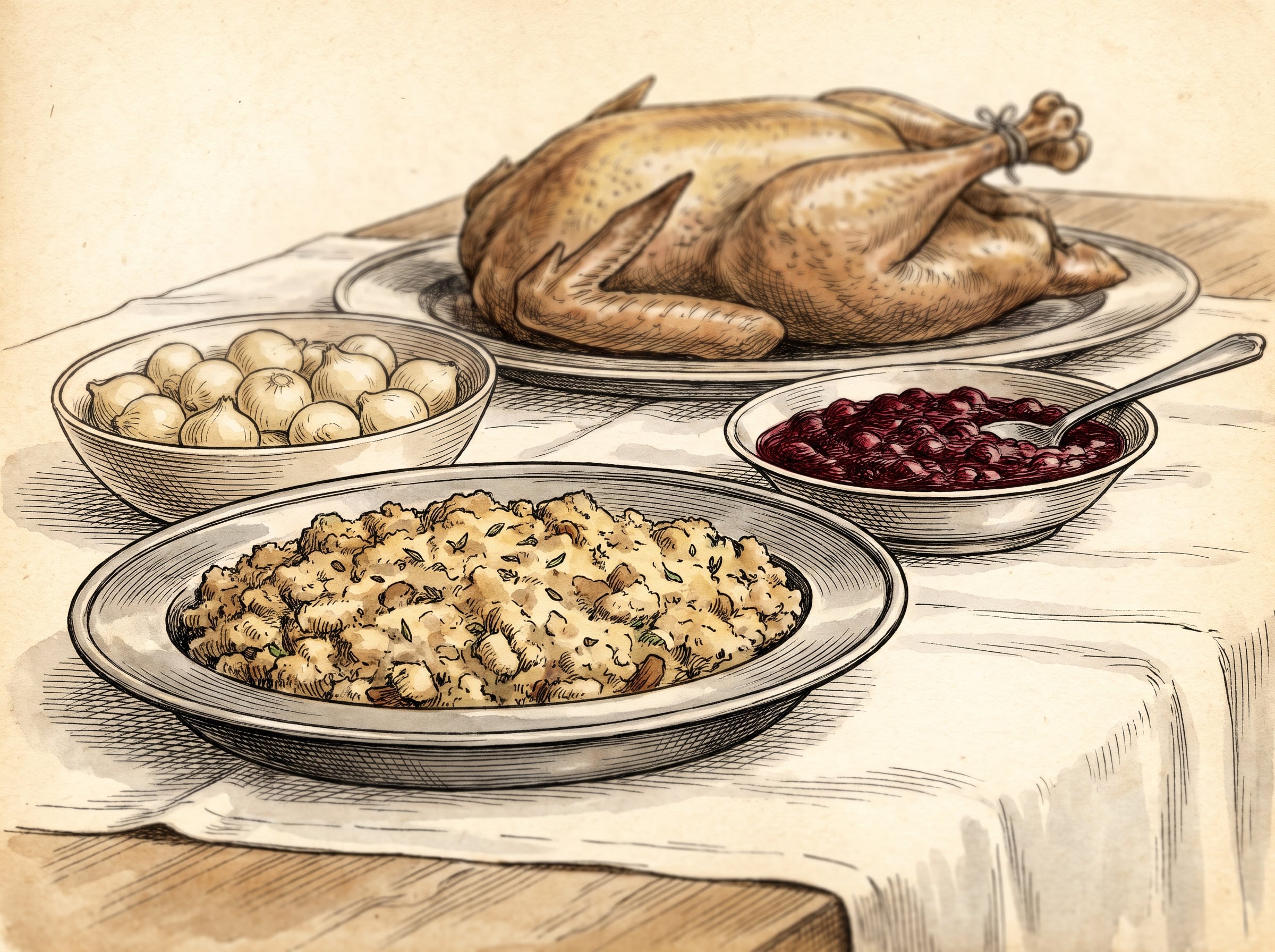
In 1796 a writer who signed herself only ‘An American Orphan’ told her readers to fill a turkey with bread, suet and eggs, hang it before the fire, and send it to the table with ‘cramberry-sauce.’ It is one of the earliest printed American recipes for stuffing a turkey, and the first time turkey and cranberries meet in print. Here is the story behind the woman, the hearth and that oddly spelled sauce.
Please note that some of the images in this article were created with the assistance of AI.
From American Cookery, 1796
The Story Behind This Recipe
The orphan who probably paid her own printer
Amelia Simmons doesn’t get much of an introduction, even on her own title page. She is simply ‘An American Orphan,’ and nearly everything we know about her comes from her one book. Historians describe her as an orphan and a woman of modest means. Hudson & Goodwin of Hartford printed American Cookery in 1796, and the first edition says it was printed ‘For the Author,’ a phrase that usually meant the writer was footing the bill. Her preface has some bite. She wrote about orphaned girls pushed ‘into families in the line of domestics,’ and she grumbled that whoever readied her recipes for the press had made ‘egregious blunders.’
The book came out of a Connecticut effort to give the new republic its own books, and the same printers published Noah Webster’s Blue Back Speller. The book swapped English kitchen words for American ones, so treacle became molasses. Hers was the first cookbook to include cranberry sauce, johnnycakes and a custard-style pumpkin pie, and other cookbook writers spent the next 30 years copying her.
Older than the turkey
Long before anyone stuffed a turkey, Roman cooks were stuffing dormice. The cookbook attributed to Apicius, the earliest written evidence of stuffing, fills chicken, hare, pig and that small, unlucky rodent. English kept renaming the idea: ‘farce’ around 1390, ‘stuffing’ in 1538, ‘forcemeat’ in 1688. Americans began saying ‘dressing’ around 1850, too late for Simmons, whose title gets straight to the point: ‘To stuff and roast a Turkey, or Fowl.’
Her filling has an English accent. Soft wheat bread is bound with beef suet and eggs, seasoned with thyme, marjoram, pepper and salt, and ‘some add a gill of wine.’ She offers two more versions. One uses parsley instead of the sweet herbs, and the other is built on mashed potatoes, butter and herbs. That suits the book’s larger plan of setting British dishes long favored in the colonies beside local foods.
A bird, a string and a fire
The line food historians point to is the last one. Nobody recorded cranberries at the 1621 harvest feast, though William Bradford did write that the settlers ate wild turkey that fall, along with venison, fish and corn. A 1672 account mentions cranberries boiled with sugar ‘for a Sauce to eat with their Meat.’ Simmons’s book, though, is the first place turkey and cranberries share a page. She gives no recipe for the sauce, only the instruction to serve it. In her day, Thanksgiving was a New England family custom. Lincoln made it a national holiday in 1863.
‘Hang down to a steady solid fire’ means roasting in front of the flames, not over them. The plainest rig was a stout string run through the bird and tied to a peg on the mantel. Every so often someone gave it a twist, and the bird turned as the string unwound. In the second half of the 1700s, tin reflector ovens reached America. Old probate inventories call them ‘tin kitchens,’ and they bounced heat back onto the roast. Simmons names no cooking time. Baste often, she says, and stop when steam rises from the breast.
1790s
What Our Readers Say
- When Piaci Pizza readers love a food photo and tap a reason, comfort comes first at 30%, with nostalgia and ingredients next at 17% each.
From Piaci Pizza reader polls and votes.
Notes From the Era
The recipe · 1796
To Stuff and Roast a Turkey, or Fowl
From American Cookery by Amelia Simmons (1796). Every word of the recipe below is as printed.
Ingredients
- One pound soft wheat bread
- 3 ounces beef suet
- 3 eggs
- a little sweet thyme
- sweet marjoram
- pepper and salt
- a gill of wine
- salt and water
- one third of a pound of butter
- flour
- boiled onions
- cramberry-sauce
- mangoes
- pickles
- celery
- parsley
- potatoes
- 3 pints potatoes
- butter
- sweet herbs
- Stuffing cooked inside the bird must reach 165°F / 74°C in its center, and the stuffing contains raw eggs, so check it with a thermometer.
- Steam from the breast is not a reliable sign of doneness, so check that the thickest part of the thigh reaches 165°F / 74°C.
- Roasting before an open fire can cook unevenly, so check the temperature in several places before serving.
Method
-
Stuff, roast and serve the bird
One pound soft wheat bread, 3 ounces beef suet, 3 eggs, a little sweet thyme, sweet marjoram, pepper and salt, and some add a gill of wine; fill the bird therewith and sew up, hang down to a steady solid fire, basting frequently with salt and water, and roast until a steam emits from the breast, put one third of a pound of butter into the gravy, dust flour over the bird and baste with the gravy; serve up with boiled onions and cramberry-sauce, mangoes, pickles or celery.
-
Parsley and potato variation
2. Others omit the sweet herbs, and add parsley done with potatoes.
-
Mashed potato stuffing variation
3. Boil and mash 3 pints potatoes, wet them with butter, add sweet herbs, pepper, salt, fill and roast as above.
Our notes
Reading It Today
A gill of wine. A gill (say ‘jill’) is a quarter of a pint, which is 4 fluid ounces or half a cup in US measure. The British imperial gill is a little larger. Simmons treats the wine as optional, since only ‘some add’ it.
What the stuffing would be like. Judging from the ingredients, this would be a firm, rich filling, with three eggs binding a pound of soft bread. Beef suet would make it rich, and thyme and marjoram would give it a gentle herbal flavor. There is no broth, so any extra moisture would come from the eggs, the suet, the wine if used, and the bird itself.
How it differs from stuffing today. Many modern stuffings start with butter, onion, celery and broth. This one has none of those in the filling. Onions and celery appear only on the side, as boiled onions and celery served with the bird. Butter goes into the gravy instead, except in the mashed-potato version.
Mangoes and ‘cramberry’. The ‘mangoes’ were most likely not tropical fruit. In 18th-century cookbooks, the word could mean a stuffed, spiced pickle, and American Cookery includes a recipe for making ‘Mangoes of Melons’ from unripe melons. ‘Cramberry’ is simply an older spelling of cranberry.
Source: Amelia Simmons, American Cookery (Hudson & Goodwin, Hartford, 1796). Read the 1796 book at Project Gutenberg.
Sources for the history
- Amelia Simmons, American Cookery (Hudson & Goodwin, Hartford, 1796), Project Gutenberg
- What America’s First Cookbook Says About Our Country and Its Cuisine (Smithsonian Magazine)
- Amelia Simmons Adds a Uniquely American Flavor to Cooking (ConnecticutHistory.org)
- A short course on the history of Thanksgiving foods (Amanda Moniz, The Washington Post, via The Cullman Times)
- When turkey met cranberries: a dinner date from the 1700s (NPR transcript)
- The Art of Open-Hearth Cooking (Mother Earth News, 1977)
- Stuffing (Wikipedia)
- To make mangoes of melons: Using the evolution of form and senses to understand historical cookbooks (Oxford English Dictionary)
- Gill (unit) (Wikipedia)
- From the Collection: Tin Reflector Oven (Webb Deane Stevens Museum)
The original recipe text is from a work published in 1796 and is in the public domain in the United States. The history, notes and illustrations are Piaci Pizza’s own. Brand names that appear in historic recipes are mentioned as historical fact only. Illustrations are AI-generated in a vintage style. The recipe is shown exactly as it was published in 1796; we have not photographed a test batch.