
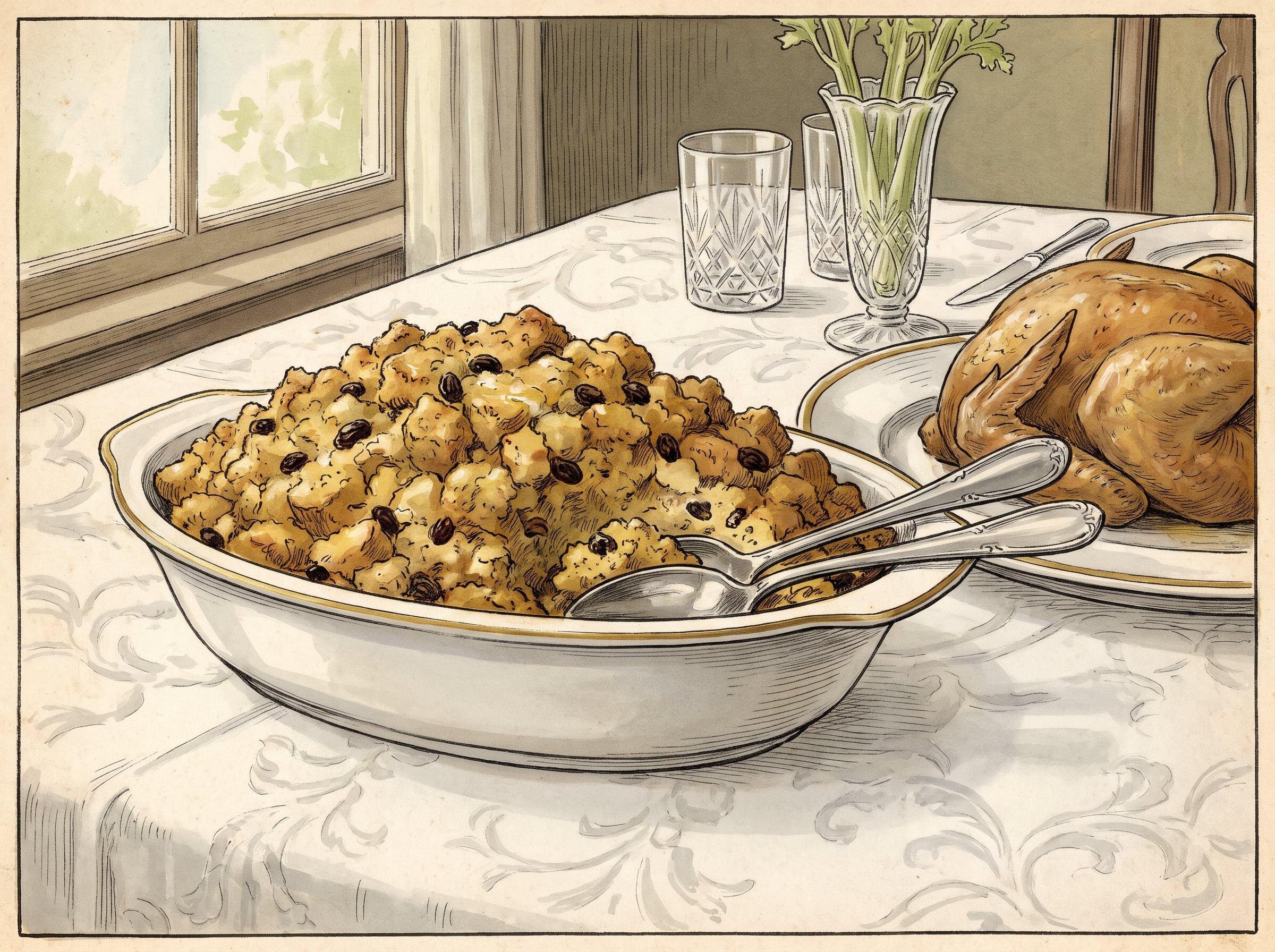
Three cups of stale bread crumbs, a cup of chopped raisins, and not a speck of butter. This little stuffing from a 1919 New York cookbook looks plain on the page. The missing butter, though, tells a story about a kosher kitchen meeting the American habit of filling a bird with bread.
Please note that some of the images in this article were created with the assistance of AI.
From The International Jewish Cook Book (second edition), 1919
The Story Behind This Recipe
A strictly kosher successor
In 1918 a New York publisher set out to replace a famous cookbook. Bloch Publishing meant its new book to succeed "Aunt Babette’s" Cook Book, which first appeared in 1889 and was the first truly successful American Jewish cookbook. Aunt Babette’s also included recipes for pork and shellfish. Bloch wanted a successor that kept the rules, and it found one in Florence Kreisler Greenbaum, a Hunter College graduate, and her International Jewish Cook Book.
Bloch did not undersell the new book. The publisher billed it as "the first strictly kosher cook book ever published in English in this country," a claim that Wikipedia’s article on Bloch notes was not quite accurate. Still, the book held 1,600 recipes, and Michigan State University’s Feeding America project says it stayed popular for many years. The copy in that collection is the 1919 second edition, the one our recipe comes from. One scholarly paper calls the book highly influential. When Bloch issued a heavily revised version in 1941, prepared by Mildred Grosberg Bellin, many of the original recipes stayed in.
From stale loaf to holiday bird
Americans were stuffing birds with bread long before Thanksgiving became official. Bread showed up in stuffings more often during the 18th century, as wheat and home baking spread. By the early 1800s a popular formula had taken hold: stale bread, herbs, onions, celery and butter. After Lincoln made Thanksgiving a national holiday in 1863, bread-stuffed turkey became widespread. By the early 20th century it was a classic.
Set Greenbaum’s recipe beside that formula and the differences stand out. The stale bread stays. The herbs, onions and celery are gone. In their place come a full cup of raisins and a little salt and white pepper. Where the butter should be, there is melted chicken fat.
Chicken fat and the rules of the kitchen
That swap is the heart of the recipe. In a kosher kitchen, butter could not go into anything eaten with meat or poultry, and a stuffing spends its whole career inside a bird. Rendered chicken fat, or schmaltz, was a mainstay of Eastern European Jewish cooking, partly because it made use of every part of a precious chicken. Greenbaum’s book had no shortage of chickens to stuff. It offered twenty-five chicken recipes.
The recipe names no holiday, so we can’t say which meal it was meant for. But by 1919 bread stuffing was a fixture of the American Thanksgiving table, and this version let a kosher cook in New York fill a bird the American way without breaking a single rule. Even the raisins mark the date. Within a few years, by about 1925, Thompson seedless grapes had largely taken over the raisin industry, and "seeded" was on its way off the shopping list.
1910s
What Our Readers Say
- When Piaci Pizza readers loved a food photo and tapped a reason, comfort came out on top at 30%, with nostalgia close behind at 17%.
From Piaci Pizza reader polls and votes.
Notes From the Era
The recipe · 1919
Raisin Stuffing
From The International Jewish Cook Book (second edition) by Florence Kreisler Greenbaum (1919). Every word of the recipe below is as printed.
Ingredients
- three cups of stale bread crumbs
- one-half a cup of melted chicken fat
- one cup of seeded raisins cut in small pieces
- one teaspoon of salt
- one-fourth teaspoon of white pepper
- If this stuffing is cooked inside a bird, the center of the stuffing must reach 165°F / 74°C.
Method
-
Combine the crumbs, fat, raisins and seasoning
Take three cups of stale bread crumbs; add one-half a cup of melted chicken fat, one cup of seeded raisins cut in small pieces, one teaspoon of salt and one-fourth teaspoon of white pepper.
-
Mix well
Mix thoroughly.
Our notes
Reading It Today
Seeded is not seedless. "Seeded raisins" were raisins made from grapes with seeds, which then had the seeds taken out. Ordinary seedless raisins from today’s store do the same job. The recipe still asks you to cut them into small pieces, so they spread through the bread instead of sitting in clumps.
No onions, no broth, no egg. Most stuffings today lean on onions, celery, herbs, stock and often an egg. This one has none of them. The only moisture is half a cup of melted fat for three cups of crumbs, so the mixture would be loose and crumbly, likely to soak up juices from any bird it fills.
Rich, sweet and plain. Judging from the ingredients, expect a savory, chicken-rich base with pockets of raisin sweetness and the mild warmth of white pepper. White pepper also keeps the stuffing pale, with no dark flecks. It is closer to a simple sweet-savory side than to the herby, oniony stuffing most tables serve now.
Measures in words. The amounts are spelled out rather than written as numbers. "One-half a cup" is ½ cup, and "one-fourth teaspoon" is ¼ teaspoon, both in standard cups and spoons. Altogether the recipe calls for 3 cups of crumbs, ½ cup of fat and 1 cup of raisins, plus seasoning.
Source: Florence Kreisler Greenbaum, The International Jewish Cook Book (second edition) (Bloch Publishing Company, New York, 1919). Read the 1919 book at Project Gutenberg.
Sources for the history
- Florence Kreisler Greenbaum, The International Jewish Cook Book, 2nd ed. (Bloch, 1919) – recipe text only
- Bloch Publishing Company – Wikipedia
- Feeding America: The Historic American Cookbook Project – Michigan State University
- Horowitz, paper on poultry and Jewish cookbooks – Barnard College Economics
- How to Make Schmaltz (Rendered Chicken Fat) and Gribbenes – Chabad.org
- Did Raisins Used To Have Seeds? – CulinaryLore
- The Surprising History Behind Thanksgiving’s Most Beloved Dishes – The Reluctant Gourmet
- Catalog record: The international Jewish cook book – HathiTrust
The original recipe text is from a work published in 1919 and is in the public domain in the United States. The history, notes and illustrations are Piaci Pizza’s own. Brand names that appear in historic recipes are mentioned as historical fact only. Illustrations are AI-generated in a vintage style. The recipe is shown exactly as it was published in 1919; we have not photographed a test batch.