
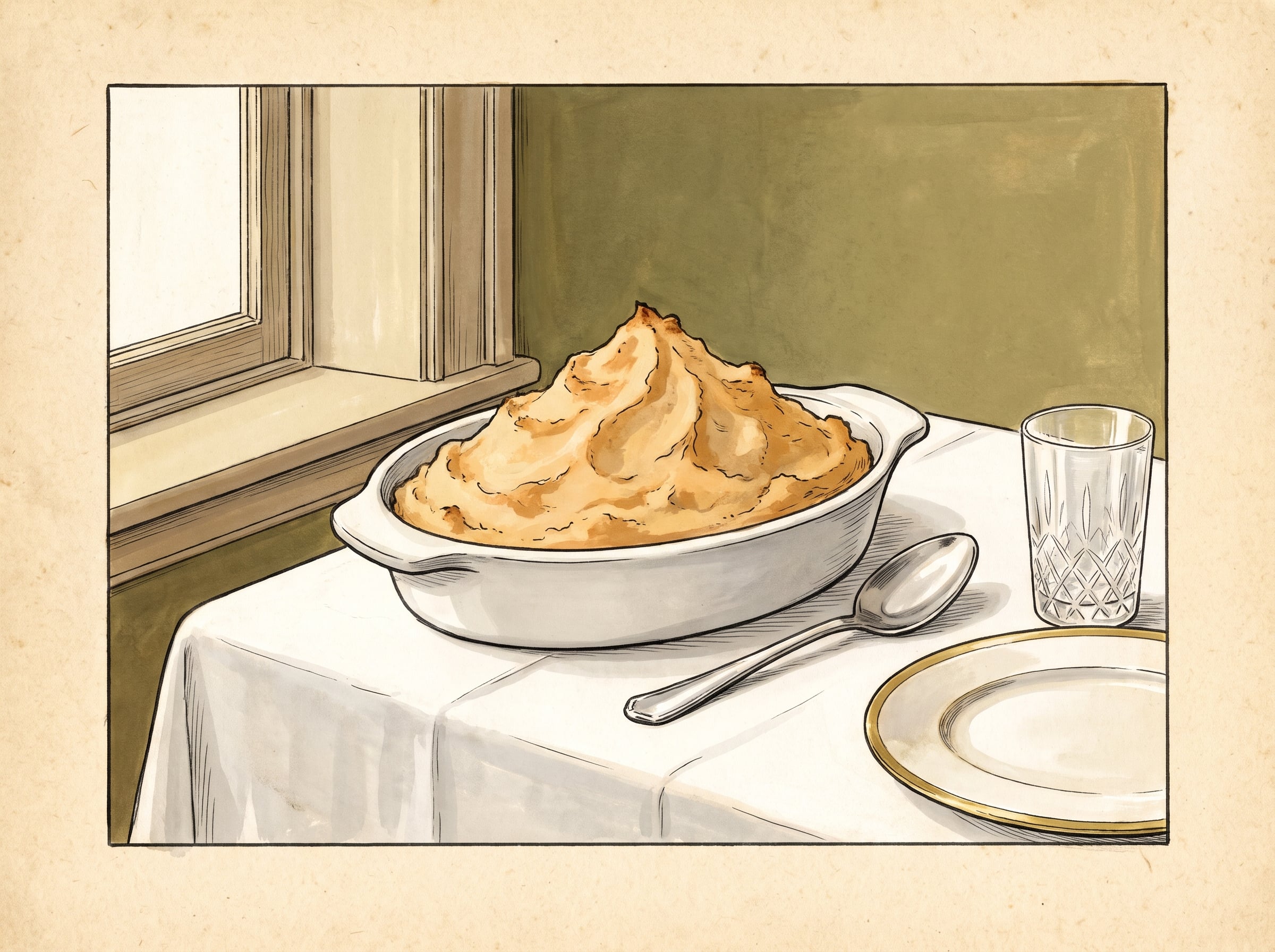
In 1915, a group of Pittsburgh women sold a cookbook under the slogan "The Best Cooks Are Suffragists," and they meant it as part of the campaign. Tucked inside is a sweet potato "souffle" with no eggs and no measurements, only chestnuts, cream, butter and a strong arm. It is about as plain as a recipe gets, and that plainness was part of the point.
Please note that some of the images in this article were created with the assistance of AI.
From The Suffrage Cook Book, 1915
The Story Behind This Recipe
A cookbook with a ballot in mind
The Suffrage Cook Book came from the Equal Franchise Federation of Western Pennsylvania, and the book credits the editor as Mrs. L. O. Kleber. A Pittsburgh Post-Gazette timeline gives her name as Elizabeth Kleber and calls her the Pittsburgh suffragist who organized the project. She cast a wide net. The Heinz History Center counts 57 women among the contributors, 30 of them from Western Pennsylvania. Famous names came in too. Jack London sent along his way to roast a duck, and she even asked governors of states where women already had the vote for contributions.
The result was part kitchen manual and part rally. A Simmons University exhibit notes that books like this mixed sincere recipes with satirical ones and added photographs, jokes, celebrity quotes and endorsements.
From the boiling pot to the oven
The method behind this dish was familiar in American kitchens of the day. Cookbooks often called for sweet potatoes to be boiled, sweetened with sugar, enriched with butter and then finished in the oven. Smithsonian magazine points to Fannie Farmer’s 1918 "Glazed sweet potatoes," which boils the potatoes and then coats them in a sugar syrup with butter before baking. That family of sweetened, oven-finished sweet potatoes later took a turn toward marshmallows and settled in as a Thanksgiving standard.
The Pittsburgh version is a quieter relative. Instead of glazing whole pieces, it mashes the potatoes with chestnuts, and the sugar never goes into the potatoes’ pot. A little is stirred into the water the chestnuts boil in, so they come out faintly sweet before everything meets in the bowl.
Home cooking as an argument
Read closely, the recipe has a puzzle in its name. A souffle usually rises on beaten eggs, and this one has none. The airiness comes from beating the mash with cream and butter "until light," and the oven’s only job is a minute or two of browning on top. There are no amounts and no temperature. The cook is trusted to know what "some" and "a little" mean.
That trust fits the book’s larger purpose. The Library of Congress counts at least six cookbooks that American suffragists published between 1886 and 1920, sold to raise money, win members and calm fears that women with the vote would neglect their homes. Historians have placed this one in a wider effort to show women as rational, practical people who deserved the ballot. A modest side dish of chestnuts and sweet potatoes made that case without raising its voice.
1910s
Notes From the Era
The recipe · 1915
What Our Readers Say
- When Piaci Pizza readers loved a food photo and tapped a reason, comfort came out on top at 30%, and nostalgic was close behind at 16%.
From Piaci Pizza reader polls and votes.
Sweet Potato Souffle
From The Suffrage Cook Book by Mrs. L. O. Kleber (compiler) (1915). Every word of the recipe below is as printed.
Ingredients
- some sweet potatoes
- ripe chestnuts
- a little sugar
- some cream
- butter
Method
-
Boil the sweet potatoes and chestnuts
Boil some sweet potatoes and ripe chestnuts separately, adding a little sugar to the water in which the chestnuts are boiled.
-
Mash with cream and butter
Mash all well together and add some cream and butter and beat until light.
-
Brown in the oven
Then place for a minute or two in the oven to brown.
Our notes
Reading It Today
A souffle that doesn’t rise. With no eggs in the bowl, nothing here will puff up the way a modern souffle does. Expect a whipped mash, fluffy from beating, with a browned top from its brief time in the oven.
"Some" and "a little". The recipe gives no amounts, so the balance of sweet potato to chestnut, and how much cream and butter, is left to the cook. The only sugar goes into the chestnuts’ cooking water, not into the mash itself.
What it would be like. Judging from the ingredients, this would be rich and gently sweet. The chestnuts would bring an earthy, nutty flavor and a slightly mealy body, and the cream and butter would smooth it into something soft and spoonable.
Far from the marshmallow casserole. Today’s holiday sweet potatoes often come heavily sugared and topped with marshmallows. This version has no topping and only a touch of sugar, so the sweet potato and chestnut flavors do most of the work.
Source: Mrs. L. O. Kleber (compiler), The Suffrage Cook Book (The Equal Franchise Federation of Western Pennsylvania, Pittsburgh, 1915). Read the 1915 book at Project Gutenberg.
Sources for the history
- Mrs. L. O. Kleber (compiler), The Suffrage Cook Book (Equal Franchise Federation of Western Pennsylvania, 1915), Project Gutenberg
- "The Best Cooks Are Suffragists", Shall Not Be Denied exhibition, Library of Congress
- The Woman Suffrage Cook Book, Suffrage at Simmons (Simmons University, Boston)
- Cookbooks with a Cause, Heinz History Center (search-result text; not opened in full)
- Women’s battle for the ballot, Pittsburgh Post-Gazette (search-result text; not opened in full)
- Suffrage Cook Book, 1915, H-Net (search-result text; not opened in full)
- How Marshmallow-Topped Sweet Potato Casserole Became a Thanksgiving Classic, Smithsonian Magazine (search-result text; not opened in full)
The original recipe text is from a work published in 1915 and is in the public domain in the United States. The history, notes and illustrations are Piaci Pizza’s own. Brand names that appear in historic recipes are mentioned as historical fact only. Illustrations are AI-generated in a vintage style. The recipe is shown exactly as it was published in 1915; we have not photographed a test batch.