
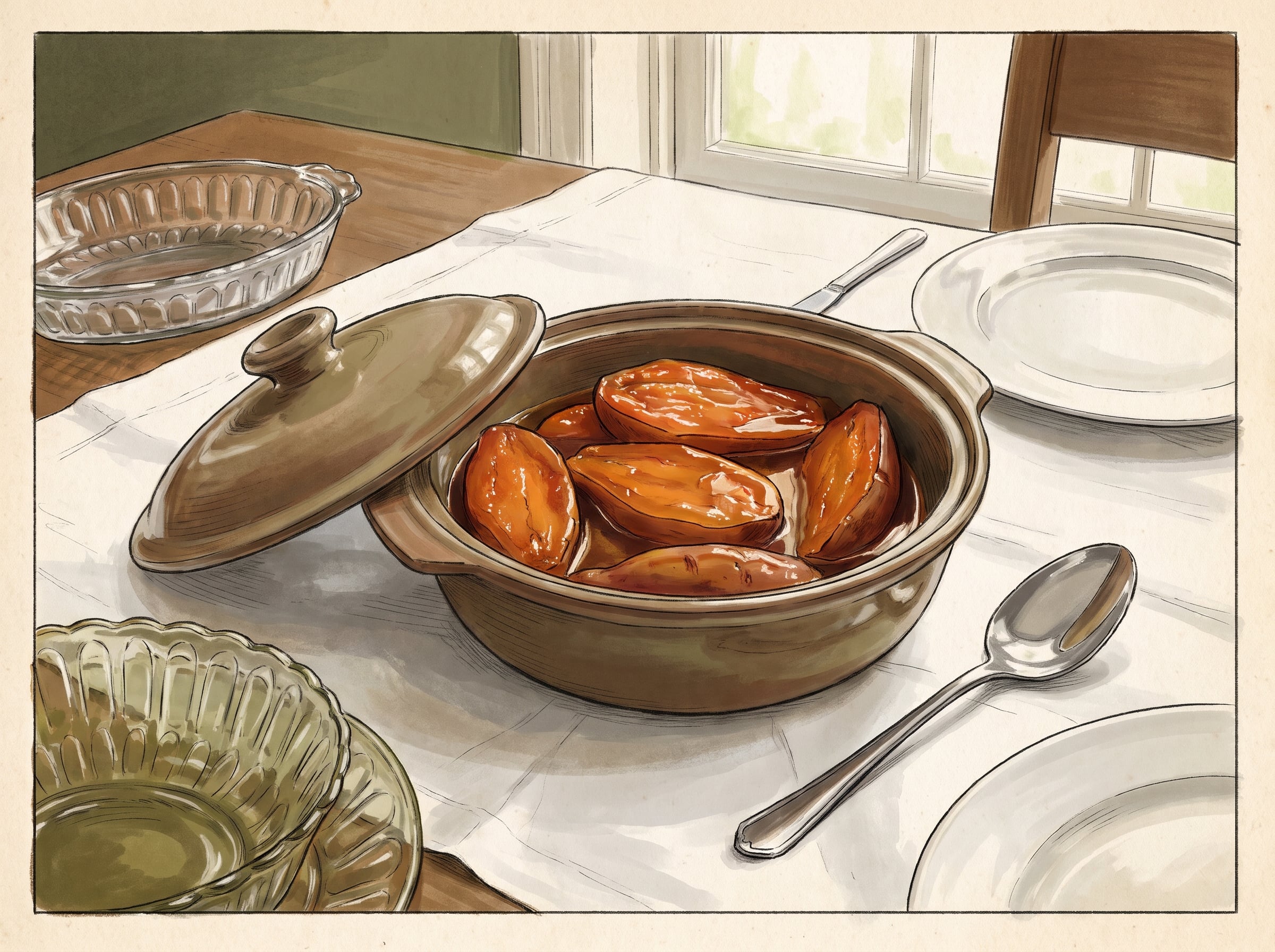
In 1911 a Chicago chef who had been born into slavery in Tennessee, and who had cooked for presidents aboard Pullman railway cars, published a cookbook himself. Tucked inside is this short recipe for sweet potatoes in butter and sugar. It ends with something most recipes skip: a frank note on exactly whose taste it was meant to please.
Please note that some of the images in this article were created with the assistance of AI.
From Good Things to Eat, as Suggested by Rufus, 1911
The Story Behind This Recipe
From Church Street to the private car
Rufus Estes started work at sixteen, in Alexander Hemphill’s restaurant on Church Street in Nashville, a well-known place that served European-style food. He had come a long way to get there. Born into slavery in Maury County, Tennessee, around 1857, he was the youngest of nine children and took his surname from the man who held his mother’s family. When the grown men left to join the Union army, the war, as he later put it, left ‘us little folks to bear the burdens.’ After the war the family moved to Nashville, where he went to school for a single term and learned to read and write.
He stayed at Hemphill’s until he was twenty-one. In 1883 he joined the Pullman Company and cooked aboard its luxurious private railway cars, where his passengers over the years included presidents, a princess and world-famous musicians. He ran a private car until 1907, then settled in Chicago as chef for subsidiary companies of United States Steel, feeding executives and living in rooms above the Appomattox, a private club for Black Republicans. Friends talked him into collecting his recipes, and in 1911 he published them himself as Good Things to Eat, as Suggested by Rufus. The book opens with ‘Hints to Kitchen Maids,’ written in the voice of a chef used to running a staff. The Chicago Defender praised him and reported that Illinois Steel Company executives auctioned an autographed first copy. According to the Defender, an autographed copy sold for $11, more than a week’s pay at his first restaurant job in Chicago. The book is counted among the first cookbooks written by an African American chef.
A recipe that explains itself
Most recipes stop talking once the food is done. This one signs off with a comment: the method, Estes writes, ‘pleases the Southern taste, which demands sugar added to the naturally sweet vegetable.’ He grew up in Tennessee and later cooked for wealthy diners in Chicago. Here he writes the Southern version down for readers in the North and tells them plainly what they are getting.
The method itself is gentle. Butter and sugar melt slowly in a casserole. Raw, peeled sweet potatoes, halved lengthwise, go in two layers, each dusted with salt and pepper. Boiling water goes in half an inch deep, the lid goes on, and the dish cooks slowly in the oven. Whatever syrupy sauce the potatoes don’t soak up comes to the table with them. We would call this a braise in a covered dish, a long way from the broiled, marshmallow-topped casserole many people picture today.
Cooking without a number
Look for an oven temperature and you won’t find one. Estes was writing for a kitchen built around a coal- or wood-fired range, and those had no thermostat. A cook judged the heat by experience. The recipe uses the range in two ways. The casserole starts ‘on the back of the range to heat slowly,’ then moves into the oven. Sliding a pot across the stovetop was how a cook turned the heat up or down. So Estes says only to ‘cook slowly’ and to serve ‘when the potatoes are tender,’ and he trusts the reader to mind the fire.
The measuring is just as relaxed: two rounding tablespoons of butter and one of sugar, and no amount at all for the potatoes, salt or pepper. The book often left out exact quantities. The casserole also does double duty, holding in the steam while the potatoes cook and then going straight to the table as the serving dish.
1910s
Notes From the Era
The recipe · 1911
What Our Readers Say
- When Piaci Pizza readers loved a food photo and tapped a reason, comfort came out on top at 30%, with nostalgia at 16%, tied with simply looking good.
From Piaci Pizza reader polls and votes.
Glazed Sweet Potatoes
From Good Things to Eat, as Suggested by Rufus by Rufus Estes (1911). Every word of the recipe below is as printed.
Ingredients
- two rounding tablespoons of butter
- one of sugar
- raw, pared sweet potatoes cut in halves, lengthwise
- salt and pepper
- enough boiling water to stand one-half inch deep in the dish
Method
-
Heat the butter and sugar
Put two rounding tablespoons of butter and one of sugar into a casserole and set on the back of the range to heat slowly.
-
Layer and season the potatoes
When hot lay in raw, pared sweet potatoes cut in halves, lengthwise. Dust with salt and pepper and put in another layer of seasoned potatoes and enough boiling water to stand one-half inch deep in the dish.
-
Cover and bake slowly
Put on the close-fitting cover and set in the oven to cook slowly.
-
Serve in the casserole
When the potatoes are tender serve in the same dish with the sweet sauce that will not be entirely absorbed in the cooking. This way of preparing sweet potatoes pleases the Southern taste, which demands sugar added to the naturally sweet vegetable.
Our notes
Reading It Today
Rounding tablespoons. A rounding tablespoon is heaped slightly above the rim, so it holds a little more than a level tablespoon.
The back of the range. On an old cast-iron range, the back of the cooktop sat away from the hottest part of the fire. It was the place for warming and slow melting, much like a low burner today.
What to expect on the plate. Judging from the ingredients, the potatoes should come out soft and tender all the way through, since they steam in a covered dish. They would be coated in a thin, buttery syrup, with salt and pepper to balance the sugar. The result is a glossy, sweet sauce rather than a thick or crunchy topping.
How it differs from today’s version. The marshmallow-topped casseroles many people picture today are finished under the broiler. Here the potatoes go in raw, cook under a lid in butter, sugar and water, and are served in their own sauce in the dish they cooked in.
Source: Rufus Estes, Good Things to Eat, as Suggested by Rufus (Published by the author, Chicago, 1911). Read the 1911 book at Project Gutenberg.
Sources for the history
- Rufus Estes, Good Things to Eat, as Suggested by Rufus (Chicago, 1911), Project Gutenberg
- Rufus Estes – Wikipedia
- Estes, Rufus 1857–19(?)(?) – Encyclopedia.com
- Former Slave Rufus Estes Helped Teach America How To Cook – LAist
- Rufus Estes: Pullman Chef and Cookbook Author – CooksInfo
- Maury native wrote cookbook – Historic Maury County
- Born into Slavery, Rufus Estes Became One of the First Black Cookbook Authors and Served Presidents – WTTW
- Episode 105 – Good Things To Eat – The Past and The Curious
- The Victorian range cooker – 1900s.org.uk
The original recipe text is from a work published in 1911 and is in the public domain in the United States. The history, notes and illustrations are Piaci Pizza’s own. Brand names that appear in historic recipes are mentioned as historical fact only. Illustrations are AI-generated in a vintage style. The recipe is shown exactly as it was published in 1911; we have not photographed a test batch.