In 1889 a chef from Delmonico’s, the most famous restaurant in Gilded Age New York, did something unusual: he printed the house recipes for anyone to read. Tucked among them is this turkey stuffing. It is rich with sausage and chestnuts, uses hardly any bread, and calls for imported "French" chestnuts at a time when America’s own chestnut trees still grew across the eastern forests.
Please note that some of the images in this article were created with the assistance of AI.
From The Table: How to Buy Food, How to Cook It, and How to Serve It, 1889
The Story Behind This Recipe
The boy from Ticino who hit the markets at 3 a.m.
Alessandro Filippini reached New York on June 5, 1866, not yet seventeen, and went straight to work at Delmonico’s on 14th Street. He was born in 1849 in Airolo, in Switzerland’s Italian-speaking canton of Ticino, the same region the Delmonico family came from. In his early teens he went to Lyon to train at one of its famous cooking schools. He did so well that the school stopped charging him and made him an instructor instead. Over more than 25 years with the Delmonicos he cooked at their Broad Street, Pine Street and Broadway restaurants. A New-York Tribune writer reported that he was at the markets by 3 o’clock every morning, buying for all of them.
In 1885 he began writing down what those kitchens actually did. The result came out in 1889 as The Table in New York and, at the same time, as The Delmonico Cook Book in London, under the English form of his name, Alexander. The recipes had been secret until then, and his employer approved. The book sold well and grew through several enlarged editions. Its author had less luck. His own restaurant, Filippini’s at 337 Broadway, lasted from 1891 to 1893. When he died in 1917, no newspaper ran an obituary.
A stuffing with restaurant manners
The Table was ambitious. It laid out a bill of fare for all three meals on every day of the year, along with notes on what was in season and how to set the table, and its third part gave a recipe for every suggested dish. It was written for private families, but only families with help in the kitchen. A Tribune reviewer noted in 1890 that most of the menus were "too elaborate for any but families of wealth with many servants."
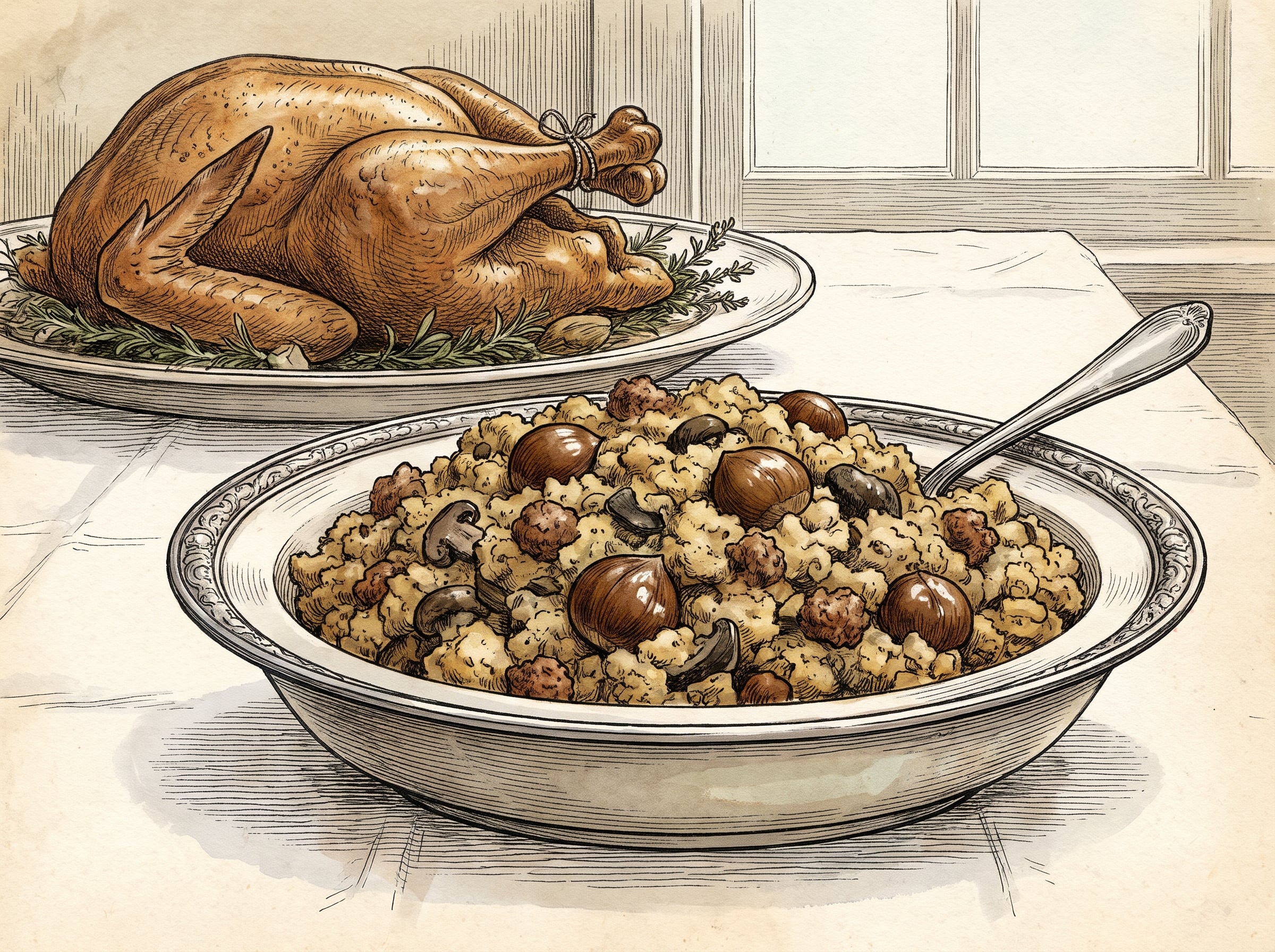
This stuffing shows why. It reads like a restaurant dish scaled down to fit one home turkey. A shallot softens in butter "without browning" before sausage, mushrooms and pounded chestnuts go in. Bread barely appears at all: just half an ounce of crumbs. The showpiece comes last, when twenty-four whole French chestnuts are folded in gently so that none of them break. Then the mixture is left to cool before it goes into the bird.
Stopwatch cooking in 1889
Notice the clock. The recipe gives three minutes for the shallot and five more once the sausage is in. Filippini was known for exact measurements at a time when many cookbooks were still vague. He had firm opinions well beyond the stove, too. He judged New York’s markets the best supplied in the world, and he wanted cattle shipped east by rail to be handled well and dressed beef to be held at a steady 38°F or so. He even had rules for the dining room: it should never be warmer than sixty degrees, and dinner should arrive very hot.
Then there are the chestnuts. Filippini asked for imported ones while the American chestnut was still a dominant tree in the Appalachians. In 1904, chestnut blight was first noticed at the New York Zoological Park, now the Bronx Zoo. Over the first half of the 20th century it killed an estimated three to four billion trees, and the native nut that grew so close to Filippini’s kitchen was nearly wiped out.
1880s
What Our Readers Say
- When Piaci Pizza readers loved a food photo and tapped a reason, comfort came out on top at 30%, with nostalgia next at 17%.
From Piaci Pizza reader polls and votes.
Notes From the Era
The recipe · 1889
Chestnut Stuffing
From The Table: How to Buy Food, How to Cook It, and How to Serve It by Alessandro Filippini (1889). Every word of the recipe below is as printed.
Ingredients
- a good-sized, sound shallot
- one tablespoonful of butter
- a quarter of a pound of sausage meat
- ten finely chopped mushrooms
- twelve well-pounded, cooked, peeled chestnuts
- one pinch of salt
- half a pinch of pepper
- half a saltspoonful of powdered thyme
- a teaspoonful of finely chopped parsley
- half an ounce of fresh bread-crumbs
- twenty-four whole cooked and shelled French chestnuts
- Make sure the sausage meat is fully cooked through before you continue.
- Stuffing cooked inside the bird must reach 165°F / 74°C in its center.
- Refrigerate the cooled stuffing if it is not used right away, and stuff the turkey just before roasting rather than ahead of time.
Method
-
Soften the shallot and add the sausage
Peel a good-sized, sound shallot, chop it up very fine, place in a saucepan on the hot range with one tablespoonful of butter, and let heat for three minutes without browning, then add a quarter of a pound of sausage meat.
-
Add mushrooms and pounded chestnuts
Cook five minutes longer, then add ten finely chopped mushrooms, twelve well-pounded, cooked, peeled chestnuts; mix all well together.
-
Season the mixture
Season with one pinch of salt, half a pinch of pepper, half a saltspoonful of powdered thyme, and a teaspoonful of finely chopped parsley.
-
Boil and fold in crumbs and whole chestnuts
Let just come to a boil, then add half an ounce of fresh bread-crumbs, and twenty-four whole cooked and shelled French chestnuts; mix all well together, being careful not to break the chestnuts.
-
Cool and stuff the turkey
Let cool off, and then stuff the turkey with it.
Our notes
Reading It Today
Pinches and saltspoons. A saltspoon was a tiny spoon for serving salt. As a measure it is usually reckoned at about a quarter teaspoon, so "half a saltspoonful" of thyme comes to roughly an eighth of a teaspoon. A pinch is simply what you can hold between finger and thumb, and "half a pinch" of pepper is about as little as it sounds. The seasoning here is very restrained.
The weights in modern terms. A quarter of a pound of sausage meat is 4 ounces, about 113 grams. Half an ounce of fresh bread-crumbs is about 14 grams, roughly a small handful. Add the thirty-six chestnuts in all and you get a sense of the balance: this is mostly meat, nuts and mushrooms.
Two kinds of chestnut. The chestnuts are used in two ways. Twelve are pounded and mixed through the sausage and mushrooms, which would give the filling a soft, slightly sweet, mealy body. The other twenty-four stay whole, so the finished stuffing would be studded with large, tender pieces rather than evenly chopped.
Not a bread stuffing. Most American stuffings today are built on cubes of bread or cornbread, moistened with broth and baked. This one has no broth, no egg and almost no bread. Judging from the ingredients, we’d expect it to be dense, savory and earthy from the mushrooms, with only a light herb note from the thyme and parsley. It was also meant to go inside the turkey, not into a separate baking dish.
Source: Alessandro Filippini, The Table: How to Buy Food, How to Cook It, and How to Serve It (New York, 1889). Read the 1889 book at Project Gutenberg.
Sources for the history
The original recipe text is from a work published in 1889 and is in the public domain in the United States. The history, notes and illustrations are Piaci Pizza’s own. Brand names that appear in historic recipes are mentioned as historical fact only. Illustrations are AI-generated in a vintage style. The recipe is shown exactly as it was published in 1889; we have not photographed a test batch.