
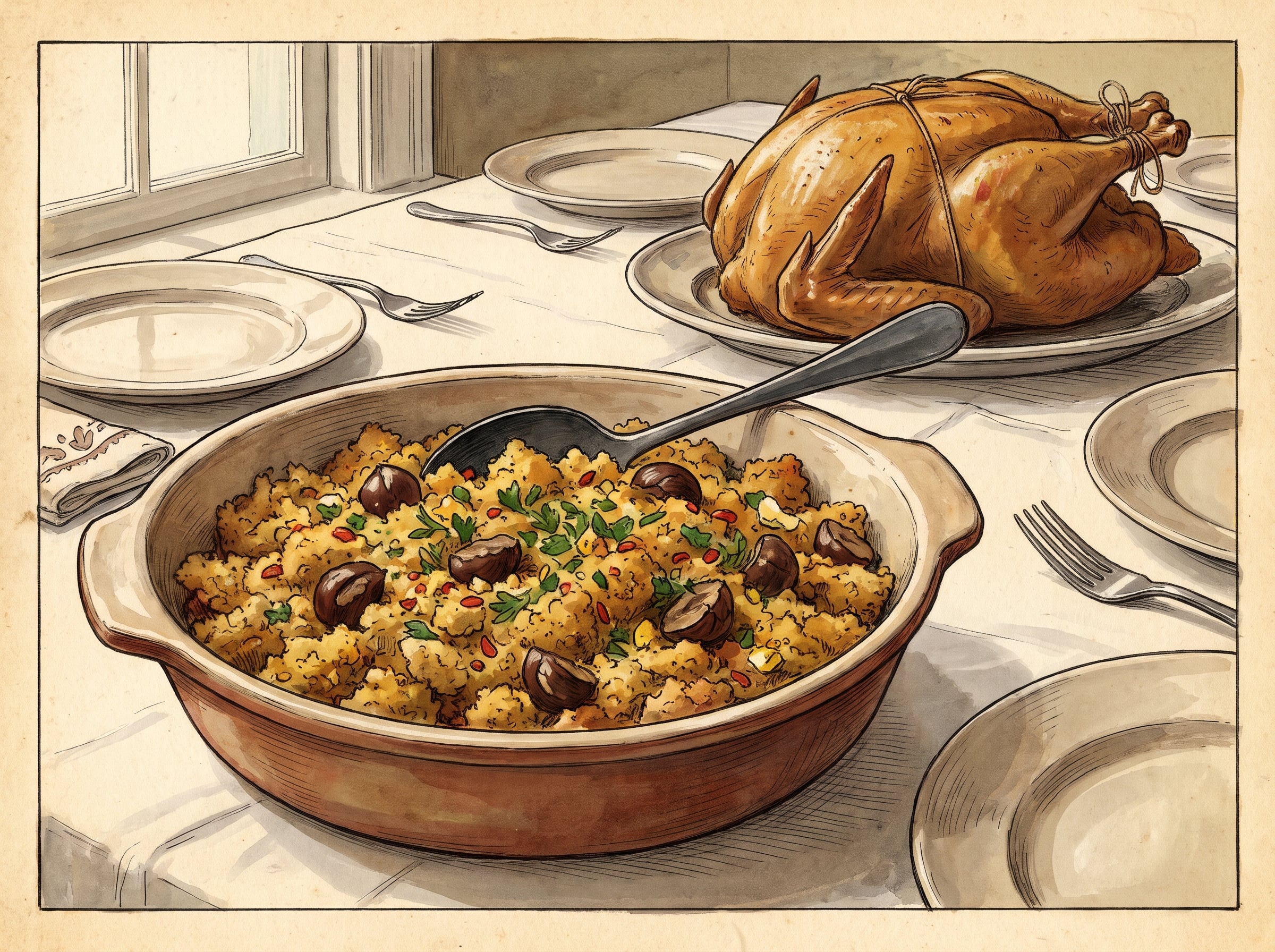
In 1914 a Los Angeles cooking teacher took the holiday stuffing American cooks already knew, with its cold cornbread, chestnuts, onion, parsley and egg, and stirred red chile into it. Then she put more chile in the sauce poured over the top. She called the result Spanish, and her own preface explains why that word was not quite right.
Please note that some of the images in this article were created with the assistance of AI.
From California Mexican-Spanish Cook Book, 1914
The Story Behind This Recipe
The teacher who packed the auditorium
Whenever Bertha Haffner-Ginger announced a lesson on Spanish dishes, she said, it drew record crowds, no matter which American city she was in. Born in 1868, she had come to Los Angeles, and in 1912 the Los Angeles Times hired her to run its new School of Domestic Science. She taught through test kitchens and hands-on classes. Every week she lectured in the auditorium of the paper’s new building, on everything from French technique to poultry. Later she toured the country teaching.
Requests for recipes sent her hunting for the best ones. She wrote that three years in California let her learn the dishes "directly from the natives, both Mexican and Spanish," and that she then reworked them into "correct proportions and practical methods." One account traces the classes to her walks through Sonoratown, a nearby neighborhood full of Mexican restaurants and food factories. She dedicated the book to her daughter, whom her pupils called Miss "Paprika."
Old American stuffing, new California name
Stuffing has gone by several names: "farce" in the 14th century, "forcemeat" in the 17th, "dressing" in the 19th. It was on the Thanksgiving table long before 1914. In her 1827 novel Northwood, Sarah Josepha Hale placed a roast turkey at the head of the table, "sending forth the rich odour of its savoury stuffing." Chestnuts are the oldest branch of this family. The first stuffing recipe published in the United States, in 1772, used them, and Mrs. Lincoln’s Boston Cook Book of 1884 helped tie chestnut stuffing to Thanksgiving. The cornbread points south, where dressing is generally made from it. Food historian Michael Twitty calls kush, a cornbread hash made by enslaved West Africans, the "grandmother" of Southern cornbread dressing.
As for "Spanish," Haffner-Ginger settled that herself. The dishes Californians called Spanish, she wrote, "are really Mexican Indian dishes." Corn bread and chile sauces were not native to Spain, but because Mexicans speak Spanish, the name stuck. It also suited the moment. Casa Verdugo, opened in Glendale in 1905 by Piedad Yorba Sowl and her husband Charles, offered diners a romanticized Old California. The book’s photographs of Mexican dancers carry a bit of the same glow.
Chile in the crumbs, chile in the gravy
The recipe sits in the meat chapter, and nearly every line would have looked familiar to a holiday cook in 1914: cold corn bread, broth, roasted chestnuts, butter, a minced hard-boiled egg, onion, parsley and a beaten egg to bind it all. Then come three tablespoons of red chile pulp. To make it, the book says to split dried red chiles, remove the seeds and veins, soak and scald them, and press them through a sieve. The last line sends the chile around again, into "the ordinary dressing of the drippings and chile sauce" spooned over the top. Here "dressing" seems to mean a sauce. A stuffed chicken a few recipes earlier simply says "make gravy of drippings."
Even the familiar parts were changing. A fungus from Asia had set off the chestnut blight in the Bronx in 1904, and by 1940 it had killed most mature American chestnut trees. Chiles, on the other hand, were getting easier to find. The book points out that California firms sold canned chiles and chile powders, which "makes it possible to cook Spanish dishes anywhere."
1910s
What Our Readers Say
- When Piaci Pizza readers loved a food photo and tapped a reason, comfort came first at 30%, with nostalgia and ingredients tied next at 17% each.
From Piaci Pizza reader polls and votes.
Notes From the Era
The recipe · 1914
Spanish Dressing for Chicken or Turkey
From California Mexican-Spanish Cook Book by Bertha Haffner-Ginger (1914). Every word of the recipe below is as printed.
Ingredients
- One pint of cold corn bread
- one cup rich chicken or turkey broth
- one-half cup roasted chopped chestnuts
- one tablespoon butter
- one hard-boiled egg minced
- one teaspoon black pepper
- three tablespoons red chile pulp
- one-fourth cup minced onion
- large tablespoon minced parsley
- one egg whipped very light
- salt to taste
- turkey or chicken
- the drippings
- chile sauce
- Stuffing cooked inside the bird must reach 165°F (74°C) at its center, as must the bird itself.
- The stuffing contains raw whipped egg and raw-poultry juices, so it must be fully cooked to 165°F (74°C) before eating.
Method
-
Mix the dressing, stuff and bake the bird, then make the sauce
One pint of cold corn bread, one cup rich chicken or turkey broth, one-half cup roasted chopped chestnuts, one tablespoon butter, one hard-boiled egg minced, one teaspoon black pepper, three tablespoons red chile pulp, one-fourth cup minced onion, large tablespoon minced parsley, one egg whipped very light, salt to taste, stuff turkey or chicken, when baked, make the ordinary dressing of the drippings and chile sauce, to serve on dressing.
Our notes
Reading It Today
A pint and a large tablespoon. A pint is 2 cups, so the recipe starts with about 2 cups of crumbled cornbread, and the recipe wants it cold. A "large tablespoon" of parsley most likely means a generous, heaped spoonful rather than the level tablespoon (3 teaspoons) that Fannie Farmer’s 1896 Boston Cooking-School Cook Book had already insisted on.
What red chile pulp is. Red chile pulp is a smooth, thick purée of dried red chiles with the seeds and veins removed, so it brings more earthy flavor and brick-red color than sharp heat. Three tablespoons spread through about 2 cups of crumbs should tint the stuffing and warm it up without making it fiery.
Texture and flavor. Judging from the ingredients, this would be a soft, moist, slightly cakey stuffing. The broth and whipped egg bind the crumbs, the roasted chestnuts add sweet, mealy bites, and the hard-boiled egg and butter make it rich. Onion and parsley keep it savory, and the chile ties it to the sauce poured on top.
How it differs from today’s stuffing. There is no celery, no sage and no cubed white bread here. The minced hard-boiled egg and the chile both set it apart from most modern versions, and chestnuts show up far less often now. The batch is small too, sized for a chicken or a modest bird, and "dressing" in the last line most likely means the chile gravy, not the stuffing.
Source: Bertha Haffner-Ginger, California Mexican-Spanish Cook Book (Los Angeles, 1914). Read the 1914 book at Project Gutenberg.
Sources for the history
- California Mexican-Spanish Cook Book, Bertha Haffner-Ginger (Project Gutenberg plain text)
- California Mexican-Spanish Cook Book (Project Gutenberg catalog page)
- Bertha Haffner-Ginger, Godmother of the Mexican Food Craze (Gustavo Arellano, from the LA Times, via One for the Table)
- Well Before Rachael Ray-There Was Bertha Haffner-Ginger (NewspaperAlum)
- The First Taco Recipe in English (Slices of Blue Sky)
- California Mexican-Spanish Cookbook (Goodreads)
- Glendale’s Casa Verdugo Neighborhood Featured in Historical Society Home Tour (Crescenta Valley Weekly)
- Chestnut stuffing (Wikipedia)
- Thanksgiving dinner (Wikipedia)
- Dressing vs. Stuffing? It’s No Contest in South Carolina (Discover South Carolina)
- Holiday Staples: The History of Stuffing (Yesterday’s America)
- Ortega Adobe (Wikipedia)
- Ortega Adobe Interpretive Panels (City of Ventura)
- Fannie Merritt Farmer (CooksInfo)
The original recipe text is from a work published in 1914 and is in the public domain in the United States. The history, notes and illustrations are Piaci Pizza’s own. Brand names that appear in historic recipes are mentioned as historical fact only. Illustrations are AI-generated in a vintage style. The recipe is shown exactly as it was published in 1914; we have not photographed a test batch.