
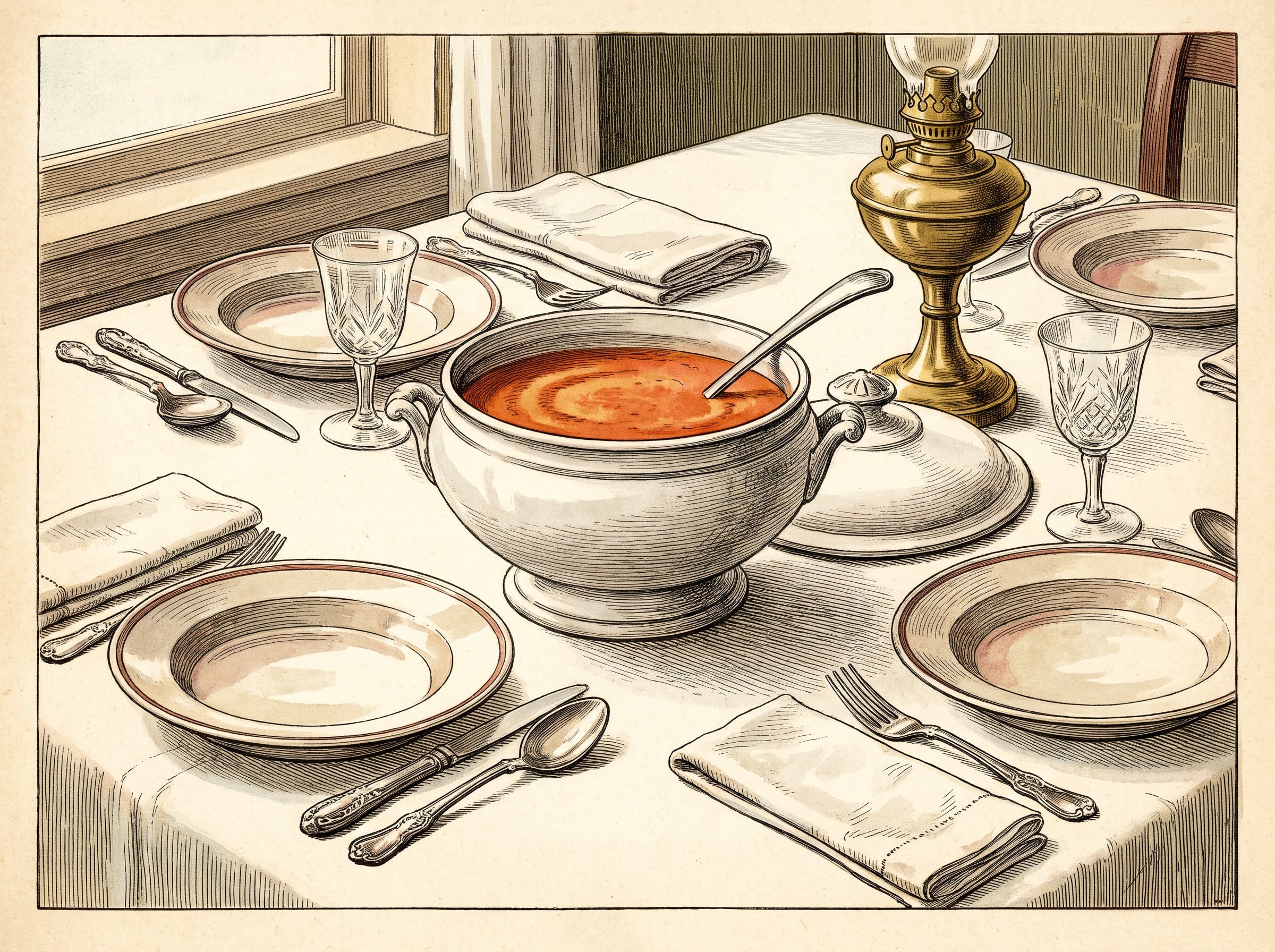
Some recipes take a page. This one takes four lines: sweet potato, tomato, salt and a little cream, pushed through a colander and warmed up again. It came from the experimental kitchen of the Battle Creek Sanitarium in Michigan, where meat was discouraged and the cook’s job was to make that rule taste good.
Please note that some of the images in this article were created with the assistance of AI.
From Science in the Kitchen, 1893
The Story Behind This Recipe
The woman in charge of the kitchen
When Ella Eaton finished at Alfred College in 1872, she was the youngest person to have earned a bachelor’s degree there. Born in 1853 in Alfred Center, New York, she went on to make her name in Michigan as a dietitian, writer and advocate for children. She married Dr. John Harvey Kellogg and worked from 1877 to 1920 as assistant editor of his magazine, Good Health. In 1883 he brought her a request many cooks would recognize: could she make his health food more appealing? She took over the sanitarium’s experimental kitchen, started a School of Cooking and a School of Home Economics, and planned meals for patients and staff as the sanitarium’s dietitian.
Out of that work came Science in the Kitchen, a cookbook that looked at food in chemical terms. A Culinary Institute of America library guide describes it as a guide to help housewives choose food that was nutritionally sound and "morally correct," and traces that link to the Seventh-day Adventist Church. The Michigan Women’s Hall of Fame, which inducted her in 1999, credits her with creating the field later called dietetics. Meanwhile she and her husband raised more than 40 children and founded the Haskell Home for Orphans in Battle Creek.
A side dish that became a soup
The star of this bowl came a long way to reach a Michigan saucepan. The sweet potato is thought to be native to tropical South America, and it was growing in Virginia as early as 1648. It became a staple of Southern cooking, while Northern cooks at first preferred the drier, white-fleshed kinds. By the 1890s it was ordinary enough to appear in Fannie Farmer’s Boston Cooking-School Cook Book of 1896.
Kellogg took something usually served on the side and made it the whole bowl. There is no stockpot behind this soup and no meat at all. Mashed sweet potato gives it body, strained tomato loosens it and adds color, and cream rounds it off. Soup suited a sanitarium, too. One food-history source notes that soups were considered easy to digest and had been prescribed for invalids since ancient times. A smooth purée seasoned with nothing but salt is about as gentle as a first course gets.
A first course without oysters
A holiday dinner in the 1890s started with a spoon. A Thanksgiving menu from Fannie Farmer’s 1896 book opens with oyster soup and crisp crackers before the roast turkey.
Kellogg never calls this a holiday soup. But oyster soup had no place on the sanitarium’s menu, and a smooth bowl made from a holiday vegetable slips neatly into that first-course spot. The Henry Ford museum keeps a coal-burning Garland cookstove from about 1890, made by the Michigan Stove Company of Detroit. Coal burned longer than wood and needed far less tending. On a stove like that, the final instruction, reheat and serve, asked very little.
1890s
Notes From the Era
The recipe · 1893
What Our Readers Say
- When Piaci Pizza readers loved a food photo and tapped a reason, comfort topped the list at 30%, and nostalgia was picked 16% of the time.
From Piaci Pizza reader polls and votes.
Sweet Potato Soup
From Science in the Kitchen by Ella Eaton Kellogg (1893). Every word of the recipe below is as printed.
Ingredients
- a pint of cold mashed sweet potato
- a pint and a half of strained stewed tomato
- salt to season
- half a cup of cream
Method
-
Combine, sieve and season
To a pint of cold mashed sweet potato add a pint and a half of strained stewed tomato, rub together through a colander, add salt to season, and half a cup of cream.
-
Reheat and serve
Reheat and serve.
Our notes
Reading It Today
Pints and cups. A pint is 2 cups, or 16 fluid ounces. The recipe calls for 2 cups of mashed sweet potato, 3 cups of strained stewed tomato and half a cup of cream. Salt is left to the cook’s taste, and no reheating time is given. Kellogg expected the cook to judge both.
Rubbing through a colander. To "rub together through a colander" means pressing the mixture through the holes with a spoon to break up lumps and blend the two vegetables. A modern cook would reach for a fine sieve, a food mill or a blender to get a similar smooth result.
What lands in the bowl. Judging from the ingredients, expect a thick, smooth soup. The sweet potato brings mellow sweetness and body, the tomato adds tang, and the cream softens both. Its color depends on the sweet potato. Orange flesh gives a warm orange-red, and the drier white kinds would make a paler bowl.
No sugar, no spice. Many sweet potato dishes today lean on brown sugar, butter, warm spices or marshmallows. This one has none of those. It is savory, seasoned only with salt, and gets its sweetness from the vegetable itself.
Source: Ella Eaton Kellogg, Science in the Kitchen (Health Publishing Company, Battle Creek, 1893). Read the 1893 book at Project Gutenberg.
Sources for the history
- Ella Eaton Kellogg, Science in the Kitchen (1893), recipe for Sweet Potato Soup
- Ella Eaton Kellogg – Michigan Women Forward (Michigan Women’s Hall of Fame)
- Science in the Kitchen: Kellogg, Meat & Morality – Shelf Life, Conrad N. Hilton Library, Culinary Institute of America
- The Food Timeline: history notes – soup
- Sweet Potato: A Thanksgiving Tradition – University of Missouri Integrated Pest Management
- Thanksgivings Past: Old Holiday Menus – Live Science
- Cookstove, circa 1890 – The Henry Ford
The original recipe text is from a work published in 1893 and is in the public domain in the United States. The history, notes and illustrations are Piaci Pizza’s own. Brand names that appear in historic recipes are mentioned as historical fact only. Illustrations are AI-generated in a vintage style. The recipe is shown exactly as it was published in 1893; we have not photographed a test batch.