
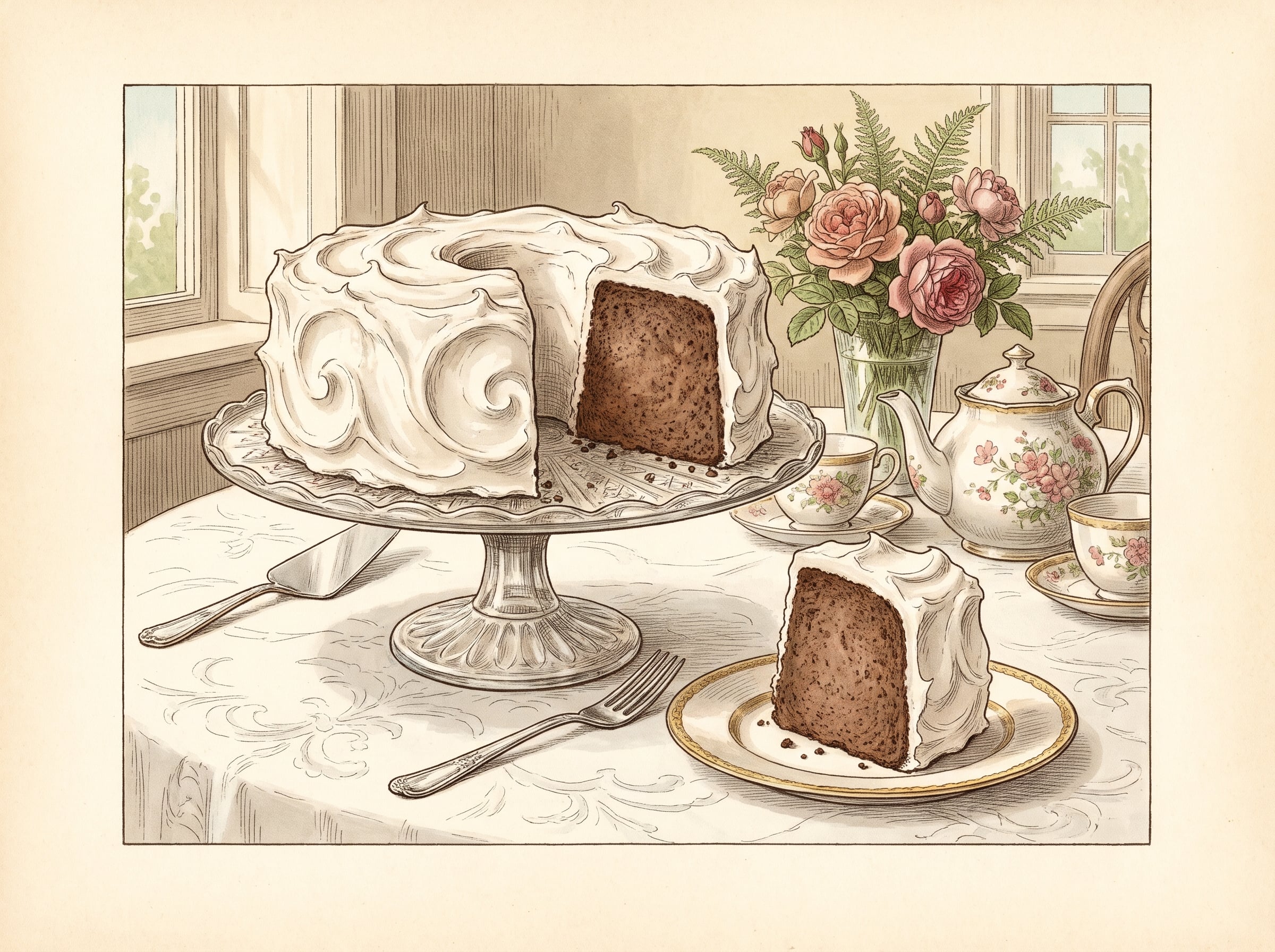
In 1905 a cake called devil’s food was new enough that it was still a stranger to most American kitchens, and Fannie Farmer slipped two versions into the 1905 edition of her famous cookbook. This is the first of them: a chocolate cake baked in an angel cake pan and covered in snow-white frosting. It is a snapshot of a dessert that was still deciding what it would become.
Please note that some of the images in this article were created with the assistance of AI.
From The Boston Cooking-School Cook Book, 1905
The Story Behind This Recipe
Miss Farmer and her book
Fannie Merritt Farmer was sixteen and still in high school when a stroke paralyzed her right leg and ended her plans for college. She was born in Boston in 1857 and raised in Medford. After the stroke she took work as a mother’s helper, and in someone else’s kitchen she turned out to be a very good cook. In 1887 she enrolled at the Boston Cooking School. When the two-year course ended, the school asked her to stay, and by the mid-1890s she was running it.
Her cookbook came out in 1896. Little, Brown had so little faith in it that they printed only 3,000 copies. It was an immediate success and became the best-selling cookbook of its day. Because the book was more or less self-published, Farmer kept the copyright, and it made her wealthy. In 1902 she opened a school under her own name, which is why the 1905 title page calls her "Of Miss Farmer’s School of Cookery." Her lasting contribution was the level measure: a level teaspoon, a level tablespoon, a level cup. American cooks have measured that way ever since. She treated cooking as a science, too. The book explains the chemistry of the human body before it offers a single recipe.
A cake named for the other side
For much of the 1800s, a "chocolate cake" was often just a yellow cake with chocolate frosting. That started to change late in the century, when cocoa processing improved and chocolate became easy to buy at the grocer’s. A Missouri newspaper printed a "Black Chocolate or Devil’s Food Cake" in 1890. Table Talk magazine ran a "Devil’s Cake" in 1893, and a year later a newspaper described the cake as "black as only his satanic majesty can be." The exact name "Devil’s Food Cake" is usually first credited to Sarah Tyson Rorer in 1902, and other recipes quickly followed.
Nobody knows for certain where the name came from. The favorite explanation is that it was meant as the dark, rich opposite of angel food cake, which was hugely popular at the time. Another explanation points to "deviled," the word cooks already used for dishes that were dark, rich, or fiery with spice.
Devil’s food in an angel’s pan
This recipe sits in the appendix of the 1905 edition, which was "revised, with an appendix of three hundred recipes." The name had been in print for only a few years, and devil’s food would not be everywhere until around 1913. Farmer gave two versions. This first one rises on beaten egg whites and baking powder. It bakes in an angel cake pan for exactly the time her Angel Cake gets, which is a nice touch for a cake named after the devil. It is finished with a white boiled frosting, and dark cake under white frosting would remain the classic look for devil’s food. Her Version II is closer to the cake we know now, with twice the chocolate in a smaller batter and sour milk with soda. Version I uses two ounces of chocolate, the same as the book’s plain Chocolate Cake. It was probably milder and paler than a modern devil’s food.
The kitchen around it was different too. Farmer explains that ready-mixed baking powder had "generally superseded" measuring soda and cream of tartar separately. She also notes that sour milk releases the gas in soda faster. Most cooks used a coal range, and they controlled its heat with dampers and fuel. Farmer wrote that no oven thermometer had yet proved practical. Instead she told cooks to divide the baking time into quarters. The cake should rise in the first quarter, rise and begin to brown in the second, keep browning in the third, and shrink from the pan in the last.
1900s
Notes From the Era
The recipe · 1905
Devil’s Food Cake
From The Boston Cooking-School Cook Book by Fannie Merritt Farmer (1905). Every word of the recipe below is as printed.
Ingredients
- ½ cup butter.
- 2 cups sugar.
- Yolks 4 eggs.
- 1 cup milk.
- 2⅓ cups flour.
- 4 teaspoons baking powder.
- Whites 4 eggs.
- 2 squares chocolate.
- ½ teaspoon vanilla.
Method
-
Cream the butter with half the sugar
Cream the butter, and add gradually one-half the sugar.
-
Beat the yolks with the rest of the sugar
Beat yolks of eggs until thick and lemon-colored, and add gradually remaining sugar.
-
Combine and finish the batter
Combine mixtures, and add alternately milk and flour mixed and sifted with baking powder; then add whites of eggs beaten stiff, chocolate melted, and vanilla.
-
Bake the cake
Bake forty-five to fifty minutes in an angel cake pan.
-
Frost the cake
Cover with White Mountain Cream (see p. 437).
Our notes
Reading It Today
Two squares of chocolate. Farmer’s table of weights says one square of Baker’s chocolate is one ounce, so this recipe calls for two ounces. She means unsweetened baking chocolate, melted over hot water before it goes into the batter. That is not much chocolate for a cake this size. That is why it was probably lighter in color and flavor than the deep, dark devil’s food most people picture today.
Level cups and sifted flour. Every cup in this recipe is a level half-pint cup, the same as a standard US cup today. Farmer’s tin cups were marked in quarters or thirds, and a cup marked in thirds is how a cook measured "2⅓ cups flour." She sifted flour before measuring and used pastry flour for cakes, along with fine granulated sugar. If you only had bread flour, she advised using two tablespoons less for each cup.
The angel cake pan. This is a tube pan, the ring-shaped pan with a hollow center tube used for angel food cake. Farmer baked her Angel Cake in an unbuttered pan. This recipe doesn’t say whether to grease the pan, but her usual advice for cake pans was to brush them with melted fat and dust them with flour. With stiffly beaten egg whites added near the end of mixing, the result should be a fairly light cake, more airy than fudgy.
White Mountain Cream. The frosting is a boiled icing. You cook sugar and water until the syrup spins a thread off the spoon, then beat it slowly into a beaten egg white until it is thick enough to spread. Farmer said to mark the slice lines in the frosting as soon as it firms, and to press on any nuts or candied cherries right after spreading.
Source: Fannie Merritt Farmer, The Boston Cooking-School Cook Book (Little, Brown, and Company, Boston, 1905), p. 587. Read the 1905 book at the Internet Archive.
Sources for the history
- Fannie Merritt Farmer, The Boston Cooking-School Cook Book (Little, Brown, 1905), p. 587, scan via Internet Archive / Library of Congress
- Farmer, The Boston Cooking-School Cook Book (1905), full text: title page
- Farmer, The Boston Cooking-School Cook Book (1905), full text: Table of Measures and Weights
- Farmer, The Boston Cooking-School Cook Book (1905), full text: Unfermented Bread (leavening)
- Farmer, The Boston Cooking-School Cook Book (1905), full text: Fire (stoves and ranges)
- Farmer, The Boston Cooking-School Cook Book (1905), full text: Cake chapter, ‘To Bake Cake’
- Farmer, The Boston Cooking-School Cook Book (1905), full text: How to Measure
- Farmer, The Boston Cooking-School Cook Book (1905), full text: Angel Cake
- Farmer, The Boston Cooking-School Cook Book (1905), full text: White Mountain Cream, p. 437
- Mass Moments (Mass Humanities): Fannie Farmer Cookbook Published / Birth of Fannie Farmer
- Wikipedia: The Boston Cooking-School Cook Book
- Wikipedia: Devil’s food cake
- Encyclopaedia Britannica: Devil’s food cake
The original recipe text is from a work published in 1905 and is in the public domain in the United States. The history, notes and illustrations are Piaci Pizza’s own. Brand names that appear in historic recipes are mentioned as historical fact only. Illustrations are AI-generated in a vintage style. The recipe is shown exactly as it was published in 1905; we have not photographed a test batch.