
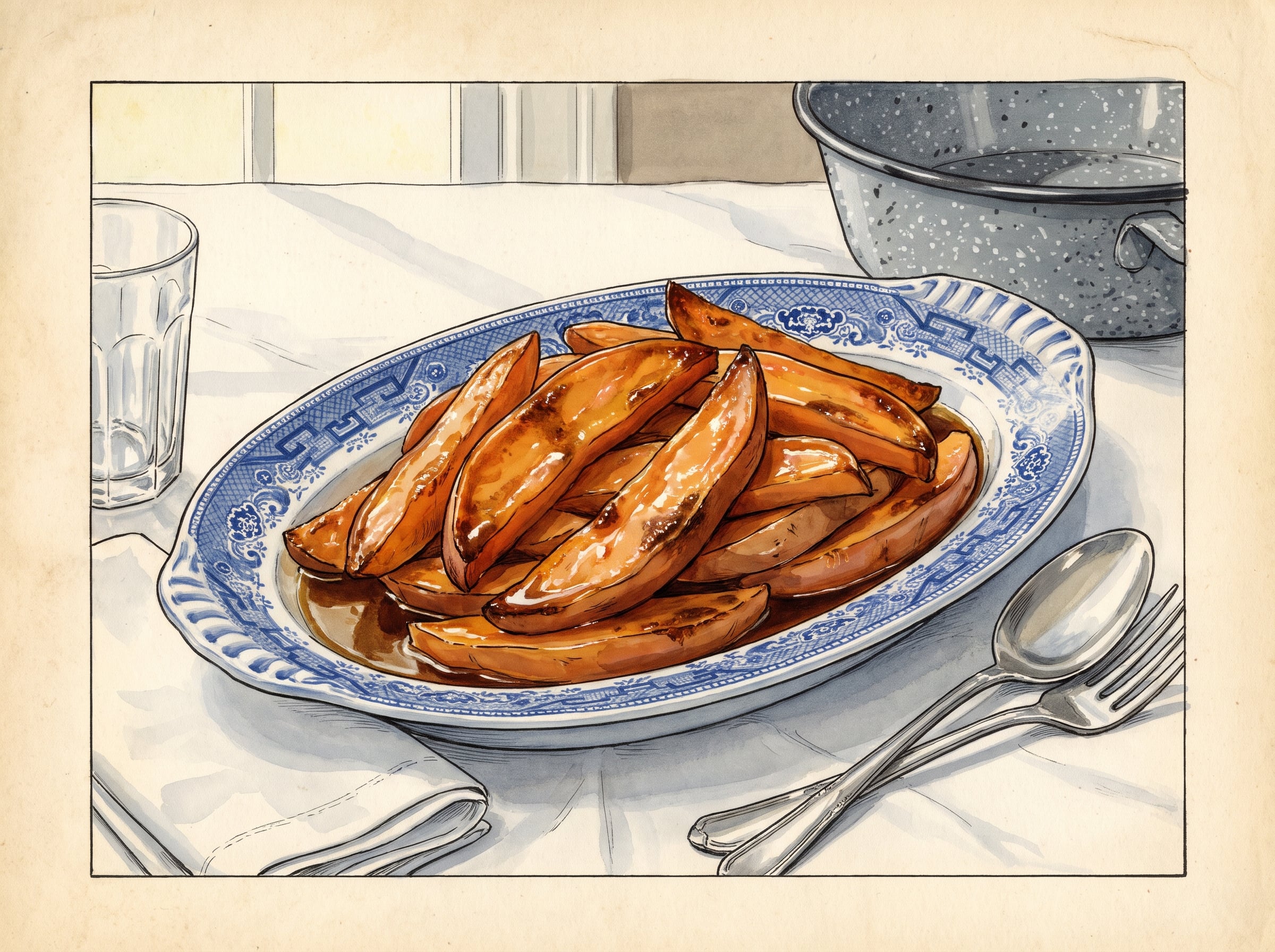
This recipe for candied sweet potatoes assumes you own a box with no fire in it. It comes from a 1917 cookbook told as the story of two newlyweds, written when kitchens were counting their fuel and candied sweet potatoes were becoming a holiday regular.
Please note that some of the images in this article were created with the assistance of AI.
From A Thousand Ways to Please a Husband with Bettina’s Best Recipes, 1917
The Story Behind This Recipe
Bettina, Bob, and a box that cooks while nobody watches
In Bettina’s house, dinner is often already done. In several scenes of A Thousand Ways to Please a Husband with Bettina’s Best Recipes, the meal turns out to have been sitting quietly in her fireless cooker all along. She says she uses the gadget a great deal. Bettina and her husband Bob are newlyweds setting up their first home, and the recipes come tucked inside short scenes from her days.
Behind Bettina were two real women, Louise Bennett Weaver and Helen Cowles LeCron, who wrote the book together in 1917. Elizabeth Colbourne drew the illustrations. The pair went on to write more Bettina books on cakes and cookies, salads, and desserts. The record we found says little about either author beyond those books, so we won’t invent lives for them. The mood of the pages is easier to read. One modern reviewer notes that economy runs through the whole thing, which fits a book published the year the United States entered World War I.
Five thousand years to reach the brown sugar
The sweet potato is thought to come from tropical South America, where people have eaten it for more than 5,000 years. By 1648 it was growing in what is now Virginia, and it went on to become a staple of the South. Along the way it picked up a name it never earned. Orange-fleshed sweet potatoes often get called "yams," but true yams belong to a different plant group altogether.
Nobody knows exactly how the sweet potato landed on the Thanksgiving table. Sarah Josepha Hale, who campaigned to make Thanksgiving a national holiday, often gets some of the credit. The cookbooks leave a clearer trail. Fannie Farmer’s Boston Cooking-School Cook Book printed glazed sweet potatoes in 1896, and by the early 1900s candied versions were common across the country. Bettina’s recipe sits right in that current: sliced potatoes in a brown sugar and butter syrup, with one unexpected touch, a sprinkle of salt and pepper before the syrup goes on.
Stored heat, and a shelf full of marshmallows
By 1917 the fireless cooker was an old idea. A felt-lined wooden box sold as the "Norwegian automatic kitchen" was shown at the Paris Exposition of 1867, and in the 1910s the U.S. Department of Agriculture urged homemakers to use one. The trick was stored heat. Food got hot on the stove first, then went into an insulated box to keep cooking, with heated soapstone or metal plates set below and above the pot. Bettina follows the routine exactly: boil the syrup five minutes, then bring out the hot disks and leave everything shut for an hour and a half. Some cookers were factory-made in the Midwest. One was the Thermator, built by National Manufacturing Company of College View, Nebraska, a firm founded around 1917. Once modern stoves and electric appliances arrived, the boxes faded and cookbooks dropped their directions.
The timing is worth a second look. In 1917, the year the book came out, a marshmallow company hired Janet McKenzie Hill, founder of the Boston Cooking School Magazine, to write recipes that would sell more marshmallows. One of them topped mashed sweet potatoes with marshmallows, and today’s casserole grew from it. Bettina’s potatoes wear nothing but syrup, and not for lack of supplies. A reviewer notes she keeps three packages of marshmallows on her emergency shelf, more than she keeps of macaroni. Her dish catches candied sweet potatoes just before the marshmallow moved in.
1910s
What Our Readers Say
- When Piaci Pizza readers loved a food photo and tapped a reason, comfort was the top pick at 30%, and nostalgia was chosen 16% of the time.
From Piaci Pizza reader polls and votes.
Notes From the Era
The recipe · 1917
Fireless Sweet Potatoes (Candied)
From A Thousand Ways to Please a Husband with Bettina’s Best Recipes by Louise Bennett Weaver and Helen Cowles LeCron (1917). Every word of the recipe below is as printed.
Ingredients
- 6 large sweet potatoes
- 1 C-brown sugar
- 1/4 C-water
- 1 t-salt
- 1/4 t-pepper
- 1 T-butter
Method
-
Peel and slice the potatoes
Wash and peel the sweet potatoes. Slice them lengthwise in one-half inch slices.
-
Make the butter syrup
Make a syrup by boiling for five minutes the brown sugar and water. Add the butter.
-
Season and add the syrup
Arrange the potatoes in a fireless cooker utensil. Sprinkle with salt and pepper, and pour the syrup over them.
-
Cook in the fireless cooker
Place the heated disks under and over the pan of potatoes, and cook in the fireless an hour and a half.
Our notes
Reading It Today
C, t and T. The abbreviations are standard. C is a cup, t is a teaspoon, and T is a tablespoon. So the syrup is one cup of brown sugar and a quarter cup of water, finished with one tablespoon of butter. The seasoning is one teaspoon of salt and a quarter teaspoon of pepper.
"The fireless" and its disks. "The fireless" is shorthand for the fireless cooker, the insulated box Bettina relies on. The "heated disks" are its heat-storing plates, usually soapstone or metal. They were heated and set under and over the pan before the lid was closed. The small amount of water fits USDA advice of the time, which said fireless-cooker recipes need less liquid because nothing can evaporate inside the closed box.
What the dish would be like. Judging from the ingredients, these would be thick, half-inch slices cooked soft in a sweet brown sugar syrup. One tablespoon of butter spread over six large potatoes makes for a lean glaze. Because the box is sealed, the syrup would likely stay loose instead of cooking down to a sticky coat. The salt and pepper would give the sweetness a savory edge.
Next to today’s version. Today’s familiar holiday casserole grew from mashed sweet potatoes topped with marshmallows. Bettina’s potatoes stay in slices and have no topping and no warm spices like cinnamon. Their only seasoning besides the sugar is salt and pepper.
Source: Louise Bennett Weaver and Helen Cowles LeCron, A Thousand Ways to Please a Husband with Bettina’s Best Recipes (Britton Publishing Company, New York, 1917). Read the 1917 book at Project Gutenberg.
Sources for the history
- A Thousand Ways to Please a Husband with Bettina’s Best Recipes (Weaver and LeCron, 1917)
- Weaver & LeCron, American Literature
- Book Review: A Thousand Ways to Please a Husband, Letters from Tre Kronor
- Fireless Cookers, USDA National Agricultural Library
- The 20th Century chest that can cook, History Nebraska
- Sweet Potato: A Thanksgiving Tradition, University of Missouri Integrated Pest Management
- Candied Yams: Boston’s role, Boston Magazine
The original recipe text is from a work published in 1917 and is in the public domain in the United States. The history, notes and illustrations are Piaci Pizza’s own. Brand names that appear in historic recipes are mentioned as historical fact only. Illustrations are AI-generated in a vintage style. The recipe is shown exactly as it was published in 1917; we have not photographed a test batch.