
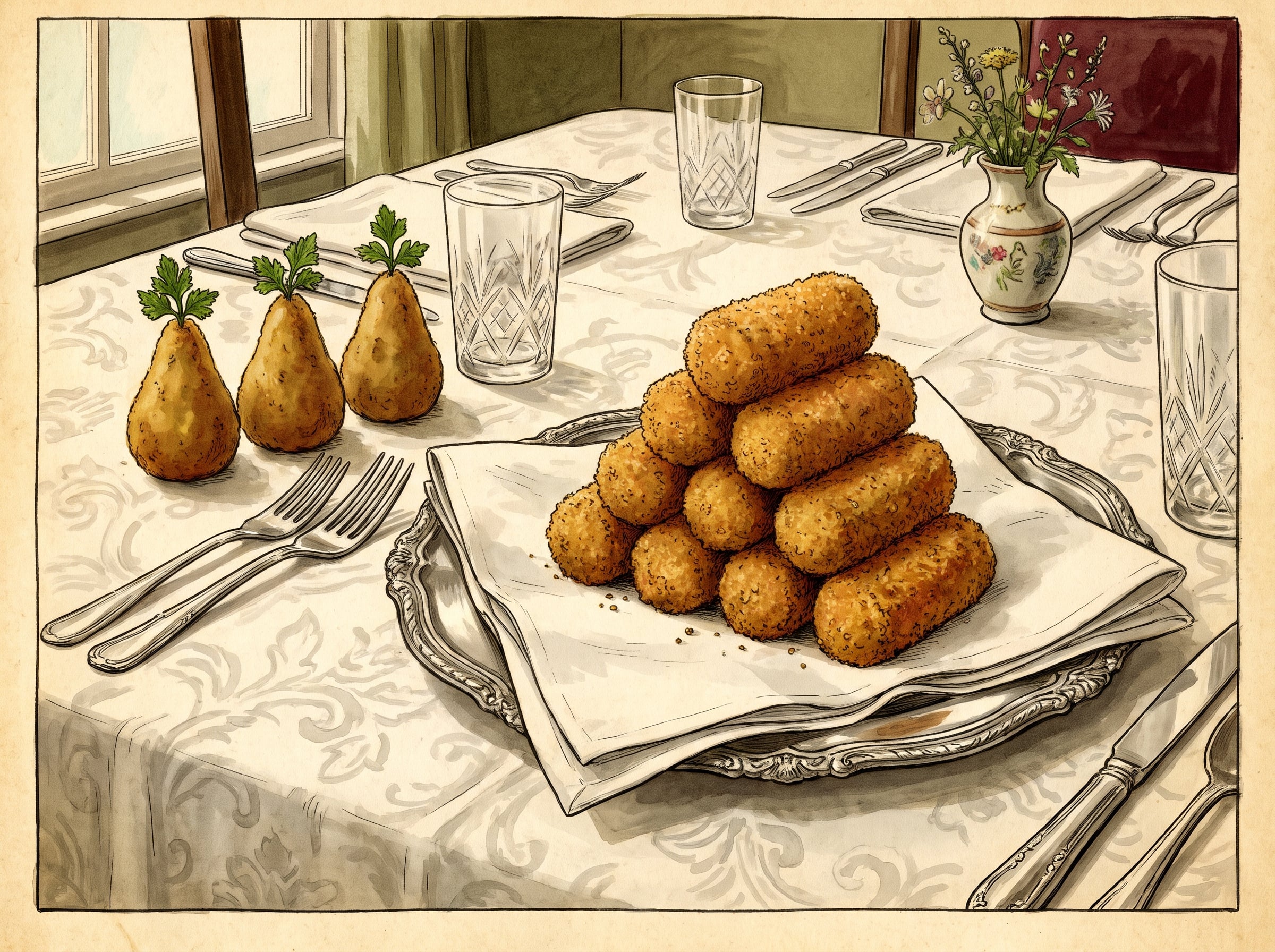
The man who wrote this recipe ran the kitchen of one of San Francisco’s grandest hotels in a red fez and named dishes after himself. Yet his sweet potato croquettes ask for little more than potatoes, butter, egg yolks and bread crumbs. The fun is in the shaping, the serving and one stubborn little mystery about the name.
Please note that some of the images in this article were created with the assistance of AI.
From The Hotel St. Francis Cook Book, 1919
The Story Behind This Recipe
A chef in a red fez
Victor Hirtzler was hard to miss. He had a pointed beard, a thick French accent, a red fez and a habit of naming dishes after himself. Celery Victor is the one people still remember. Born around 1875 in Strasbourg, he trained at the Grand Hotel in Paris and is said to have cooked for Czar Nicholas II and for Carlos I of Portugal. He then worked at Sherry’s and the Waldorf in New York before arriving in San Francisco in 1904 to run the food at the new St. Francis Hotel on Union Square. The hotel had been built by the estate of Charles Crocker, whose heirs pictured the city as a ‘Paris of the West.’ Its frame survived the 1906 earthquake, but the fire that followed gutted the inside, and it reopened in late 1907. By 1913 it had 1,000 rooms at $2.00 a day and up, and its guests included Woodrow Wilson, Theodore Roosevelt and Charlie Chaplin. Hirtzler stayed as head chef until 1926.
Starting in 1910, he wrote cookbooks that doubled as advertising for the hotel and for himself. They were laid out as menus of several courses for three meals a day, every day of the year. The 1919 Hotel St. Francis Cook Book, published in Chicago by the Hotel Monthly Press, is the best known. His first version, L’Art Culinaire, was written in a clipped style, in the manner of Escoffier, whom he considered a rival. Soup stocks are made ‘in the usual way,’ and that is all the instruction you get. The book assumes you already know how to cook, and this recipe, only a few lines long, has the same terse approach.
Born to crunch
Croquette comes from the French croquer, ‘to crunch,’ which neatly states the goal. In the 17th century, François Massialot bound meat, truffles, marrow, bread crumbs and cheese with egg, breaded the mixture and fried it in lard. Bind with egg, bread, fry in lard: that is the same basic method Hirtzler uses. The thick-binder croquette most of us picture today appears in 1822, in an English cookbook by the French cook Louis Eustache Ude.
Hirtzler skips the meat and sauce entirely and builds his croquettes on a mash of potato, butter and egg yolk. The heading says sweet potato, and the text simply says ‘four large potatoes,’ trusting the cook to read it in context. We’ve left it as written.
Pears, parsley and a puzzle
Then comes the flourish. Shape the same mixture like a small pear, stand it pointed end up on a napkin, stick a sprig of parsley in the top, and it becomes ‘Palestine potatoes.’ The name is a small mystery. ‘Palestine’ in a dish name usually signaled Jerusalem artichokes, as in Palestine soup, which turns up in cookbooks from the early 1900s. There are none here, and Hirtzler doesn’t explain himself.
The rest of the recipe belongs to its era. Croquettes were popular enough in the 1800s that special croquette fryers were advertised, and the Ebenezer Maxwell Mansion museum shows a 19th-century ad for one. The potatoes go through a sieve, which gave a smooth mash that could hold a neat cork or pear shape in hot fat. Both versions end on a napkin, a bit of display that suits a chef known for his flair for presentation.
1910s
Notes From the Era
The recipe · 1919
What Our Readers Say
- When Piaci Pizza readers loved a food photo and tapped a reason, comfort came out on top at 30%, with ingredients and nostalgia close behind.
From Piaci Pizza reader polls and votes.
Sweet Potato Croquettes
From The Hotel St. Francis Cook Book by Victor Hirtzler (1919). Every word of the recipe below is as printed.
Ingredients
- four large potatoes
- salt water
- two ounces of butter
- the yolks of three eggs
- salt and pepper
- flour
- beaten eggs
- bread crumbs
- very hot swimming lard
- a sprig of parsley
Method
-
Boil and sieve the potatoes
Boil four large potatoes in salt water, when soft, peel, and pass through a sieve.
-
Mix with butter and yolks
Then put in a casserole, add two ounces of butter, the yolks of three eggs, season with salt and pepper, and mix well.
-
Shape, coat and fry
When cold, roll in flour, shape in the form of a large cork, then roll in beaten eggs and bread crumbs, and fry in very hot swimming lard.
-
Serve
When nice and brown serve on a napkin.
-
Palestine potatoes variation
Palestine potatoes. Sweet potato croquettes formed in the shape of a small pear. When fried, dress on a napkin with the pointed end up, and stick a sprig of parsley in the top.
Our notes
Reading It Today
Swimming lard. This means deep-frying: enough hot fat for the croquettes to float rather than sit on the bottom of the pan. ‘Very hot’ is all the recipe says about the temperature.
Casserole and ounces. Here the casserole is simply the pot where the mash, butter and yolks are mixed. Two ounces of butter is 4 tablespoons, or half a stick. Everything else is counted, not measured.
What it would be like. Judging from the ingredients, picture a crisp, golden crumb shell around a soft, rich center. The butter and three yolks make the mash dense and smooth, and salt and pepper are the only seasonings. The shape of a large cork means a short, plump cylinder.
Not the usual holiday sweet potato. Many sweet potato sides today lean on brown sugar, marshmallows or cinnamon. This one has no sugar or spice at all. Made with sweet potatoes, the sweetness would come only from the vegetable itself.
Source: Victor Hirtzler, The Hotel St. Francis Cook Book (The Hotel Monthly Press, Chicago, 1919). Read the 1919 book at Project Gutenberg.
Sources for the history
The original recipe text is from a work published in 1919 and is in the public domain in the United States. The history, notes and illustrations are Piaci Pizza’s own. Brand names that appear in historic recipes are mentioned as historical fact only. Illustrations are AI-generated in a vintage style. The recipe is shown exactly as it was published in 1919; we have not photographed a test batch.