
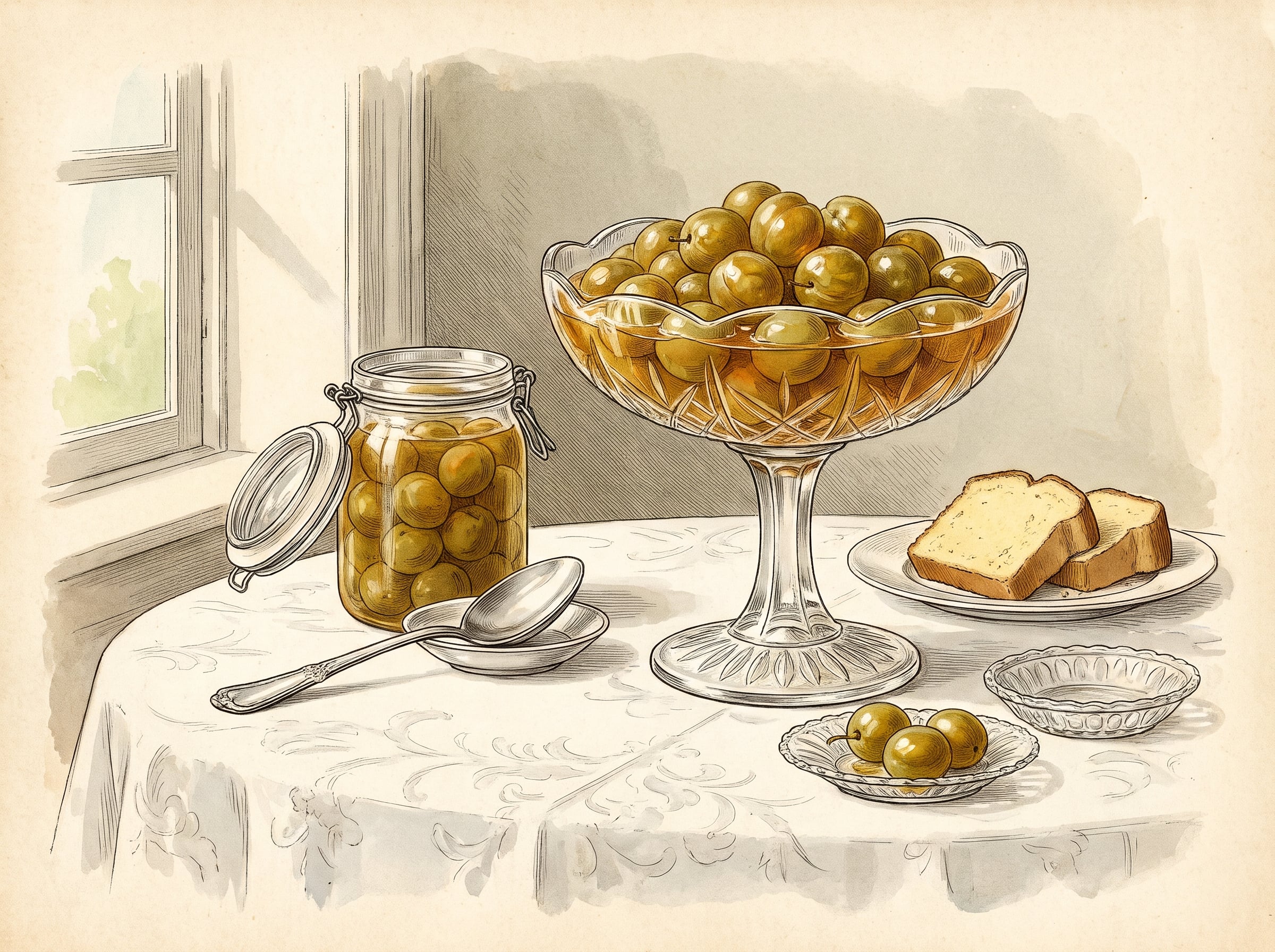
Maria Parloa wanted farm families to have fruit in the lean months, and she wanted every jar free of germs. This greengage preserve comes from a 32-page government pamphlet she wrote near the end of her career. It is one of the richest recipes in it: whole green plums in a very heavy syrup, which she meant for special occasions.
Please note that some of the images in this article were created with the assistance of AI.
From Canned Fruit, Preserves, and Jellies: Household Methods of Preparation, 1904
The Story Behind This Recipe
A cooking teacher, a church organ and a farm pamphlet
Parloa’s teaching career began with a fundraiser. In 1876 she gave a lecture on cooking in New London, Connecticut, to help buy an organ for a Sunday school. By then she had already worked her way through private kitchens and hotels, including a stint as pastry chef at the Appledore Island summer resort off the coast of Maine and New Hampshire, and had published The Appledore Cook Book in 1872. She was born in Massachusetts in 1843 and orphaned young. After the lecture she became one of the first instructors at the Boston Cooking School in 1879. In 1883 she opened her own school in New York, with free evening classes for immigrant girls. She also wrote for the Ladies’ Home Journal and became an editor and part owner. In 1899 she joined the Lake Placid group that set out to make home economics a profession.
Among her last works were two Farmers’ Bulletins for the Department of Agriculture. This one, No. 203, appeared in 1904. Her case was practical: fruit mattered most on farms far from markets, so families should can enough in season to last through the months when fruit was scarce. She even explained how to sell extra preserves to city grocers, and warned that the commission would probably take 20 percent. The government was still reprinting the bulletin in 1917. Our scan is a 1917 commercial edition from Saalfield, which is why the recipe falls on page 69 there and on page 22 in the government printing. When Parloa died in Bethel, Connecticut, in 1909, the $2,000 she left the town helped open its first public library.
A queen’s plum with a gardener’s name
The greengage started out with a crown. Its original name is Reine Claude, after Queen Claude, wife of Francis I of France. The English name comes from the Gage family of Hengrave Hall in Suffolk, though accounts differ on which Gage brought the tree over. Britain’s National Fruit Collection says Sir Thomas. Another account says Sir William Gage, 2nd Baronet, who brought it from Paris.
The best version involves a lost label. In a story traced to the fruit historian Frederick A. Roach, the tag fell off during shipping, so the gardener named the plum after its color and his employer’s family. Roach also suspected the fruit had reached England by 1688 under an Italian name. Parloa kept the two words apart: ‘green gages.’
Sugar, germs and darning needles
Not long before Parloa wrote, people blamed spoiled fruit on the oxygen in the air. Pasteur and others had shown that bacteria and other tiny organisms were the real cause. Her bulletin is built around that discovery: sterilize the fruit, the jars and every utensil. She usually preferred canning fruit with only a little sugar. She called rich preserves ‘only desirable for occasional use’ and suggested putting them up in small jars or tumblers.
This recipe is one of the rich ones. Its syrup is the heaviest on her chart, the strength she gave strawberries and cherries, while plums elsewhere got lighter syrups. Pricking keeps the plums from bursting, and she had a home-made gadget for the job: a dozen or more coarse darning needles pushed through a slice of cork, tacked to a board, with the fruit struck against it. California prune curers, she noted, had given up pricking machines because the steel needles broke off in the fruit.
1900s
Notes From the Era
The recipe · 1904
Plum Preserve
From Canned Fruit, Preserves, and Jellies: Household Methods of Preparation by Maria Parloa (1904). Every word of the recipe below is as printed.
Ingredients
- 4 quarts of green gages
- 2 quarts of sugar
- 1 pint of water.
- Filling hot jars without processing them (open-kettle canning) is no longer considered safe. Process filled jars in a boiling-water canner using a current tested recipe for timing.
Method
-
Prick the plums
Prick the fruit and put it in a preserving kettle.
-
Scald and drain
Cover generously with cold water. Heat to the boiling point and boil gently for five minutes. Drain well.
-
Make and skim the syrup
Put the sugar and water in a preserving kettle and stir over the fire until the sugar is dissolved. Boil five minutes, skimming well.
-
Cook the plums in the syrup
Put the drained green gages in this sirup and cook gently for twenty minutes.
-
Fill the jars
Put in sterilized jars.
-
Other plums
Other plums may be preserved in the same manner. The skins should be removed from white plums.
Our notes
Reading It Today
Quarts, pints and a gill. Read as standard US kitchen measures, a quart is 4 cups and a pint is 2 cups, so the recipe calls for 16 cups of greengages, 8 cups of sugar and 2 cups of water. Parloa gave everything by volume because many housekeepers did not own scales. Her syrup chart also uses gills. A gill is a quarter of a pint, or half a cup (4 fl oz).
Sirup, and a lot of it. ‘Sirup’ is simply an older spelling of syrup. The proportions are four parts sugar to one part water, so this is a very dense syrup. It is the same strength as her chart’s ‘one pint of sugar to one gill of water.’
What to expect in the jar. Judging from the ingredients, this is a whole-fruit preserve, not a spreadable jam. The plums stay whole with their skins on, softened by a quick boil in water and then twenty minutes in syrup. The result would be very sweet, with the fruit sitting in thick syrup. The last line extends the method to other plums, but white plums are to be peeled first.
How it differs from canning today. The recipe ends with putting the hot preserve into sterilized jars. Current tested home-canning guidance also calls for processing filled jars in a boiling-water bath. Treat this as a historical recipe rather than a safety-tested method, and follow a modern tested guide if you put up plums yourself.
Source: Maria Parloa, Canned Fruit, Preserves, and Jellies: Household Methods of Preparation (U.S. Department of Agriculture, Washington, D.C., 1904), p. 69. Read the 1904 book at the Internet Archive.
Sources for the history
- Maria Parloa, Canned Fruit, Preserves, and Jellies (Internet Archive scan, University of California Libraries)
- Full text of the scanned copy (Saalfield edition, p. 69 recipe)
- Project Gutenberg: Farmers’ Bulletin No. 203 (GPO 1917 printing)
- Internet Archive: Farmers’ Bulletin no. 203 (National Agricultural Library copy)
- National Agricultural Library, How Did We Can? exhibit item
- Bethel Public Library: Maria Parloa
- National Fruit Collection (UK): Reine Claude
- Wikipedia: Sir William Gage, 2nd Baronet
- CooksInfo: Greengage Plums
The original recipe text is from a work published in 1904 and is in the public domain in the United States. The history, notes and illustrations are Piaci Pizza’s own. Brand names that appear in historic recipes are mentioned as historical fact only. Illustrations are AI-generated in a vintage style. The recipe is shown exactly as it was published in 1904; we have not photographed a test batch.