Would you like to save this?
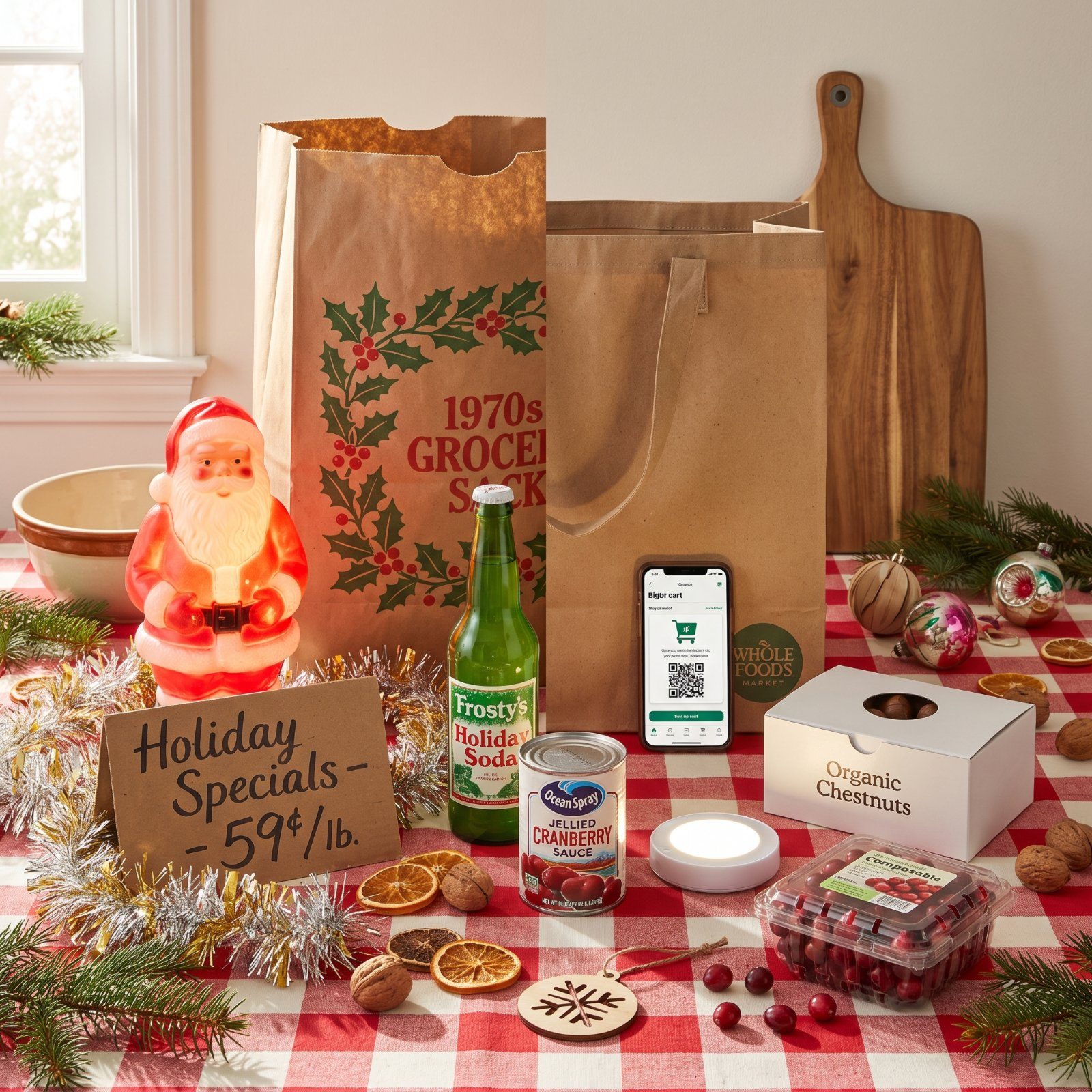
Most stores didn’t have automatic doors yet. You shouldered them open with your arms full, and the smell hit all at once: pine boughs stapled over the produce, the bakery running full tilt, that faint metallic cold off the freezer aisle. A plastic Santa glowed in the window. The cashier knew your last name. We lined up the pieces of the Christmas grocery run and photographed each one twice, then and now. Some things got better. Some we quietly miss.
50. Storefronts: Glowing Plastic Santas vs. Minimalist LED Branding
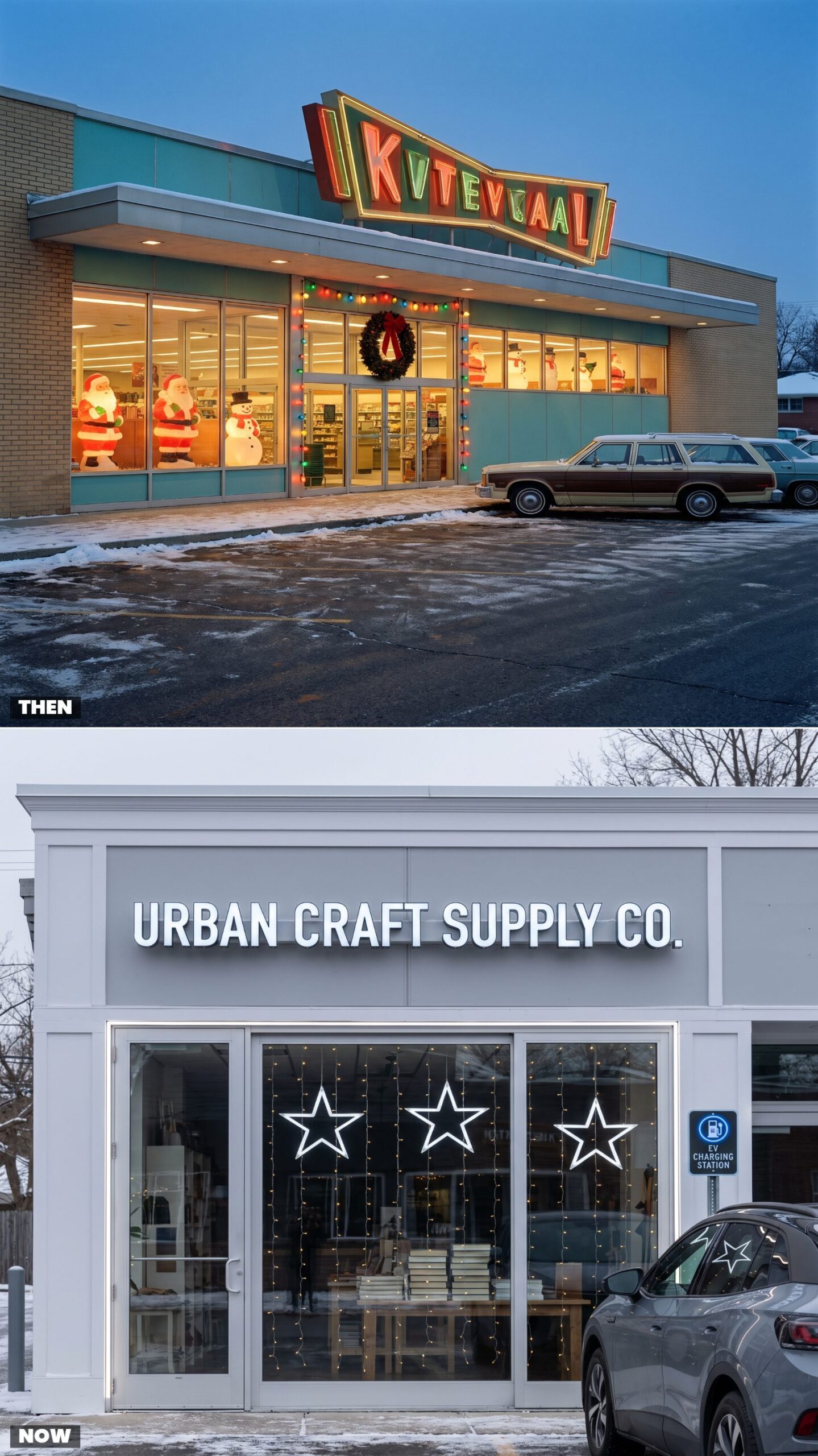
The 1970 storefront wanted your attention like a kid on Christmas morning. Plastic Santas the size of a toddler, glowing orange from a single bulb inside, propped right in the window, big fat C9 bulbs strung crooked around the door. It looked handmade because half of it was.
Now the same building whispers. Cool white channel letters, a couple of lit stars evenly spaced, nothing out of line. It photographs beautifully and stirs nothing. I miss the Santas. There, I said it.
49. Front Windows: Hand-Painted Christmas Scenes vs. Printed Promotional Graphics
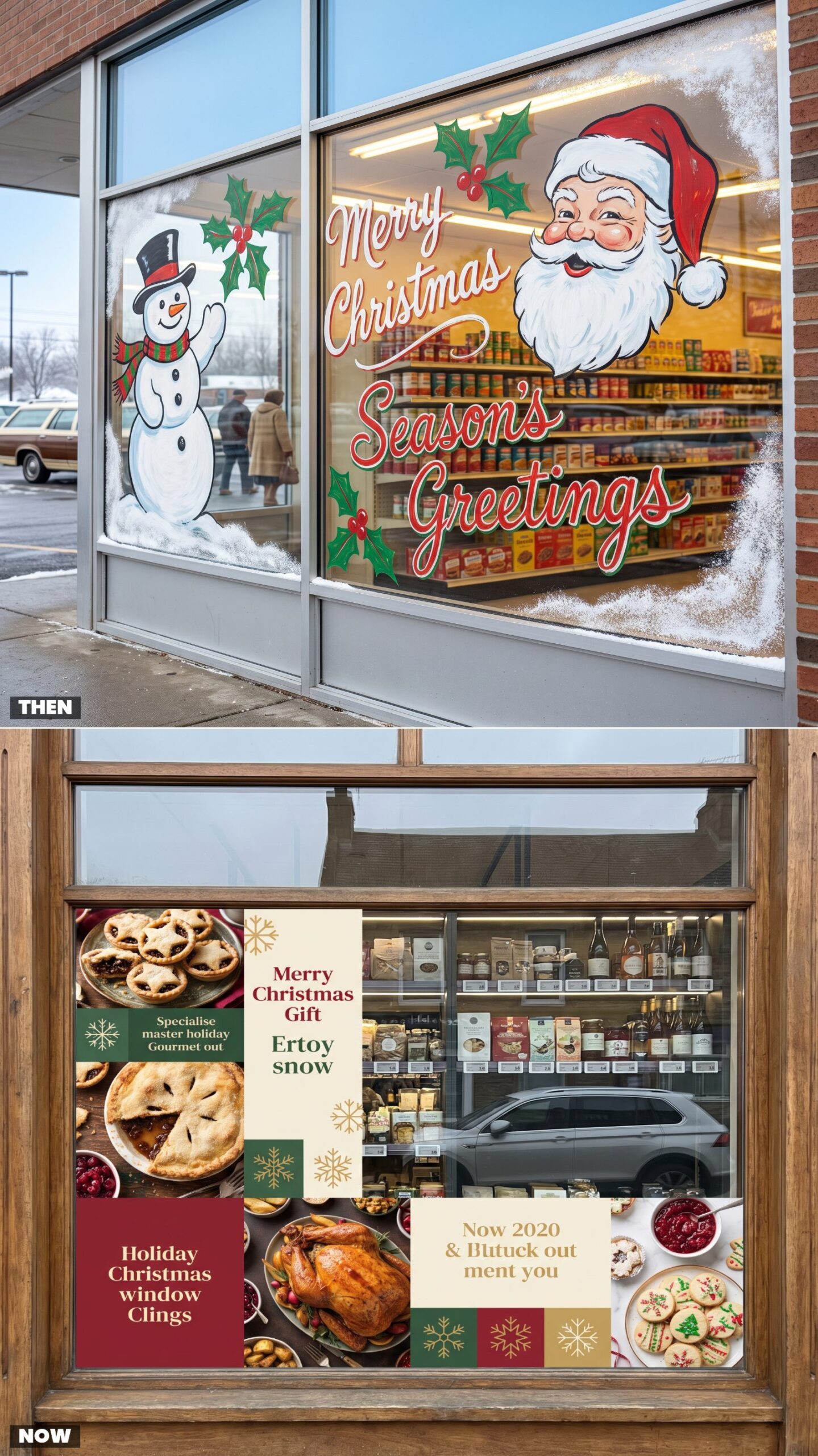
Somebody in 1970 stood on a stepladder with a bucket of tempera and painted that snowman freehand, and you could see it. The Santa’s eyes ran a little uneven. The greeting curved because the person’s arm curved. That window had a human hand all over it.
Today the window wears a printed cling that arrived rolled in a tube from a regional office. The snowflakes are mathematically perfect. Nobody at the store painted anything, and it shows.
48. Parking Lots: Wood-Paneled Station Wagons vs. Pickup Spaces and EV Chargers
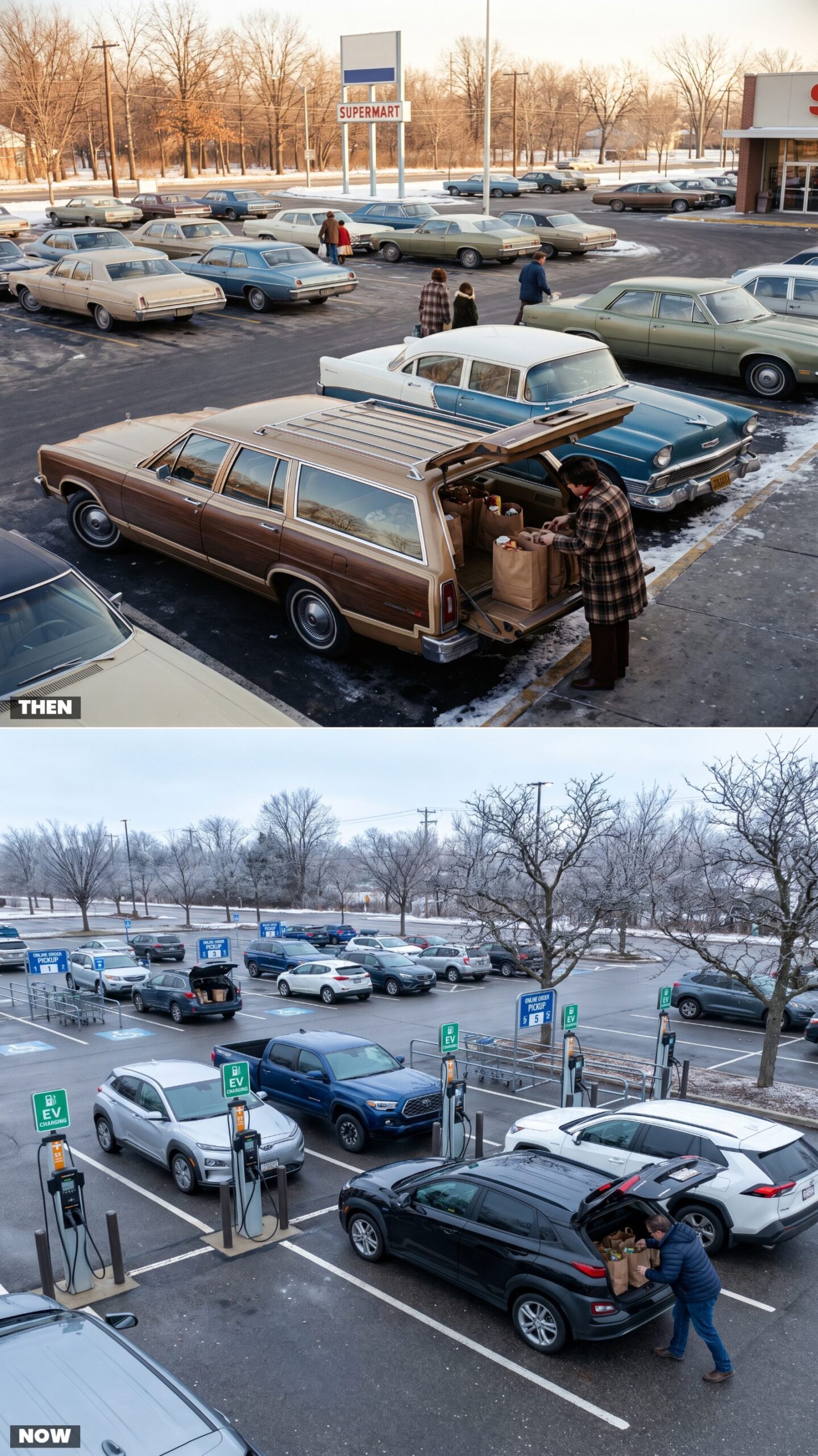
The 1970 lot was a car show nobody organized. Faux-wood Country Squires, two-tone sedans, tailgates dropped, brown paper sacks going in the back one at a time. You loaded your own bags, or a bag boy did it and you tipped him a quarter.
Now whole rows belong to cars that aren’t shopping. EV chargers hum along one edge. Numbered pickup spots wait for people who already paid on their phones and never came inside. The lot got quieter, and stranger.
47. Entrance Doors: Manual Glass Doors vs. Motion Sensors and Security Gates
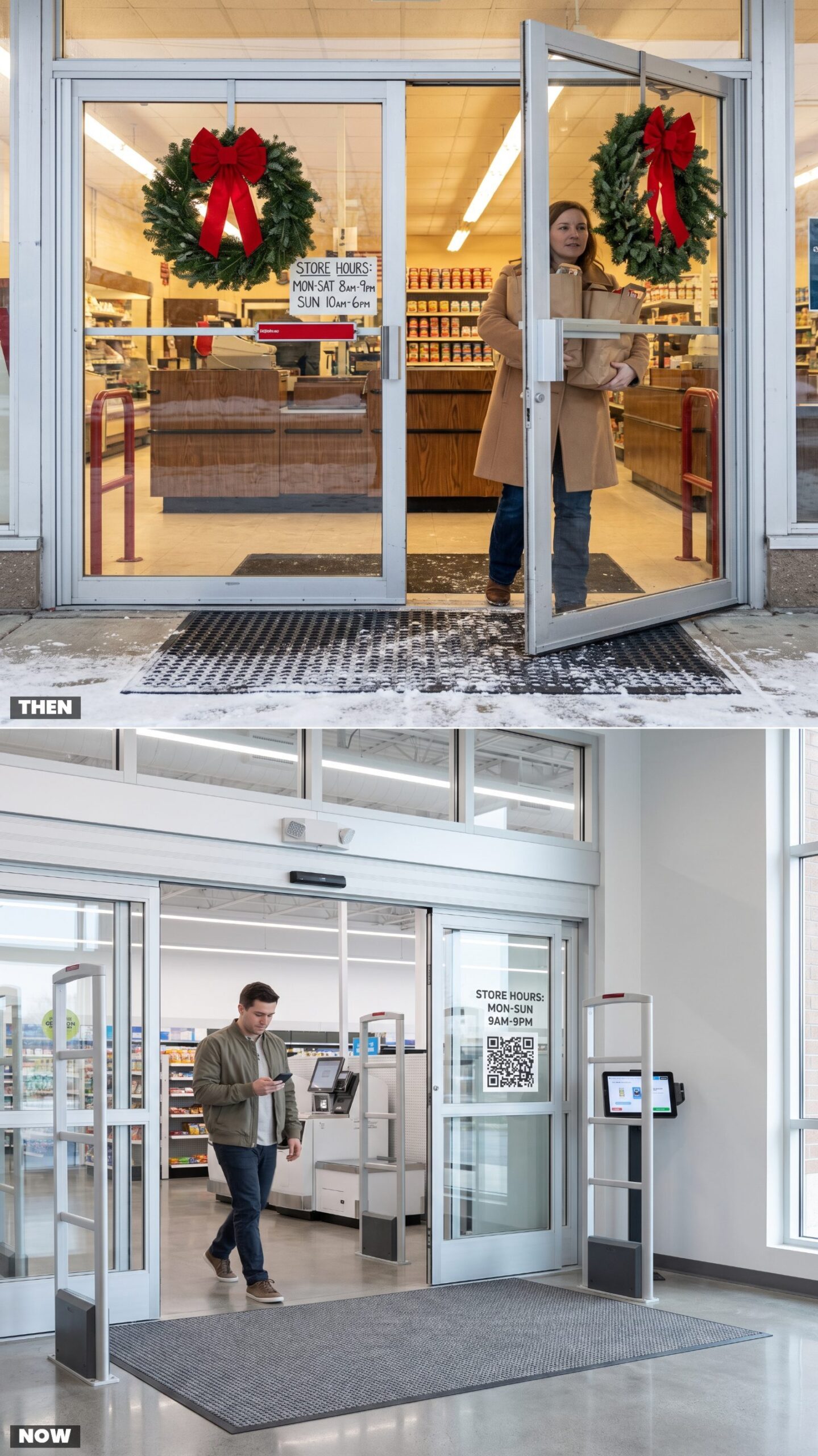
You opened the door yourself in 1970. Shoulder, hip, whatever was free, because your arms were full of paper bags with no handles. The push bar was cold aluminum and a wreath swung on it every time somebody came through.
The doors open for you now before you reach them, which is genuinely nice. Then you pass between two security gates that beep when the register forgot to deactivate something, and a small screen tries to sell you app coupons on the way in. Convenience arrived. So did the surveillance.
46. Holiday Hours: Hand-Lettered Poster Board vs. App and QR-Code Notices
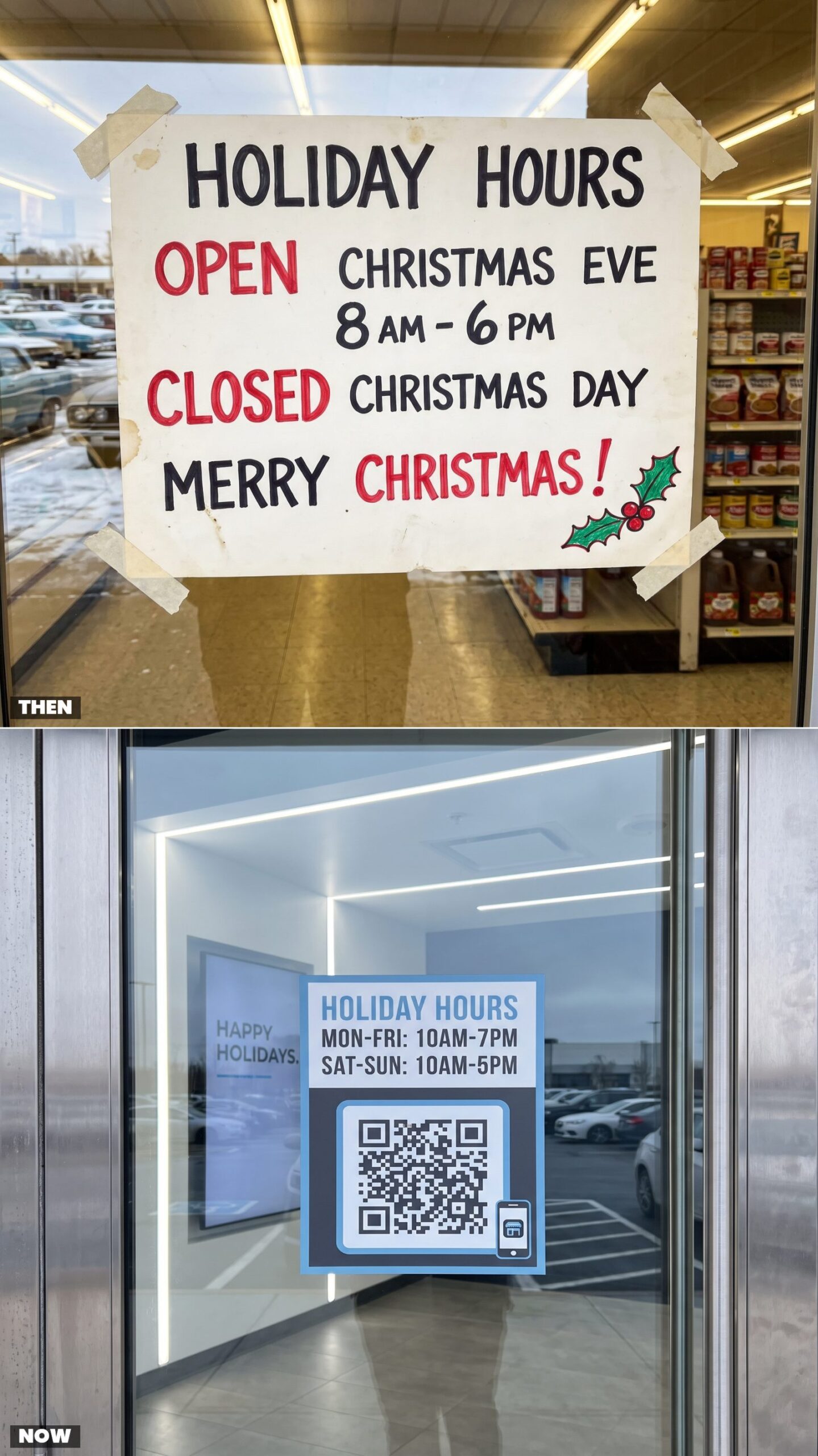
Christmas hours in 1970 got written by whoever had decent handwriting. Marker on poster board, a little holly doodle in the corner, four strips of masking tape. If they closed at noon Christmas Eve, that’s what the sign said, and that was the whole system.
Now the hours live in an app, on a QR code, and on a decal so clean it looks legal. You scan a square to learn whether a store is open. We used to just read a sign and go home.
45. Store Vestibules: Community Bulletin Boards vs. Pickup Lockers
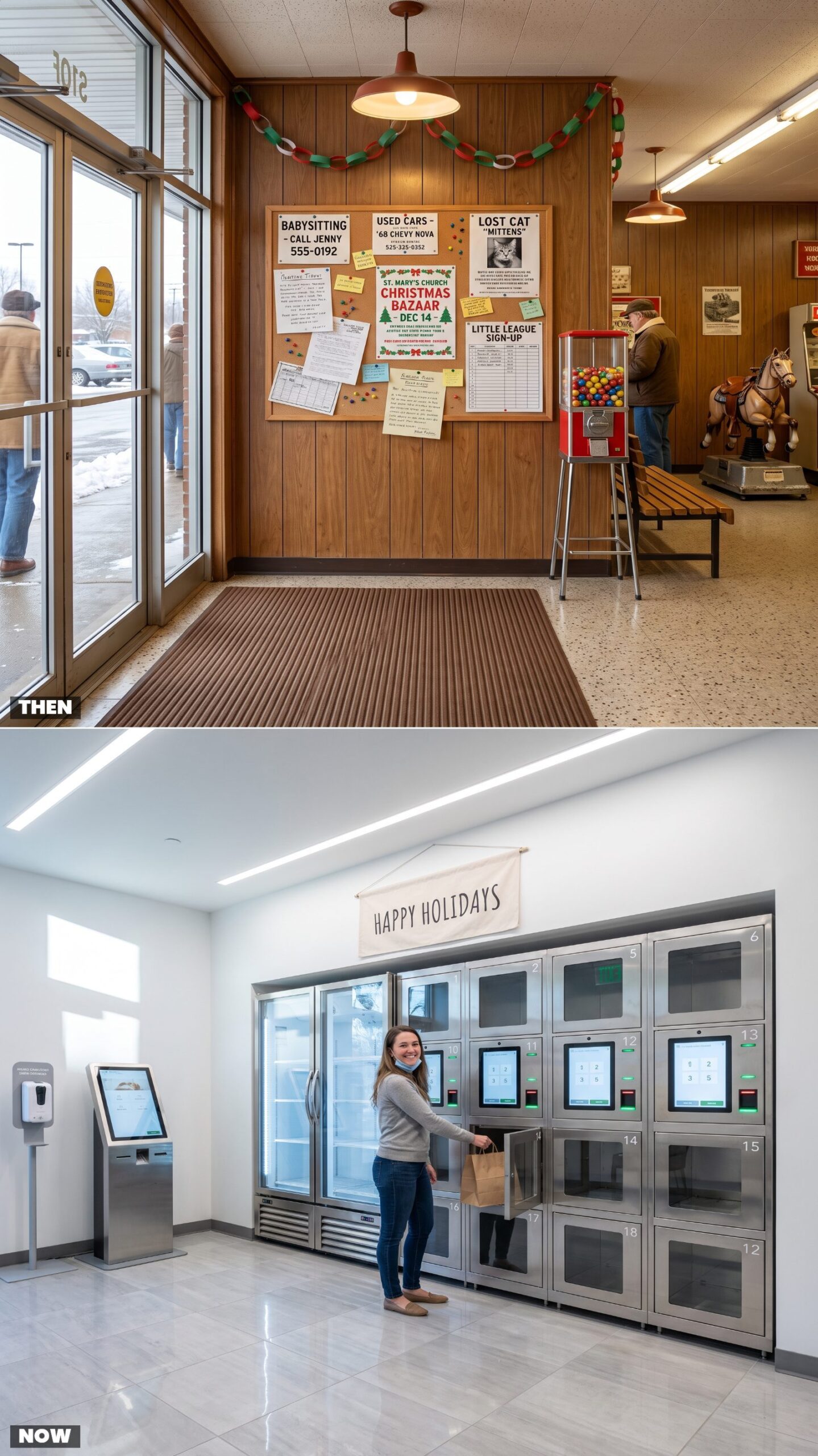
The vestibule was the town square you didn’t know you had. Cork board packed three notices deep: babysitting, a used snowblower, the church bazaar, somebody’s lost cat. You read it while you waited for your ride, and the gumball machine and the mechanical horse stood guard.
That wall belongs to lockers now. Refrigerated cubbies with little green lights, holding bags for people who ordered from the couch. It’s efficient. It doesn’t know anybody’s cat is missing.
The bulletin board was the neighborhood’s group chat, printed on index cards and stuck up with pushpins.
44. Ceiling Decorations: Foil Bells and Tinsel Garlands vs. Suspended Branded Banners
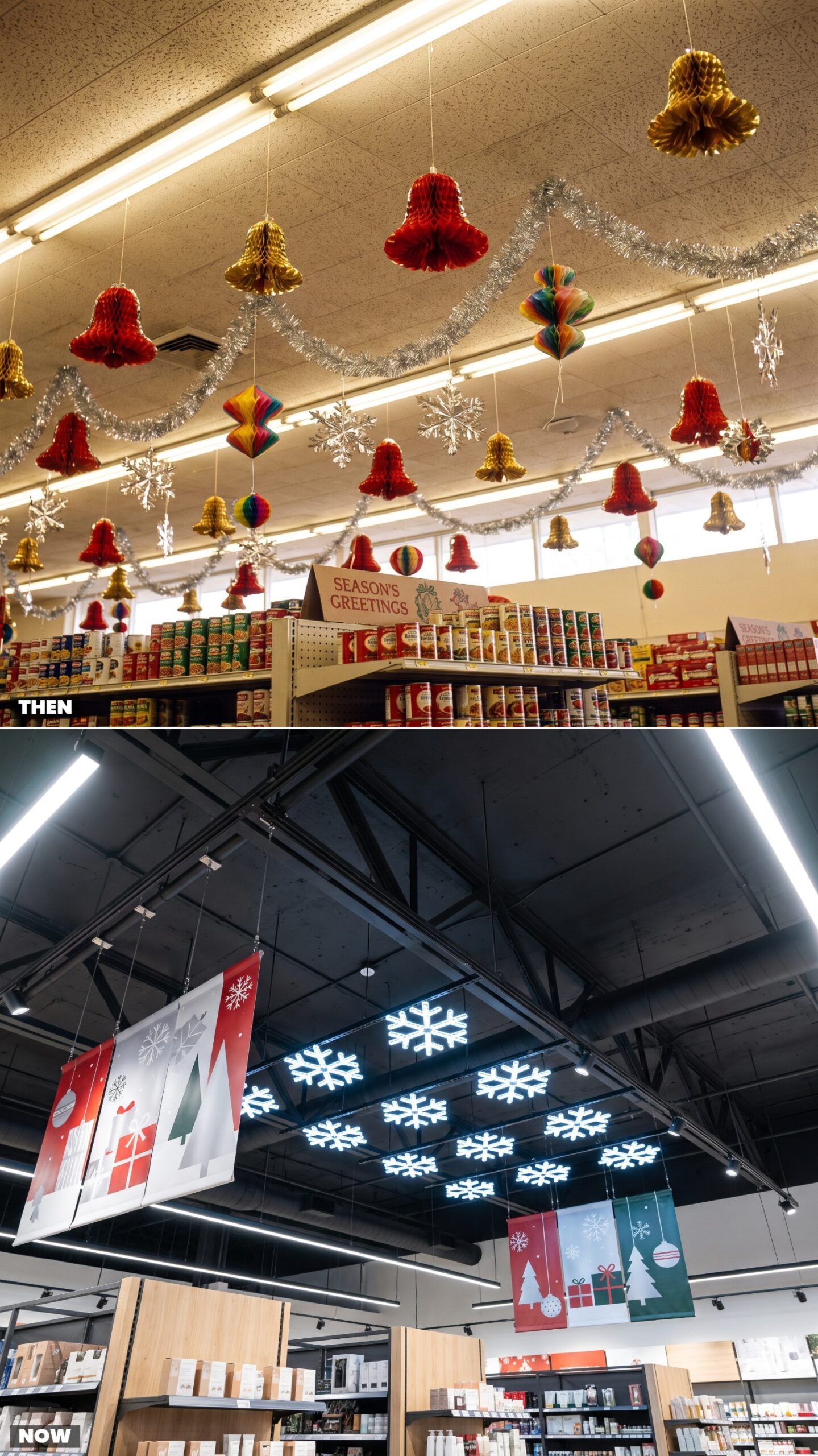
Look up in 1970 and the ceiling was working overtime. Honeycomb foil bells, tinsel garland strung fixture to fixture, foil snowflakes turning slowly in the heater draft. It sagged in the middle because a human on a ladder hung it, and a human on a ladder gets tired.
Now the ceiling holds printed vinyl banners on steel cables, aligned to the inch. Pre-lit snowflakes in a grid. It’s crisp. It’s also identical in every store in the chain, which is sort of the opposite of festive.
43. Christmas Shoppers: Dress Coats and Bouffants vs. Athleisure and Smartphones
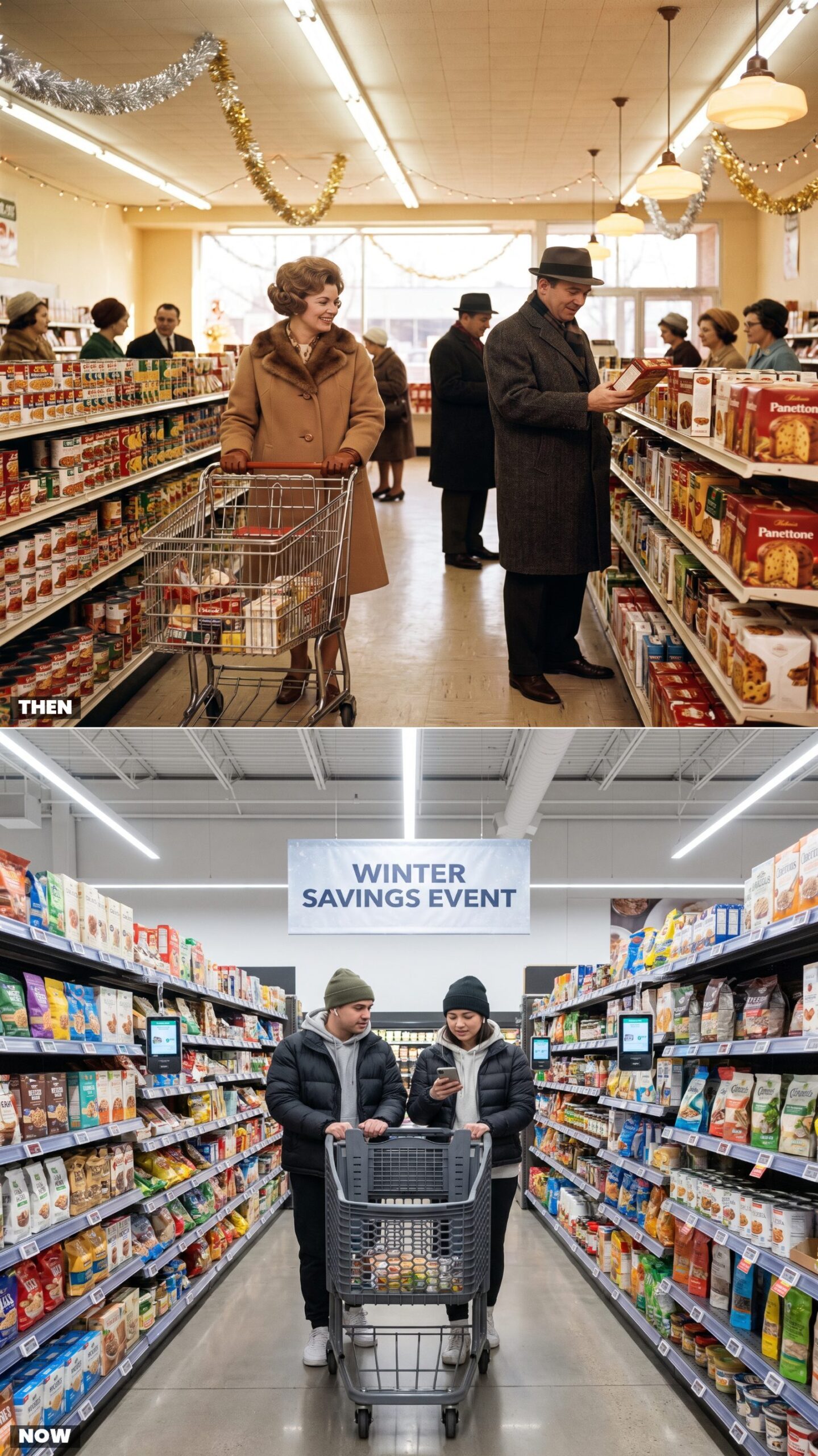
People got dressed to buy groceries in 1970. A wool coat, gloves, hair set the day before, because you might see somebody you knew, and you would. The Christmas run was a small public event, and everybody understood the dress code without anyone stating it.
The aisle today runs on leggings and puffer jackets, one earbud in, eyes down on a phone list. Nobody’s performing for anybody. Honestly the comfort looks great, and I still catch myself missing the gloves.
42. Shopping Carts: Compact Wire Baskets vs. Oversized Carts With Child Seats
Would you like to save this?
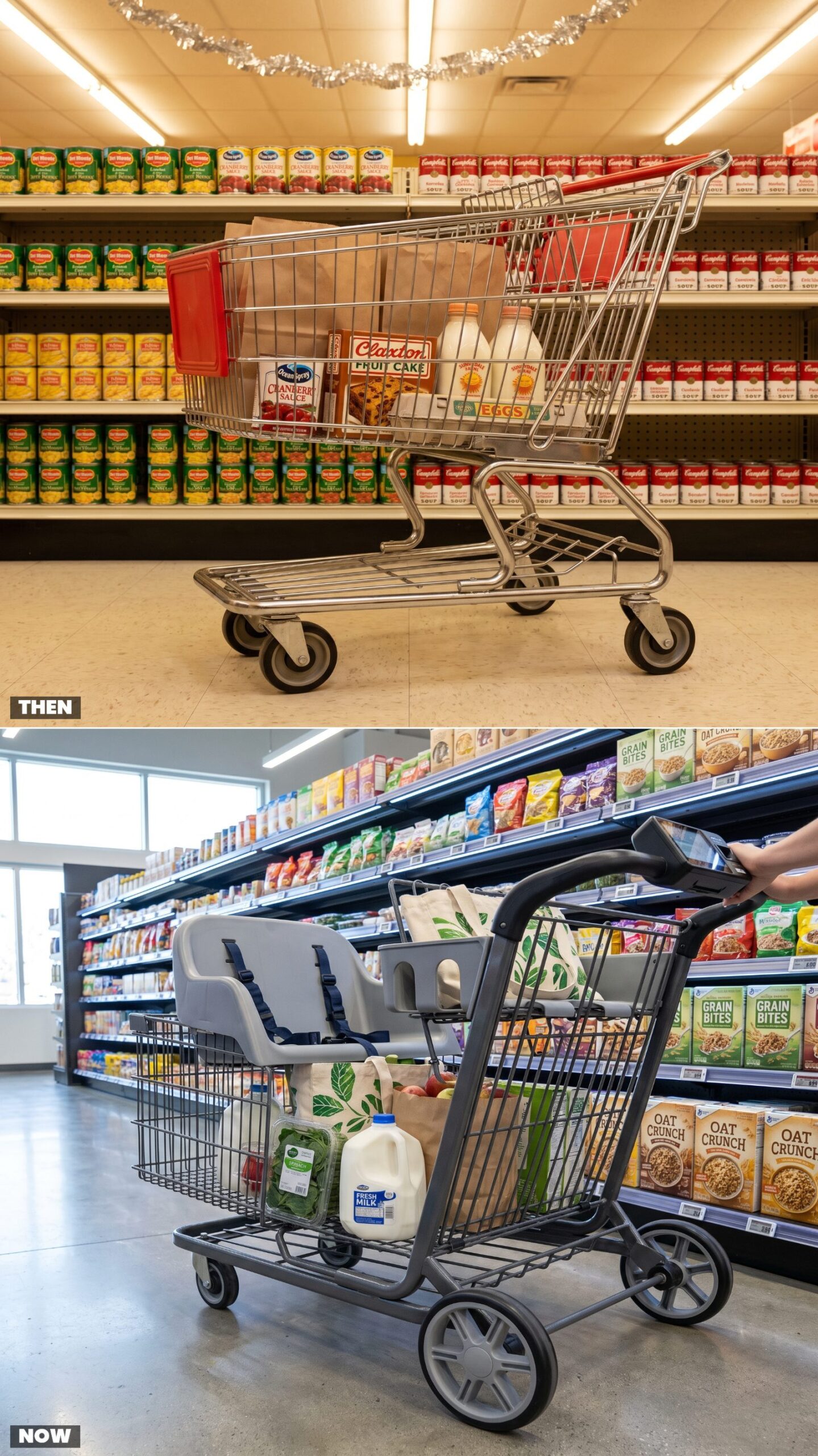
The 1970 cart was almost dainty. A shallow chrome basket, a little fold-down seat with a red plastic flap for the baby, wheels that squealed on turns. You filled it and it felt full.
Today’s cart could haul a small appliance. Deeper, wider, cup holders, safety straps, a front basket for the eggs. It holds more because we buy more, and it’s built so a full one still steers. Progress you feel in your forearms.
41. Aisle-End Displays: Hand-Stacked Cans vs. Precision Merchandising Towers
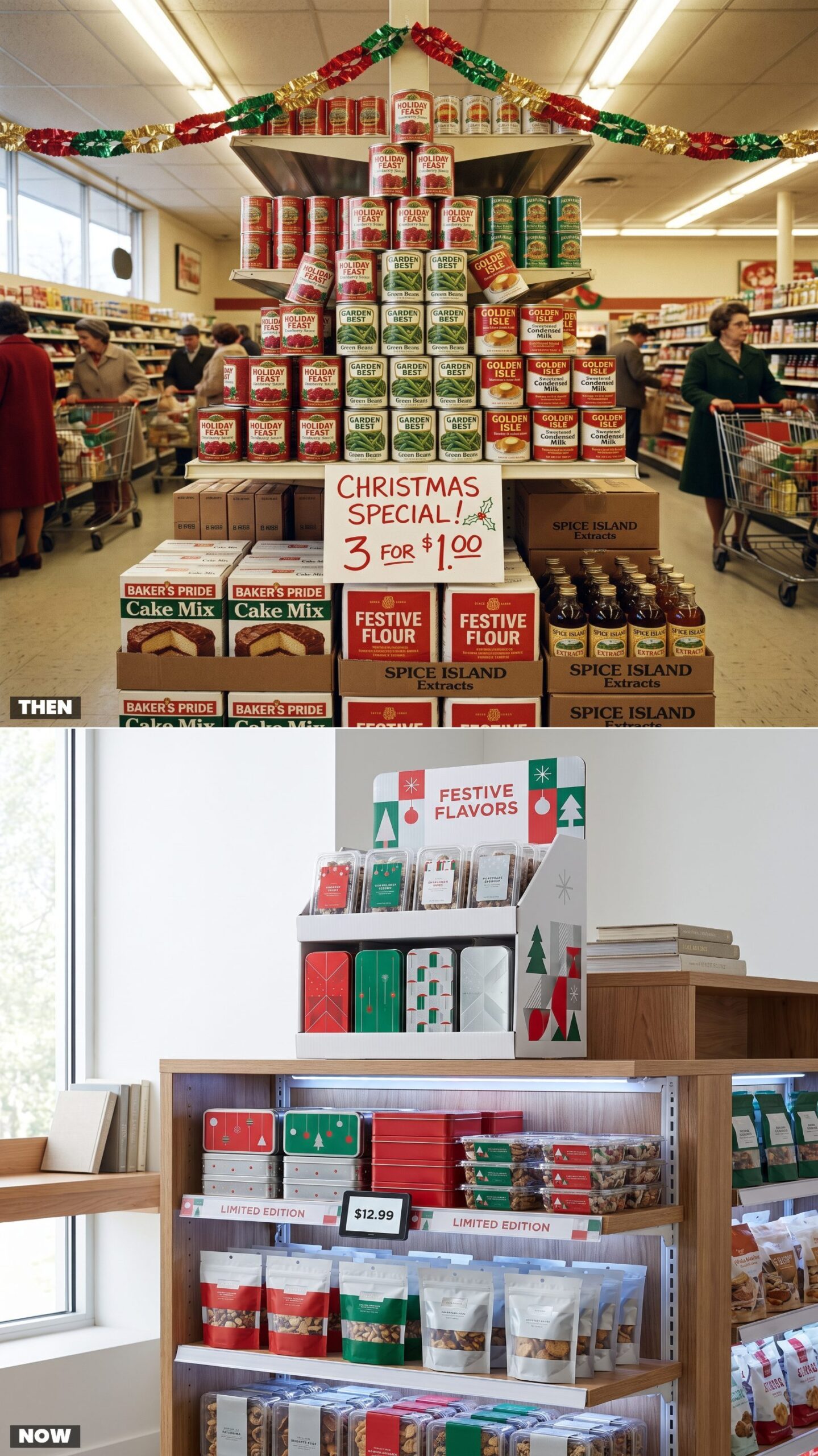
Somebody built that can pyramid by hand, on the clock, and prayed nobody pulled from the bottom. A poster-board price card sat on top with a marker sale price and, if the clerk was feeling it, a little holly sprig. The whole thing had a tilt to it, and personality with it.
The end-cap now arrives pre-built. A cardboard shipper, products faced by a planogram, a printed header that matches every other store’s header. A digital screen flips the price. Nothing tilts. Nothing was really built here at all.
40. Price Signs: Grease-Pencil Cards vs. Digital Shelf Labels
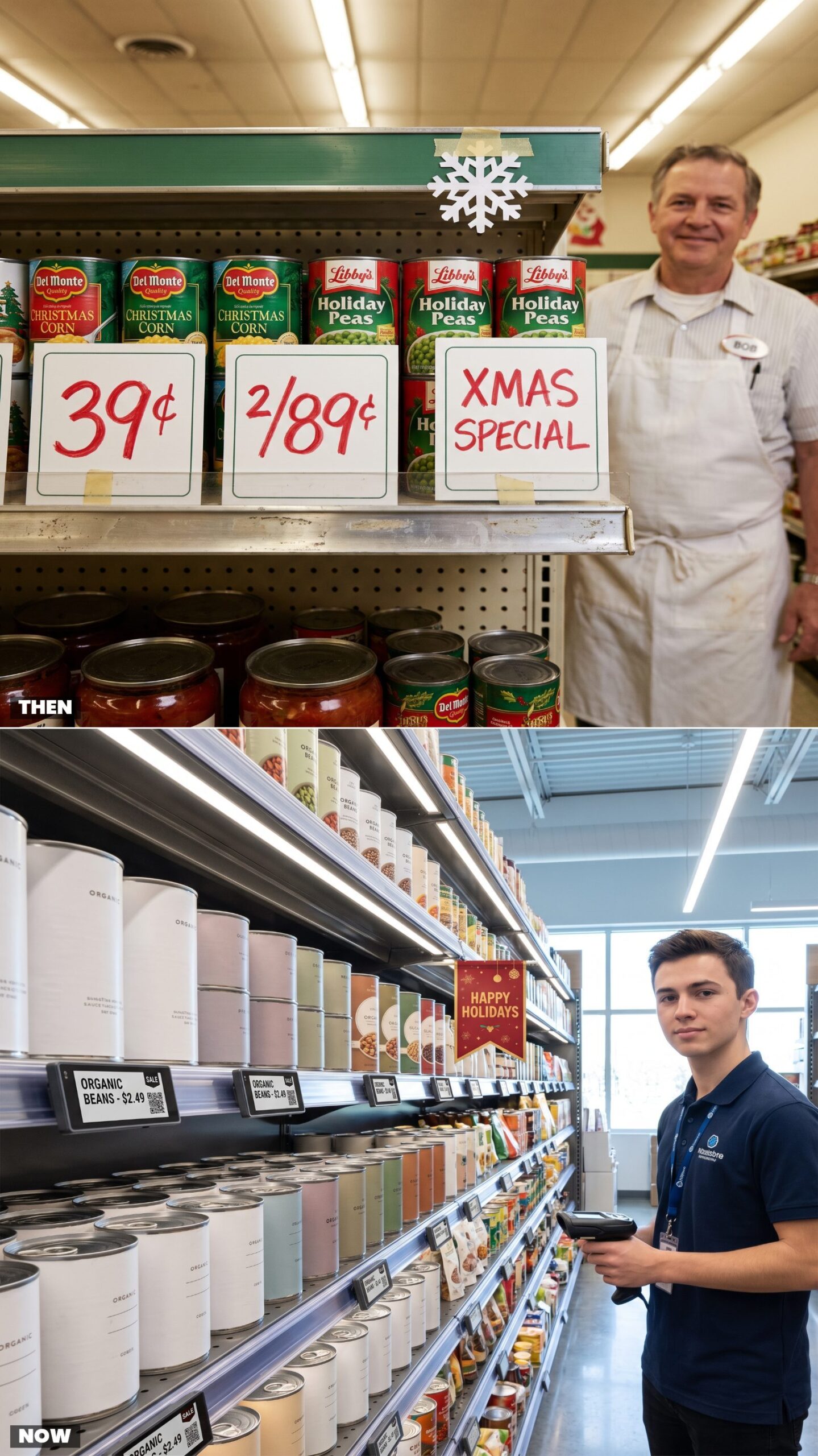
In 1970, a price was a person’s handwriting. Someone stood in the aisle with a grease pencil, wrote ’39¢’ on a card, and crossed out the old number to scrawl the sale price above it. You could tell how busy the store was by how smudged the cards got.
Now the shelf edge blinks at you. E-ink labels update from a back office, and the price you see at 9 a.m. might change by noon without a single human touching it. Efficient, sure. But nobody ever felt that little jolt of a bargain from a perfectly rendered digital font.
39. Produce Departments: Wooden Crates and Cellophane vs. Misted Displays and Organic Labels
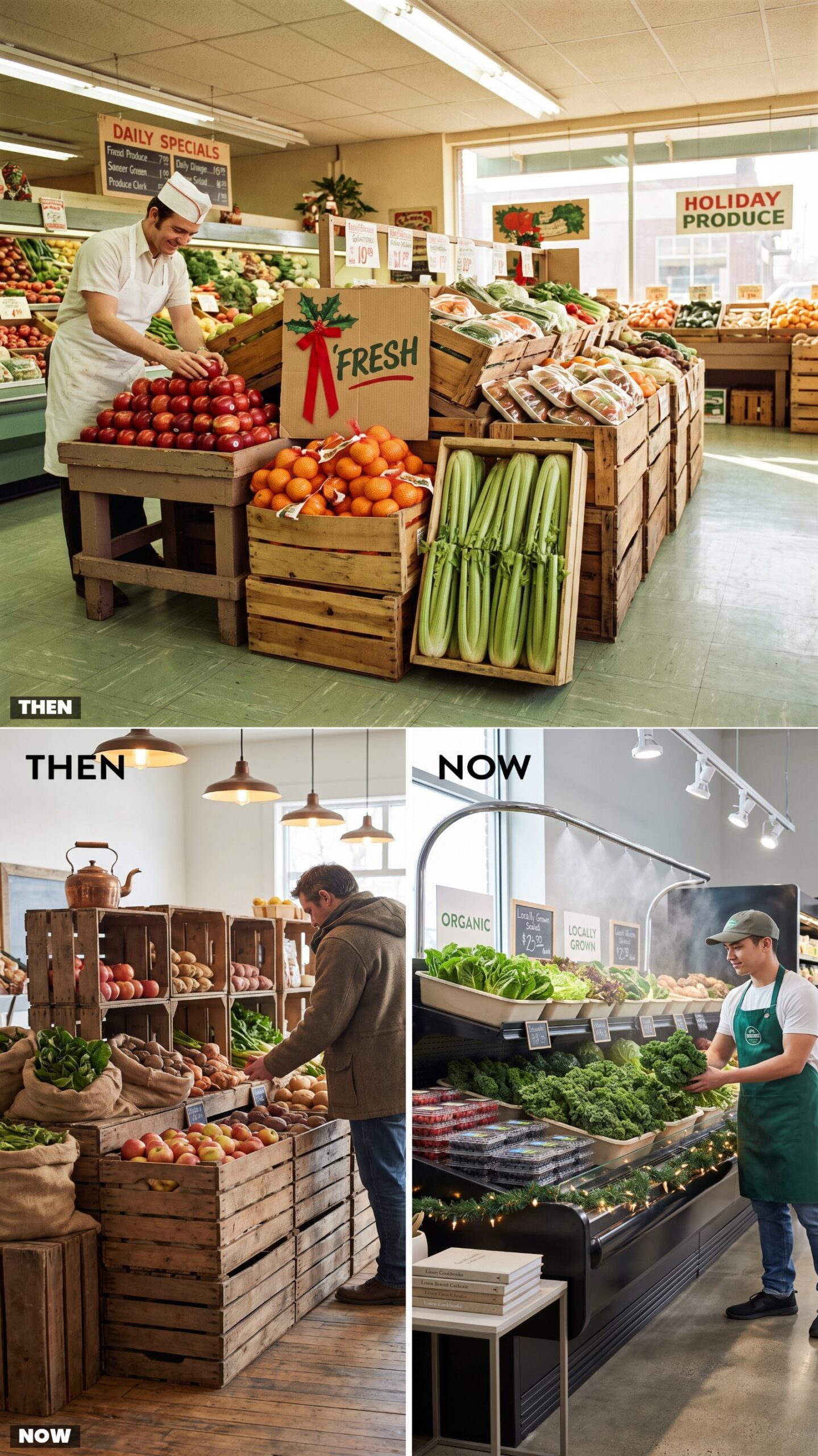
The 1970 produce section smelled like wood and cold water. Apples came stacked in the same crates that had shipped them, and half of what you bought was already sealed in cellophane over a little foam tray whether it needed it or not. Nobody said the word organic back then. Fruit was fruit.
Today that same corner hisses. A misting bar keeps the romaine looking alive, and every item wears a label announcing where it grew and how, because the crates are gone unless somebody kept one around to look rustic. More information. More choice. I do miss the crates, though — they had a smell you can’t print on a card.
38. Christmas Fruit Gifts: Orange-and-Nut Boxes vs. Curated Produce Hampers
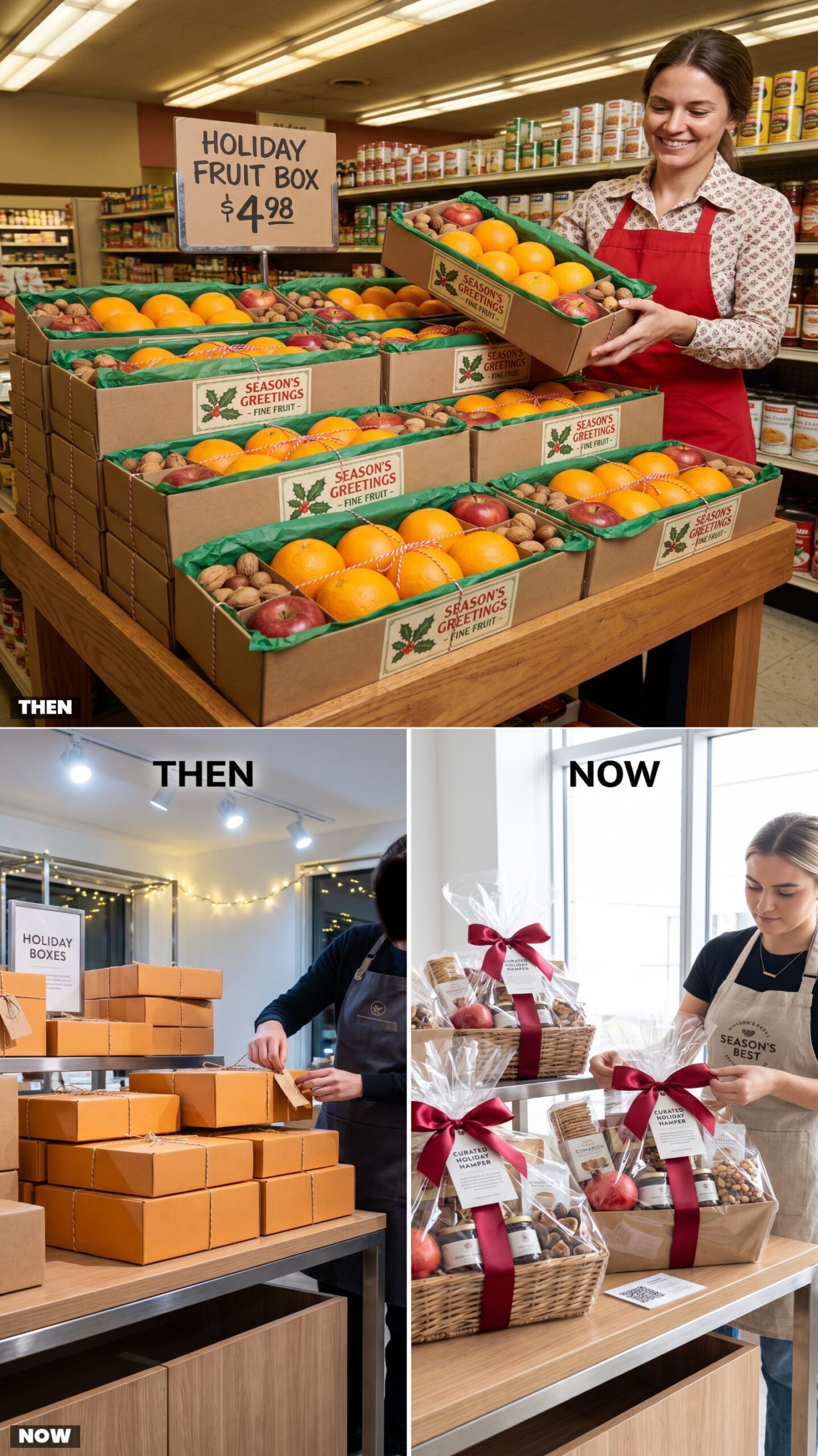
For a lot of families in 1970, the Christmas fruit box was the gift. A cardboard box of oranges, a couple of apples, a scatter of walnuts still in the shell, all for around five dollars, and it felt generous. Oranges in December still carried a whiff of luxury.
The modern version costs a great deal more and calls itself a hamper. Cellophane, a satin bow, artisan crackers, a jar of fig jam, maybe a little gift card tucked in a woven basket you’ll end up using for magazines. Prettier. Pricier. And nobody’s heart races anymore at the sight of an orange.
37. Holiday Nuts: Open Barrels and Shell-On Mixes vs. Sealed Flavored Pouches
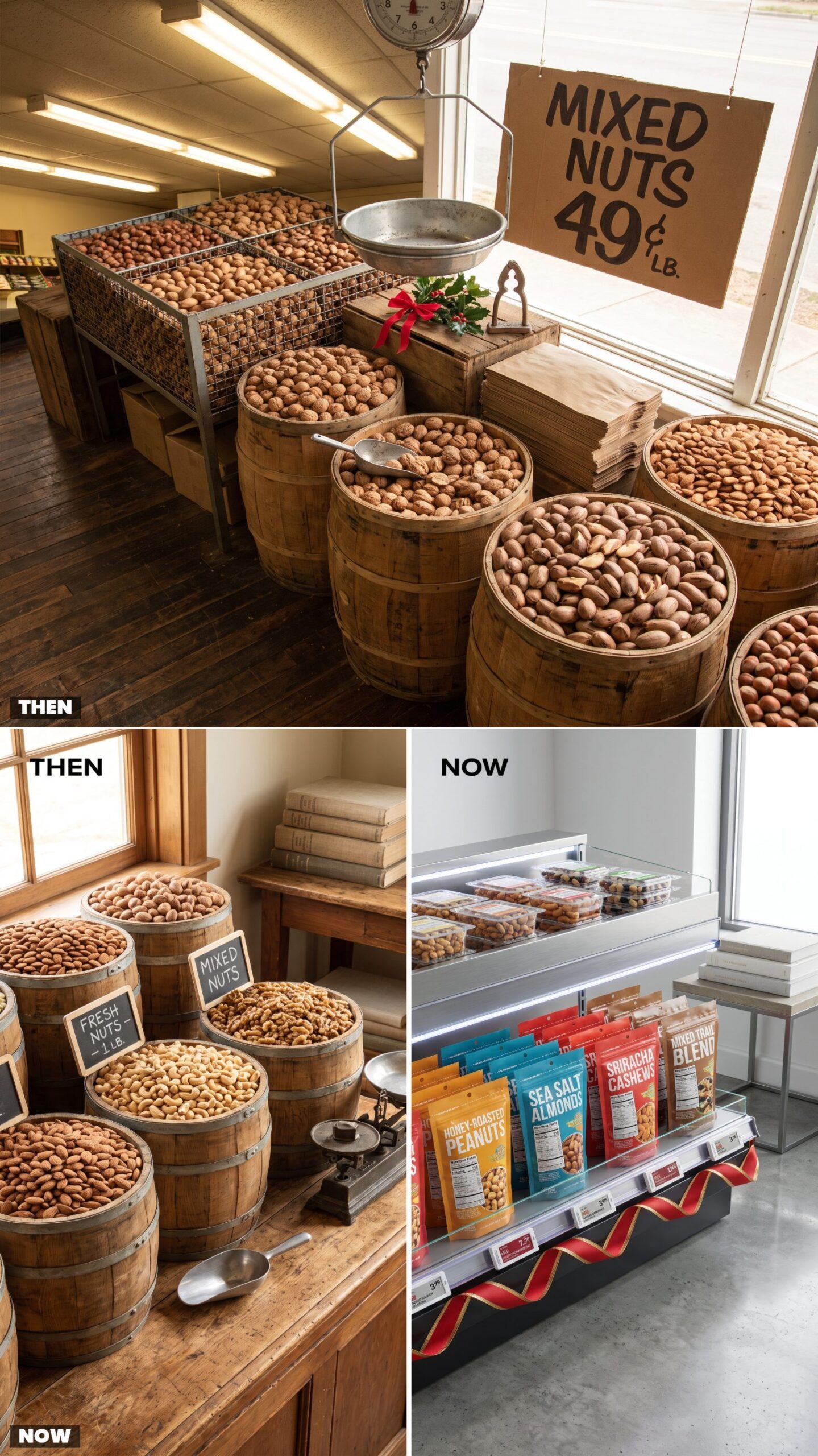
Christmas nuts used to be a chore, and that was half the fun. Open barrels, a metal scoop, a brown paper bag you filled yourself, and a bowl at home you had to fight your way into with a stubborn little nutcracker. Shells everywhere by the tree.
The pouches did away with all of it. Pre-shelled, honey-roasted, sriracha-dusted, sealed with a zip top and a barcode — you buy exactly what you want and there’s nothing to crack. Cleaner. Also quieter. That sharp snap of a walnut giving way was part of the season, and honestly? I’ll take the shells if it means the sound comes back too.
36. Butcher Counters: Paper Number Tickets vs. Touchscreen Ordering
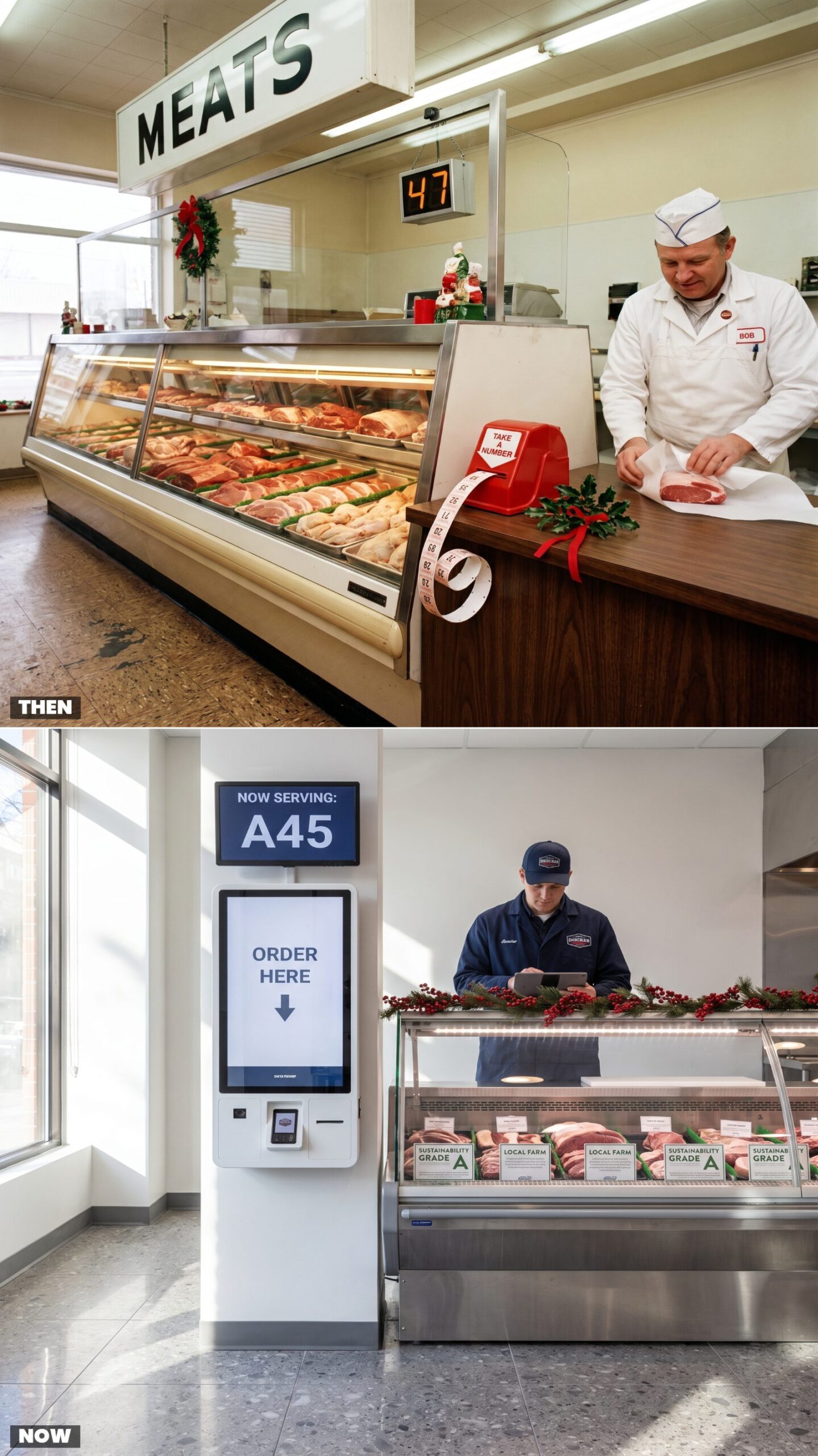
You knew the drill. Walk up, pull a paper tab from the little red dispenser, and wait for your number to light up over the case. There was a whole social order to it — people compared tickets, and somebody always tried to skip.
Now a touchscreen takes your order while a digital board counts you down. Faster on a busy December Saturday, no question. But there’s less to it. No butcher leaning over the glass asking how you’re cooking it, no paper curl in your hand. The wait used to come with conversation.
The number ticket wasn’t just a queue. It was permission to relax and eavesdrop for ten minutes.
35. Christmas Turkeys: Fresh Birds Behind Glass vs. Branded Frozen-Bird Freezers
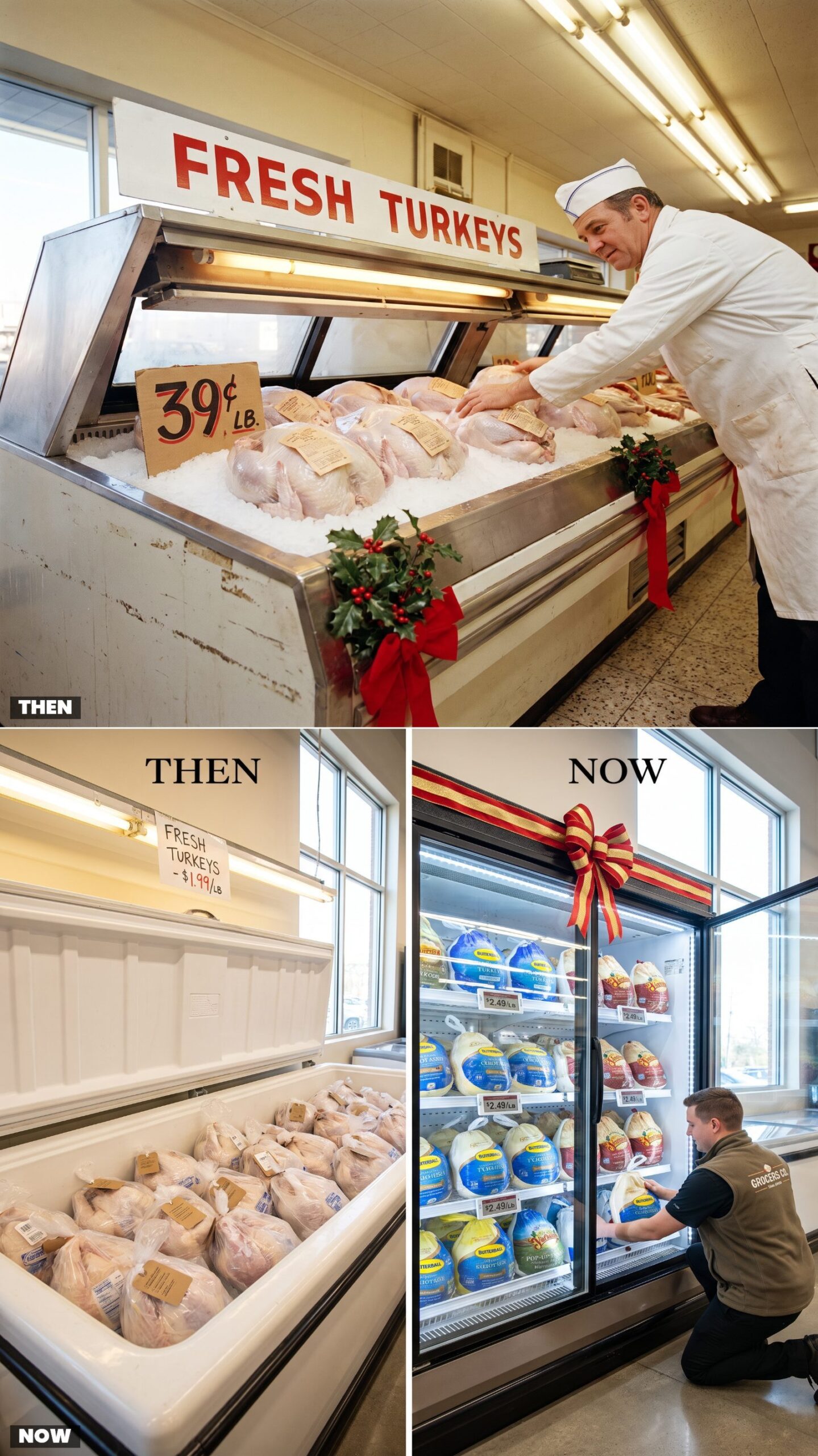
The Christmas turkey once sat on ice where you could see it, and the butcher pulled the one you wanted and weighed it right in front of you. Fresh, pale, tagged, and cheap by any modern measure. Buying the bird was a moment.
Today it’s mostly a freezer wall. Branded bags, pop-up timers bragging on the label, a printed weight sticker, and a glass door you swing open. Grab and go. Convenient and reliable, both. Just don’t expect anyone to ask how many you’re feeding.
34. Holiday Hams: Foil-Wrapped Displays vs. Spiral-Sliced Premium Selections
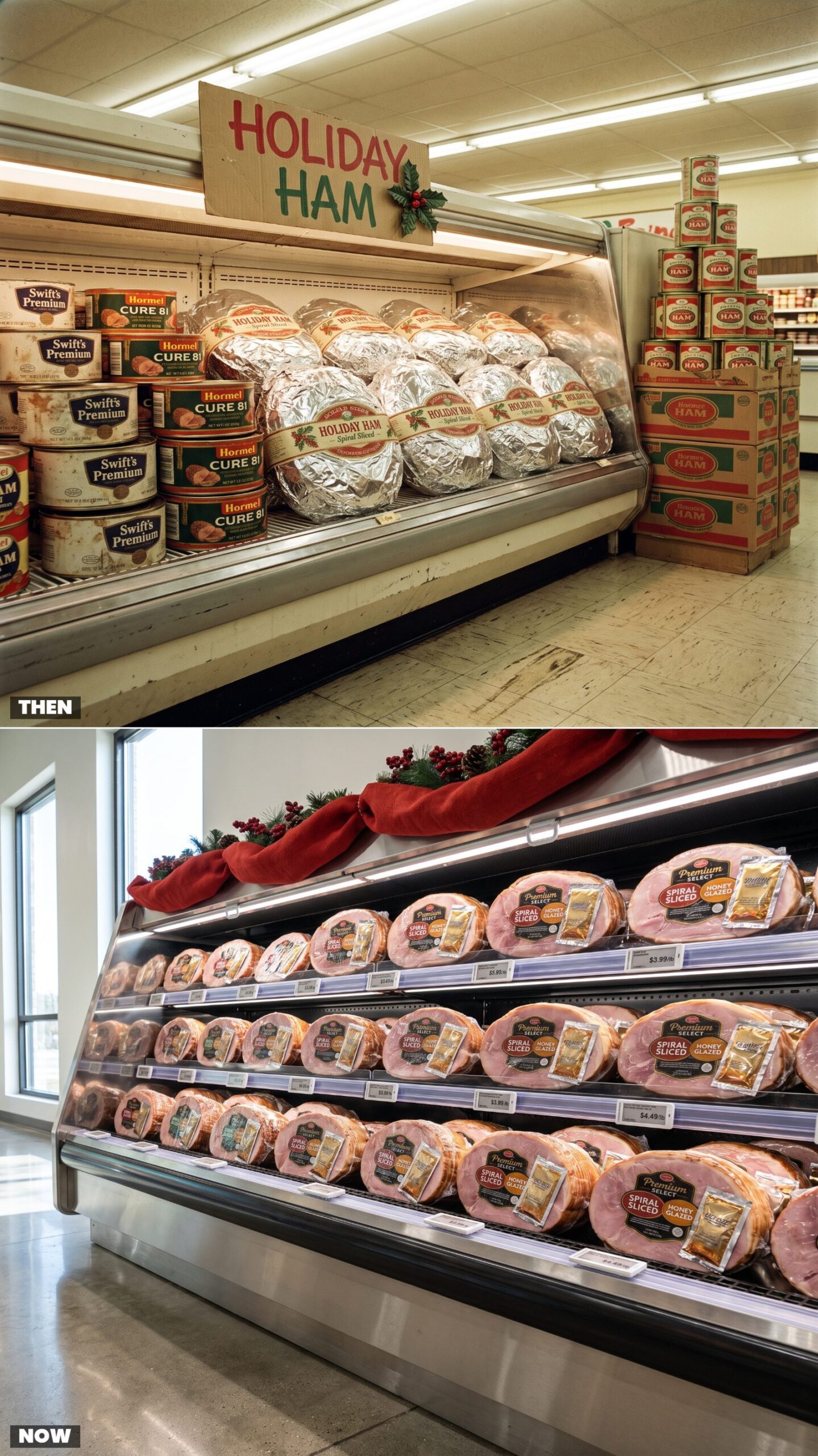
The 1970 holiday ham had a working-class glamour to it. Tin cans with a twist key, foil-wrapped bone-in hams stacked in a pyramid on the end-cap, a paper band holding the whole thing together. You brought it home and did the scoring and the cloves yourself.
The modern one shows up pre-solved. Spiral-sliced so you never lift a carving knife, glaze packet clipped to the bag, vacuum-sealed and stamped with words like honey and premium. Less work. Also less to be proud of when it lands on the table. Somebody used to earn that ham with a paring knife.
33. Seafood Counters: Crushed-Ice Trays vs. Sustainability-Labeled Cases
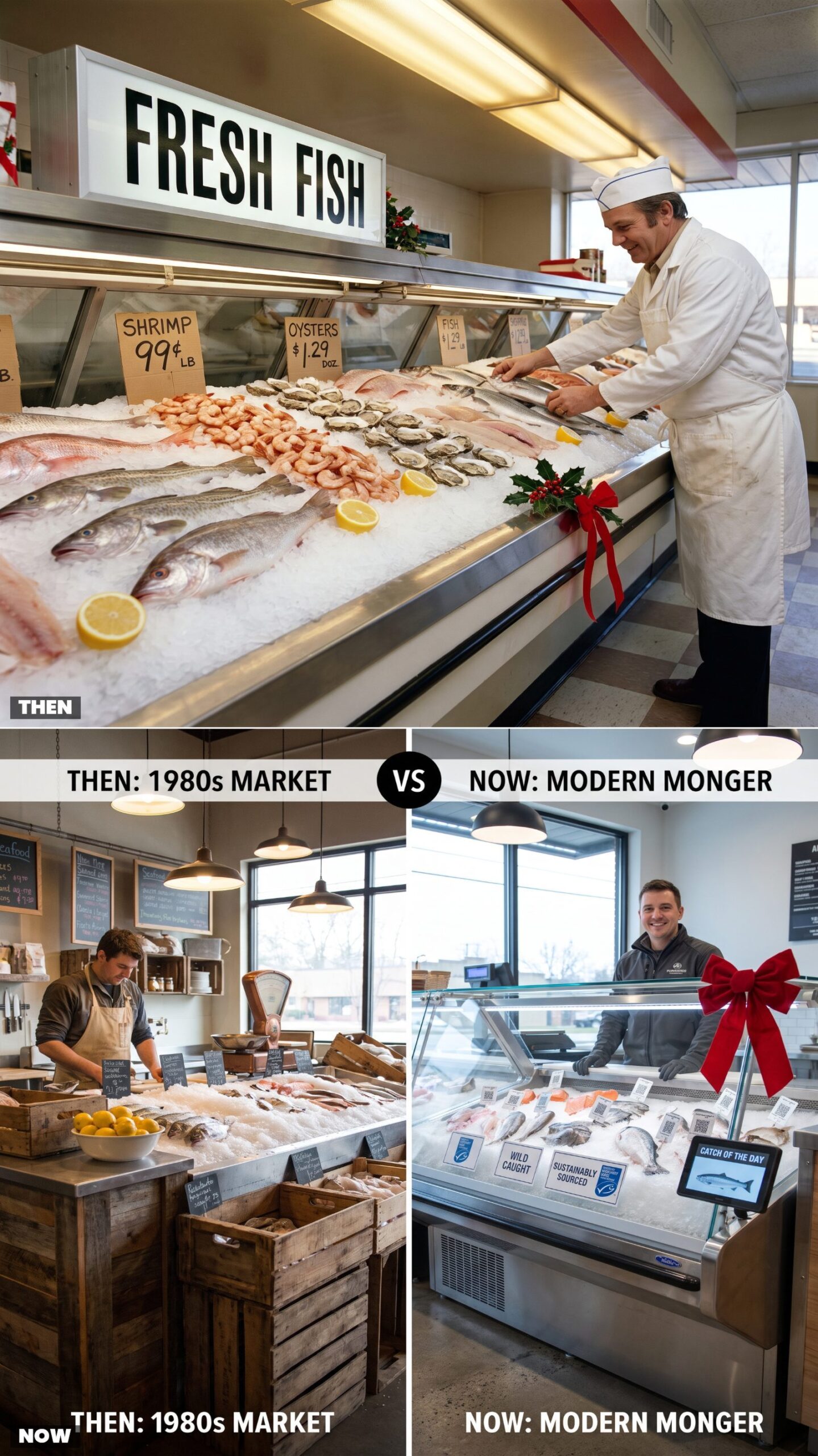
Christmas Eve seafood in 1970 was a wall of crushed ice and whole fish looking right back at you, shrimp piled high, oysters on the shell, a lemon half or two tucked in for looks. The price card sat stabbed into the ice at an angle. You pointed, and the man in the white coat weighed it.
The ice is still there. Now it comes with a lecture — wild caught, sustainably sourced, QR codes that tell you which ocean it came from and exactly how it got here. Good stuff to know. The fish, though, is doing what it always did: sitting on ice, waiting for Christmas Eve.
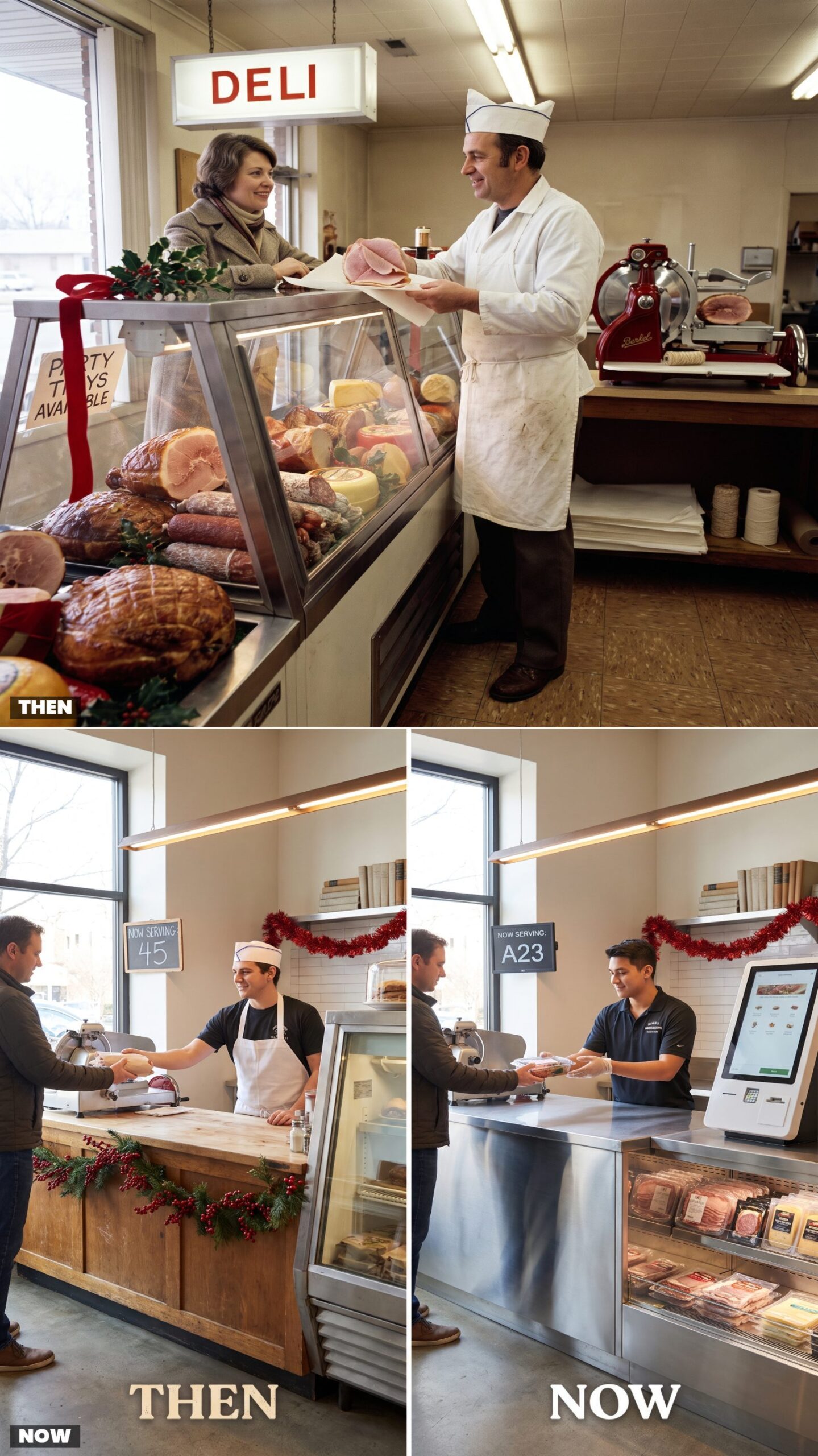
32. Deli Counters: Hand-Sliced Party Meats vs. Digital Kiosks and Grab-and-Go Packs
Would you like to save this?
The deli was theater. A whole ham going into a red slicer, the blade whirring, the clerk folding a warm slice over a square of paper and handing it across the glass to try. Ordering a party tray meant an actual conversation — how thick, how much, who’s coming over.
Half of it happens without a word now. You tap a kiosk, or you skip the counter entirely and pull a sealed grab-and-go pack off the shelf. Quick, and honestly fine for a Tuesday sandwich. But the sample slice, the small kindness of it, that’s mostly gone. I miss being handed something to taste before I bought it.
31. Cheese Sections: Processed Party Loaves vs. Specialty Cheese Islands
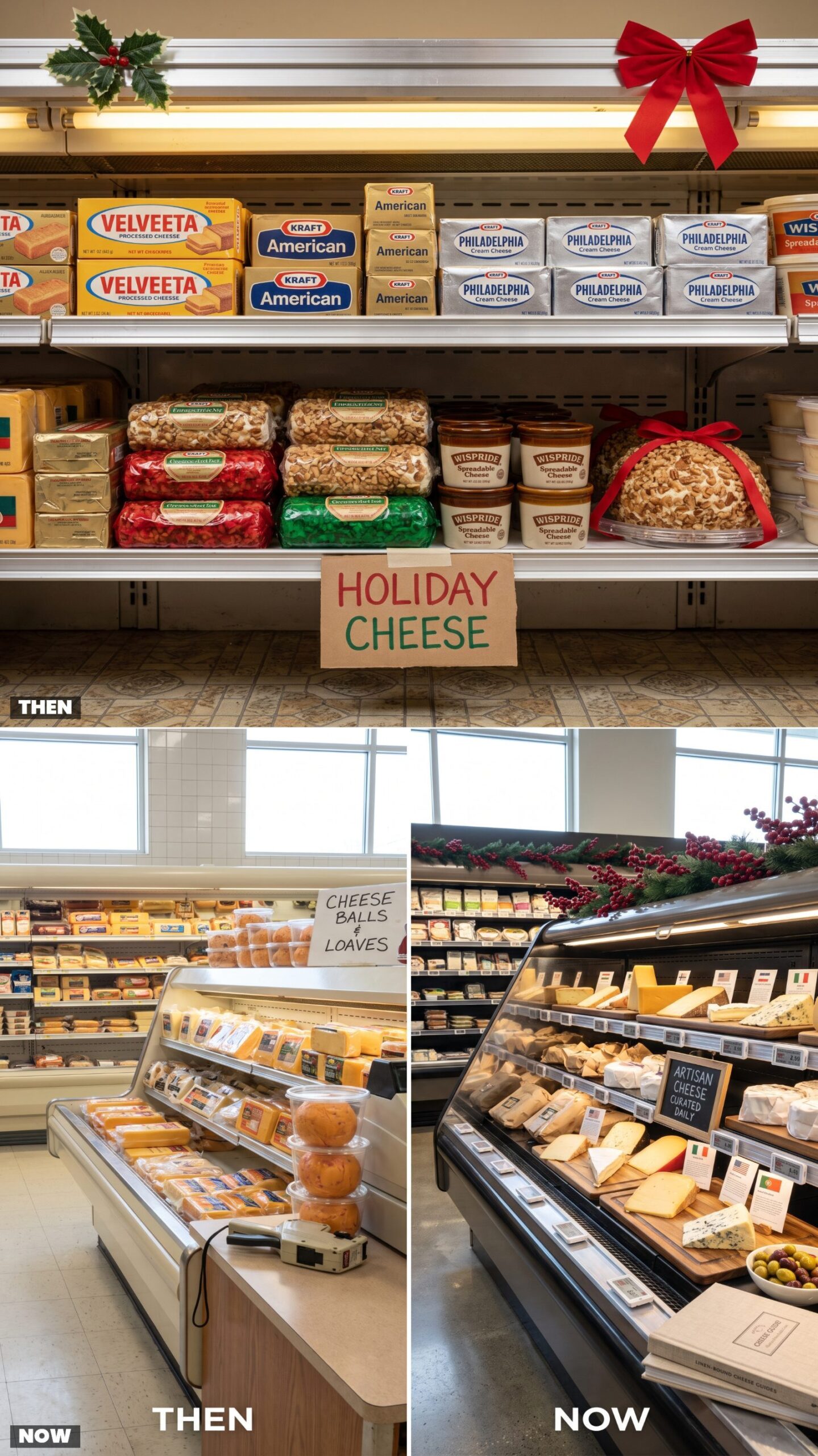
Holiday cheese in 1970 came in a box or wore a coat of walnuts. Processed loaves, foil bricks, cheese balls on a display plate, spreadable crocks you’d set out with a butter knife and a sleeve of crackers. Bright orange and unbothered, and every party had one.
Today there’s an island. Wedges of aged cheddar and brie on wooden boards, paper-wrapped rounds with origin cards telling you which farm and how many months, a little chalkboard sign to complete the look. Fancier, and yes, better tasting. But that cheese ball rolled in nuts had a swagger the brie can’t touch — it knew exactly what it was for.
One built for a crowd, one built for a photo. Both belong on the table.
30. Eggnog Displays: Glass Bottles vs. Dairy-Free and Flavored Cartons
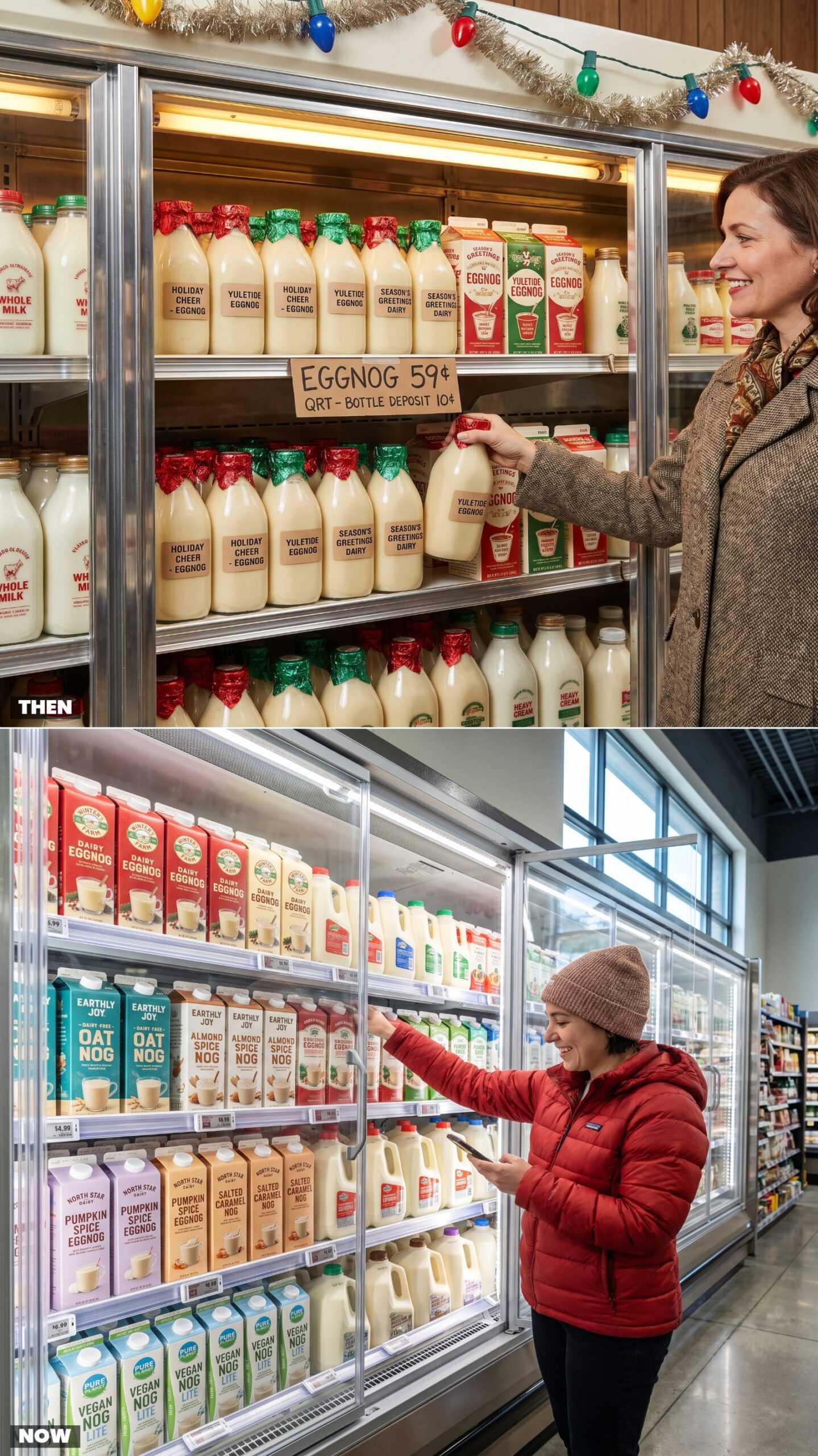
Eggnog in 1970 came in glass — returnable bottles with foil caps, heavy in the hand and fogged with cold. You bought the nog, you brought the bottle back. Nobody thought twice about it.
Now the case is a lineup of cartons with a dozen personalities: oat nog, almond nog, salted caramel, pumpkin spice for the people who cannot let October go. The glass is gone and the flavors multiplied, which made the whole thing lighter to carry and a lot harder to choose from.
29. Baking Aisles: Paper Flour Sacks vs. Gluten-Free and Artisan Baking Mixes
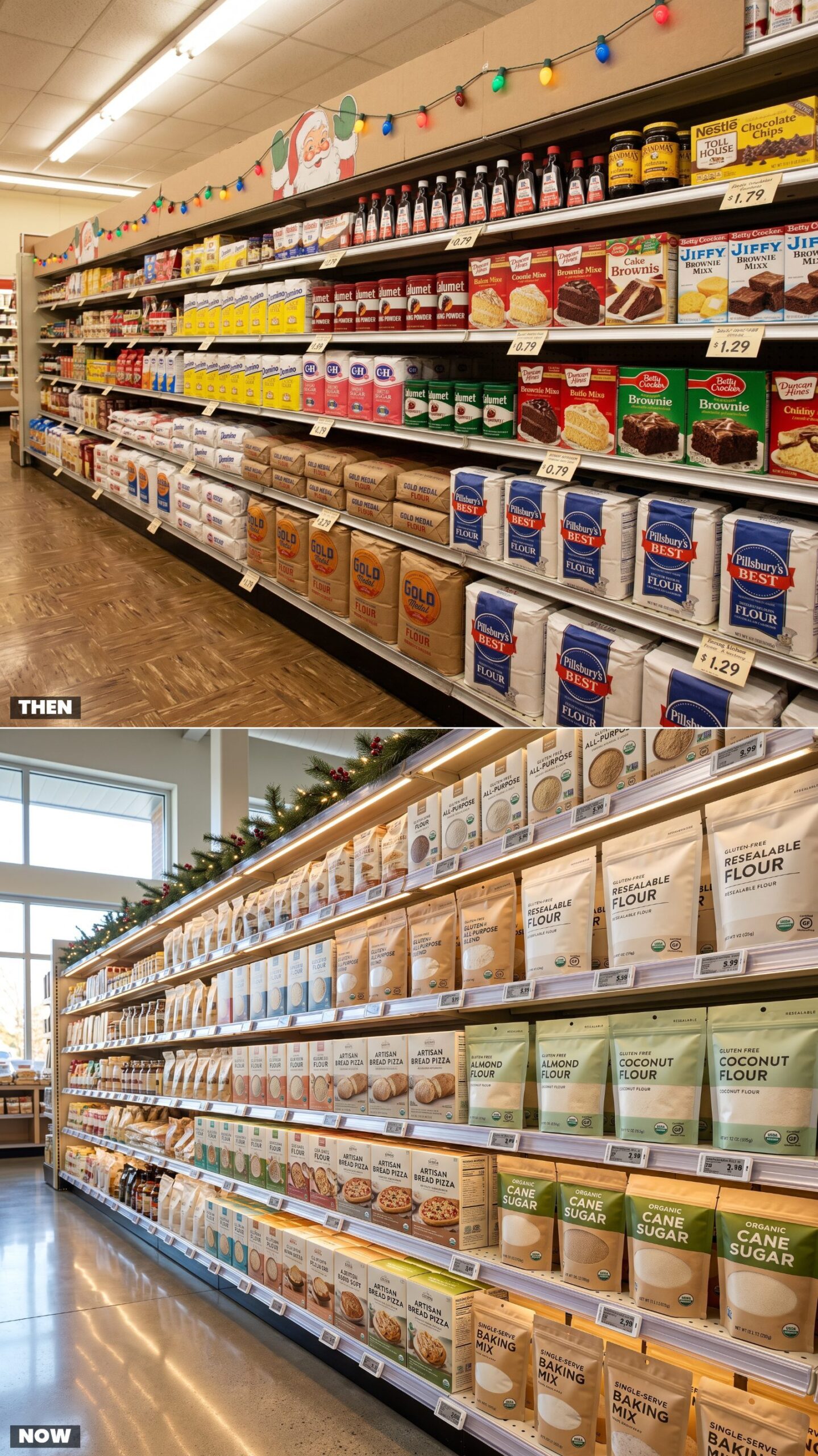
The 1970 baking aisle was a wall of paper. Flour in sacks, sugar in sacks, a Santa shelf-topper doing the seasonal heavy lifting. You bought a box of mix and a bag of chips and got to work — simple math, simple shelf.
Today’s version reads like a chemistry set wearing a holiday face. Almond flour next to coconut flour next to a gluten-free blend that costs more than the vanilla did in 1970. Artisan kits promise you a bakery loaf you have to assemble yourself. The aisle got smarter, sure, and a whole lot more particular about what it will and won’t put in your body.
28. Cranberry Sauce Displays: Can Pyramids vs. Fresh, Organic and Gourmet Options
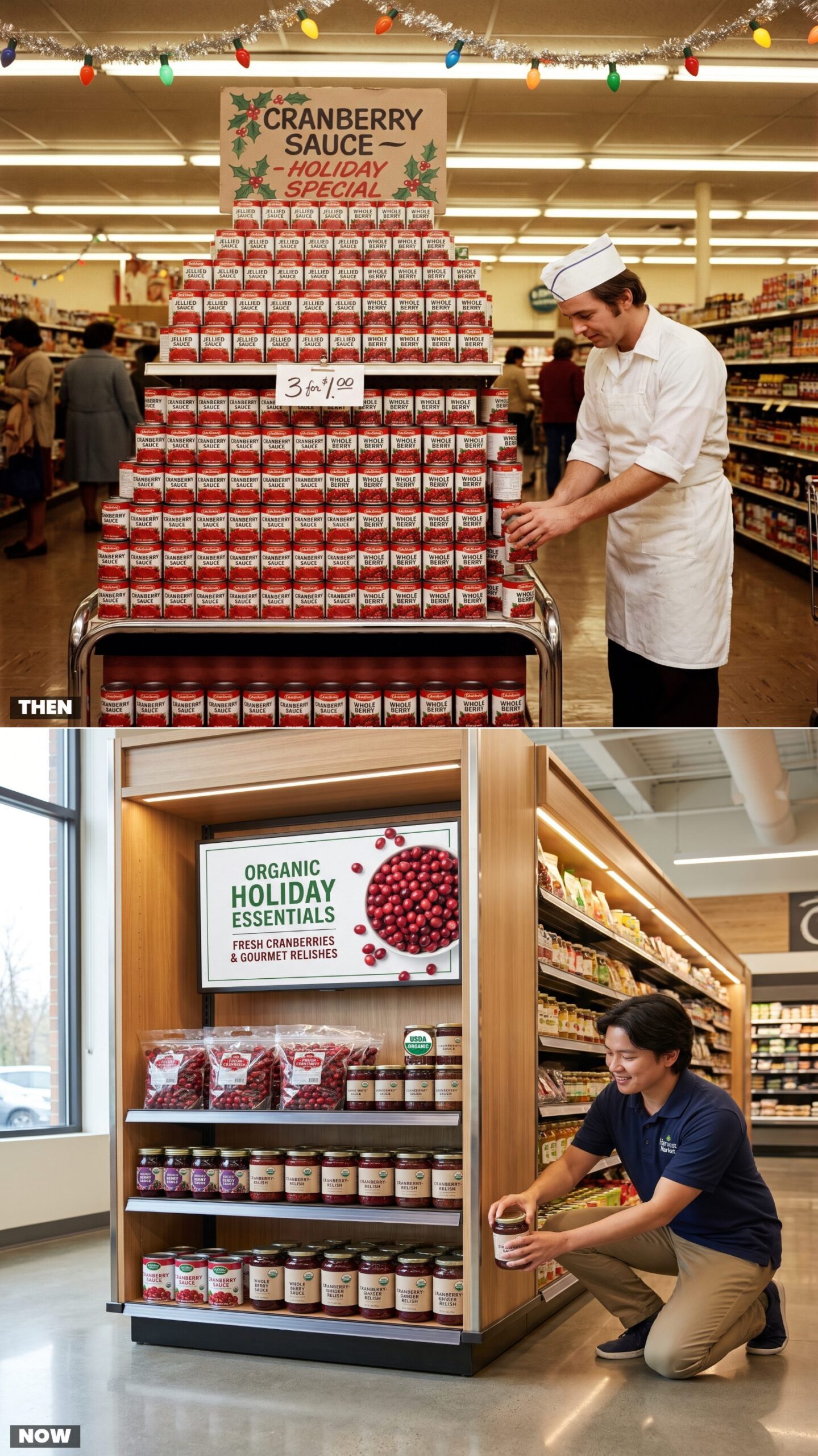
Nothing said December 1970 like a pyramid of cranberry cans stacked four feet high on an end-cap. Jellied on one side, whole-berry on the other, and the whole tower built to topple gloriously the second a kid leaned on it. You bought the can, and it slid out with that unmistakable sound and held the ridged shape right there on the plate.
Now the cans are outnumbered. Fresh berries in clamshells, glass jars of cranberry-ginger relish, organic everything. The pyramid’s a memory. Honestly? The can-shaped log still tastes like Christmas to a lot of people who’d never admit it out loud.
27. Stuffing Sections: Seasoned Bread Cubes vs. Multigrain and Gluten-Free Mixes
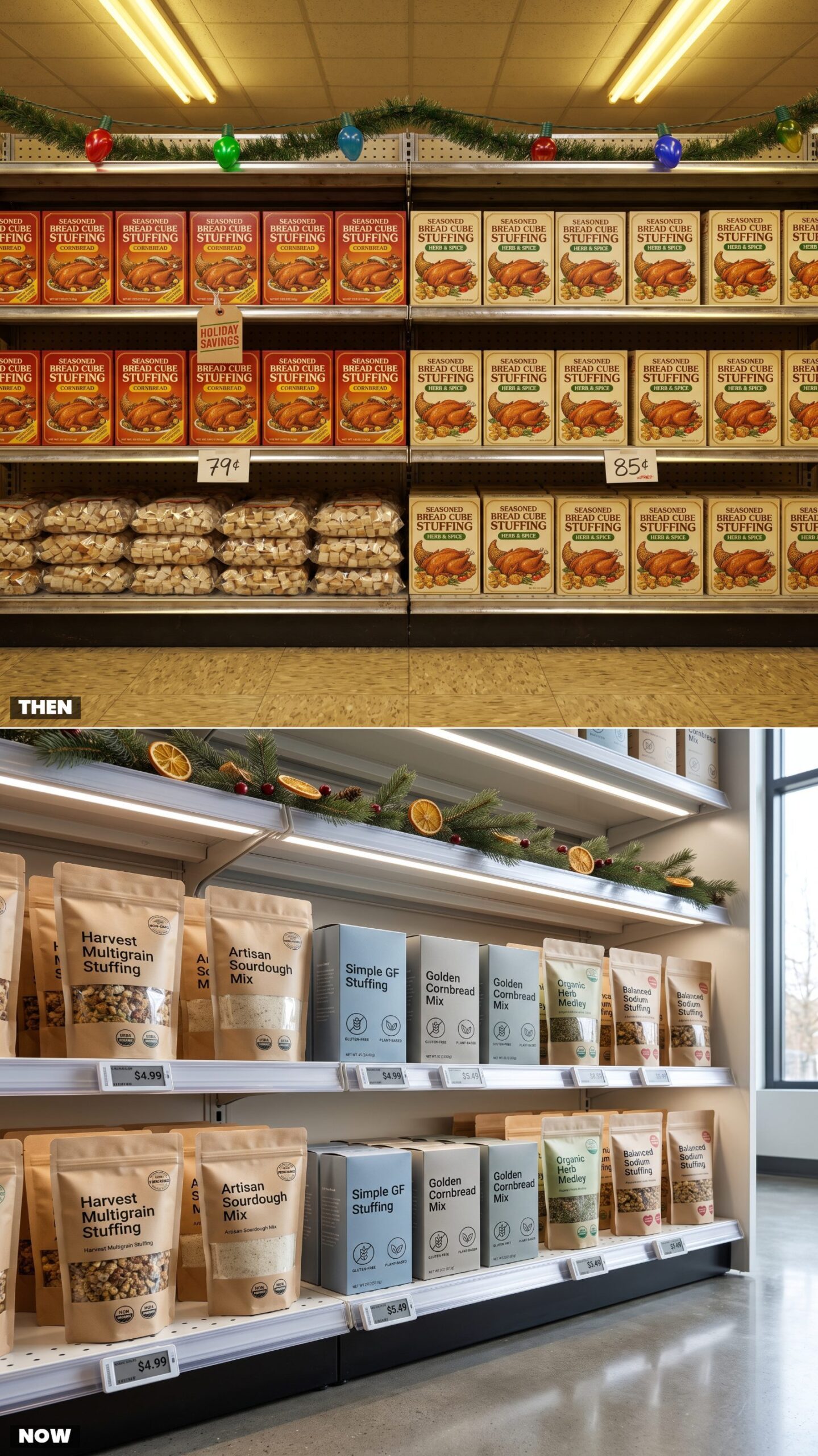
Stuffing in 1970 was seasoned bread cubes in a box with a turkey on the front. Herb or cornbread — that was the fork in the road. You added water and butter and let the smell of sage take over the kitchen.
The shelf today asks more questions. Gluten-free? Multigrain? Sourdough cubes? Low sodium? Same idea, dressed for a room full of dietary requests, with the turkey illustration swapped out for a badge telling you what the mix will not do to you.
26. Bread Aisles: Soft White Loaves vs. In-Store Sourdough and Seeded Breads
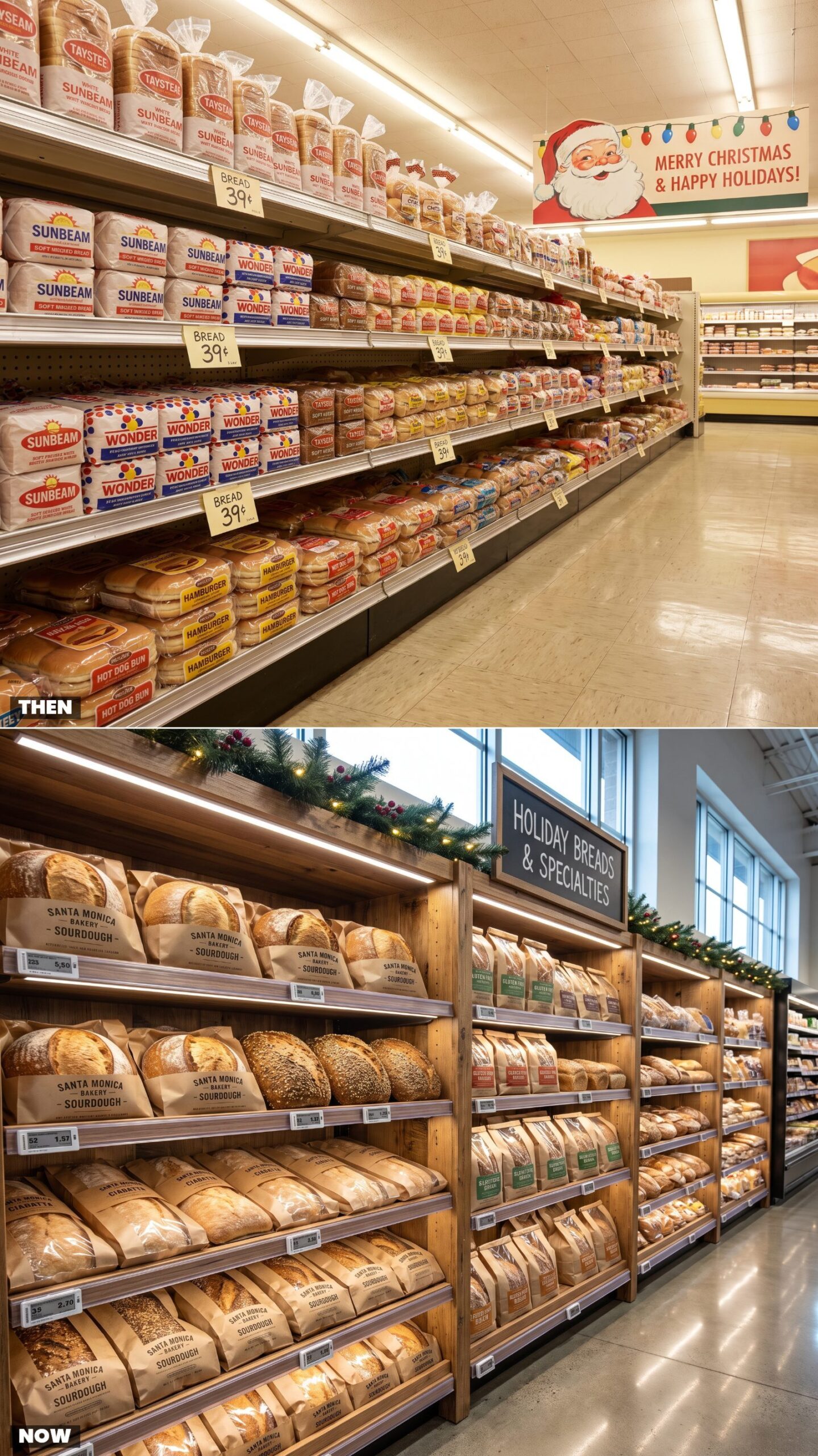
Soft white bread ruled the 1970 aisle. Sliced thin, squeezable, sold in bags with cartoon characters — the kind you could ball up into a marble and nobody stopped you. Wheat bread existed, but it was the polite exception rather than the point.
The modern bread aisle wants you to slow down and read. Sourdough baked in the back that morning, seeded multigrain, sprouted grain, a gluten-free loaf in a clear window bag. Soft white’s still around. It just shuffled down the shelf while the crusty loaves took the good light.
25. Supermarket Bakeries: Sheet Cakes Behind Glass vs. Open Artisan-Baking Stations
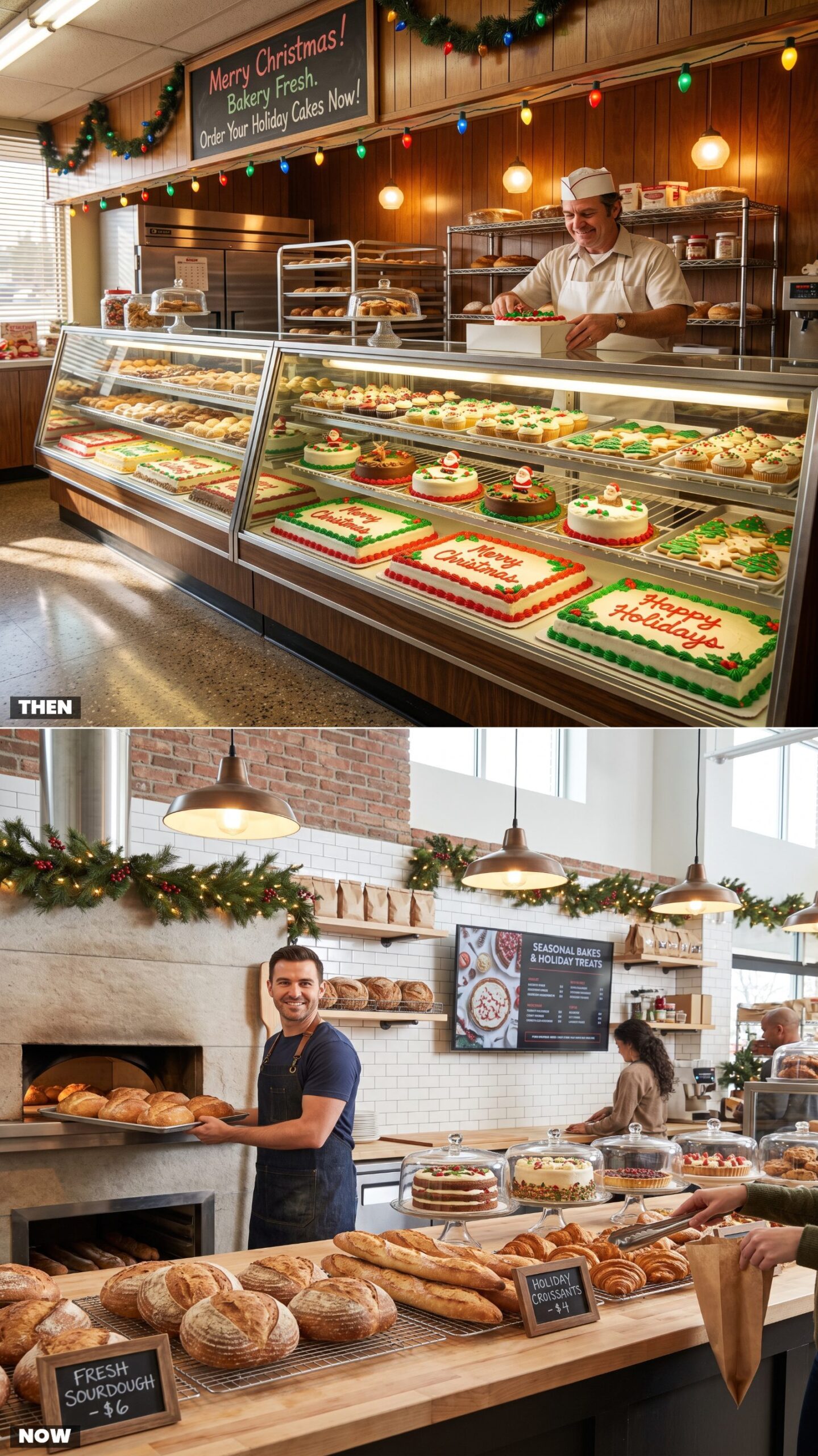
The 1970 bakery counter kept its treasures behind glass. Sheet cakes with piped borders, a Santa in buttercream, a clerk in a paper cap who slid the box across and tied it off with string. You pointed at what you wanted, and someone brought it to you.
Today the wall came down. Ovens on display, croissants cooling on racks you can see, sourdough stacked like the store wants you to smell it before you decide. Self-serve tongs, glass domes, a chalkboard menu — the theater moved from behind the counter to right out in front of you.
The old bakery hid its work. The new one performs it.
24. Fruitcake Displays: Cellophane-Wrapped Bricks vs. Small-Batch Gift Cakes
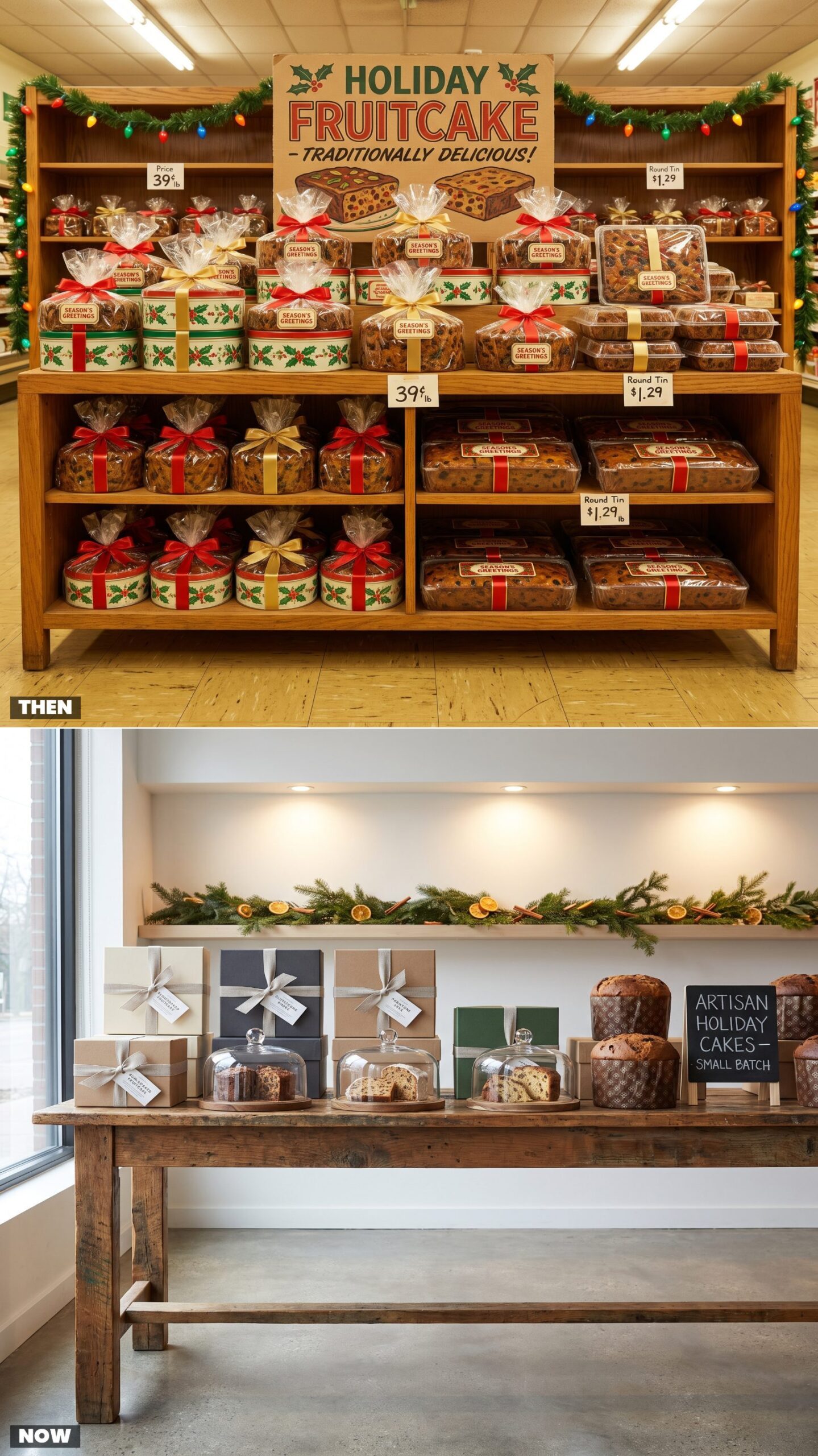
Fruitcake in 1970 came as a brick. Wrapped in cellophane, tied with a ribbon, dense enough to prop a door. Some arrived in painted holly tins that families reused for buttons and sewing thread for the next twenty years, because the cake was the punchline and the tin was the keeper.
The modern fruitcake got a rebrand it desperately needed. Small-batch, rum-soaked, boxed in kraft with linen ribbon, parked next to the imported panettone like it finally made something of itself. Same fruit. New reputation.
23. Christmas Cookies: Bakery Trays vs. Decorating Kits and Allergy-Friendly Packs
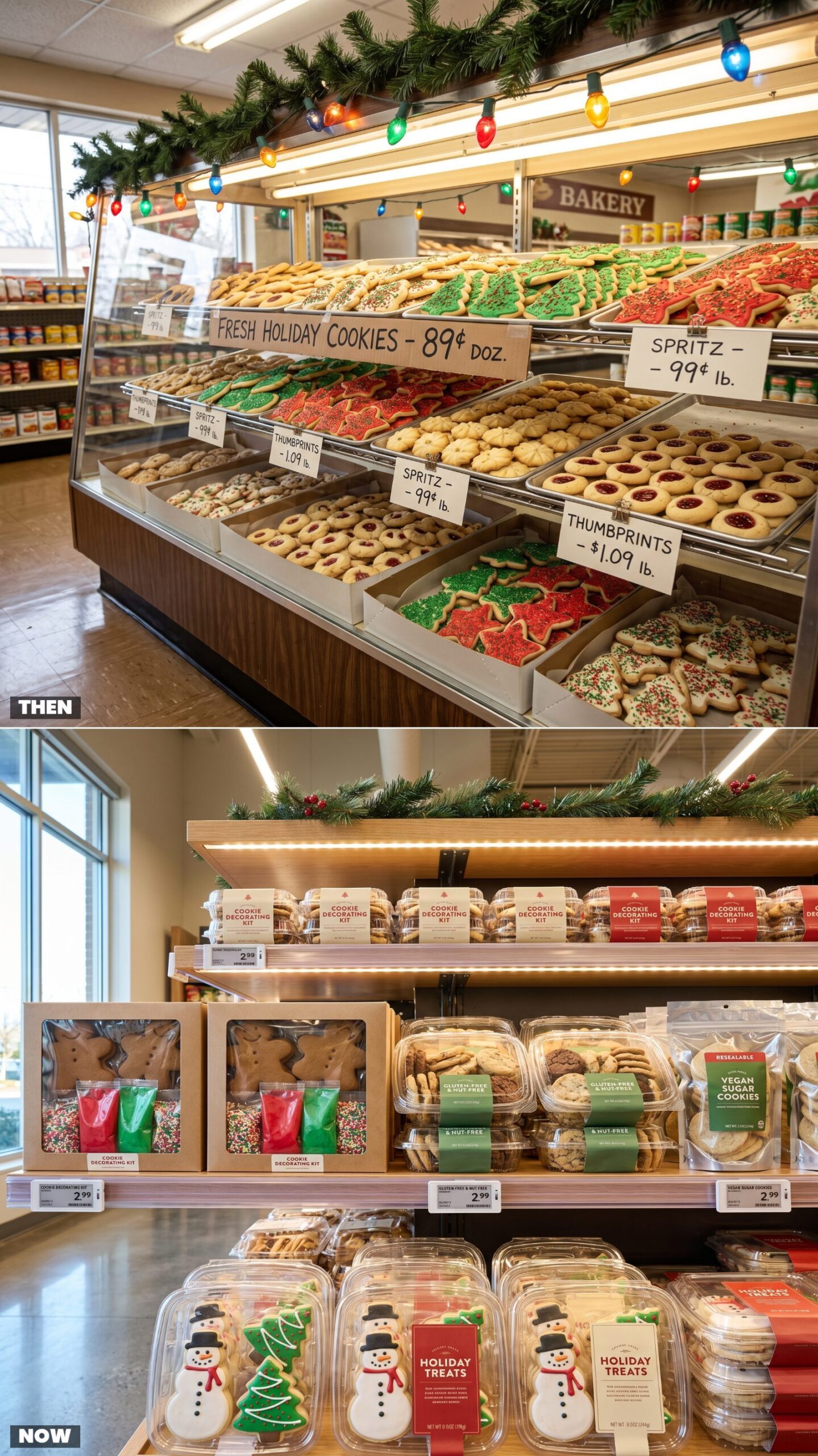
Christmas cookies in 1970 sat out on chrome trays behind the bakery glass. Sugar cookies shaped like trees, spritz pressed into wreaths, thumbprints with a dab of jam. You bought them by the dozen in a white box, and the sprinkles fell off in the car on the way home.
The cookie aisle today hands you a project. Decorating kits with icing pouches and sprinkle packets. Nut-free packs for the classroom party. Vegan sugar cookies for the cousin who changed everything. The cookies are still the point — now they just come with instructions and a list of what’s not inside.
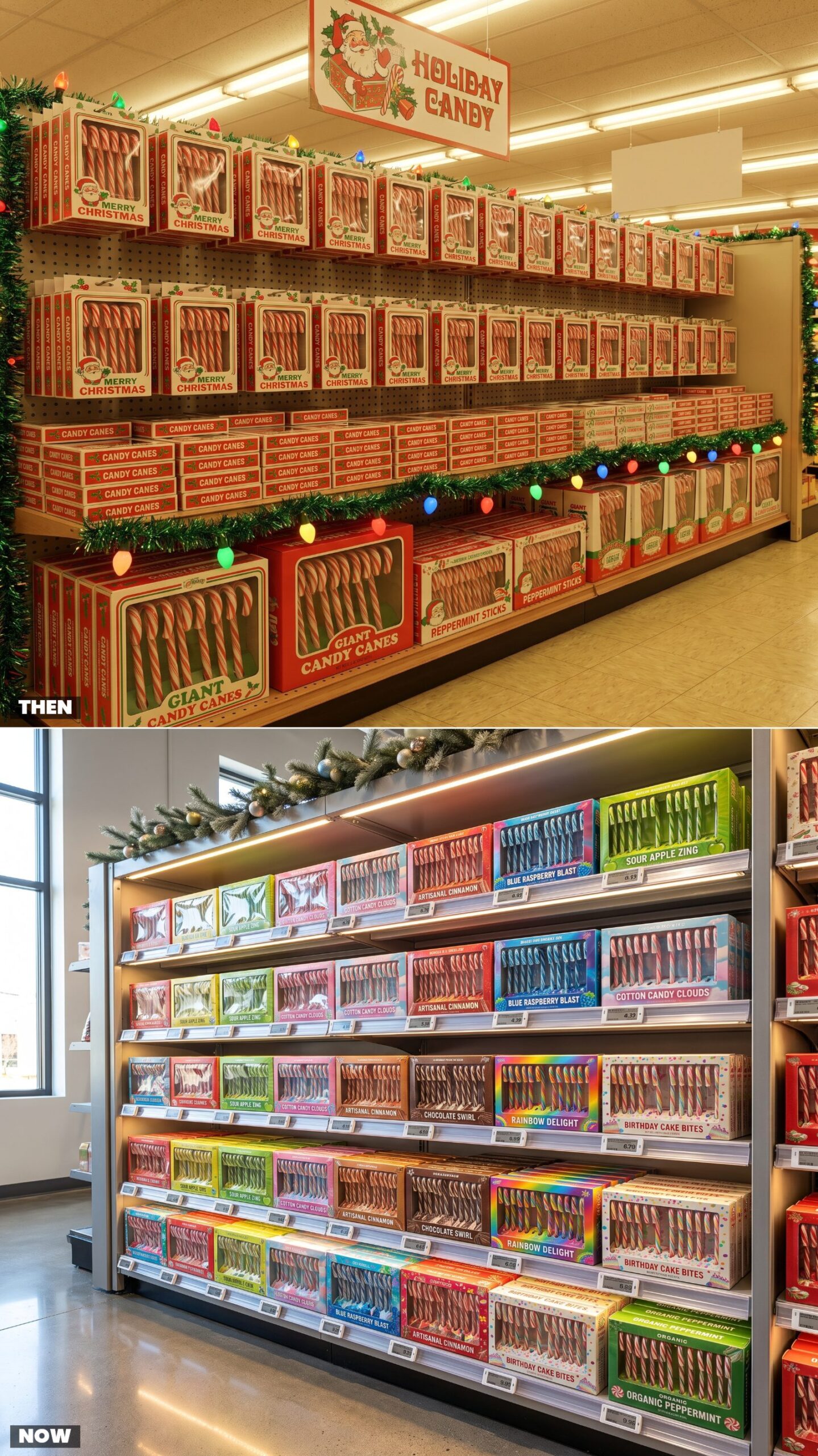
22. Candy Cane Displays: Simple Red-and-White Boxes vs. Dozens of Novelty Flavors
Would you like to save this?
A candy cane in 1970 tasted like peppermint, and that was the whole conversation. Red and white, cellophane box, hung on a rack near the register. You got the striped one or the slightly bigger striped one.
The rack today reads like a soda fountain lost its mind. Sour apple, cotton candy, blue raspberry, birthday cake, chocolate, rainbow swirl. Peppermint holds its ground in the middle of it all while a wall of neon flavors argues around it. Kids love it. Purists quietly reach past every one of them for the original.
21. Chocolate Gift Boxes: Ribboned Assortments vs. Premium Ethical-Cocoa Collections
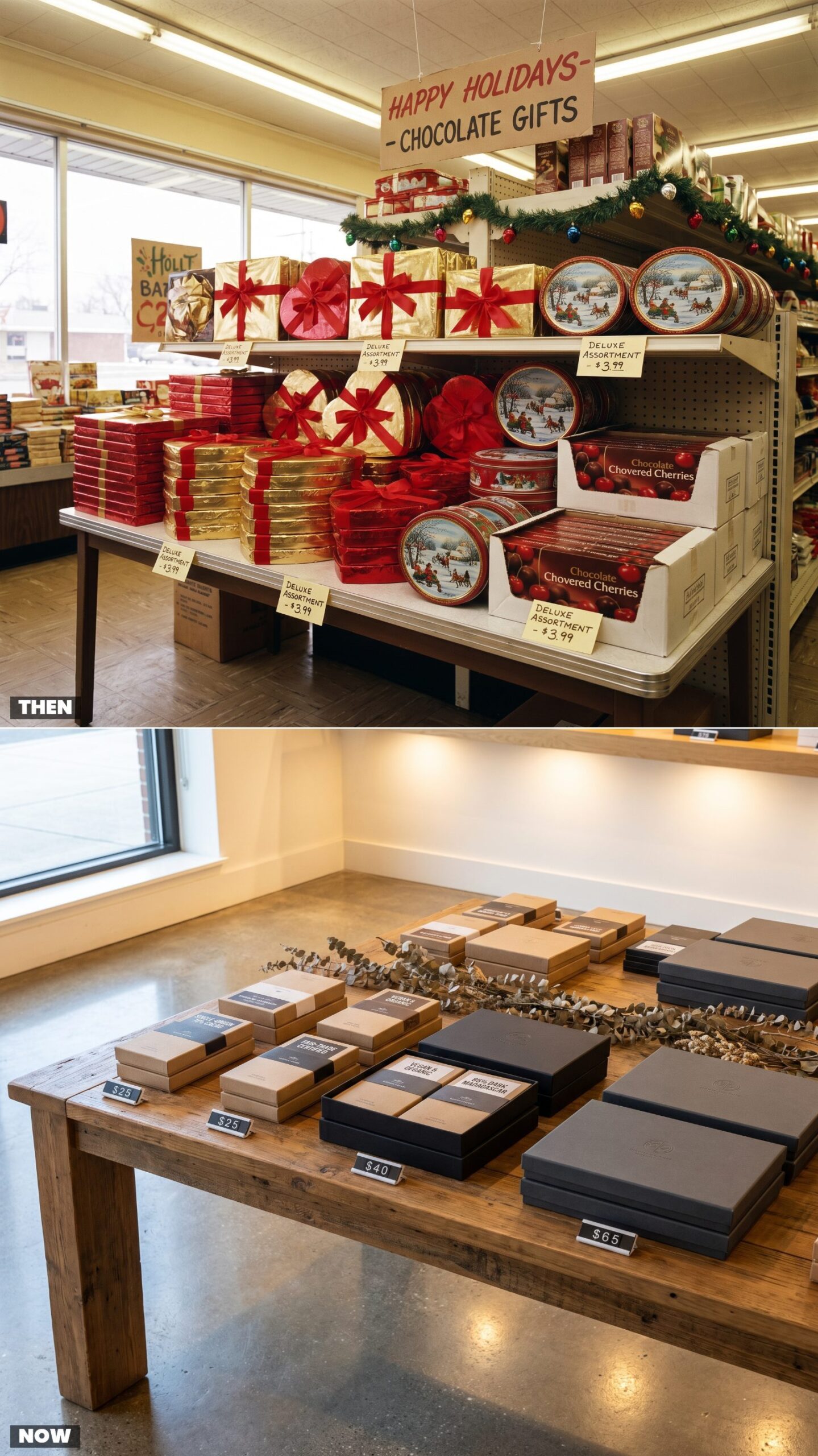
The 1970 chocolate box was gold foil and a satin bow you weren’t supposed to untie too fast. Assorted centers, a little paper map inside so you didn’t bite into coconut by accident, and a tin with a painted winter scene that outlived the candy by a decade. It was the gift you grabbed on the way to somebody’s house, and it always worked.
The gift box now wears its conscience on the front. Single-origin, fair-trade, high-cacao, matte kraft packaging with a certification badge where the ribbon used to be. It costs more and tells you a longer story. Smaller bow, louder talking.
20. Soft-Drink Displays: Returnable Glass Bottles vs. Zero-Sugar Multipacks
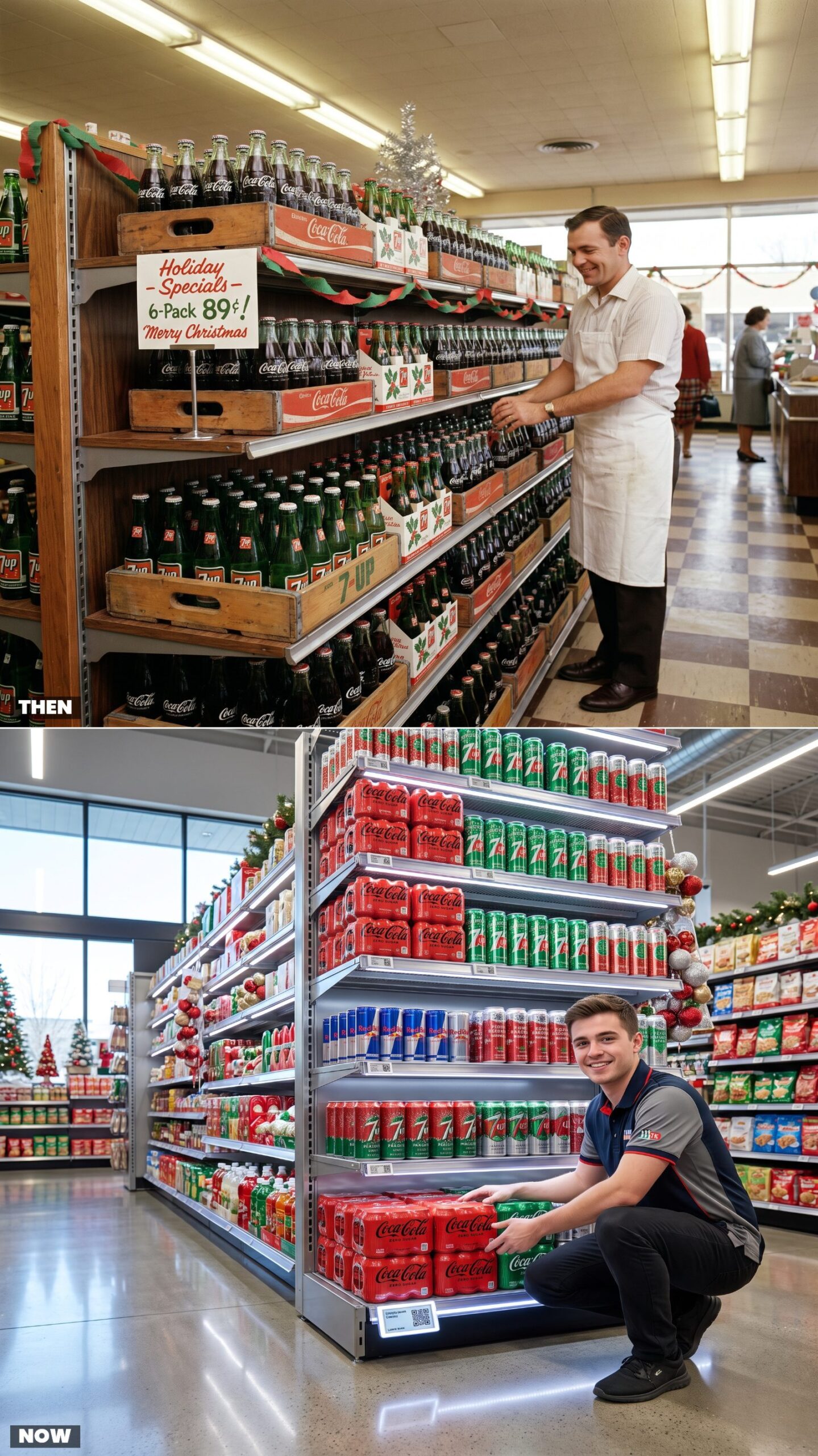
In 1970 the soda display was heavy, literally. Returnable glass bottles clinked in wooden crates, and every kid knew those bottles were worth a nickel back at the counter. Holly printed right on the cardboard six-packs, pop hauled home for the family, empties hauled back next week — that was the rhythm of it.
Now the same endcap groans under shrink-wrapped plastic. Zero-sugar this, sparkling that, a wall of aluminum in metallic holiday reds. The bottles don’t come back anymore, and nobody’s collecting deposits at the register. Honestly? I miss the sound of a crate being set down.
19. Coffee Aisles: Vacuum-Sealed Metal Cans vs. Single-Origin Beans and Pods
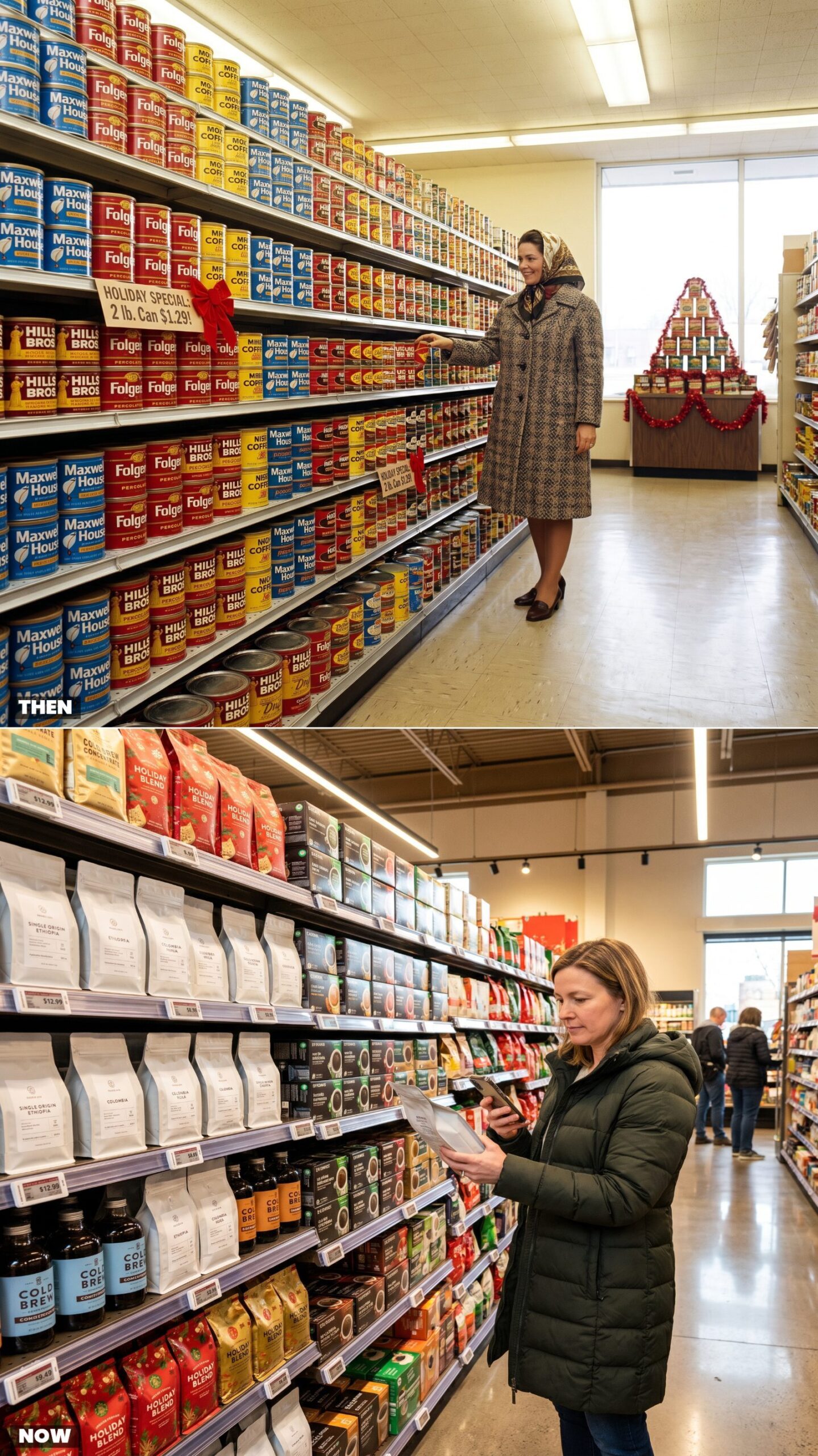
The coffee can was an event. You popped the plastic lid, worked the metal key around the rim, and the whole kitchen smelled like Sunday morning before the pot even started. One brand, one grind, maybe a fancy tin around the holidays if company was coming.
The modern aisle wants to have a conversation with you. Origin, roast level, tasting notes, pods for the machine on the counter — bags instead of cans, resealable zippers instead of that satisfying hiss. More choice than anyone strictly needs. The holiday blends still smell like December, at least.
18. Tea and Cocoa Shelves: Instant Tins vs. Elaborate Hot-Chocolate Bars
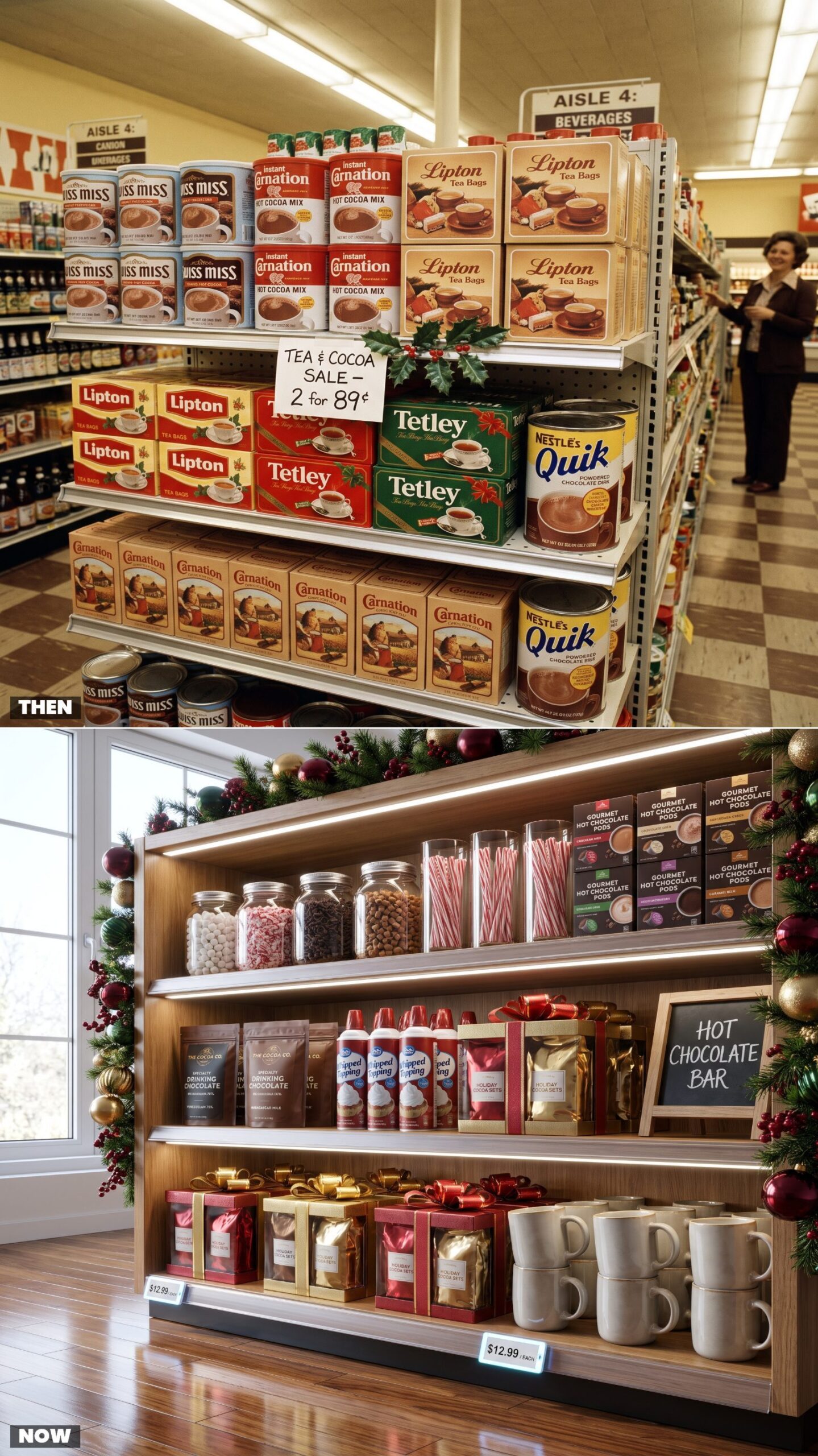
Cocoa used to be a tin and a promise. You spooned the powder into a mug, added hot milk, and if the box had holly on it, that was the holiday spirit sorted. Tea was tea. A red box near the register in December, and everyone was satisfied.
Today there’s practically a hot-chocolate department. Drinking chocolate flakes, gourmet marshmallows in a jar, peppermint stir sticks, gift sets in foil boxes — the shelf wants you to build an experience.
17. Beer Departments: Stacked Domestic Cases vs. Craft Holiday Releases
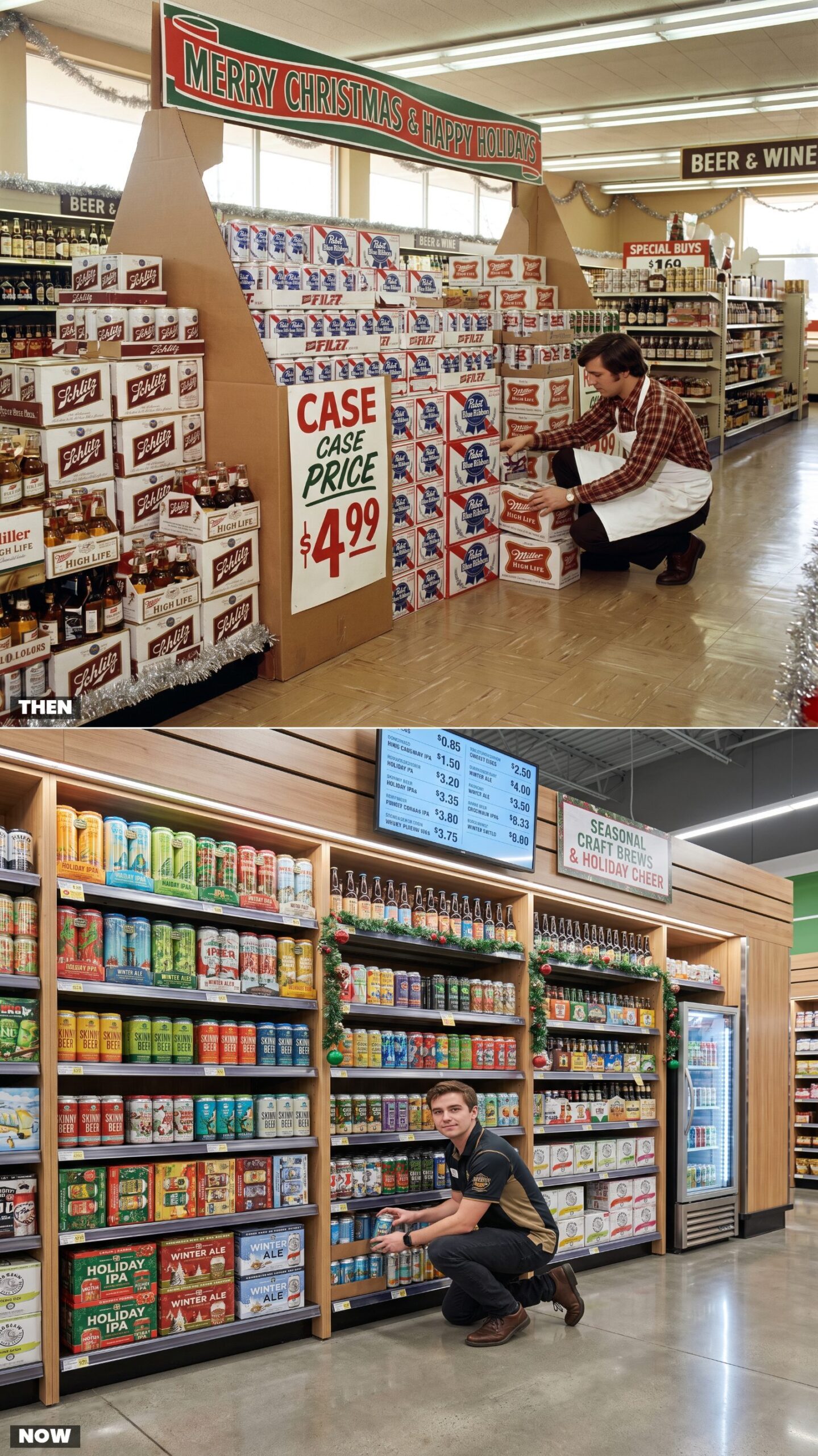
Christmas beer in 1970 meant a case of the domestic stuff stacked shoulder-high on a cardboard floor display. Maybe two brands to choose from. You grabbed a case for the party, the clerk waved you toward the register, and that was the whole transaction.
Now the wall reads like a gallery hung by someone with strong opinions. Winter warmers, spiced holiday ales, mix-your-own six-packs in tall cans with labels somebody clearly paid a designer to make. More styles on one shelf than a whole town used to sell. I’m not complaining, exactly. But a plain old case had a certain honesty to it.
16. Frozen-Food Aisles: Chest Freezers vs. Glass-Door Walls With Digital Screens
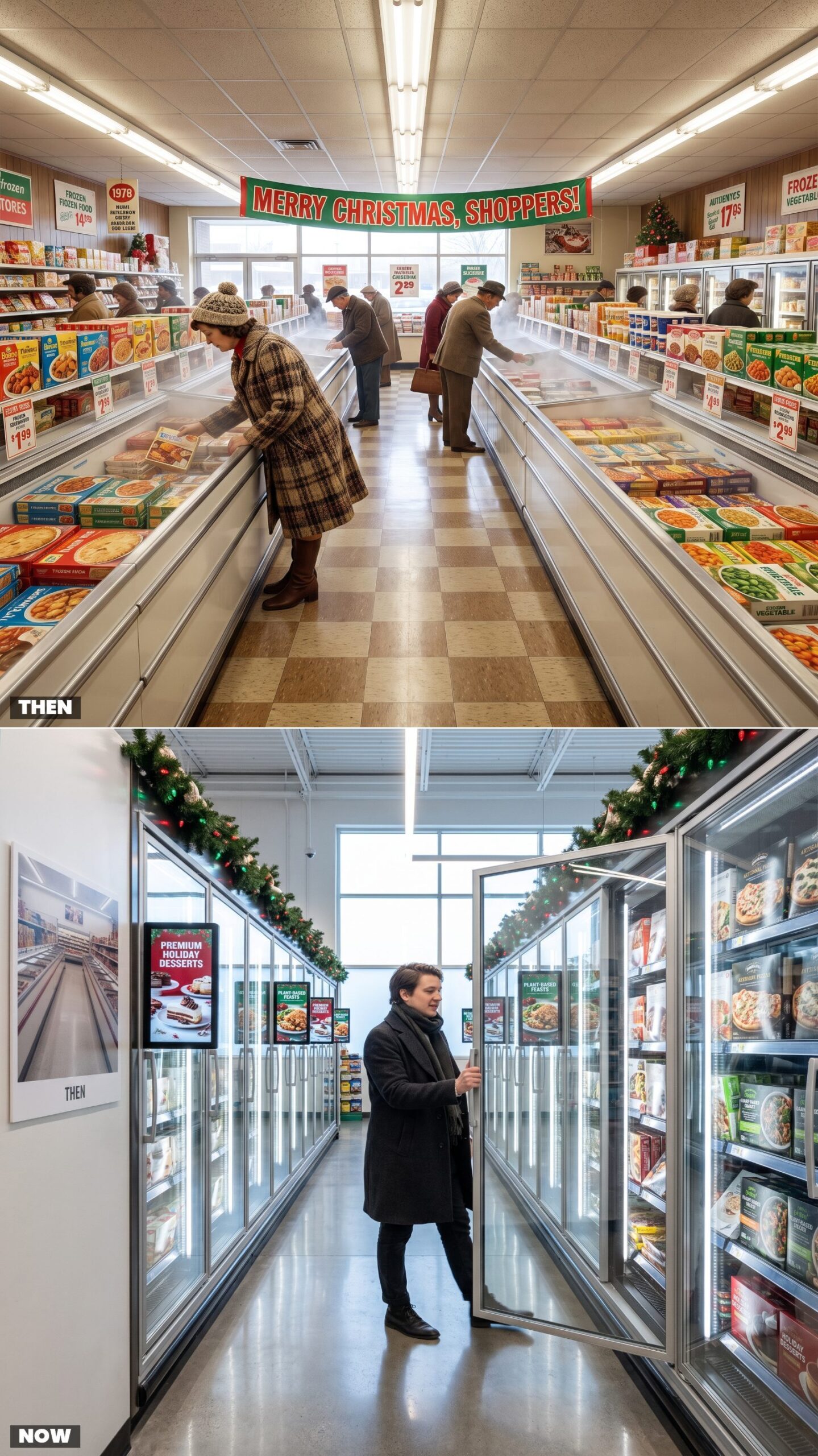
You leaned into the frozen aisle in 1970, because the chest freezers were open on top and you bent down into the cold fog to fish out a TV dinner or a frozen pie. Kids loved sticking their arms in up to the elbow while the cold air rolled right up into your face.
The freezers stand up now, behind glass doors, some with little video screens playing ads at you while you decide. LED light, no fog, no bending. More efficient, sure. But there’s no drama in opening a door.
15. Paper Goods: Printed Christmas Napkins vs. Coordinated Disposable Tablescapes
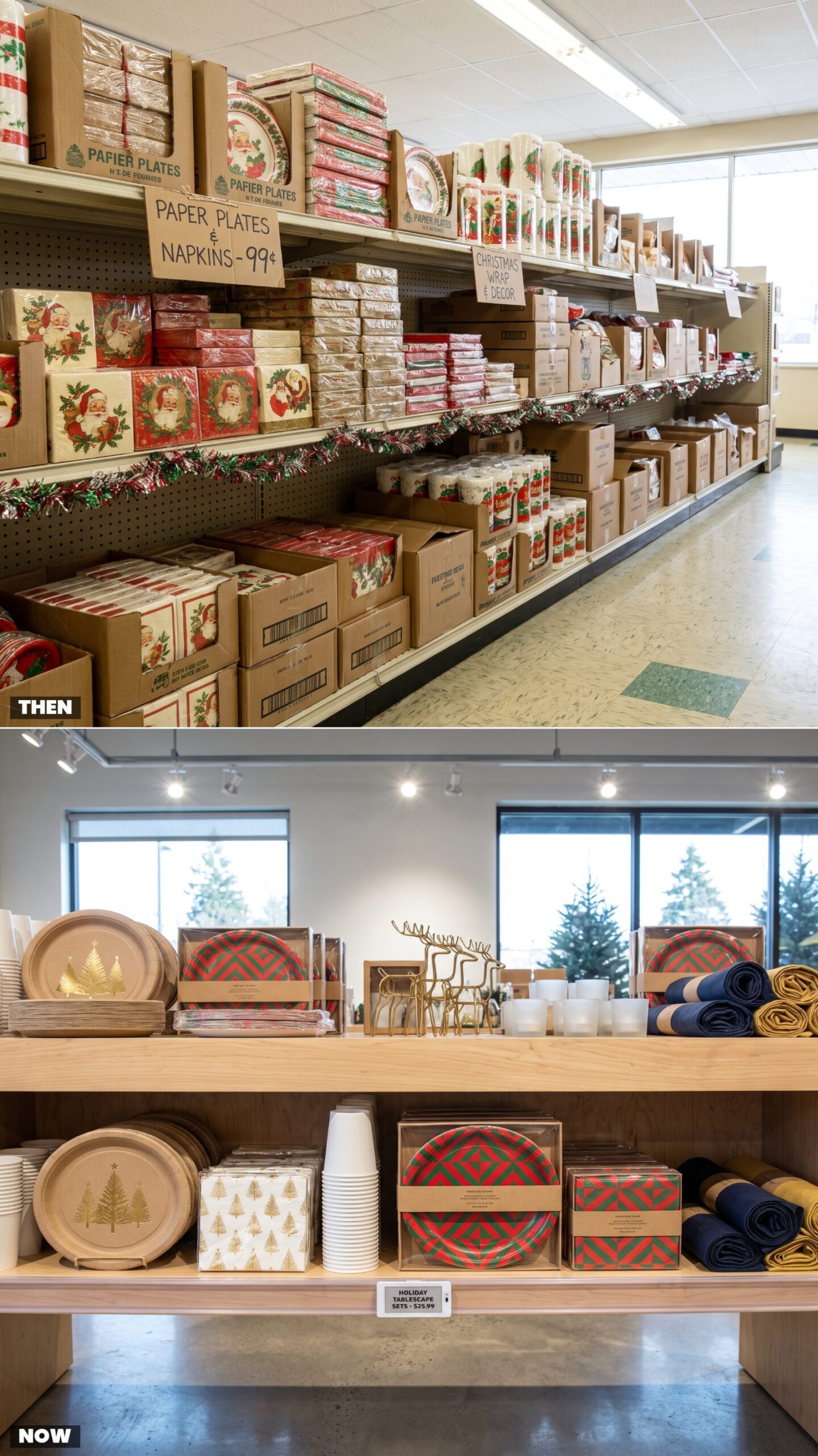
A pack of napkins with Santa on them was enough in 1970. You grabbed the holly-print ones, maybe matching paper plates if you were having people over, and that was the extent of the coordination. Cheerful graphics, a little goofy, nobody minded.
The modern paper aisle expects you to design a table. Napkins that match the plates that match the cups that match the runner that matches the little centerpiece, all sold in coordinated sets. It looks great on the table. It also costs three times what a Santa napkin used to.
14. Pet Sections: Basic Kibble Bags vs. Pet Stockings and Refrigerated Food
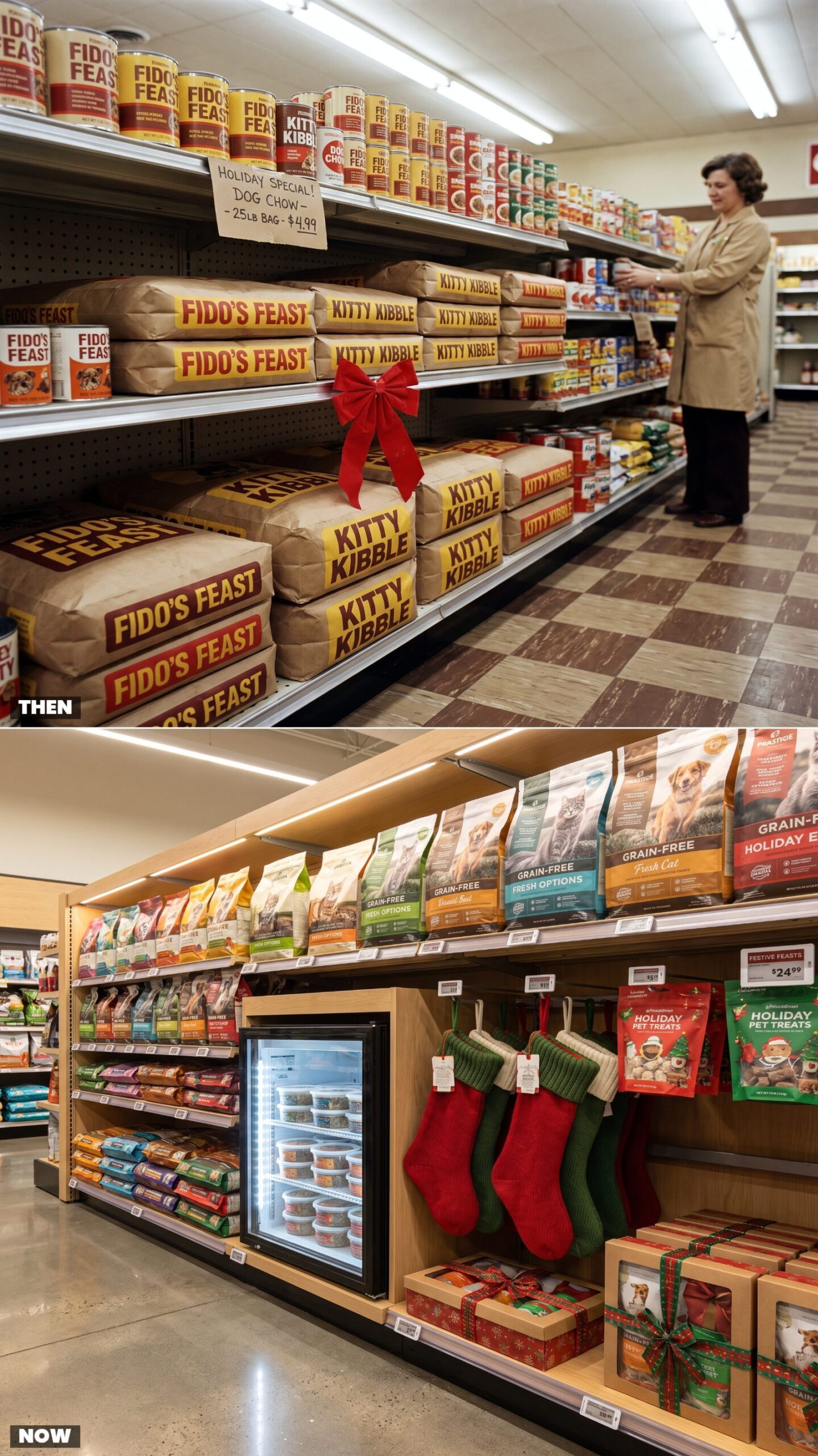
The pet aisle in 1970 was short and to the point. A couple bags of kibble, some cans, a price card, done. Nobody was buying the dog a Christmas present at the grocery store, and if you’d suggested it, folks would’ve looked at you funny.
Walk down there now and there’s a stocking with your dog’s name practically waiting on it. Refrigerated fresh food, holiday treats, gift sets, grain-free everything. Somewhere along the way the pet section got serious. I have thoughts about a refrigerated case for dog food, but I’ll keep them to myself.
13. Toy Racks: Small Tin Toys Near Checkout vs. Licensed Seasonal Gift Displays
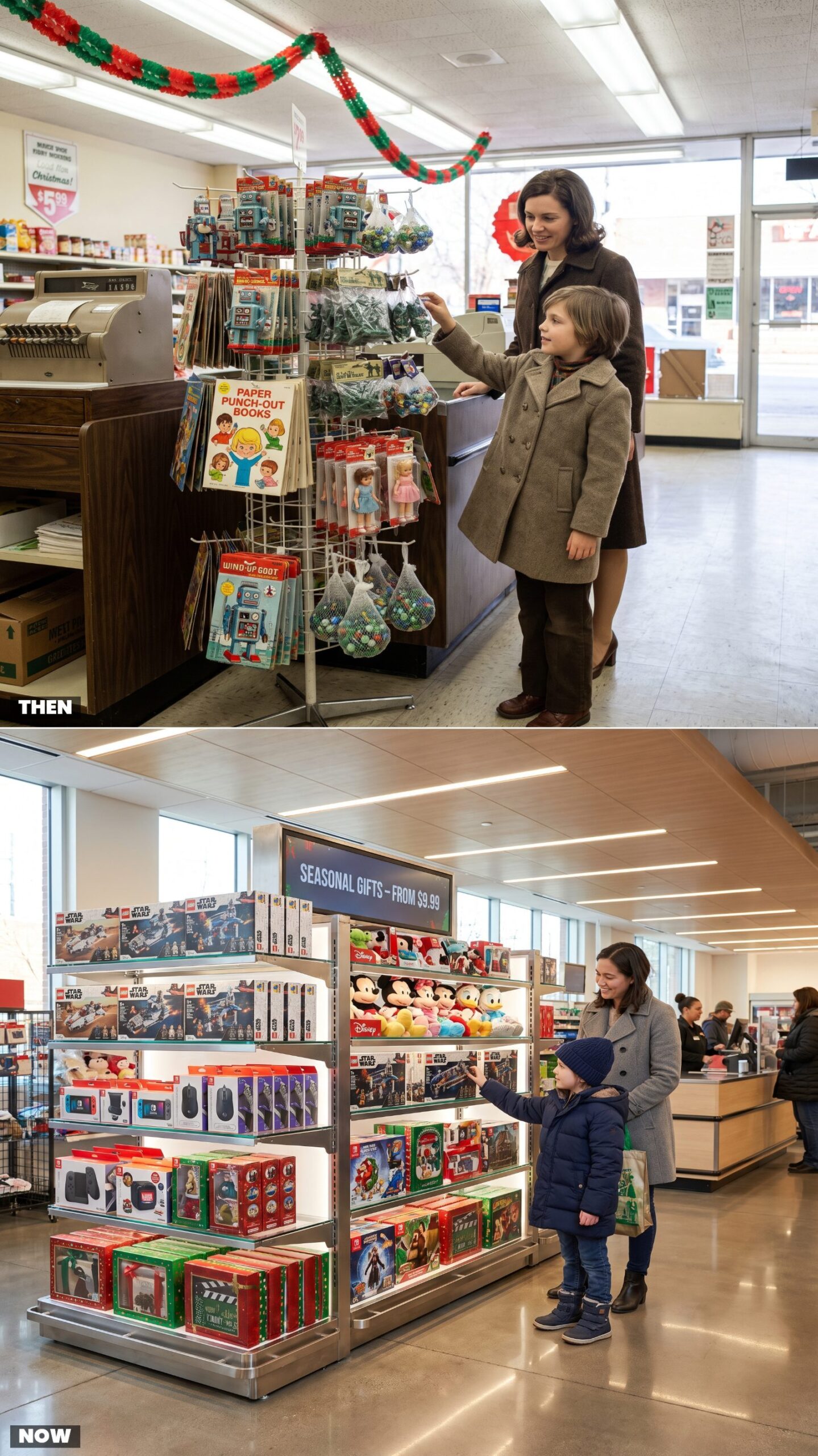
The toys lived on a spinning wire rack by the register in 1970 — little tin wind-ups, plastic soldiers, a bag of marbles, punch-out paper books. Cheap enough that a kid could beg for one and sometimes win. The whole rack cost less than one thing on today’s shelf.
Now there’s a full seasonal gift display: licensed characters, plush, small electronics, glossy packaging designed to catch a seven-year-old’s eye from across the store. The impulse buy went from a nickel to real money.
12. Magazine Racks: Christmas Recipe Issues vs. Slimmed-Down Lifestyle Displays
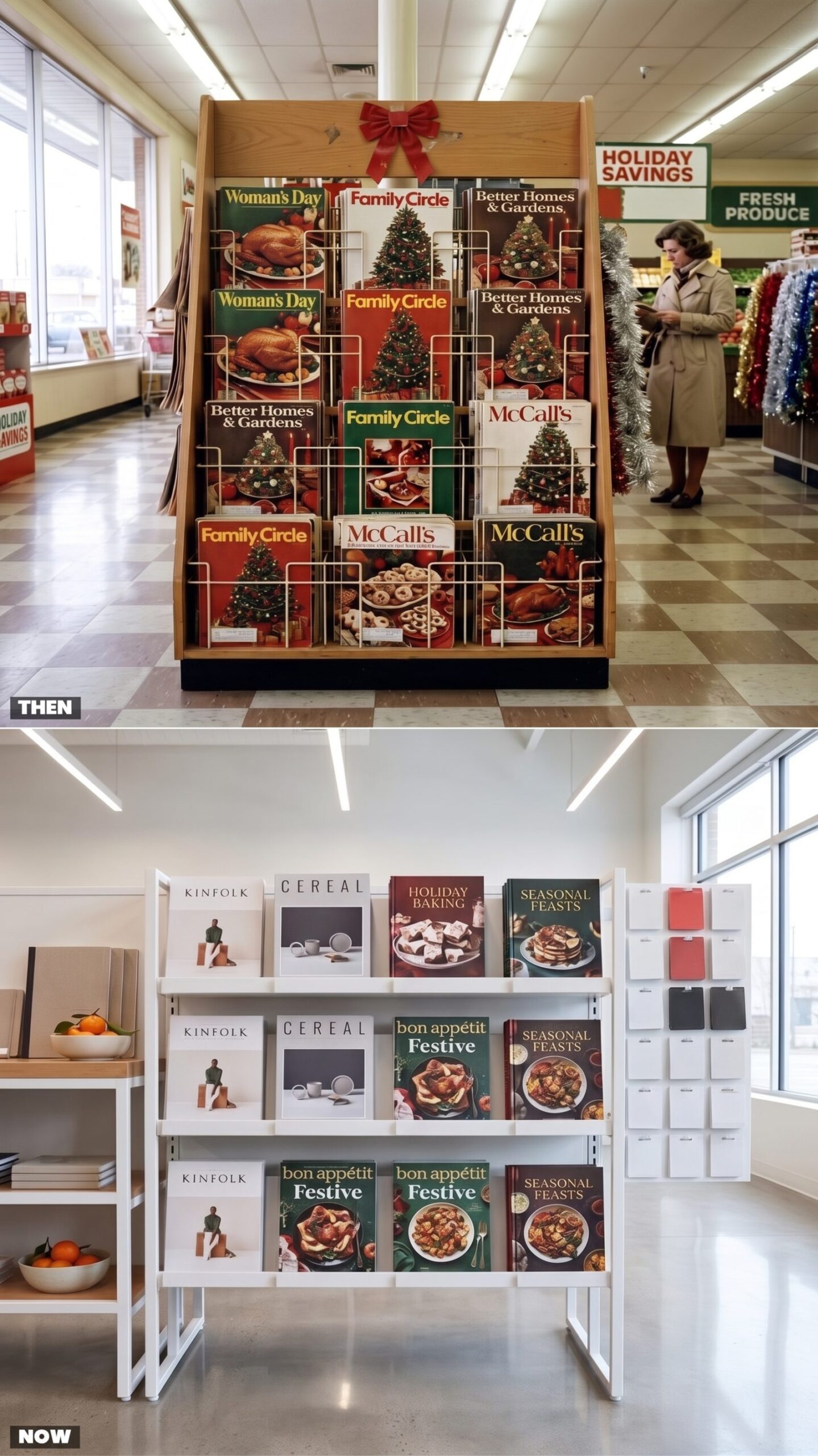
The magazine rack in December was stuffed to bursting. Homemaking titles, family magazines, holiday recipe issues with a golden roast on the cover you could practically smell. You’d flip through one in line while the cart got rung up, and half the time it came home with you.
The rack is thinner now. Fewer titles, more space between them, a couple glossy holiday specials, and a whole hook of gift cards where the reading used to be. People pull the recipes off their phones. The rack knows it, and it stopped fighting.
11. Greeting Card Aisles: Long Rows of Boxed Cards vs. Compact Boutique Selections
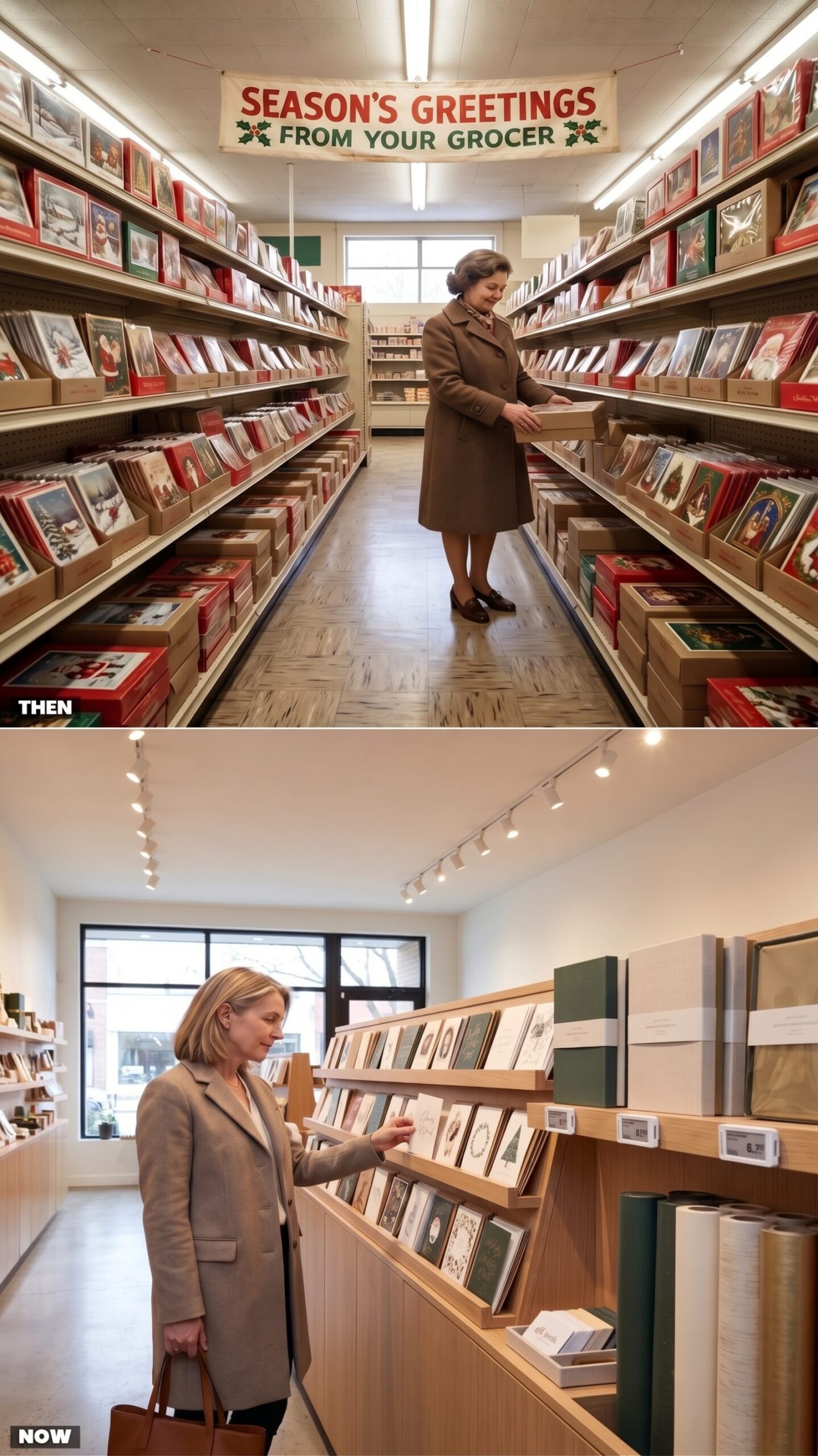
Sending cards used to be a project. The aisle in 1970 ran long, both sides packed with boxed sets, thirty or forty cards to a box, snowy churches and nativity scenes and jolly Santas. Everybody on the list got one, and you bought the boxes deep.
Then the aisle shrank. Now it’s a compact boutique of single designer cards in little slots, a few slim boxed sets, gift wrap tucked in beside it. Fewer people mail cards, so the store gives it less room. Those long deep rows are mostly a memory — and, I’ll admit, a warmer one than I expected.
10. Holiday Music: Christmas LP Racks vs. QR Codes for Streaming
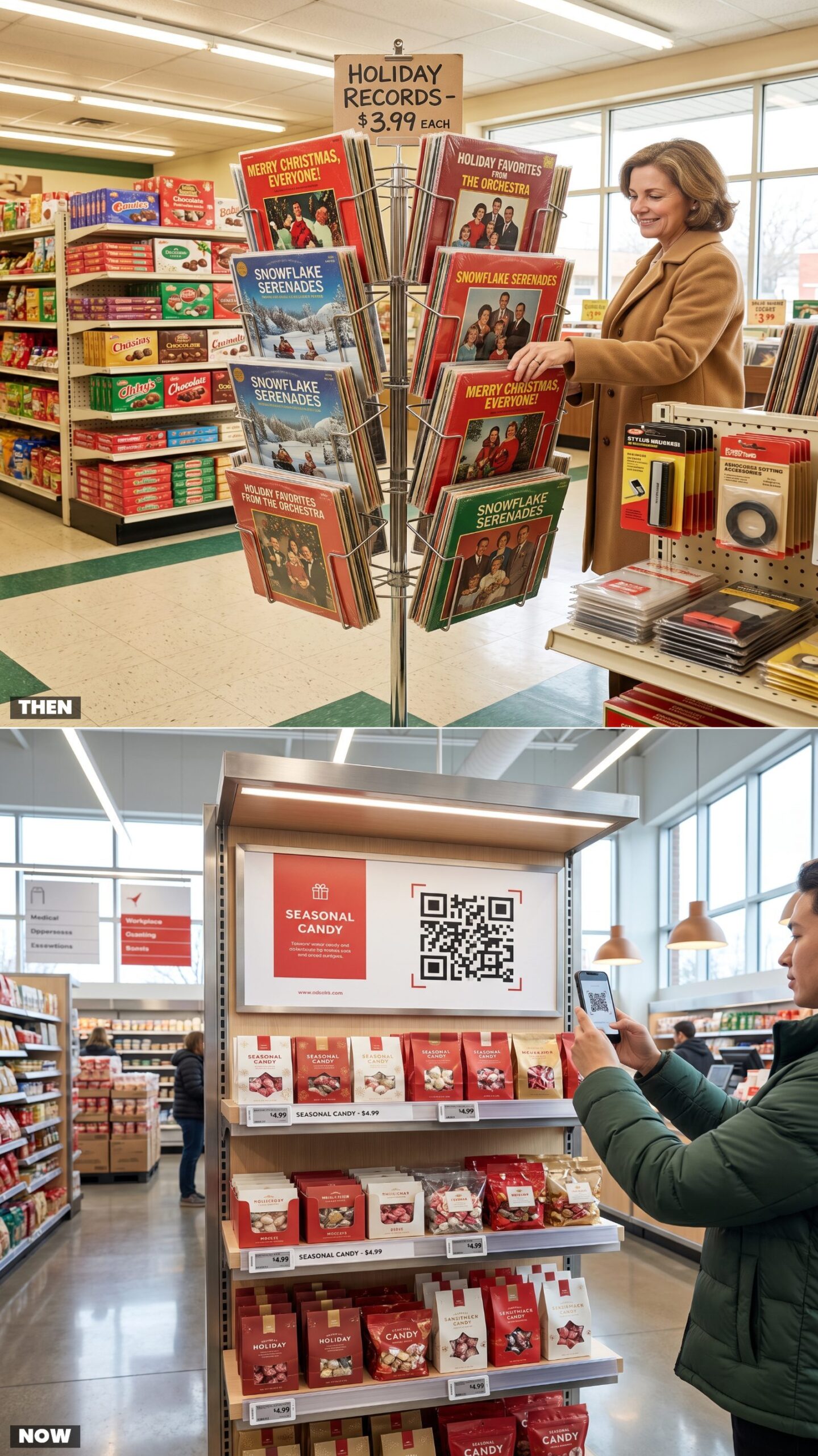
Back in 1970, the store handed you your holiday soundtrack in a cardboard sleeve. Firestone and Goodyear pressed their own Christmas LPs, and the wire spinner rack near the candy aisle spun with orchestras, choirs, and crooners in red-and-gold jackets. You bought the record, brought it home, dropped it on the turntable, and there it stayed all December.
Now there’s a QR code taped to a candy shelf. Scan it and the store’s curated playlist pipes through your earbuds while a speaker overhead loops the same twelve songs. Nothing to hold. Nothing to keep.
9. Floral Departments: Cellophane Poinsettias vs. Designer Arrangements
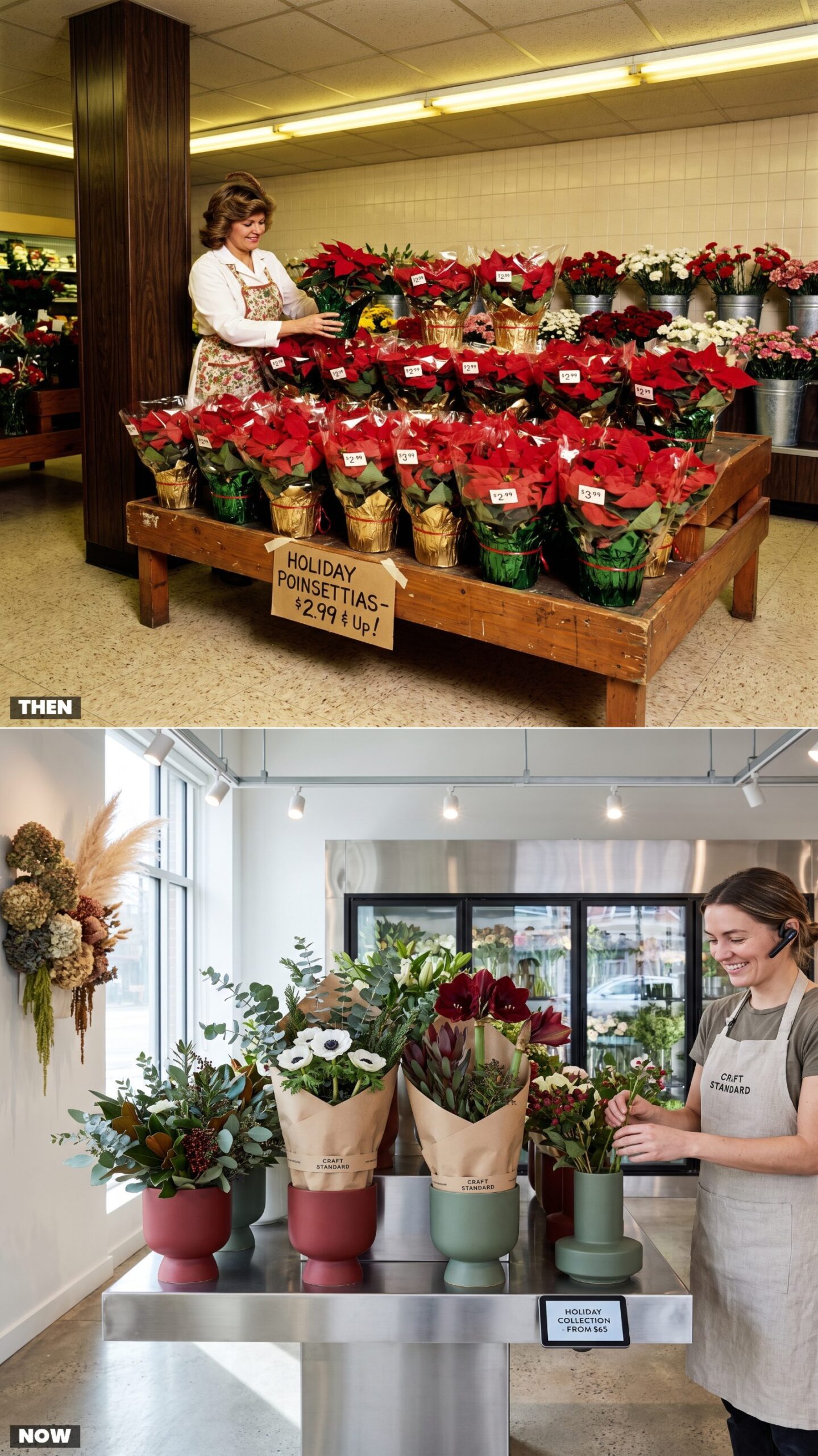
A 1970 poinsettia came sheathed in stiff cellophane that crackled when you carried it to the car, the pot dressed in gold foil, a twist tie holding the whole thing shut. You grabbed one on your way past the produce for a couple of dollars, and it lived on the windowsill until New Year’s.
The modern floral department wants to sell you a moment instead. Arrangements come styled like a magazine shoot — kraft paper, ceramic pots, prices to match. Beautiful, sure. But nothing crackles.
8. Food Samples: Electric-Skillet Demos vs. Branded Sampling Carts
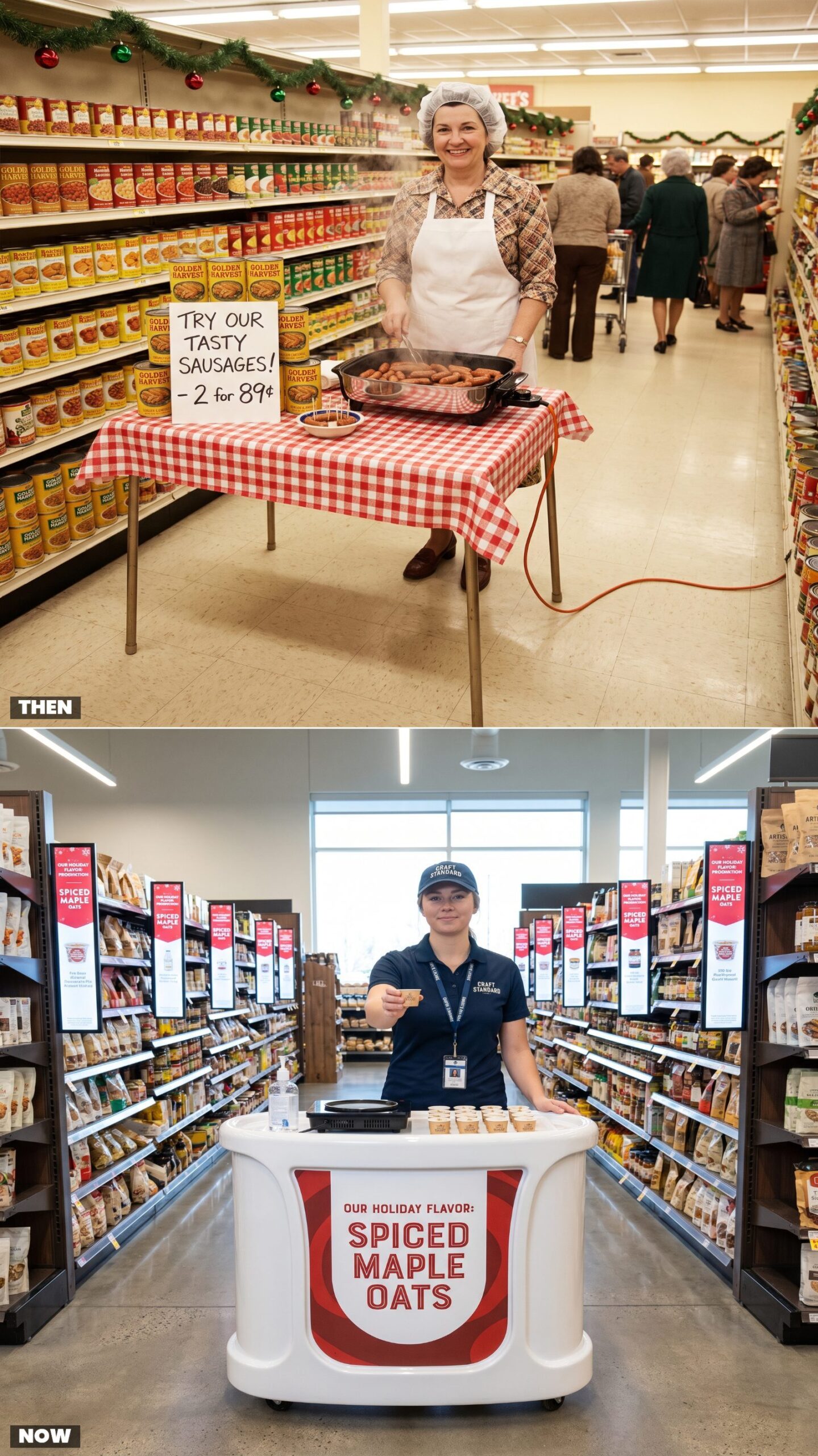
The sample lady is one of the great lost institutions. In 1970 she set up a folding table, plugged an electric skillet into an extension cord, and cooked cocktail sausages right there in the aisle, spearing one on a toothpick and handing it over with a wink. By noon the whole store smelled like her station.
Today the samples come in little paper cups off a molded plastic cart, portioned and sanitized, a printed graphic where her handwritten sign used to be. Efficient. A little lonely.
7. Employee Uniforms: White Aprons and Paper Caps vs. Polos and Headsets
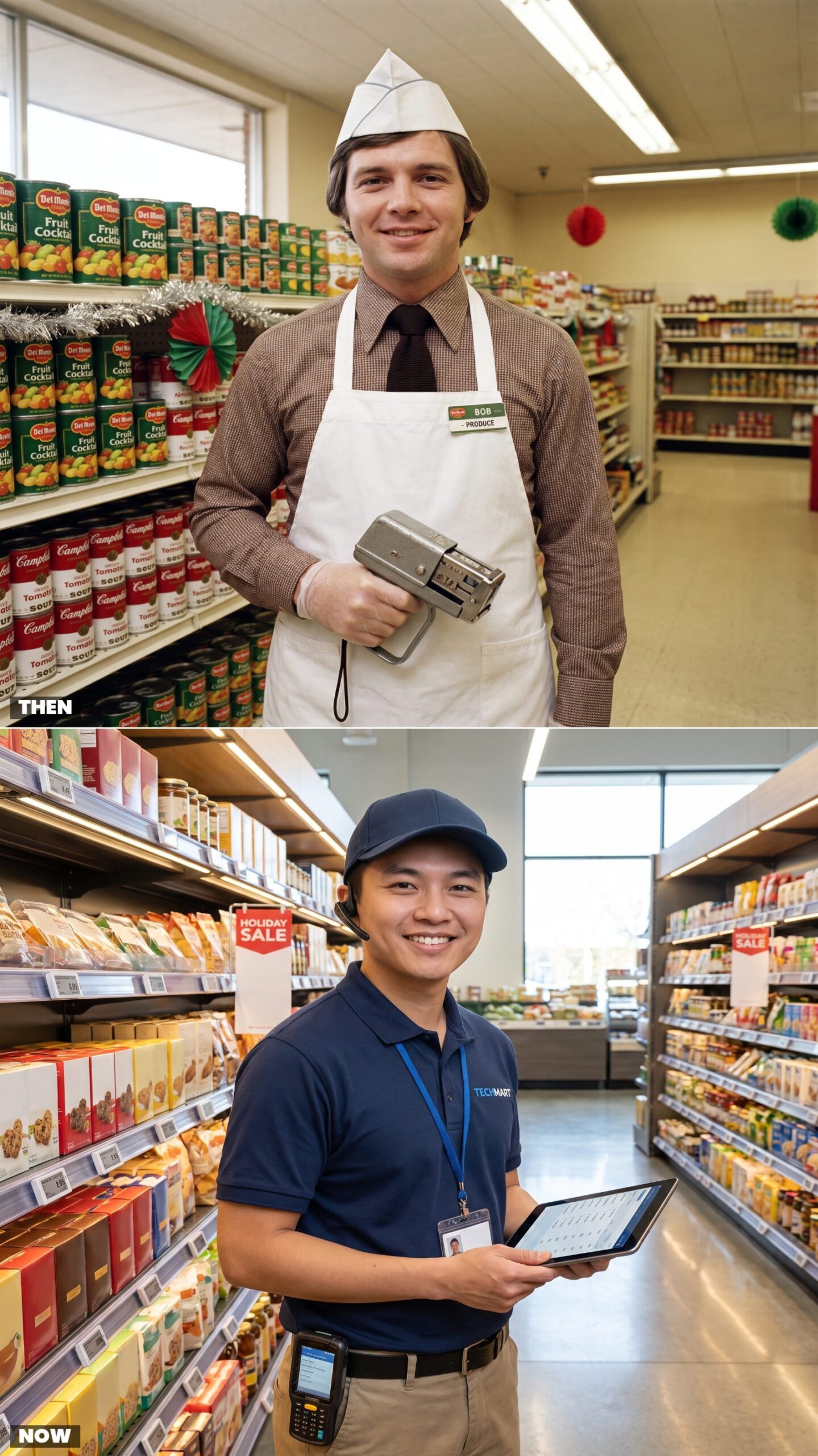
There was a dignity to the old uniform. A white bib apron, a shirt and tie underneath, and that folded paper cap perched on top like the clerk had somewhere important to be. He carried a price-stamping gun and knew where everything was because he’d stocked it himself.
Now it’s a branded polo, a ball cap, a headset crackling in one ear, a scanner on the hip. He’s plugged into the store’s network, tracking inventory in real time — faster, connected, and somehow harder to flag down when you can’t find the cranberry sauce.
6. Checkout Lanes: Narrow Mechanical Belts vs. Self-Checkout Corrals
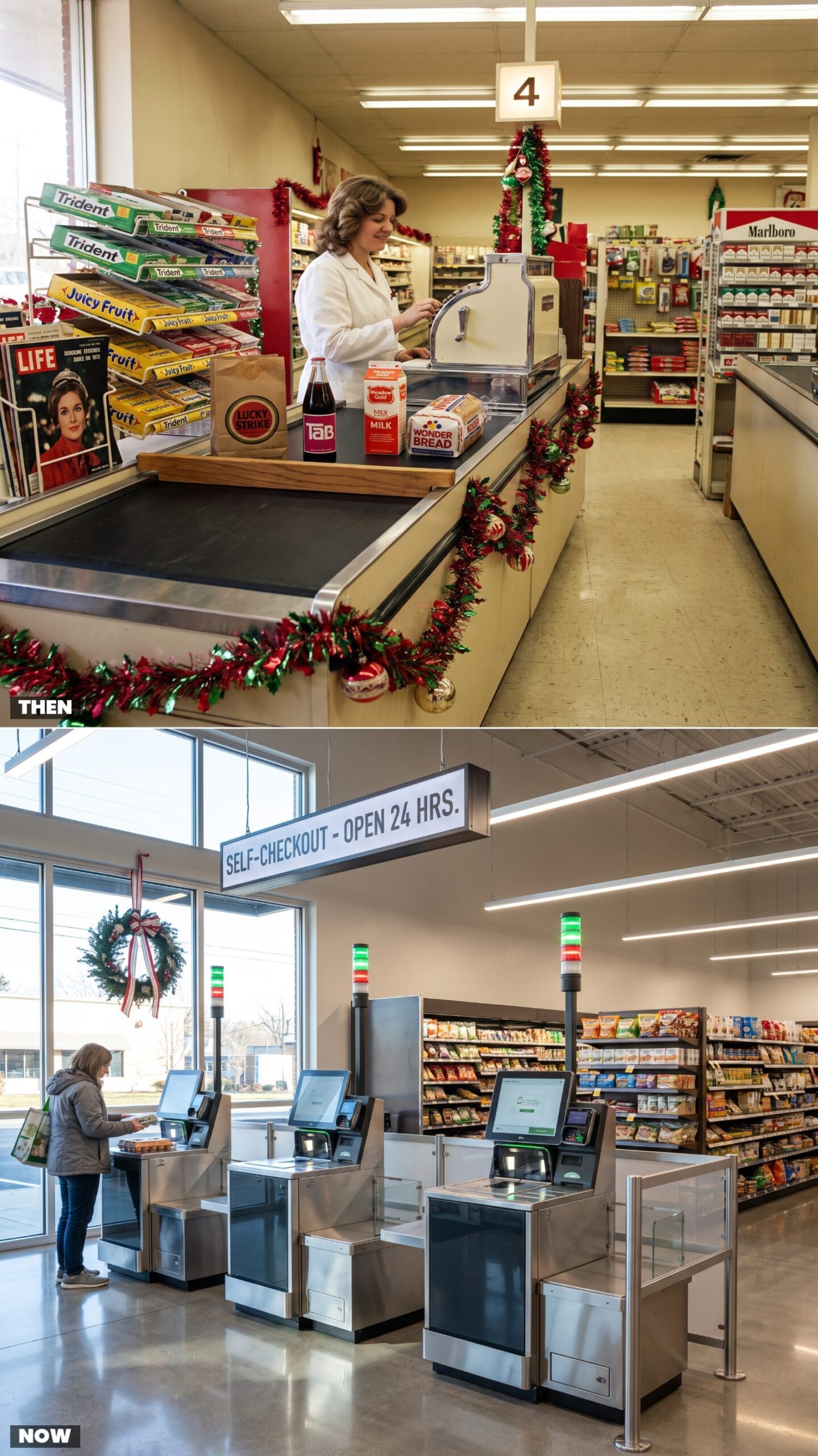
The old checkout lane was a tight little canyon — a stubby rubber belt, a wooden divider bar you set behind your order, cigarette racks pressing in on both sides. You unloaded your cart, the belt lurched forward, and the cashier’s hands never stopped moving.
Today you walk into a corral of touchscreens and ring yourself up under a blinking status light, bagging your own groceries at a station that scolds you the second it detects an “unexpected item.” The store handed you the job and called it convenience.
5. Cash Registers: Keyed Electromechanical Machines vs. Touchscreens
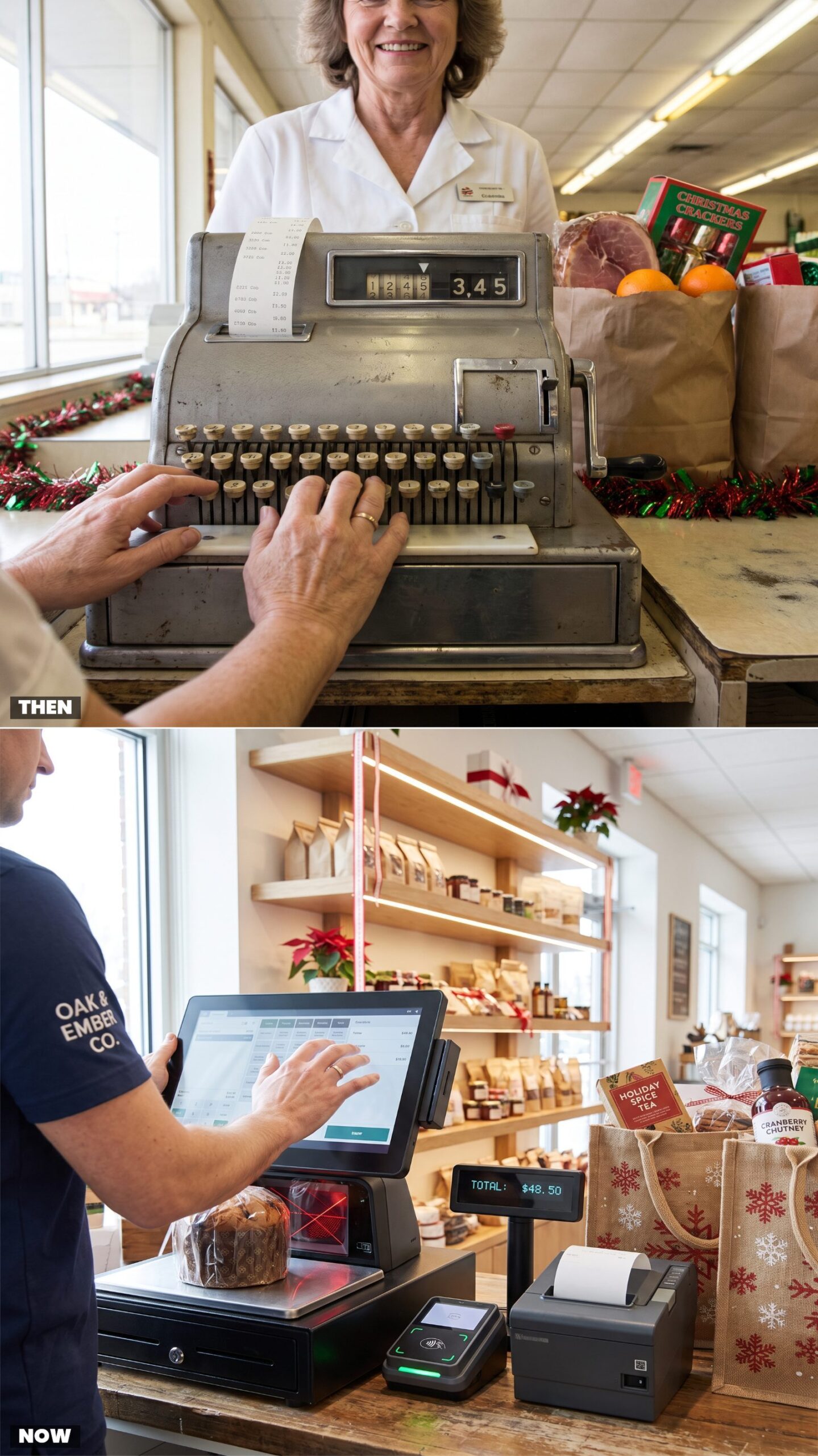
Ringing up a 1970 register was a full-body activity. The cashier punched heavy round keys, pulled a chrome lever, and little numbered tabs popped up behind the glass with a satisfying ka-chunk. The drawer flew open like a starting gun. Every price was memorized or read off the stamped sticker.
The modern terminal is a black touchscreen and a laser that reads the barcode before you’ve set the item down. Faster by a mile. But nothing about a touchscreen has ever gone ka-chunk, and I miss the sound.
4. Grocery Bagging: Paper Sacks and Carryout Boys vs. Bagging Stations
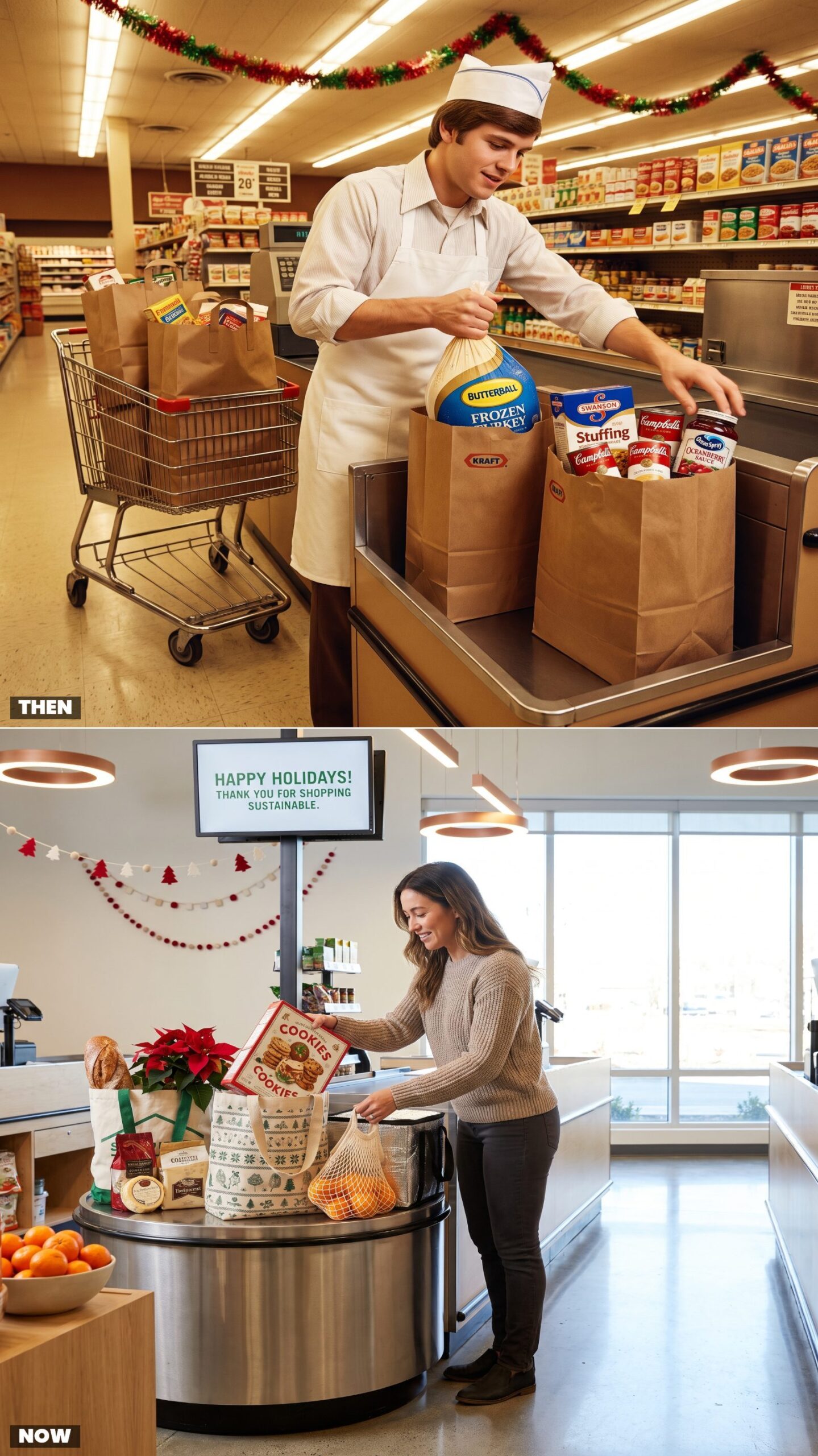
Someone bagged your groceries in 1970, and they were good at it. Heavy cans on the bottom, bread on top, everything squared into a brown Kraft sack that stood up on its own. Then a carryout boy hoisted it into your cart without being asked.
Now you bag your own at a stainless carousel, cramming a holiday haul into canvas totes you remembered to bring (or bought again at the register because you forgot). The paper sack still exists. The person who packed it for you mostly doesn’t.
3. Deals and Rewards: Clipped Coupons and Green Stamps vs. App Offers
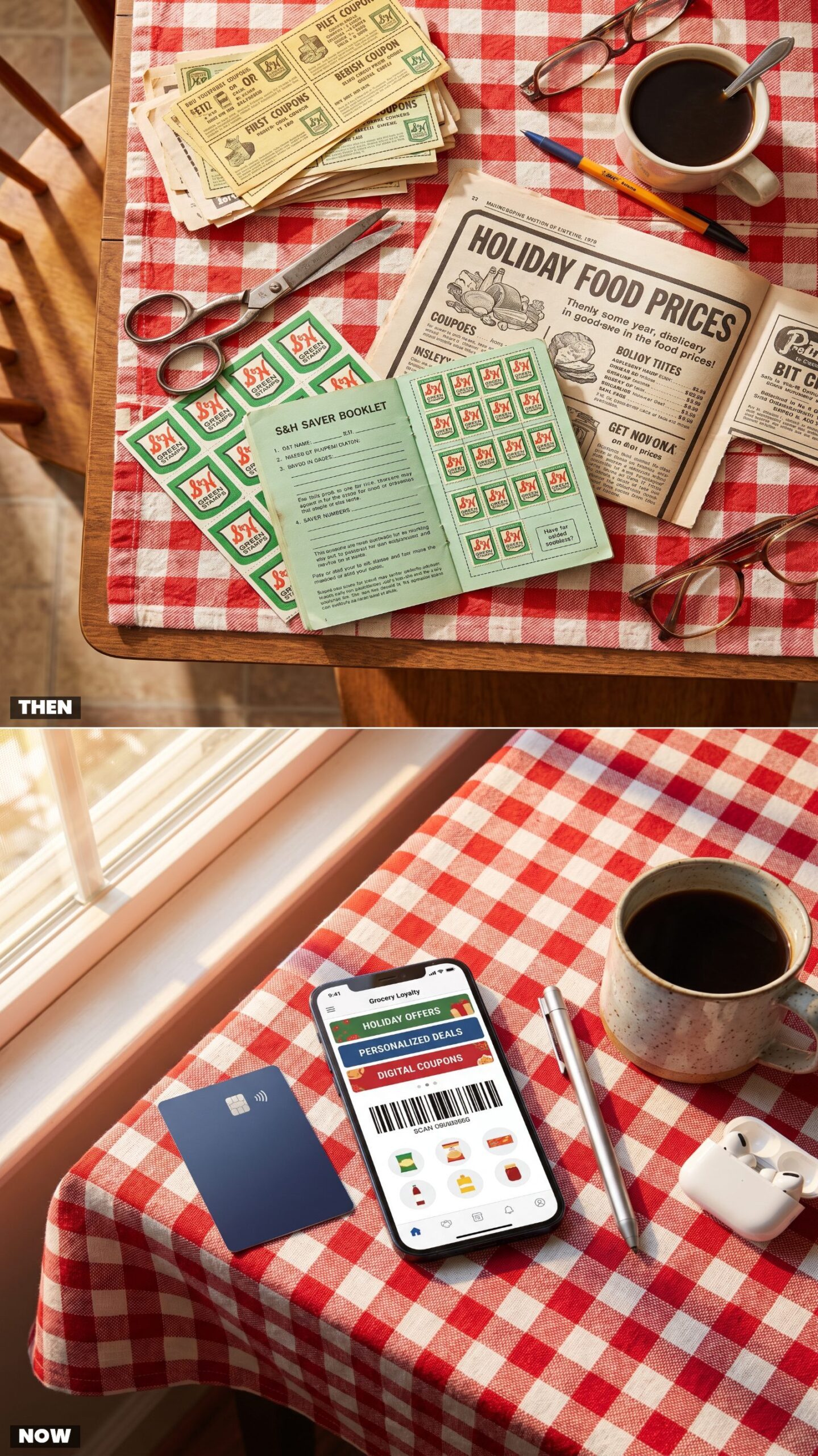
Saturday mornings smelled like newsprint. You spread the paper across the kitchen table, scissors in hand, and clipped the week’s grocery coupons for the Christmas shop. And the Green Stamps — every purchase earned them, you licked them into a saver book, and enough books got you a toaster or a lamp from the redemption center.
Now the deals live in an app that already knows you buy the store-brand cranberry sauce. It serves you a personalized offer before you’ve thought to want it. No scissors. No licking stamps. No toaster at the end of the rainbow.
2. Bottle Returns: Manual Sorting Counters vs. Reverse-Vending Machines
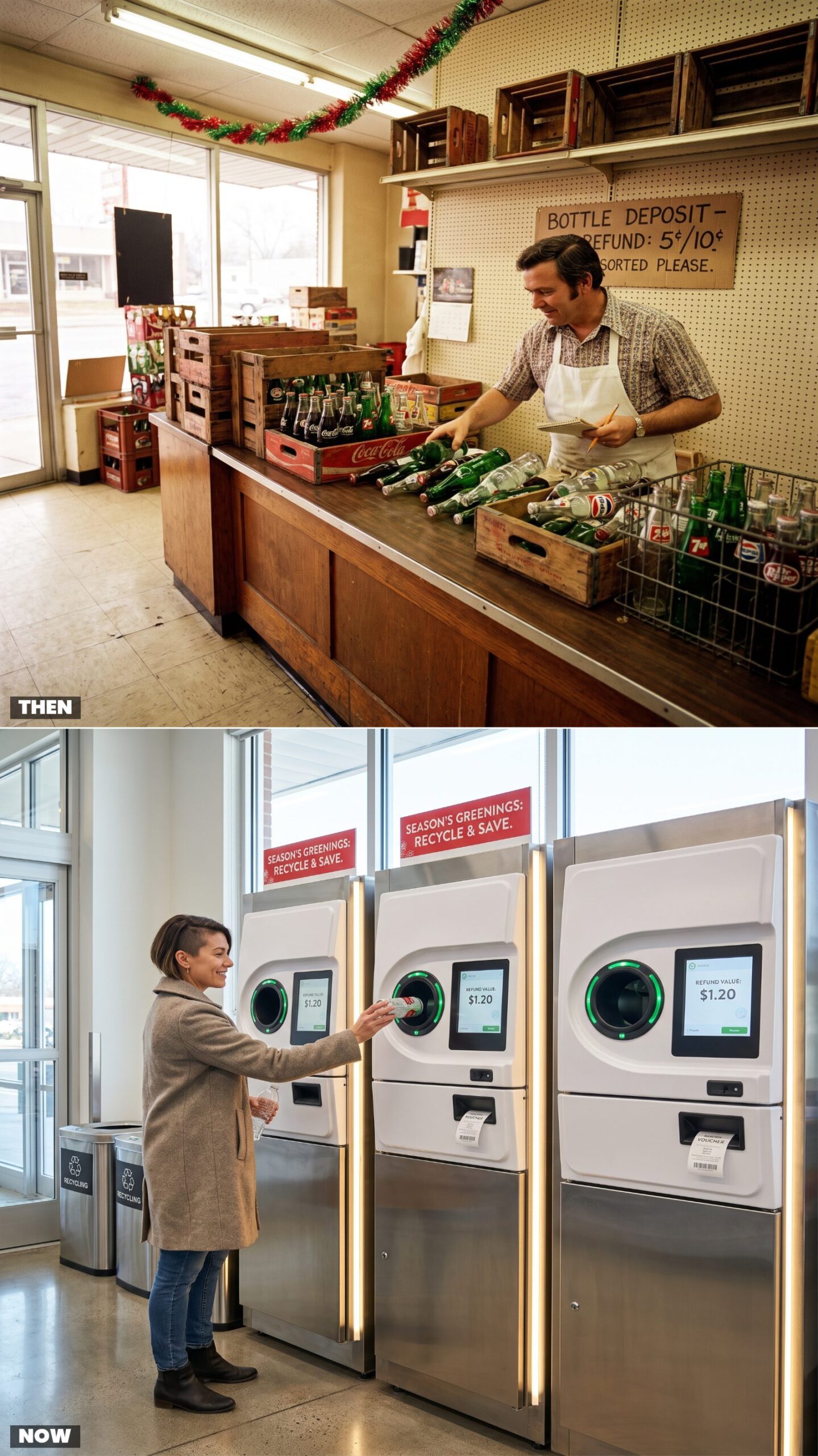
Returning bottles used to require a human being. You hauled your empties to the counter in a crate, and a clerk counted them out loud, sorting green from clear, tallying your deposit refund on a pad before counting the coins into your palm. The glass clinked. It was a whole transaction.
The reverse-vending machine took over. You feed cans and plastic into a humming steel port, it scans each one, and it spits out a voucher you redeem inside. Nobody counts. Nobody clinks. The machine just swallows.
1. Carryout Service: Loading the Station Wagon vs. Curbside Pickup
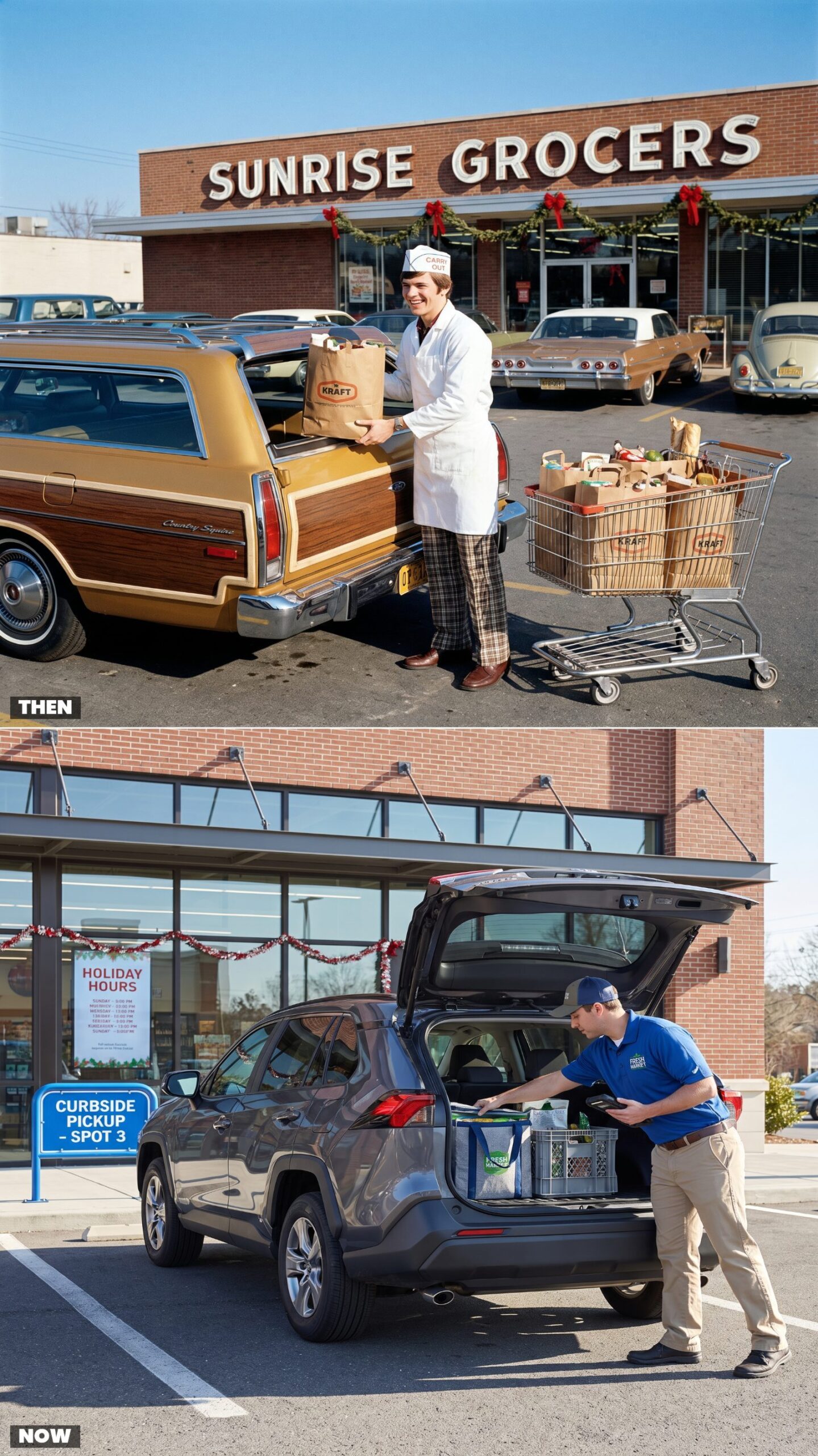
The carryout boy walked your groceries all the way to the car and loaded the paper sacks into the back of the station wagon while you stood there feeling like royalty. Maybe a quarter for his trouble — just part of the deal. You backed out of the lot with the tailgate window rolled up and the bags standing neat behind the seat.
Curbside pickup is the strange modern echo of that, except you never go inside at all. You park in a numbered spot, an employee wheels out your order in totes and a crate, scans a code, and loads your SUV while you scroll your phone.
The service came back around. It just skips the part where you actually shopped.