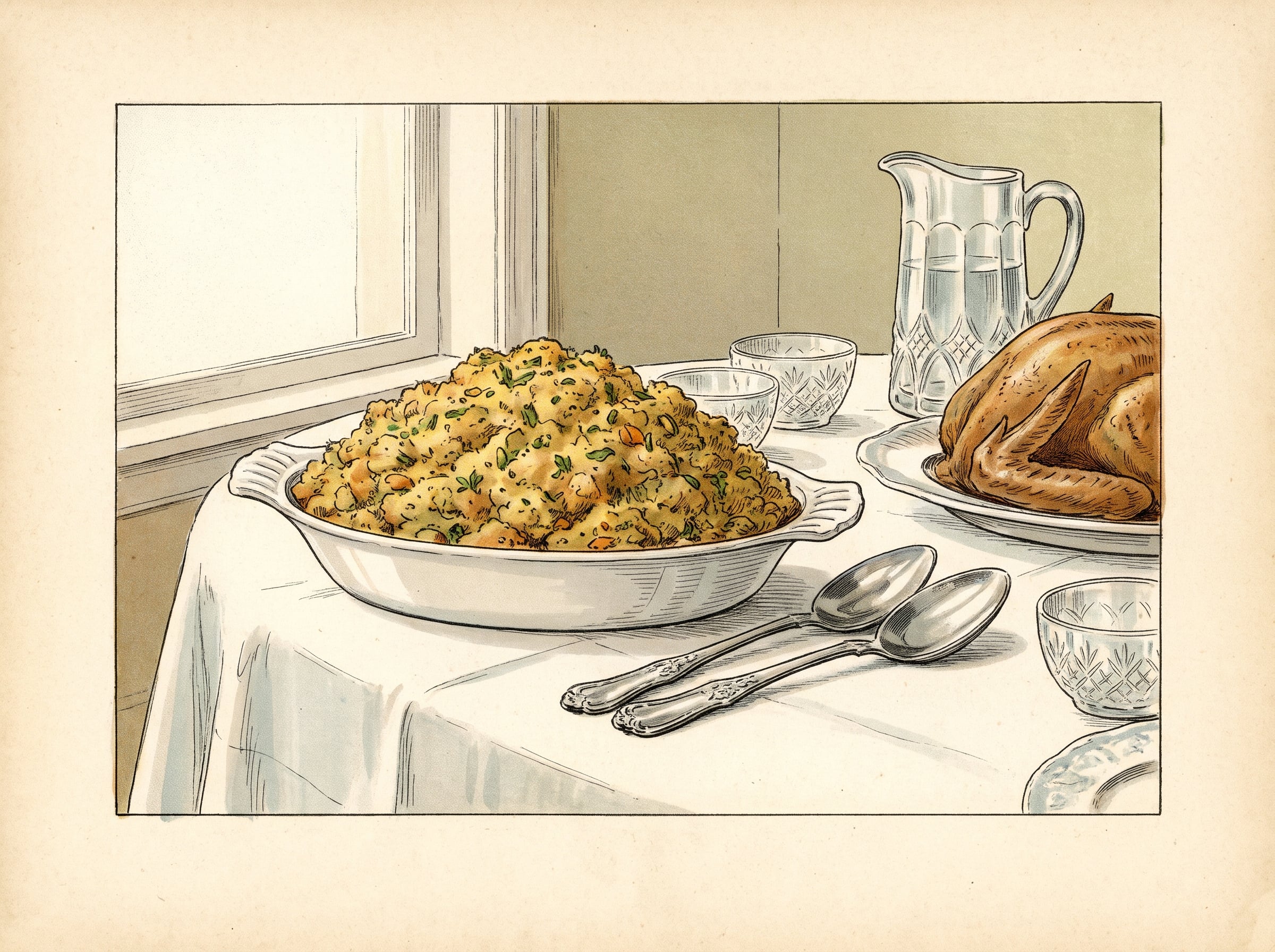
Before stuffing came in a box, it came from stale bread, an onion and a cook who knew by sight when the pan was ready. This recipe, from a 1901 edition of a cookbook, fits two ways of making it into a single paragraph, and its author was a New York naturalist writing under a pen name. It is short and plain, and it leaves a great deal to the cook’s judgment.
Please note that some of the images in this article were created with the assistance of AI.
From The Century Cook Book, 1901
The Story Behind This Recipe
A naturalist in the kitchen
Mary Ronald was a pen name. The name belonged on title pages, and the woman behind it was Augusta Foote Arnold, born in Seneca Falls, New York, in 1844. She was a writer and naturalist who died at her home in New York City in 1904. As Mary Ronald she published two cookbooks, starting with The Century Cook Book, which The Century Co. brought out in New York in 1895. Our recipe comes from the 1901 edition. That same year, the same publisher issued a very different book of hers, a guide to life along the seashore.
Her stuffing recipe takes a lot on trust. The heading says fowls, not turkey, so the filling could go into a chicken, a turkey or whatever bird was headed for the oven. There are no oven times and no temperatures. Ronald explains the filling and then politely steps aside, leaving the stuffing and roasting of the bird to the cook.
Roman roots and many names
No one knows who first packed one food inside another, but the Romans left the earliest written proof. The cookbook credited to Apicius, De Re Coquinaria, includes stuffed chicken, stuffed hare, stuffed pig and, for the more adventurous host, stuffed dormouse. One food-history account describes those Roman fillings as mixtures of vegetables, herbs, spices and spelt, an early kind of wheat. A common explanation for the practice is a practical one: a cleaned-out bird keeps its shape better with something inside it. Over the centuries, cooks traded whole vegetables for stale bread and chopped vegetables, which had the added benefit of soaking up the juices of the roasting meat.
The dish kept changing names along the way. Around 1390 it was farce. By 1538 it was stuffing, and by 1688 forcemeat had joined the list. Americans began calling it dressing around 1850, half a century before this edition of Ronald’s book still used the older word in its heading.
A quick version and a careful one
Ronald fits two recipes into one paragraph, joined by a single ‘or.’ The fast one barely counts as cooking. It calls for a cupful of crumbs and a tablespoonful of melted butter, seasoned ‘highly’ with salt, pepper, thyme, parsley and onion juice. The slower one begins with a minced onion frying in butter. Then come soaked bread squeezed dry, stock, salt, pepper, thyme and celery cut small, all stirred ‘until it leaves the sides of the pan.’ Thyme and onion run through both versions, so the cook could choose by the clock and the pantry and still keep the same thyme-and-onion backbone.
Was it Thanksgiving food? The holiday’s own history is vague on that point. Records of the Pilgrims’ first Thanksgiving mention turkeys and waterfowl but say nothing about stuffing. By the nineteenth century, Thanksgiving menus listed stuffed turkeys and stuffed hams as main courses, and some traditional Thanksgiving stuffings use oysters. Ronald’s bread, onion, celery and herbs sit at the plainer end of that range. The shortcut era was still decades away: General Foods introduced Stove Top in 1972 and marketed it as a Thanksgiving essential.
1900s
What Our Readers Say
- When Piaci Pizza readers loved a food photo and tapped a reason, comfort came out on top at 30%, with nostalgia next at 17%.
From Piaci Pizza reader polls and votes.
Notes From the Era
The recipe · 1901
Stuffing for Fowls
From The Century Cook Book by Mary Ronald (1901). Every word of the recipe below is as printed.
Ingredients
- a cupful of bread-crumbs
- a tablespoonful of melted butter
- salt
- pepper
- thyme
- chopped parsley
- onion juice
- a tablespoonful of butter
- one minced onion
- one cupful of soaked bread, the water being pressed out
- one half cupful of stock
- one teaspoonful of salt
- one half teaspoonful each of pepper and thyme
- one half cupful of celery cut into small pieces
- If you cook this stuffing inside the bird, its center must reach 165°F / 74°C.
Method
-
Mix the crumbs or fry the onion and add the bread
Moisten a cupful of bread-crumbs with a tablespoonful of melted butter; season highly with salt, pepper, thyme, chopped parsley, and onion juice; or put in a saucepan a tablespoonful of butter and fry in it one minced onion; then add one cupful of soaked bread, the water being pressed out, one half cupful of stock, one teaspoonful of salt, one half teaspoonful each of pepper and thyme, and one half cupful of celery cut into small pieces.
-
Stir until it leaves the pan
Stir it until it leaves the sides of the pan.
Our notes
Reading It Today
Cupfuls and spoonfuls. A cupful is one cup (8 fluid ounces), a tablespoonful is a tablespoon and a teaspoonful is a teaspoon. One cup of bread makes a fairly small batch, closer to what a chicken would hold than a large turkey, so a bigger bird would call for scaling it up several times over.
Onion juice. Onion juice is what you get by grating an onion and pressing the pulp through a fine sieve or cloth. It gives the crumbs a strong onion flavor with no pieces of onion in them. The second method uses a minced onion fried in butter instead, which would be milder and a little sweeter.
Two different textures. Judging from the ingredients, the quick version would be loose, lightly buttered and herby, closer to seasoned crumbs than a solid dressing. The cooked version, made with soaked bread and stock, would be soft and moist, with bits of celery through it. ‘Leaves the sides of the pan’ means it has thickened enough to pull together into one mass.
Compared with today. Many stuffings today start with dried bread cubes and are baked in a separate dish until the top crisps. Ronald’s cooked version starts with soaked, squeezed bread, so it would be denser and smoother. It is also lighter on butter than many modern recipes, and it was written to go inside the bird.
Source: Mary Ronald, The Century Cook Book (The Century Co., New York, 1901). Read the 1901 book at Project Gutenberg.
Sources for the history
The original recipe text is from a work published in 1901 and is in the public domain in the United States. The history, notes and illustrations are Piaci Pizza’s own. Brand names that appear in historic recipes are mentioned as historical fact only. Illustrations are AI-generated in a vintage style. The recipe is shown exactly as it was published in 1901; we have not photographed a test batch.