
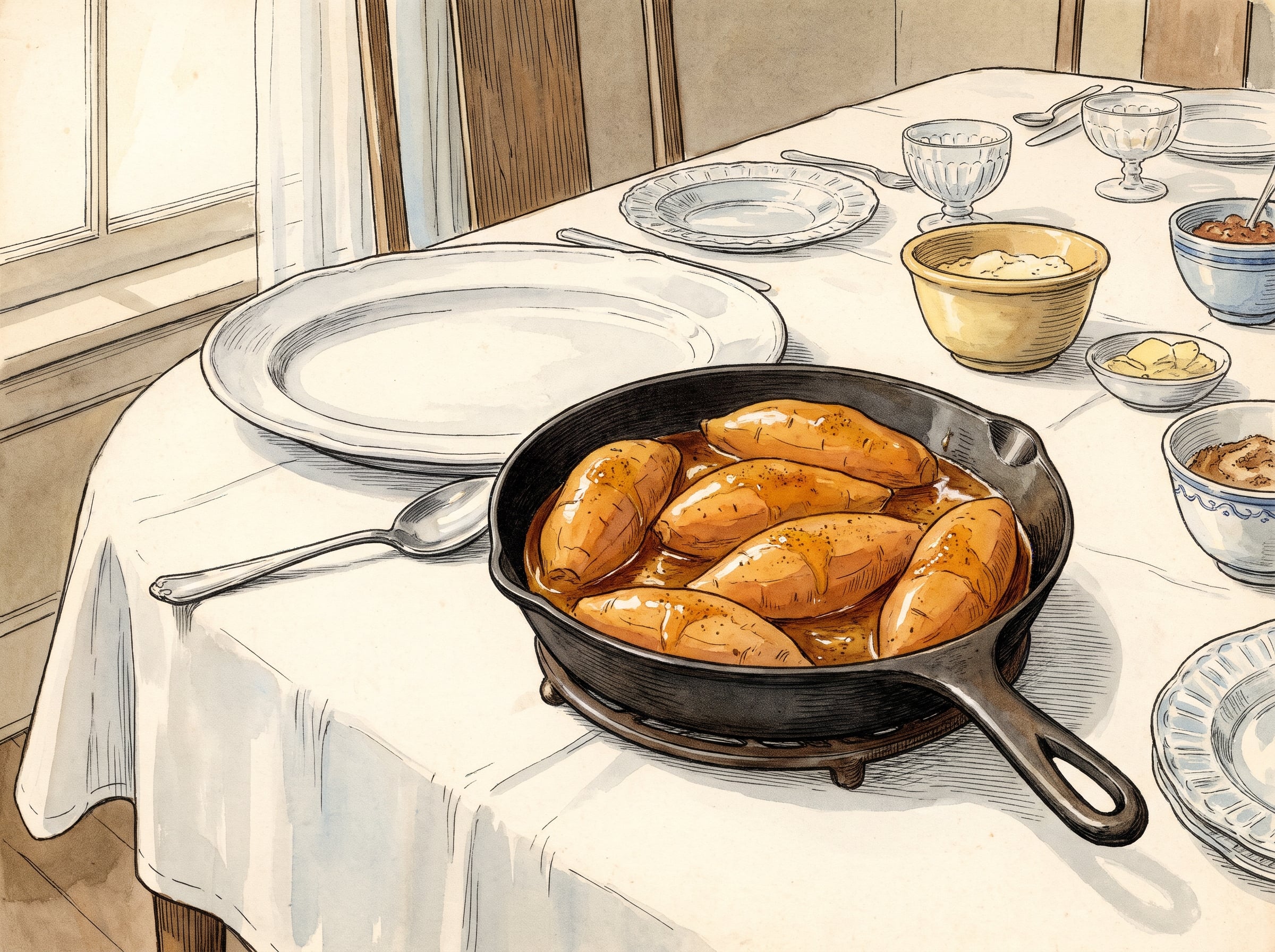
In 1920, butter was expensive enough that a Philadelphia cooking teacher left it out of at least one of her recipes. Her candied sweet potatoes use honey and shortening instead, cook start to finish in an iron frying pan, and arrived three years after a marshmallow company began reshaping the dish. This is a holiday side dish caught just before its modern makeover.
Please note that some of the images in this article were created with the assistance of AI.
From Mrs. Wilson’s Cook Book, 1920
The Story Behind This Recipe
A cooking teacher who watched the grocery bill
The subtitle tells you what kind of book this is: "Numerous New Recipes Based on Present Economic Conditions." A modern reader might guess those conditions were the Great Depression, but one reviewer points out that the dates don’t work. Mrs. Wilson’s Cook Book was published by J. B. Lippincott in Philadelphia in 1920, so the pinch Mary A. Wilson had in mind was the one in front of her that year.
She came to the job with real credentials. According to a publisher’s description of a modern reissue, she taught Domestic Science at the University of Virginia Summer School and founded the school that later became Mrs. Wilson’s Cooking School in Philadelphia. In 1920 she also wrote a newspaper column as Mrs. M. A. Wilson, answering readers’ cooking problems. On January 9 of that year it laid out six rules for economical shopping. Another of her 1920 recipes skipped butter entirely because butter was so expensive.
A luxury that became a Southern staple
Sweet potatoes are native to the Americas, and they did not grow well everywhere. They grew poorly outside southern Europe, so in the 16th century northern Europeans came to treat them as a luxury. A London cookbook from the mid-1600s gives a dish of cooked potatoes under a sugary, buttery, spiced topping. The historian Trudy Eden considers it "more than likely" a sweet potato dish and an early ancestor of American candied yams.
In America the dish became far less exclusive. During the 1800s, candied sweet potatoes were eaten across the South, often by poor families, both white and Black. Mary Stuart Smith’s Virginia Cookery Book of 1885 layers boiled or steamed slices with butter and covers them with sugar. One more thing worth knowing: the familiar name "candied yams" is a misnomer, because the dish is made with sweet potatoes.
Honey in the pan, marshmallows on the horizon
Wilson keeps the old method of boiling the potatoes first and then finishing them in a sweet, spiced syrup, but she changes the ingredients. Honey takes the place of sugar, shortening stands in for butter, and a quarter teaspoon each of mace and cinnamon carries on the long habit of spicing the dish. The book doesn’t explain the swap. Still, shortening makes sense from a cook whose newspaper recipes avoided costly butter.
The timing matters too. In 1917 the Angelus Marshmallow company asked the cook Janet McKenzie Hill to write a booklet of marshmallow recipes, and it included what became the sweet potato casserole. Even so, the dish took off only once mass-produced marshmallows arrived. Candied sweet potatoes went on to become a Thanksgiving fixture, and by the 1960s they were also linked to New Year among African Americans from the South. Wilson’s recipe, printed in 1920, has no marshmallows at all. It belongs to the older tradition of sweet potatoes glazed in syrup and nothing more.
1920s
What Our Readers Say
- When Piaci Pizza readers loved a food photo and tapped a reason, comfort was the top pick at 30%, and nostalgia also made the list at 16%.
From Piaci Pizza reader polls and votes.
Notes From the Era
The recipe · 1920
Candied Sweet Potatoes With Honey
From Mrs. Wilson’s Cook Book by Mary A. Wilson (1920). Every word of the recipe below is as printed.
Ingredients
- Three-quarters cup of honey
- Two tablespoons of shortening
- One-quarter teaspoon of mace
- One-quarter teaspoon of cinnamon
- six boiled sweet potatoes
- four tablespoons of water
Method
-
Combine the syrup ingredients in the pan
Place in an iron frying pan
Three-quarters cup of honey,
Two tablespoons of shortening,
One-quarter teaspoon of mace,
One-quarter teaspoon of cinnamon. -
Boil the syrup and add the potatoes
Bring to a boil and cook until it becomes thick, then add six boiled sweet potatoes.
-
Turn and cook slowly
Turn them frequently in syrup, adding four tablespoons of water to prevent burning. Cook slowly for twenty minutes.
-
Prepare the potatoes in advance
NOTE.–Have the potatoes boiled and then peeled, and ready waiting before putting the honey in the pan.
Our notes
Reading It Today
The measures in plain numbers. Three-quarters of a cup of honey is 6 fluid ounces, or 12 tablespoons. The spices are a quarter teaspoon each. "Cook slowly" means low, gentle heat. The recipe gives no temperature because it never goes in the oven.
Shortening and mace. Shortening is a solid cooking fat, such as lard or vegetable shortening, used here instead of butter. Mace is the lacy outer covering of the nutmeg seed. It tastes like a softer, slightly more delicate nutmeg.
What the dish would be like. Judging from the ingredients, expect soft boiled sweet potatoes coated in a sticky, glossy honey glaze. The honey would bring its own floral flavor, and the mace and cinnamon would add warmth. The added water keeps the syrup loose enough to coat the potatoes without scorching.
How it differs from today’s version. Today’s version is often a casserole topped with marshmallows. This one is made entirely on the stovetop in an iron frying pan, which today would be a cast-iron skillet. It uses honey instead of sugar and has no topping at all.
Source: Mary A. Wilson, Mrs. Wilson’s Cook Book (J. B. Lippincott Company, Philadelphia, 1920). Read the 1920 book at Project Gutenberg.
Sources for the history
- Mrs. Wilson’s Cook Book, Mary A. Wilson (J. B. Lippincott, 1920), recipe text as printed
- Mrs. Wilson’s Cook Book, publisher description (Apple Books)
- Mrs. Wilson’s Cook Book: Numerous New Recipes Based on Present Economic Conditions, Goodreads book page and reader review
- Today in 1920: Mrs. Wilson’s Cheese Sauce, Rooted in Foods
- Candied sweet potatoes, Wikipedia
- TBT: The Local Boston History of Candied Yams, Boston Magazine
The original recipe text is from a work published in 1920 and is in the public domain in the United States. The history, notes and illustrations are Piaci Pizza’s own. Brand names that appear in historic recipes are mentioned as historical fact only. Illustrations are AI-generated in a vintage style. The recipe is shown exactly as it was published in 1920; we have not photographed a test batch.