
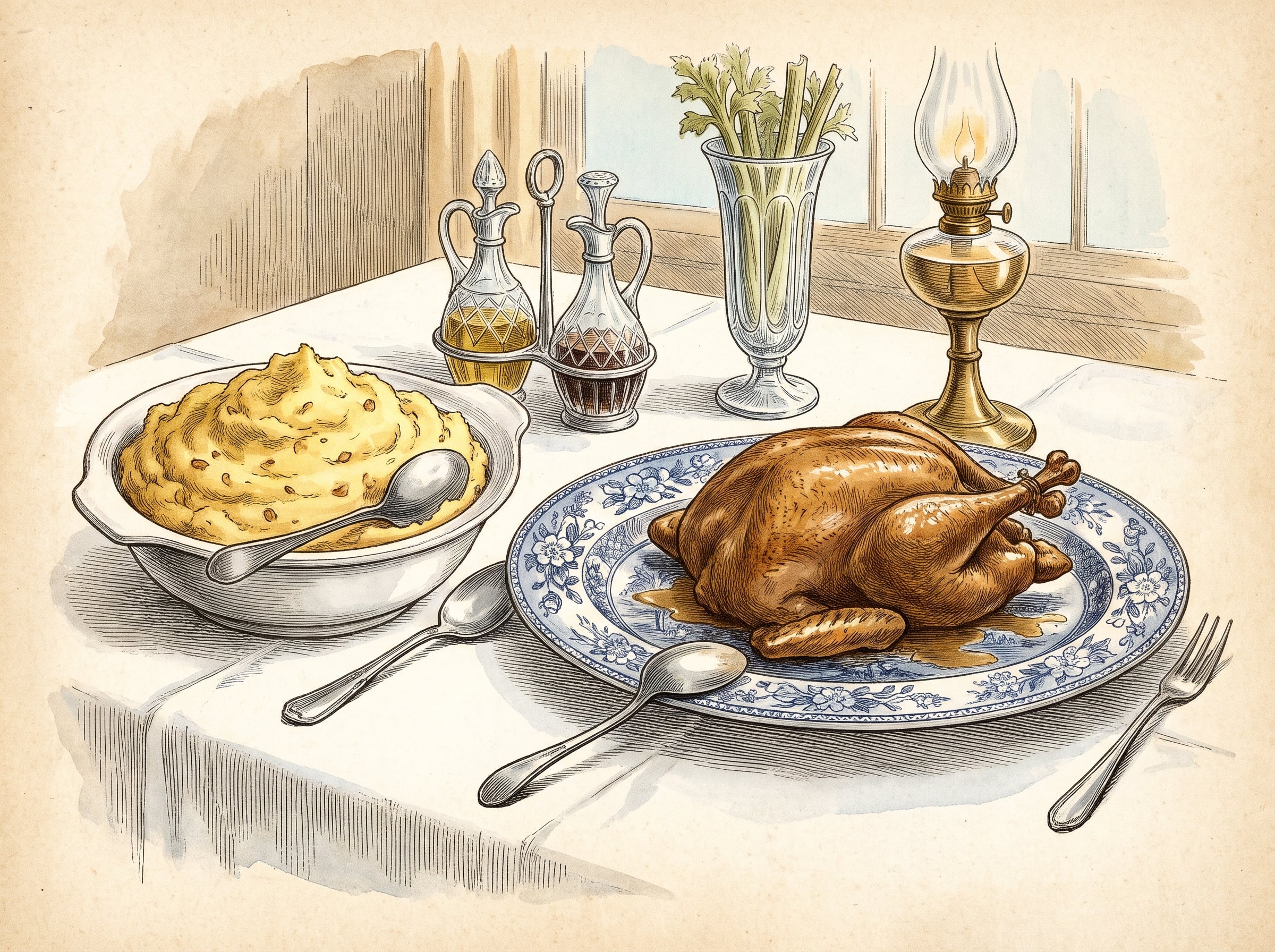
Six potatoes, one small onion, a spoonful of lard, a walnut of butter, an egg, salt and pepper. That is the entire stuffing, as it was printed in 1878 under the name of a Virginia housewife known only as "Mrs. McG.," and there isn’t a crumb of bread anywhere in it. Behind those few lines stands a cookbook edited by a granddaughter of Patrick Henry, with recipes from 250 Virginia women.
Please note that some of the images in this article were created with the assistance of AI.
From Housekeeping in Old Virginia, 1878
The Story Behind This Recipe
Patrick Henry’s granddaughter and 250 housewives
Marion Cabell Tyree of Lynchburg, Virginia, had a famous grandfather in Patrick Henry, but when she built Housekeeping in Old Virginia she leaned on a crowd. She gathered recipes from what she called "two hundred and fifty of Virginia’s noted housewives," and she printed their names alongside their dishes. Our cook signed hers "Mrs. McG.," which is all she left us.
That roll call did more than give credit. Historians of the post-Civil War South note that the names lent the book a pedigree, and Tyree was frank about who it was for. She aimed it at "elegant and refined women" in upper-class white households who, after the war, might now find themselves without a cook. A recipe from a noted Virginia housewife came with a kind of guarantee. The book was printed in Louisville by John P. Morton & Co. The edition quoted here is dated 1878; Wikipedia gives 1877 for the first printing.
Potatoes where the bread should be
Ask most Americans what goes inside a turkey and the answer starts with bread. Mrs. McG. skipped it. Her stuffing is mashed potato, browned onion, butter, egg, salt and pepper, which puts it closer to seasoned mashed potatoes firmed up with an egg than to anything we’d call dressing.
Its best-known cousin lives in Pennsylvania Dutch country. There, potato filling mixes mashed potatoes with bread and can be packed into the bird or baked in a dish of its own. Old-fashioned versions call for onion, parsley, eggs, milk, salt and pepper. One Pennsylvania Dutch food historian traces filling to at least the 1700s and says it truly caught on in the century after. It is still a Thanksgiving fixture there. One Berks County grange that sells it gets calls in September from customers reserving their share. We found nothing tying the Virginia recipe to the Pennsylvania one, and Tyree’s book never pins this stuffing to a holiday. Still, the two share a sensible idea: let the potato do bread’s job.
Built for whatever bird turned up
The title promises a stuffing "for turkeys and other fowls," and the last line keeps that promise. For geese or ducks, stir in "a little sifted sage and a small quantity of red pepper." This was a workhorse rather than a once-a-year showpiece, a base a cook could tilt toward whatever was roasting that day.
The method hints at the kitchen around it. Fry the onion "a light brown, in a frying-pan," then stir in the rest "till perfectly dry." No heat is given. By 1850, according to one food encyclopedia, cast-iron cookstoves had replaced the open hearth in most urban middle-class homes, though poorer and remote households changed more slowly. The new stoves brought new pans. Flat-bottomed ones that sat right on the hot iron replaced the legged, round-bottomed pots of the hearth. Cooks fed these stoves wood, with hardwood preferred, or coal, which burned hotter and longer and suited city kitchens, despite running arguments over its fumes. The stoves had their moods, too, and a good cook learned them. "Till perfectly dry" assumes she had.
1870s
What Our Readers Say
- When Piaci Pizza readers loved a food photo and tapped a reason, comfort came out on top at 30%, with nostalgia next at 17%.
From Piaci Pizza reader polls and votes.
Notes From the Era
The recipe · 1878
Potato Stuffing for Turkeys and Other Fowls
From Housekeeping in Old Virginia by Marion Cabell Tyree (editor) (1878). Every word of the recipe below is as printed.
Ingredients
- six good-sized boiled Irish potatoes
- a small onion
- a dessertspoonful lard
- salt and pepper
- a lump of butter as large as a walnut
- one well beaten egg
- a little sifted sage
- a small quantity of red pepper
- If you cook the stuffing inside the bird, the center of the stuffing must reach 165°F / 74°C.
Method
-
Mash the potatoes
Mash smoothly six good-sized boiled Irish potatoes.
-
Fry the onion
Chop a small onion very fine and fry a light brown, in a frying-pan, with a dessertspoonful lard.
-
Add potatoes, seasoning and butter
Then add the potatoes with salt and pepper, and a lump of butter as large as a walnut.
-
Stir in the egg
To this add one well beaten egg, stirring till perfectly dry.
-
Season for geese or ducks
If for geese or ducks, add a little sifted sage and a small quantity of red pepper.
Our notes
Reading It Today
Irish potatoes. "Irish potatoes" simply means ordinary white potatoes, as opposed to sweet potatoes. Here they are boiled first and then mashed smooth.
A dessertspoonful and a walnut of butter. A dessertspoon sits between a teaspoon and a tablespoon, about 2 teaspoons (10 ml). That is a modest amount of lard for frying one small onion. A lump of butter "as large as a walnut" is commonly read as about 2 tablespoons.
What it would be like. Judging from the ingredients, this would be a dense, smooth, savory mash. The browned onion supplies the main flavor, and the beaten egg binds everything. Stirring it in the pan "till perfectly dry" drives off moisture, so the mixture would be firm enough to pack into a bird rather than loose and creamy. The goose-and-duck version adds an herbal note from the sage and some heat from the red pepper.
How it differs from today’s stuffing. Most stuffings now start with bread cubes or crumbs. This one has no bread at all, and even Pennsylvania Dutch potato filling, its closest relative, includes bread. There is no broth or milk either. The only added liquid comes from the egg and the melted fats, which is why it reads more like stiffened mashed potatoes than like a dressing.
Source: Marion Cabell Tyree (editor), Housekeeping in Old Virginia (John P. Morton & Co., Louisville, 1878). Read the 1878 book at Project Gutenberg.
Sources for the history
- Marion Cabell Tyree (editor), Housekeeping in Old Virginia (John P. Morton & Co., 1878), Project Gutenberg
- Marion Cabell Tyree – Wikipedia
- Potato filling – Wikipedia
- An old-fashioned Thanksgiving side dish to try: How to make potato filling (not stuffing) – PhillyVoice
- Iron Cookstove, The – Encyclopedia.com
The original recipe text is from a work published in 1878 and is in the public domain in the United States. The history, notes and illustrations are Piaci Pizza’s own. Brand names that appear in historic recipes are mentioned as historical fact only. Illustrations are AI-generated in a vintage style. The recipe is shown exactly as it was published in 1878; we have not photographed a test batch.