
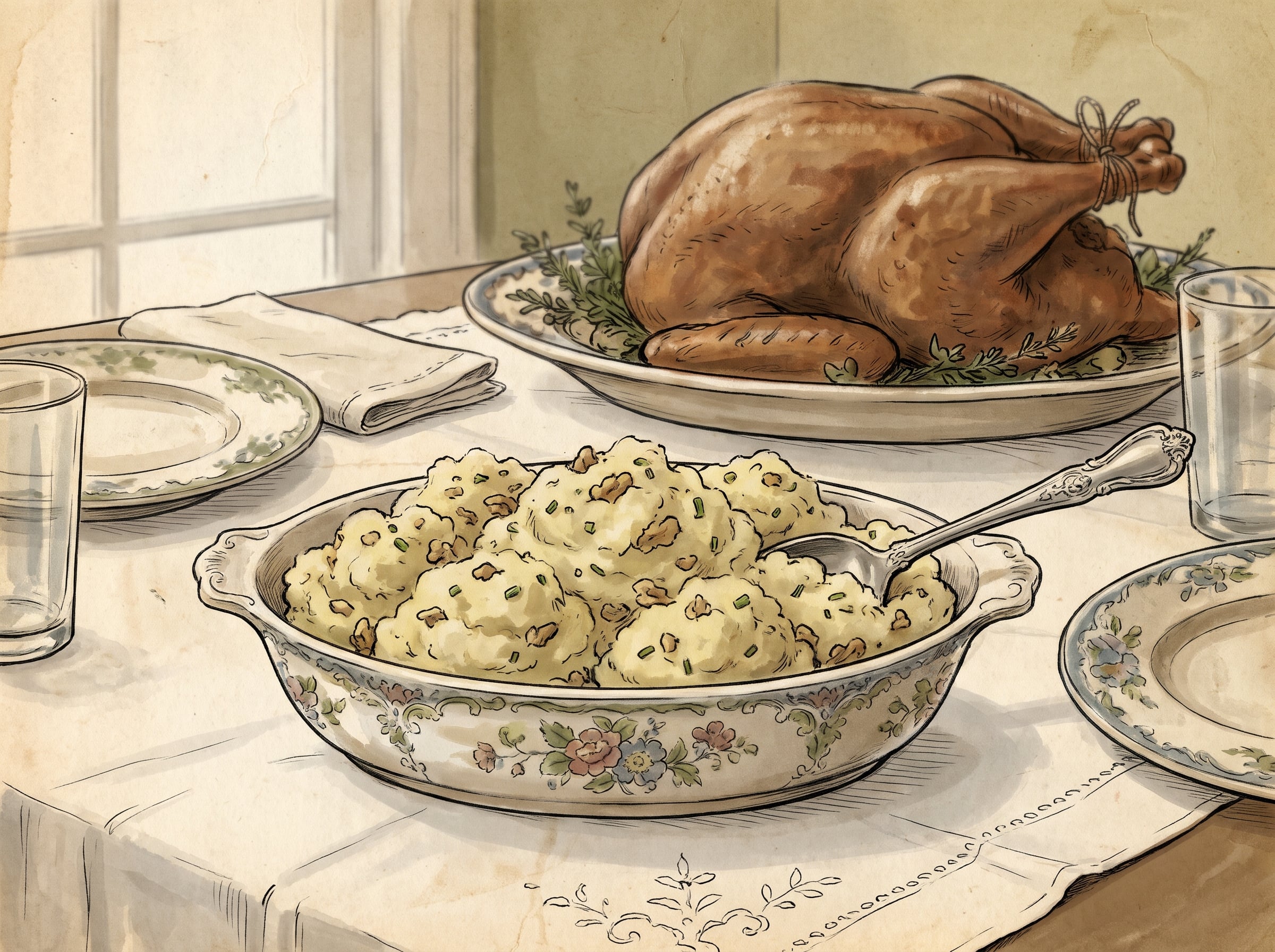
This stuffing for the Sunday goose has no bread in it at all. It is hot mashed potatoes made rich with cream, butter and egg yolks, with a cup of chopped walnuts stirred through. A Chicago cooking teacher printed it in 1913, in a book published by a shortening company, at a time when many of the city’s holiday geese were coming down from Watertown, Wisconsin.
Please note that some of the images in this article were created with the assistance of AI.
From Fifty-two Sunday Dinners, 1913
The Story Behind This Recipe
A cooking teacher, a column she lost, and a shortening company
In 1905 the Woman’s Home Companion invited six leading cooks to compete for a regular column. Elizabeth O. Hiller entered and lost to Fannie Farmer, about as respectable a loss as American cooking had to offer. It barely slowed her down. Hiller, born around 1856, had trained at the Pratt Institute in Brooklyn and at the Boston Cooking School, finishing with the class of 1898. She went on to run the Chicago Domestic Training School at 53 Dearborn Street. Her Chicago Tribune recipes traveled to papers across the country. She lectured at shows, at clubs and on the radio, and her name turned up in ads for gas ranges and a fruited cereal.
Fifty-two Sunday Dinners came out of that same busy world. Its publisher was the N. K. Fairbank Company of Chicago, maker of Cottolene, a shortening of beef tallow and cottonseed oil that had a whole shelf of promotional cookbooks written in its honor. The plan of the book was simple and useful: one menu for every Sunday of the year, built around the family’s biggest meal of the week. The edition quoted here is dated 1913; Wikipedia also lists a Fairbank printing from 1915.
What goes inside a goose depends on your grandparents
Ask what belongs inside a roast goose, and the answer used to depend on where your family came from. Food writer Bonny Wolf, writing for NPR, sorts it out. The English, and the American colonists after them, liked sage and onion. Germans reached for sauerkraut or mashed potatoes. Scandinavians tucked in prunes and apples, and German Jews filled a Hanukkah goose with apples, red cabbage and chestnuts.
Potato stuffing had made it into American cookbooks before Hiller. American Heritage magazine credits one for roast goose to Catharine Beecher’s Domestic Receipt-Book. In that version, hot mashed potatoes are bound with bread crumbs, onion, eggs, sage, celery leaves and parsley. Hiller left out the bread and the sage. In went a cup of English walnuts, cream, butter, two egg yolks and a little paprika, with ‘sweet herbs’ only ‘if the flavor is desired.’ The name tells you exactly what you are getting: potato and nut. The heading offers it for duck as well, but by the last line the method has its mind firmly on ‘the body of the goose.’
Nine hundred geese in a day
In the 1912 holiday season, one seed store in Watertown, Wisconsin, sold 900 geese in a single day. One of them weighed 37 pounds. Watertown was famous for its fattened ‘stuffed’ geese, and a local paper reported that they were the preferred kind in the Chicago market, sold on South Water Street, the city’s great poultry market. So the Chicago goose of 1913 did not always come from a nearby farm. Goose was a festive bird in many Jewish homes too, where German Jews roasted one for Hanukkah and cooked latkes in its fat.
Next to all that bustle, Hiller’s recipe is refreshingly short. Mix everything ‘in the order given,’ fill the bird and get on with dinner. The measures are cooking-school exact, down to ‘1-1/4 teaspoon salt.’ The potatoes have to be ‘hot,’ so they were boiled and mashed just before the stuffing went in. And for a book published by a shortening maker, there is a small irony: this recipe calls for butter and cream, with no Cottolene anywhere in sight.
1910s
Notes From the Era
The recipe · 1913
What Our Readers Say
- When Piaci Pizza readers loved a food photo and tapped a reason, comfort came out on top at 30%, with nostalgia next at 17%.
From Piaci Pizza reader polls and votes.
Potato and Nut Stuffing
From Fifty-two Sunday Dinners by Elizabeth O. Hiller (1913). Every word of the recipe below is as printed.
Ingredients
- 4 cups hot mashed potatoes
- 2-1/2 tablespoons finely chopped onion or chives
- 1 cup English Walnut meats chopped moderately
- 1/2 teaspoon paprika
- 1-1/4 teaspoon salt
- 1/2 cup cream
- 2 tablespoons butter
- Yolks of 2 eggs
- 1 teaspoon sweet herbs if the flavor is desired
- Stuffing cooked inside the bird must reach 165°F / 74°C in the center, which also ensures the raw egg yolks are fully cooked.
Method
-
Mix and stuff the goose
Mix the ingredients in the order given and fill the body of the goose.
Our notes
Reading It Today
Walnut "meats" and odd fractions. "Meats" is the old word for shelled nut kernels, so "English Walnut meats" are simply shelled walnuts of the ordinary kind sold today. "Chopped moderately" means coarse pieces rather than a fine crumb. The written fractions are just mixed numbers: "1-1/4 teaspoon" is one and a quarter teaspoons, and "2-1/2 tablespoons" is two and a half.
Sweet herbs. "Sweet herbs" was a general term for mild, fragrant kitchen herbs such as thyme, marjoram and savory, often used dried. Hiller asks for only a teaspoon and makes even that optional, so the main seasoning comes from the onion or chives, the paprika and the salt.
What it would be like. Judging from the ingredients, this would be soft and rich, close to very buttery mashed potatoes, with the egg yolks helping it firm up a little as the bird roasts. The walnuts would add pockets of crunch and a faintly bitter, nutty note. Chives would make it milder and greener than onion.
How it differs from stuffing today. Most American stuffings now are built on bread cubes, moistened with broth and seasoned with celery and sage, and they are often baked in a separate dish. This one uses no bread, no broth and no sage. It is a potato mixture meant to go straight inside the bird, which places it closer to a side of mashed potatoes than to a bread dressing.
Source: Elizabeth O. Hiller, Fifty-two Sunday Dinners (The N. K. Fairbank Company, Chicago, 1913). Read the 1913 book at Project Gutenberg.
Sources for the history
- Elizabeth O. Hiller, Fifty-two Sunday Dinners (N. K. Fairbank Company, Chicago, 1913), Project Gutenberg
- Elizabeth O. Hiller – Wikipedia
- Home Helps – Science History Institute Digital Collections
- How to Cook Your Goose – NPR
- Roast Goose with Potato Stuffing – American Heritage
- Watertown Stuffed Geese – Watertown Historical Society
The original recipe text is from a work published in 1913 and is in the public domain in the United States. The history, notes and illustrations are Piaci Pizza’s own. Brand names that appear in historic recipes are mentioned as historical fact only. Illustrations are AI-generated in a vintage style. The recipe is shown exactly as it was published in 1913; we have not photographed a test batch.