
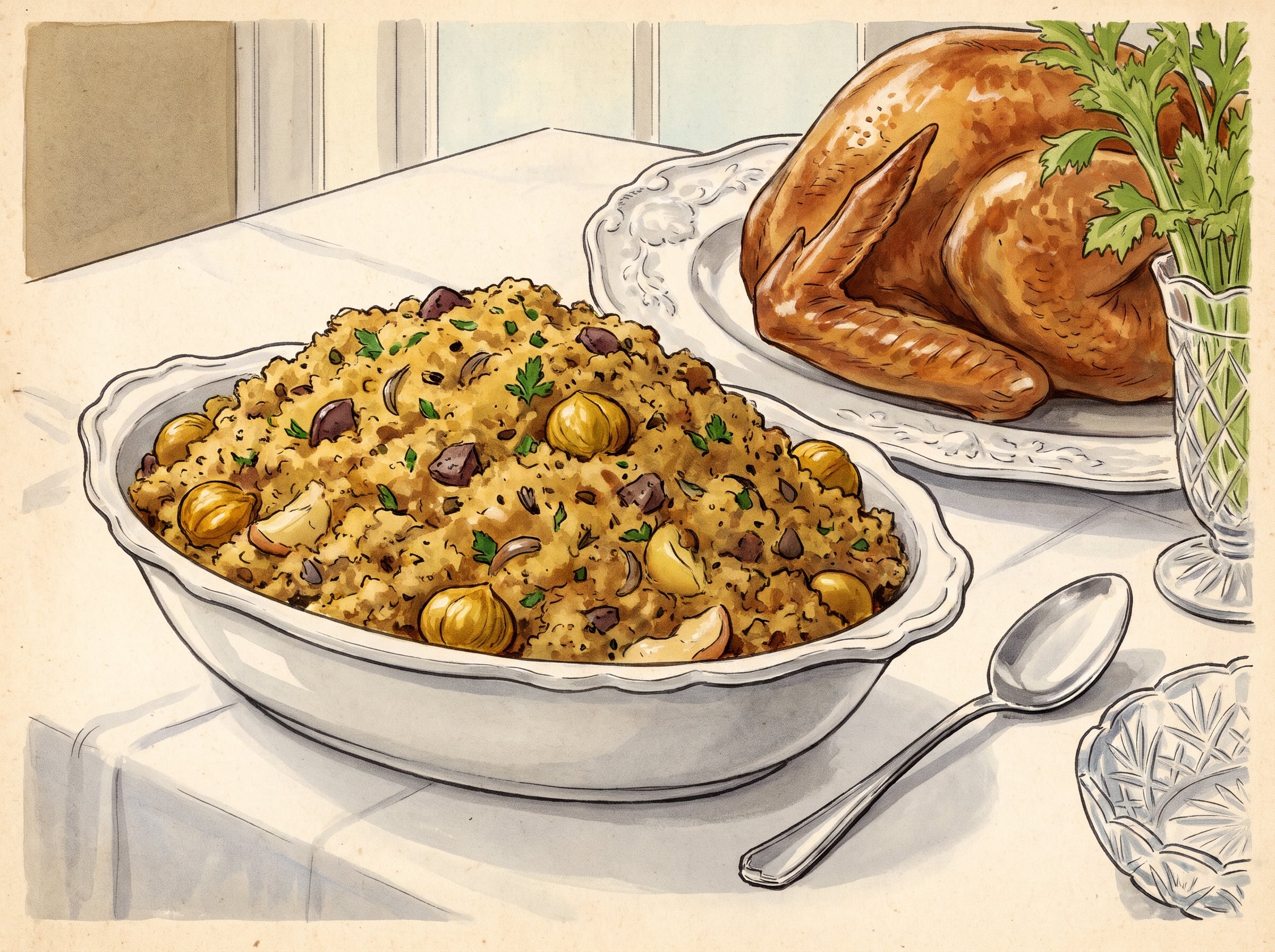
In 1919 the head chef of San Francisco’s Hotel St. Francis published a dressing built on onions and diced livers, then added a chestnut version and an apple version as if they were afterthoughts. The man was a showman in a red fez, the book was partly an advertisement, and the chestnuts were already disappearing from American forests. It is a short recipe with a lot going on behind it.
Please note that some of the images in this article were created with the assistance of AI.
From The Hotel St. Francis Cook Book, 1919
The Story Behind This Recipe
A red fez on Union Square
Picture the head chef of San Francisco’s new grand hotel: thick French accent, curled moustache, red fez. That was Victor Hirtzler, born around 1875 in Strasbourg and trained at the Grand Hotel in Paris. His biography says he cooked and tasted food for Czar Nicholas II and served as chef de cuisine for Carlos I of Portugal, then put in time at Sherry’s and the Waldorf in New York. In 1904 he came west to run the food at the St. Francis on Union Square, a $2.5 million hotel that opened that March with a champagne party for 600 of the city’s most fashionable people. Two years later the 1906 earthquake struck, and the hotel still served breakfast that morning, Enrico Caruso among the diners, before fire gutted the building. Hirtzler stayed on as head chef until 1926.
He named dishes after famous guests and, with no apparent embarrassment, after himself. Celery Victor is the one people remember, and he may have invented Crab Louie as well. From 1910 he put that flair into cookbooks laid out as a full menu for breakfast, lunch and dinner on every day of the year. The first was titled L’Art Culinaire, borrowing from Escoffier’s famous guide, though Hirtzler considered Escoffier a rival. The best-known edition came out in 1919 from The Hotel Monthly Press in Chicago, and it reads like a chef talking to his own staff. Stocks are made "in the usual way," and that is all the explanation you get.
Older than the word for it
Nobody knows who first stuffed one food with another, but the oldest written evidence comes from the Roman cookbook of Apicius, where stuffings were often full of chopped liver and other organ meats. Hirtzler’s diced livers have very old company. Medieval English cooks called the mixture a "farce," from the French farcir, "to stuff." The word "stuffing" reached print in 1538, "forcemeat" came later, and around 1850 Americans began saying "dressing." One language blog credits that change to Victorians who found "stuffing" a little too crude.
The chestnut version has deep American roots too. The first stuffing recipe published in the United States, in 1772, was a chestnut stuffing reprinted from an English edition of Susannah Carter’s The Frugal Housewife, and chestnut stuffing has been part of Thanksgiving since at least the 19th century. Even the line about adding sage for suckling pig follows a familiar pattern: in England, roast pork often comes with sage and onion stuffing.
A recipe from a working kitchen
Hirtzler gives one onion-and-liver base and two quick variations, more like notes for a hotel crew than a lesson for beginners. There is no oven temperature, no amount for the breadcrumbs, and the garlic is left to the cook. The same books that skipped the basics still found room for California raisins and cactus fruit.
The chestnuts carry a quieter story. In 1904, the year Hirtzler arrived in San Francisco, a forester noticed chestnut trees dying at the Bronx Zoo. The cause was a fungus from Asia, and when this book appeared it was spreading fast. Within about 30 years it had killed roughly 99 percent of American chestnut trees, and chestnut stuffing slowly became less common on American tables.
1910s
Notes From the Era
The recipe · 1919
What Our Readers Say
- When Piaci Pizza readers loved a food photo and tapped a reason, comfort came first at 30%, with nostalgia and ingredients tied at 17% each.
- When our readers disliked a food photo, the top reason was simply “not for me” at 39%, followed by the ingredients themselves at 29%.
From Piaci Pizza reader polls and votes.
Dressing for Chicken, Turkey, Suckling Pig, Etc
From The Hotel St. Francis Cook Book by Victor Hirtzler (1919). Every word of the recipe below is as printed.
Ingredients
- six onions
- turkey, chicken or suckling pig livers
- fresh bread crumbs
- a piece of fresh butter
- salt and pepper
- a little powdered thyme
- chopped parsley
- garlic if desired
- some sage
- two pounds of chestnuts
- a small piece of celery
- salt
- half a dozen apples
- three ounces of butter
- The raw livers in this dressing must be fully cooked, so the dressing should reach 165°F / 74°C.
- Dressing cooked inside the bird or pig must reach 165°F / 74°C in its center.
Method
-
Bake and chop the onions
Bake six onions, with the skins on, in oven for ten minutes. Remove the skins and chop very fine.
-
Add livers, crumbs and butter
Add turkey, chicken or suckling pig livers cut in very small squares. Then add fresh bread crumbs, a piece of fresh butter, salt and pepper.
-
Season the dressing
Mix well, add a little powdered thyme, chopped parsley, add garlic if desired. If for suckling pig add some sage.
-
Roast and peel the chestnuts
Chestnut dressing. Split the shells of two pounds of chestnuts with a sharp pointed knife. Put in oven and when they burst open remove and peel.
-
Boil chestnuts and combine
Put in pot with a small piece of celery, salt, cover with water, boil till done, allow to cool, and mix with dressing described above.
-
Simmer the apples in butter
Apple dressing. Peel half a dozen apples, remove the cores, cut in six pieces, put in pan with three ounces of butter and simmer slowly for ten minutes.
-
Combine the apple dressing
Mix with above dressing, omitting chestnuts.
Our notes
Reading It Today
Dressing means stuffing. "Dressing" here is simply the American word of the day for stuffing. It can go inside the bird or be cooked separately. The USDA now advises cooking turkey stuffing separately, because stuffing inside the bird can stay unsafe even after the meat is done.
The measures, decoded. Three ounces of butter is 6 tablespoons, or three-quarters of a stick. Two pounds of chestnuts are weighed in the shell. "Powdered thyme" is ground dried thyme. "A piece of fresh butter" means unsalted butter, in whatever amount looks right, and the chestnuts are "done" when they are tender.
What it would be like. Judging from the ingredients, we’d expect this to be soft and rich rather than crisp. Fresh breadcrumbs make a finer, moister mix than cubed bread. Baked onions add sweetness, and the livers make it deeply savory. The chestnut version would be earthy and a little sweet. The apple version would be fruity and buttery.
How it differs from today’s stuffing. Most modern stuffings use cubed bread, sautéed celery and onion, broth and often egg. Hirtzler uses no broth and no egg, and the base has no celery. The celery appears only as a flavoring for the boiling chestnuts. The livers are the biggest difference.
Source: Victor Hirtzler, The Hotel St. Francis Cook Book (The Hotel Monthly Press, Chicago, 1919). Read the 1919 book at Project Gutenberg.
Sources for the history
- Victor Hirtzler, The Hotel St. Francis Cook Book (The Hotel Monthly Press, Chicago, 1919), Project Gutenberg
- Victor Hirtzler – Wikipedia
- San Francisco’s Infamous St. Francis Hotel: Dames, Deaths, Dogs – KQED
- Stuffing – Wikipedia
- Chestnut stuffing – Wikipedia
- You say dressing, I say stuffing … – Glossophilia
- Chestnut Blight – Invasive Species Centre
The original recipe text is from a work published in 1919 and is in the public domain in the United States. The history, notes and illustrations are Piaci Pizza’s own. Brand names that appear in historic recipes are mentioned as historical fact only. Illustrations are AI-generated in a vintage style. The recipe is shown exactly as it was published in 1919; we have not photographed a test batch.