
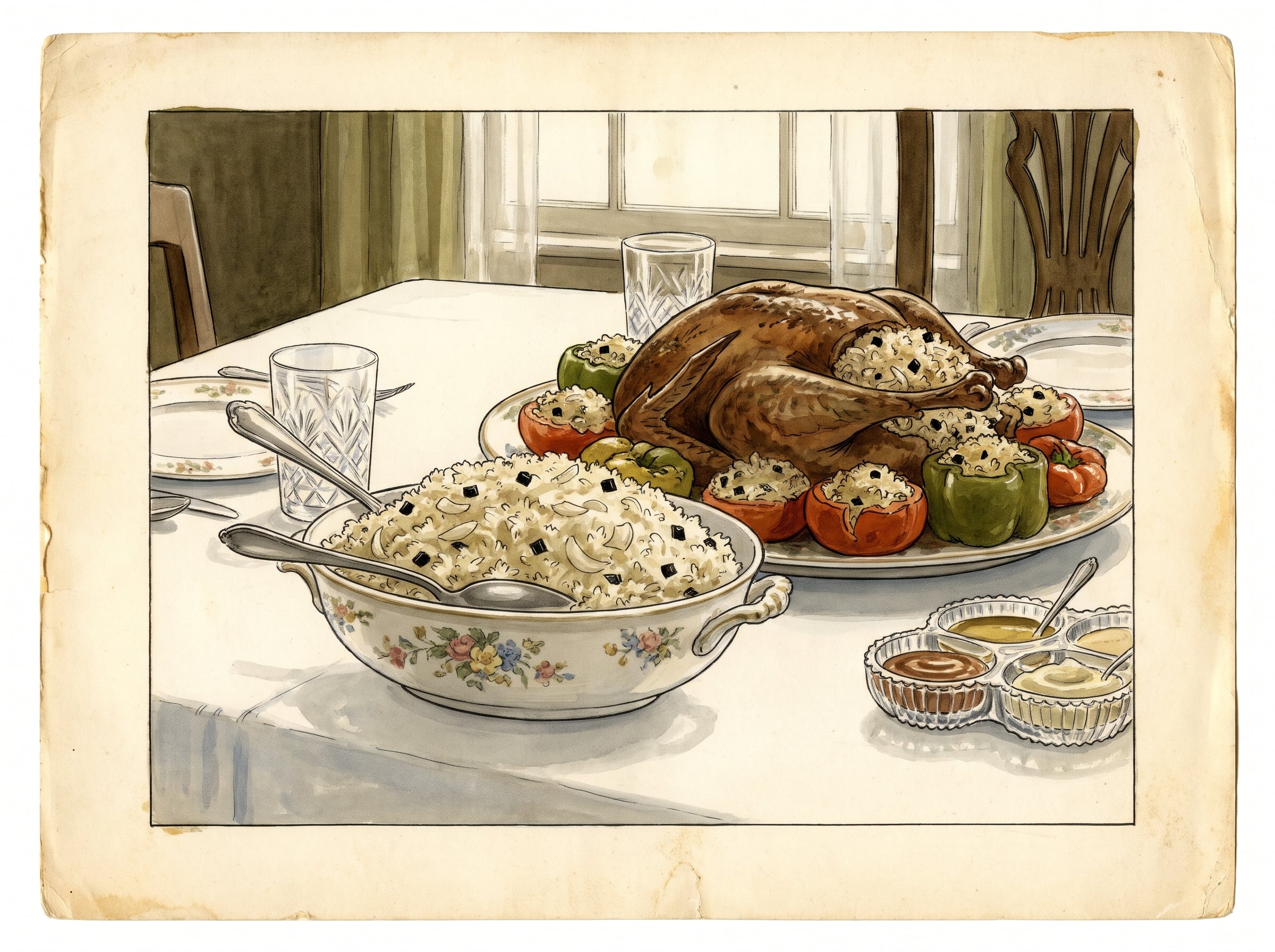
In 1919 the head chef of a grand San Francisco hotel, a Strasbourg man known for wearing a red fez, printed a rice stuffing only a few lines long. Underneath, it is a pilaf, a dish with roots centuries older than the hotel. He finished it with two whole truffles and offered it for roast birds and garden vegetables alike.
Please note that some of the images in this article were created with the assistance of AI.
From The Hotel St. Francis Cook Book, 1919
The Story Behind This Recipe
The chef in the red fez
Picture the man running the kitchens of the West Coast’s biggest hotel dressed in a red fez. That was Victor Hirtzler. He was born around 1875 in Strasbourg and trained at the Grand Hotel in Paris. By his own telling, he had been cook and food taster to Czar Nicholas II and chef to Carlos I of Portugal. After Sherry’s and the Waldorf in New York, he came west in 1904 to take charge of the food at the new St. Francis on Union Square, built by the Crocker estate. The hotel stood through the 1906 earthquake, lost its insides to the fire that followed, and reopened in late 1907. With later wings it became the largest hotel on the Pacific Coast. Hirtzler stayed until 1926. He was a showman with a heavy French accent who named dishes after famous guests and after himself. Celery Victor is the one people remember.
His first cookbook, L’Art Culinaire, came out in San Francisco in 1910 as a subscription edition, with the subscribers’ names printed up front. The 1919 Chicago edition from The Hotel Monthly Press is a second, expanded version, and it carries the hotel’s name. It offers a menu for every day of the year, with the recipes alongside. In the preface Hirtzler says he studied under the great masters of cookery in Europe and America. Even his ending comes in two versions: Wikipedia gives his death as 1931, while library records say 1935.
A pilaf in disguise
Take away the truffles and this is a pilaf. Pilaf is rice cooked in stock so the grains stay separate, often by stirring the rice in hot fat before the liquid goes in. Hirtzler’s onion softened in butter comes close. The food historian Charles Perry calls pilaf an eastern Arabic invention from after the 10th century, and a cookbook from Aleppo in the early 13th century holds the first recipe that resembles the modern dish.
The word made its own long trip. English picked up ‘pilau’ in 1609, from Persian by way of Turkish. French had ‘pilau’ by 1654 and ‘pilaf’ by 1833. Even Hirtzler’s ‘washed rice’ belongs to the old method, since pilaf rice is usually rinsed well to remove the surface starch.
Stuffing for everything
The last line is the most hotel-like part of the recipe: use it for poultry, game, peppers, tomatoes, ‘etc.’ A single batch of rice could fill a roast bird for one table and a tray of peppers for another. Then there are the truffles. Two for a cup of rice sounds lavish now, but around 1900 France produced something like a thousand tonnes of black truffles a year. Today the figure is roughly 30 to 50 tonnes. Here a chef from Alsace finished an old Middle Eastern rice dish with truffles.
We looked for the day’s menu this stuffing belongs to and couldn’t find it, so we can’t place it at Thanksgiving or Christmas. What we can say is that it was written for professionals. The rice and stock are measured, but the seasoning is simply ‘season.’ The oven gets no temperature at all, as if a hot one were always waiting.
1910s
Notes From the Era
The recipe · 1919
What Our Readers Say
- When Piaci Pizza readers loved a food photo and tapped a reason, comfort came top at 30%, with nostalgia close behind at 17%.
From Piaci Pizza reader polls and votes.
Rice Stuffing
From The Hotel St. Francis Cook Book by Victor Hirtzler (1919). Every word of the recipe below is as printed.
Ingredients
- a small chopped onion
- butter
- one cup of washed rice
- three cups of stock or bouillon
- two truffles cut in small squares
- Stuffing cooked inside poultry or game must reach 165°F / 74°C in the center of the stuffing.
Method
-
Cook the onion and rice
Simmer a small chopped onion in butter, add one cup of washed rice, three cups of stock or bouillon, season, and cook in oven for twenty minutes.
-
Add the truffles
Then add two truffles cut in small squares.
-
Use the stuffing
This stuffing is used for poultry, game, peppers, tomatoes, etc.
Our notes
Reading It Today
Stock or bouillon. Bouillon is the French word for broth. In a hotel kitchen there was always stock on hand, and the recipe treats the two as interchangeable, so any good broth fits the instruction.
Season, and a hot oven. No amounts are given for seasoning, which most likely means salt and pepper to taste. The oven has no temperature either. Both details were left to the judgment of a trained cook.
What it would be like. Three cups of liquid to one cup of rice is more than many rice recipes call for today, so expect soft, moist rice rather than dry, separate grains. Butter and onion make it rich and mellow. The truffles, cut ‘in small squares’ (a small dice), would add an earthy aroma.
Not your usual stuffing. Most American stuffing today is built on bread, often with celery, herbs and egg. This one has no bread and no herbs on the list. It is closer to a seasoned rice side dish that happens to fit inside a bird or a hollowed-out pepper.
Source: Victor Hirtzler, The Hotel St. Francis Cook Book (The Hotel Monthly Press, Chicago, 1919). Read the 1919 book at Project Gutenberg.
Sources for the history
- Hirtzler, Victor, approximately 1875-1935 – MSU Libraries Digital Repository
- Victor Hirtzler – Wikipedia
- Hotel St. Francis Cook Book – Bauman Rare Books
- Hotel St. Francis Book of Recipes and Model Menus: L’Art Culinaire – AbeBooks listing
- St. Francis Hotel – Clio
- The St. Francis, San Francisco – Historic Hotels Then & Now
- Pilaf – Wikipedia
- Périgord Truffles – The Truffle Encyclopedia
The original recipe text is from a work published in 1919 and is in the public domain in the United States. The history, notes and illustrations are Piaci Pizza’s own. Brand names that appear in historic recipes are mentioned as historical fact only. Illustrations are AI-generated in a vintage style. The recipe is shown exactly as it was published in 1919; we have not photographed a test batch.