In 1908 a Philadelphia publisher put out a cookbook whose title made a promise: every recipe inside had been in use for a hundred years and more. One of them came from a Miss Sarah Rutledge of Charleston, and it fits a great deal into a single paragraph: a tuber from the Americas, a name borrowed from cornbread, and a hefty three tablespoons of ginger.
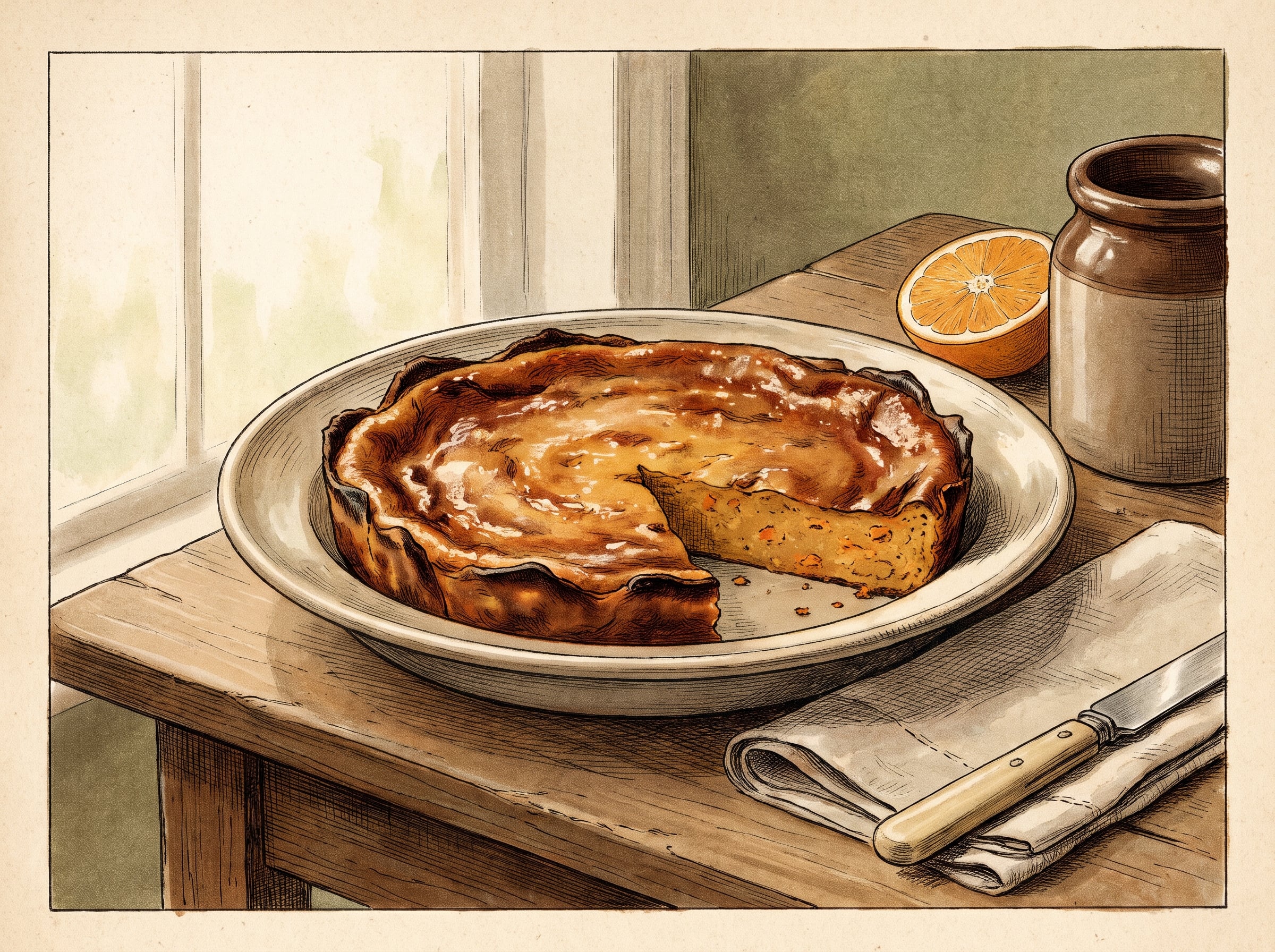
Please note that some of the images in this article were created with the assistance of AI.
From Famous Old Receipts Used a Hundred Years and More in the Kitchens of the North and the South, 1908
The Story Behind This Recipe
A cookbook built from family memory
Jacqueline Harrison Smith wasn’t hunting for new dishes. Her book, Famous Old Receipts Used a Hundred Years and More in the Kitchens of the North and the South, published by The John C. Winston Co., was made of recipes that families had already been cooking for generations. Descendants sent them in, and Smith printed each one under the name of the person it came from.
So this pone arrives with a byline: "Miss Sarah Rutledge, Charleston, S. C." That small credit changes how we read it. This is a dish someone thought worth handing down, and it was already looking back to an older South when it reached print in 1908.
A cornbread name on a sweet potato cake
Before "pone" meant anything sweet, it meant bread. The word probably entered English from Algonquian words such as apan or oppone, meaning baked. A corn pone was a small round loaf, traditionally cooked in a cast-iron skillet. Over time the name stretched to cover sweetened pones, and cooks made sweet potato versions with sugar or molasses and spice. Historical cookbooks hold hundreds of variations. Some were served as a side dish and some as dessert, and with this much sugar, Miss Rutledge’s clearly belongs with the desserts.
The sweet potato itself had come a long way. It was grown in Peru long before Columbus carried it to Spain, and it crossed the Atlantic early enough to become an established crop in Africa. In the American South, enslaved cooks drew on memory and technique to turn sweet potatoes into puddings. Food historian Michael Twitty traces how those puddings and pones eventually became sweet potato pie.
A rich pone for 1908
Look at the shopping list. Three-quarters of a pound of sugar and ten ounces of butter point to a well-supplied household, and the grated orange peel adds a little extra polish. There are no eggs. The pone holds together with grated potato, butter, sugar and milk, baked slowly in a shallow dish, while a generous measure of ginger does most of the seasoning. The dish behind it, though, grew out of a much wider kitchen tradition than any one Charleston household.
Sweet potato puddings had been in American cookbooks long before 1908, and over the generations puddings and pones like this one led to sweet potato pie. The Jim Crow Museum notes that the pie kept its place at the center of Black celebrations, at Sunday dinners and holiday gatherings. Sweet potatoes also became a Thanksgiving staple. Miss Rutledge’s pone belongs to that line, and it comes from before anyone thought to add marshmallows.
1900s
Notes From the Era
The recipe · 1908
Sweet Potato Pone
From Famous Old Receipts Used a Hundred Years and More in the Kitchens of the North and the South by Jacqueline Harrison Smith (compiler) (1908). Every word of the recipe below is as printed.
Ingredients
- One qt. of grated potato
- ¾ lb. sugar
- 10 oz. of butter
- ½ pt. of milk
- 3 tablespoonsful of powdered ginger
- the grated peel of an orange
Method
-
Measure out the ingredients
One qt. of grated potato, ¾ lb. sugar, 10 oz. of butter, ½ pt. of milk, 3 tablespoonsful of powdered ginger, the grated peel of an orange.
-
Rub together and bake slowly
Rub the ingredients well together, and bake in a shallow plate in a slow oven.
Our notes
Reading It Today
Translating the measures. A quart of grated potato is 4 cups. Three-quarters of a pound of sugar is 12 ounces, a little over 1½ cups of granulated sugar. Ten ounces of butter is 2½ sticks, and half a pint of milk is 1 cup. The ginger is ground ginger, and three tablespoons is far more than most modern recipes would use.
What "a slow oven" means. A slow oven means low, gentle heat, usually taken to be roughly 300 to 325°F. The recipe gives no temperature or baking time because cooks were expected to know their own ovens. A "shallow plate" is a shallow baking dish.
What it would be like. Judging from the ingredients, this would be dense and moist rather than light. Grated raw sweet potato baked slowly with plenty of butter and sugar suggests something sticky and fudgy at the center, probably caramelized at the edges, with a strong ginger warmth and a bright note from the orange peel. Without eggs, it would be less custardy than a pie filling.
How it differs from today’s dishes. Modern sweet potato pies and casseroles usually start with cooked, mashed potato, are bound with eggs, and are often spiced with cinnamon or topped with marshmallows. This pone uses raw grated potato and no eggs, and it relies on ginger and orange for flavor. The potato also may not have been the deep orange kind, since sweet potatoes have come in white, red, purple and yellow as well.
Source: Jacqueline Harrison Smith (compiler), Famous Old Receipts Used a Hundred Years and More in the Kitchens of the North and the South (The John C. Winston Co., Philadelphia, 1908). Read the 1908 book at Project Gutenberg.
Sources for the history
- Famous Old Receipts Used a Hundred Years and More in the Kitchens of the North and the South (Jacqueline Harrison Smith, comp., 1908)
- Pone (food) – Wikipedia
- A Sweet Potato History – Inside Adams, Library of Congress
- Thanksgiving Primer Part Two – Afroculinaria (Michael Twitty)
- Sweet Potato Pie – Jim Crow Museum, Ferris State University
The original recipe text is from a work published in 1908 and is in the public domain in the United States. The history, notes and illustrations are Piaci Pizza’s own. Brand names that appear in historic recipes are mentioned as historical fact only. Illustrations are AI-generated in a vintage style. The recipe is shown exactly as it was published in 1908; we have not photographed a test batch.