
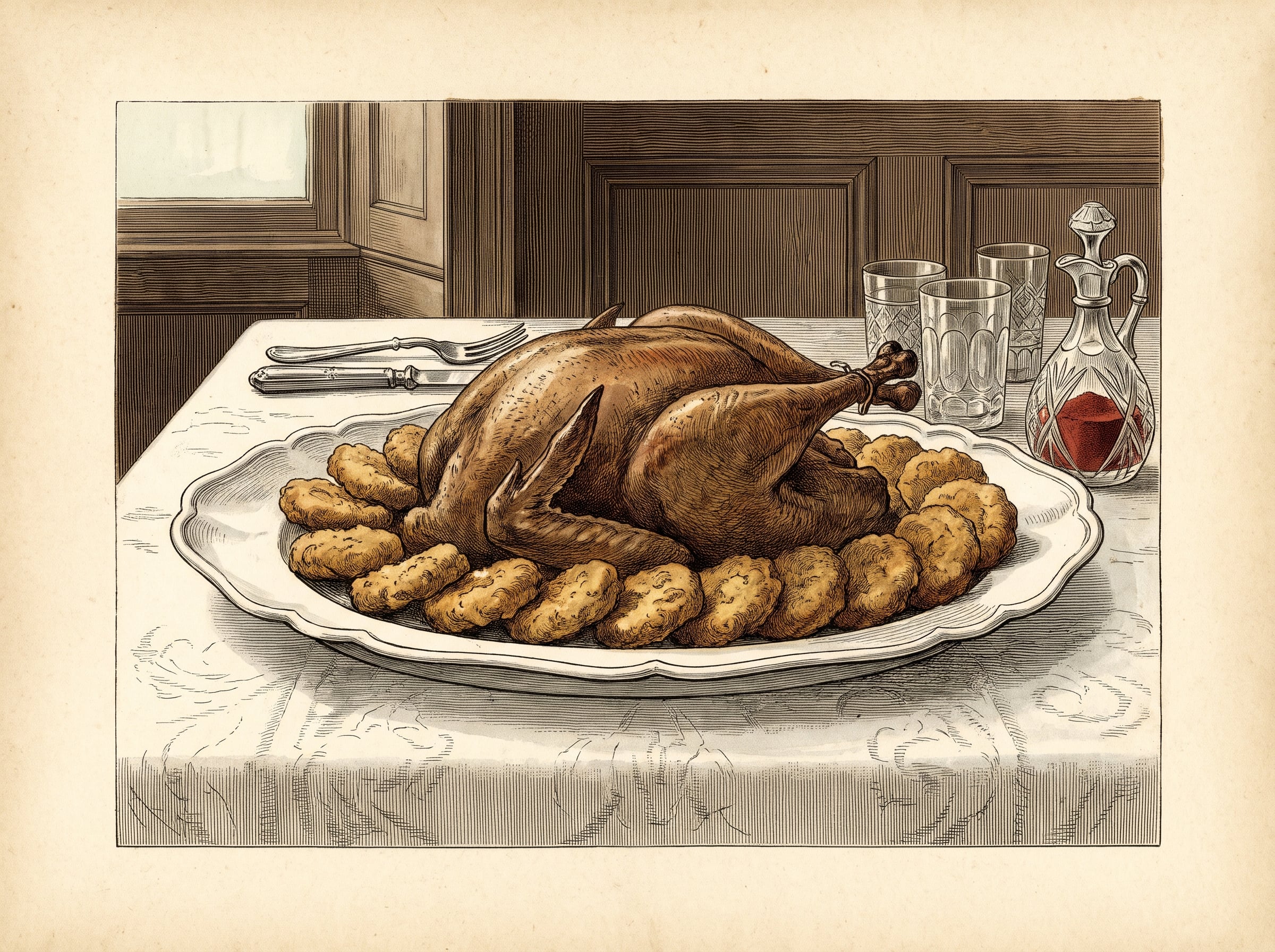
This stuffing never goes inside the turkey. Oysters, bread crumbs and beef suet are bound with egg, fried into cakes and set around the bird on the platter. The recipe comes from an 1885 New Orleans cookbook put together by a newspaperman who, by one publisher’s account, was not a cook at all.
Please note that some of the images in this article were created with the assistance of AI.
From La Cuisine Créole, 1885
The Story Behind This Recipe
A reporter, a failed restaurant and a cookbook
On March 2, 1879, a cheap eatery called The Hard Times opened at 160 Dryades Street in New Orleans. It had first been advertised as a five-cent restaurant. By March 22 it had closed. Its owner was Lafcadio Hearn, born on the Greek island of Lefkas in 1850 to an Irish army doctor and a Greek mother. He went to school in Dublin and in Durham, England, and landed in Cincinnati at nineteen and became a reporter. One paper there fired him when word got around that he had married a Black woman, Alethea Foley. He came to New Orleans in 1877 and wrote for the City Item and the Times-Democrat, and later for Harper’s and Scribner’s.
La Cuisine Créole appeared in 1885 with no author’s name on it, but Hearn is generally accepted as its maker. One publisher says he lived in boarding houses and agreed to edit the book in exchange for getting another of his works into print. It was timed to sell to crowds at the Cotton Centennial Exposition. Hearn described Creole cooking as a blend of ‘the American, French, Spanish, Italian, West Indian and Mexican,’ and he wrote for the ‘young housekeeper.’ The book has stayed in print almost ever since, though the novelist Monique Truong notes that it credits none of the chefs whose recipes it gathered and stays silent about slavery and the enslaved labor behind lavish dishes.
Oysters in birds, long before New Orleans
Food historians trace oyster-stuffed poultry to seventeenth-century Europe. La Varenne’s The French Cook (1651) fills a capon with them, a Dutch book from 1683 does the same, and Robert May’s English Accomplisht Cook (1685) adds bread. In 1796 Amelia Simmons printed ‘To smother a Fowl in Oysters’ for American readers, and the oldest American oyster stuffing recipes were printed in the southern colonies. In the 1800s, oysters packed on ice traveled by rail across the country, and oyster stuffing turned up in cookbook after cookbook. Polite Americans began calling stuffing ‘dressing’ around then. Hearn uses the older word, ‘force-meat.’ His general forcemeat recipe tells cooks to roll leftover filling into balls, fry them and use them as ‘a nice garnish.’ These oyster cakes follow the same idea.
Three dozen oysters for a garnish
Asking for three or four dozen oysters just to decorate a platter makes more sense once you know the supply. From mid-September to late April, oyster luggers sailed into New Orleans every day. Wholesalers paid $1.25 to $3 a barrel, and the best oysters went to restaurants and saloons for upwards of $4. In the late 1870s a price war between two saloons drove raw oysters from 30 cents a dozen down to 20.
The recipe names no holiday, but oysters and turkey were close partners in this period. Elsewhere in the book Hearn stuffs a wild turkey with oysters and serves a boiled turkey with oyster sauce. In 1889 a Helena, Montana, fish market handed out a can of oysters with every Thanksgiving turkey it sold, and in 1897 Ida McKinley put oyster stuffing on the White House Thanksgiving menu. In New Orleans, Christmas was the big oyster day. The geographer Richard Campanella writes that the city wanted its oysters then ‘most popularly in the form of oyster dressing.’
1880s
Notes From the Era
The recipe · 1885
What Our Readers Say
- When Piaci Pizza readers loved a food photo and said why, comfort was the top reason at 30%, followed by nostalgia and ingredients at 17% each.
- When our readers disliked a food photo, the top reason was simply “not for me” at 39%, with the ingredients themselves next at 29%.
From Piaci Pizza reader polls and votes.
Oyster Stuffing for Turkey
From La Cuisine Créole by Lafcadio Hearn (1885). Every word of the recipe below is as printed.
Ingredients
- three or four dozen nice plump oysters
- a tumblerful of bread crumbs
- a tumblerful of nice beef suet
- three eggs
- salt
- pepper
- a little butter
- a teaspoonful of mace
- some cayenne pepper
- The cakes contain raw oysters and raw eggs, so fry them until cooked through to 165°F / 74°C in the center.
- Keep raw oysters cold and wash your hands and surfaces after handling them.
Method
-
Mix and season the force-meat
Take three or four dozen nice plump oysters, wash and beard them, add to them a tumblerful of bread crumbs; chop up a tumblerful of nice beef suet; mix together, and moisten with three eggs; season with salt, pepper, a little butter, a teaspoonful of mace, and some cayenne pepper.
-
Shape and fry the cakes
Roll force-meat into cakes, and fry them.
-
Serve around the bird
They are pretty laid around a turkey or chicken.
Our notes
Reading It Today
A tumblerful. A tumbler was an ordinary drinking glass, and a tumblerful came to about a cup. Cooking teachers then made little distinction between a rounded measure and a level one, so the amounts here are approximate.
Beard and suet. To ‘beard’ an oyster means trimming off the frilly fringe around its edge. Beef suet is the hard, crumbly fat from around the kidneys. Chopped up and mixed in, it melts as the cakes fry and adds fat and richness.
What the cakes would be like. Judging from the ingredients, these would be crisp outside and soft inside, briny from the oysters and rich from the suet and butter. Mace, the lacy outer covering of nutmeg, gives warmth, and the cayenne adds a little heat.
Not your usual stuffing. Many stuffings today are bread-heavy and baked in or beside the bird, usually with onion, celery and herbs. This one has no onion, celery or herbs. The oysters lead, the crumbs add body and the eggs bind, and the cakes are fried separately and served as a garnish around the turkey.
Source: Lafcadio Hearn, La Cuisine Créole (F. F. Hansell & Bro., New Orleans (second edition), 1885). Read the 1885 book at Project Gutenberg.
Sources for the history
- Lafcadio Hearn, La Cuisine Creole (second edition), Project Gutenberg full text
- Project Gutenberg catalog page: La cuisine creole
- Andrews McMeel Publishing: La Cuisine Creole
- Rabelais Inc.: La Cuisine Creole, first edition description
- Hermann-Grima + Gallier Historic Houses: The Books and Cooks of Nineteenth-Century Creole Cuisine
- 64 Parishes: Lafcadio Hearn (T.R. Johnson)
- Southern Foodways Alliance, Gravy: Recipes from a Hungry Man (Monique Truong)
- Gastronomica: Ruby’s Oyster Dressing, or Edible Nostalgia
- Coastal Review: Our Coast’s Food: Oyster Stuffing
- 64 Parishes: Lugger Culture (Richard Campanella)
- Deseret News / Old Farmer’s Almanac: Fannie didn’t invent measures
The original recipe text is from a work published in 1885 and is in the public domain in the United States. The history, notes and illustrations are Piaci Pizza’s own. Brand names that appear in historic recipes are mentioned as historical fact only. Illustrations are AI-generated in a vintage style. The recipe is shown exactly as it was published in 1885; we have not photographed a test batch.