
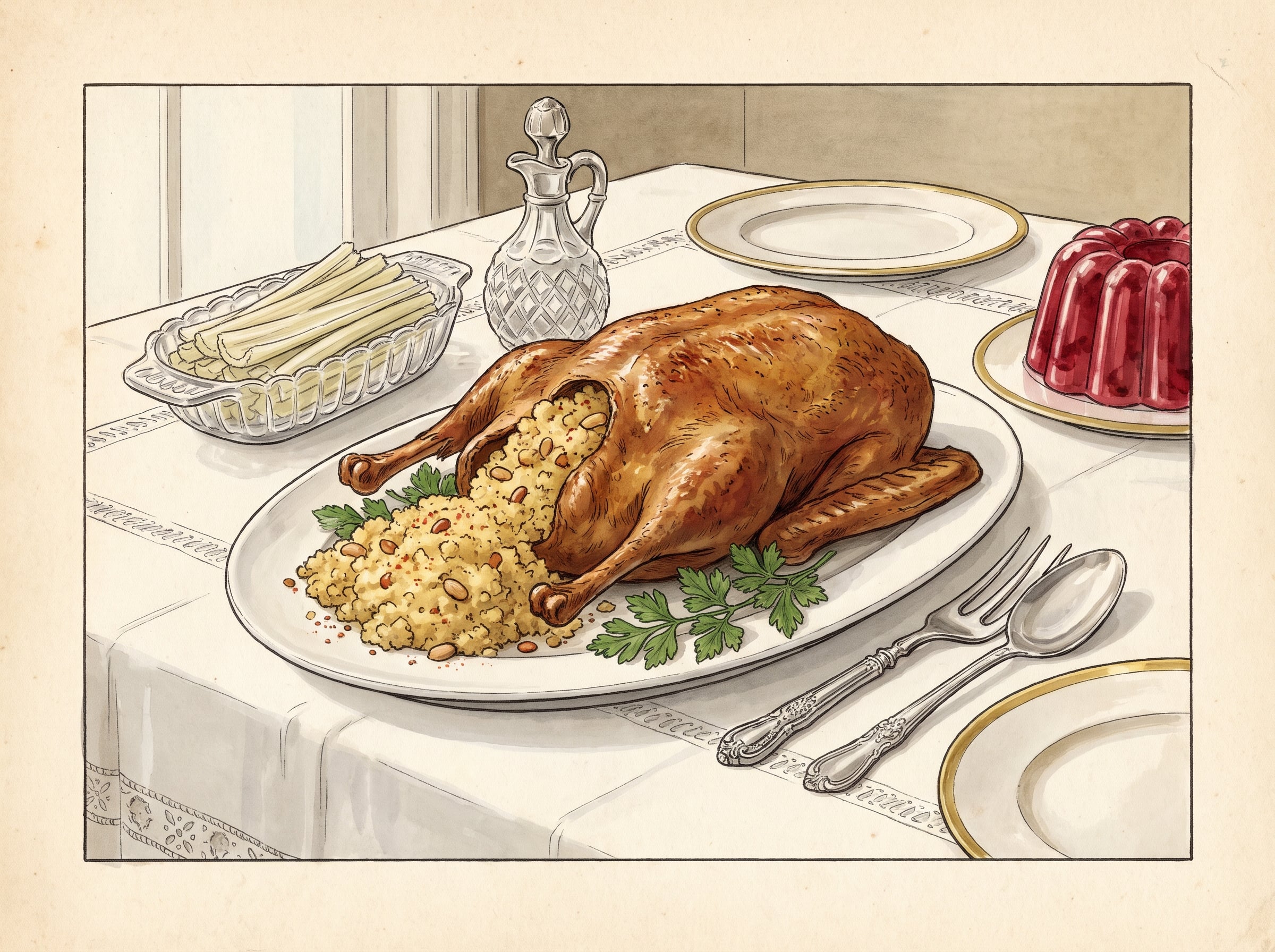
In 1910, Fannie Farmer’s Boston Cooking-School Cook Book offered a duck stuffing made of cracker crumbs, chopped peanuts and heavy cream. It sounds unusual now, but it was a sensible little recipe from a Boston kitchen, where crackers came from a barrel and peanuts were getting a promotion from snack to supper.
Please note that some of the images in this article were created with the assistance of AI.
From The Boston Cooking-School Cook Book, 1910
The Story Behind This Recipe
The woman who measured everything
Fannie Merritt Farmer had planned on college, not cookery. Born in Boston on March 23, 1857, the oldest of four daughters, she fell ill at 16 and spent years at home. The illness left her with a limp for the rest of her life. Cooking filled the long recovery. On the advice of Mrs. Charles Shaw, she enrolled at the Boston Cooking School, founded in 1879 by the Women’s Education Association of Boston. She graduated in 1889 and stayed on to run the place.
In 1896 she published The Boston Cooking-School Cook Book. Her publisher, Little, Brown, was so unsure of it that it printed only 3,000 copies, and Farmer paid for them herself. The book sold at once, and later editions simply went by the name Fannie Farmer Cookbook. In 1902 she opened Miss Farmer’s School of Cookery. Her 1904 book on feeding the sick and convalescent eventually put her at a lectern at Harvard Medical School. Our recipe comes from the 1910 edition.
Thirty-seven centuries of filling birds
Stuffing a bird is ancient. Historian Amanda Foreman points to a clay tablet some 3,700 years old that describes a roasted bird served with specially flavored soft bread. The Roman collection De Re Coquinaria stuffed almost anything, dormice included. American stuffing, Foreman writes, has been regional rather than showy: oysters for some New Englanders, cornbread in the South, wild rice in parts of the Northwest.
Our sources don’t say who first put peanuts in a duck, and we won’t invent an answer. The recipe itself is a plain crumb stuffing, with crumbs and butter bound with liquid and seasoned. The peanuts do the job an oyster or a handful of herbs might do in another version. Farmer filed it as "Duck Stuffing (Peanut)," one variation among the book’s stuffings for duck.
A barrel of crackers and a nut on the rise
Both main ingredients made sense for Boston around 1910. Common crackers were baked across New England under local names, and Massachusetts had the Boston Cracker. Country stores sold them loose from barrels. Thrifty Yankees mashed them into soups and chowders, so crumbling a few for a duck was nothing special. Peanuts had a livelier résumé. Civil War soldiers roasted them as a cheap snack, and later they turned up at circuses, fairs and ballgames. In 1895 John Harvey Kellogg filed a patent for an early peanut butter, which he pitched as a healthy alternative to meat. By 1908 one ad claimed that a dime’s worth of peanuts held six times the energy of a porterhouse steak.
The recipe also shows off Farmer’s famous habit of measuring. Older cookbooks asked for a "handful" or a "heaping spoon." This one wants ¾ cup of crumbs, ½ cup each of peanuts and cream, and 2 tablespoons of butter. Then it leaves the cook to judge the "few drops onion juice" and the salt, pepper and cayenne. It gives one instruction, to mix in the order given. How to stuff and roast the duck, it assumes, you already know.
1910s
Notes From the Era
The recipe · 1910
What Our Readers Say
- When Piaci Pizza readers loved a food photo and tapped a reason, comfort came first at 30%, with nostalgia next at 17%.
From Piaci Pizza reader polls and votes.
Duck Stuffing (Peanut)
From The Boston Cooking-School Cook Book by Fannie Merritt Farmer (1910). Every word of the recipe below is as printed.
Ingredients
- ¾ cup cracker crumbs
- ½ cup shelled peanuts, finely chopped
- ½ cup heavy cream
- 2 tablespoons butter
- Few drops onion juice
- Salt and pepper
- Cayenne
- If the stuffing is cooked inside the duck, its center must reach 165°F / 74°C.
Method
-
Mix the stuffing
Mix ingredients in the order given.
Our notes
Reading It Today
Which crackers?. In New England, "cracker" meant the hard, dry common cracker, not a buttery snack cracker. A plain, unsweetened, dry cracker is the closest match for the crumbs.
Onion juice, by the drop. Onion juice is the liquid pressed from grated raw onion. A few drops give only a faint onion note.
What it would be like. Judging from the ingredients, this would be a rich, soft, fairly dense filling. Cream and butter soak the crumbs, the peanuts add nutty flavor and some texture, and cayenne brings a little warmth. The amounts are small, enough for a duck rather than a big turkey.
How it differs from today’s stuffing. There is no bread, celery, sage, egg or broth here. Cream does all the moistening. It was also meant to cook inside the bird. Boxed stovetop stuffing didn’t arrive until 1972.
Source: Fannie Merritt Farmer, The Boston Cooking-School Cook Book (Little, Brown, and Company, Boston, 1910). Read the 1910 book at Project Gutenberg.
Sources for the history
- Fannie Merritt Farmer, The Boston Cooking-School Cook Book (Little, Brown, and Company, 1910), Project Gutenberg
- Fannie Farmer (1857-1915), Massachusetts Women’s History (Katie Woods)
- Fannie Farmer, Wikipedia
- The Boston Cooking-School Cook Book, Wikipedia
- Former Site of Miss Farmer’s School of Cookery: Fannie Farmer, Boston Women’s Heritage Trail
- WSJ Historically Speaking: Much Ado About Stuffing: A History, Amanda Foreman
- Cracking the History of the Uncommon Common Cracker, New England Historical Society
- A Brief History of Peanut Butter, Smithsonian Magazine
- Going Nuts: The History of the Peanut Industry, Morning Ag Clips
The original recipe text is from a work published in 1910 and is in the public domain in the United States. The history, notes and illustrations are Piaci Pizza’s own. Brand names that appear in historic recipes are mentioned as historical fact only. Illustrations are AI-generated in a vintage style. The recipe is shown exactly as it was published in 1910; we have not photographed a test batch.