
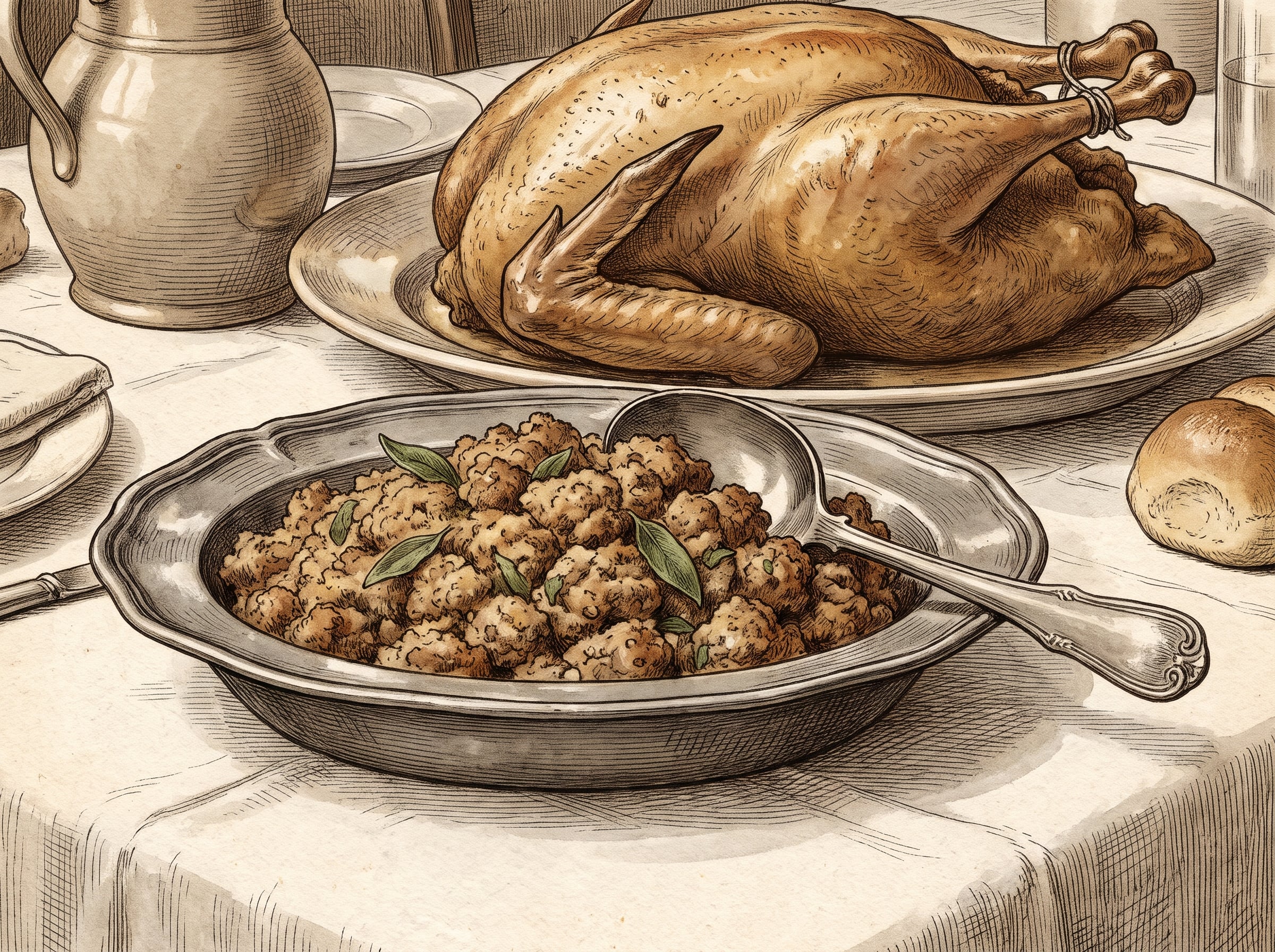
Six ounces of lean pork, six of fat, a spoonful of sage, and a closing reminder of whose taste really counts. This 1861 turkey stuffing is priced at ninepence on the page, and nearly every line of it hints at who was cooking, who was eating, and who could afford the bird in the first place.
Please note that some of the images in this article were created with the assistance of AI.
From The Book of Household Management, 1861
The Story Behind This Recipe
The cookbook author who wasn’t a cook
The woman whose name is on this book never worked as a cook. Isabella Mayson was born in Marylebone, London, in 1836. She went to school in Islington and then in Heidelberg, and she took pastry lessons from a local baker. In 1856 she married the publisher Samuel Orchart Beeton, and before long she was writing the cookery column in his Englishwoman’s Domestic Magazine.
Her book arrived in installments. Starting in 1859 it came out as monthly supplements to the magazine at 3d. apiece, and in October 1861 the 24 parts were bound into a single volume. It sold 60,000 copies in its first year, and one study puts the total near two million by the end of the decade. Readers sent in more than 2,000 recipes, and many others were borrowed from earlier cookery writers. Her gift was order: ingredients set out before the method, with the cost, the season and the number of servings alongside. She died of puerperal fever in 1865, at 28.
A very old idea with a lot of names
People were tucking one food inside another long before anyone wrote down a turkey recipe. The oldest written evidence comes from the Roman cookbook of Apicius, which stuffs chicken, hare and pig. English kept collecting words for the same trick: "farce" around 1390, "stuffing" in 1538 and "forcemeat" in 1688.
Some stuffings start from sausage meat rather than bread, and this is one of them: lean and fat pork chopped fine, held together with crumbs and egg, and seasoned with sage and mace. That made it a bit of a departure, since Victorian forcemeat was usually made from veal. The book even suggests a blend, half this stuffing and half its forcemeat No. 417, so the herbs and lemon peel in the second recipe can flavor the pork.
A bird for the well-off
Turkey had a long head start as a holiday bird. In 1573 the poet Thomas Tusser already counted it among good Christmas fare, and in 1851 it was the centerpiece of the royal family’s Christmas dinner. Most Victorian families still could not afford one. They ate goose, often paid off a little each week through pub-run goose clubs in the eight to ten weeks before Christmas. Before the railways improved, turkeys and geese usually walked to city markets with their feet wrapped in rags or coated in tar, and that long trip added to the price. Even on upper-class menus turkey was common but optional, often boiled with celery or galantined rather than served as the main roast. It only became the standard British Christmas bird in the 1950s. A stuffing labeled "for Turkey" in 1861 probably had a comfortable household in mind.
That kitchen would likely have had a coal-fired iron range, though the bird itself might still turn on a spit in front of an open fire. The last line gives away the real audience: the cook "should study her employer’s taste." The book was aimed at the people who hired the cook. Historians Suzanne Daly and Ross G. Forman call it "an important index of mid-Victorian and middle-class society," and argue that because so many recipes came from readers, it shows what people actually cooked and ate. Ninepence of pork and sage, made downstairs and judged upstairs, fits that picture neatly.
1860s
Notes From the Era
The recipe · 1861
What Our Readers Say
- When Piaci Pizza readers loved a food photo and tapped a reason, comfort came top at 30%, with nostalgia and ingredients tied next at 17% each.
From Piaci Pizza reader polls and votes.
Sausage-Meat Stuffing for Turkey
From The Book of Household Management by Isabella Beeton (1861). Every word of the recipe below is as printed.
Ingredients
- 6 oz. of lean pork
- 6 oz. of fat pork
- both weighed after being chopped (beef suet may be substituted for the latter)
- 2 oz. of bread crumbs
- 1 small tablespoonful of minced sage
- 1 blade of pounded mace
- salt and pepper to taste
- 1 egg
- This stuffing contains raw pork and raw egg, so it must be cooked all the way through before eating.
- Stuffing cooked inside the bird must reach 165°F / 74°C at its center.
Method
-
Chop the meat and mix
Chop the meat and fat very finely, mix with them the other ingredients, taking care that the whole is thoroughly incorporated.
-
Bind with the egg
Moisten with the egg, and the stuffing will be ready for use.
-
Combine with forcemeat if liked
Equal quantities of this stuffing and forcemeat, No. 417, will be found to answer very well, as the herbs, lemon-peel, &c. in the latter, impart a very delicious flavour to the sausage-meat.
-
Season to taste
As preparations, however, like stuffings and forcemeats, are matters to be decided by individual tastes, they must be left, to a great extent, to the discrimination of the cook, who should study her employer’s taste in this, as in every other respect.
Our notes
Reading It Today
Weighed after chopping. Six ounces is about 170 grams, so the two kinds of pork add up to three-quarters of a pound. Beeton wants them weighed after chopping, not before. The 2 ounces of bread crumbs come to about 57 grams.
A blade of mace. Mace is the lacy red covering around the nutmeg seed, dried and sold in flat pieces called blades. "Pounded" simply means ground. Its flavor is warm and close to nutmeg, a little softer, and it pairs naturally with pork and sage.
Small spoons and pennies. A "small tablespoonful" is a slightly scant tablespoon. "9d." means ninepence in old British money. The "d." comes from the Latin denarius and was the usual abbreviation for a penny.
More sausage than stuffing. Judging from the ingredients, we’d expect this to be firm, close-textured and rich. It has six parts meat to one part crumbs, plenty of fat, and sage up front. Most American stuffings today are the other way around, with bread as the bulk and onion, celery and broth for moisture. Here there is no onion or broth, and the egg is the only moisture.
Source: Isabella Beeton, The Book of Household Management (S. O. Beeton, London, 1861). Read the 1861 book at Project Gutenberg.
Sources for the history
- Isabella Beeton, The Book of Household Management (S. O. Beeton, London, 1861), recipe 520
- Isabella Beeton – Wikipedia
- Susan Zlotnick, "On the Publication of Isabella Beeton’s Book of Household Management, 1861" – BRANCH
- Stuffing – Wikipedia
- What’s on the table? Christmas turkey in Victorian England – English Heritage (Dr Annie Gray)
- Why do we eat turkey at Christmas? – The Museum of English Rural Life, University of Reading
- The Kitchen Range – Holst Victorian House
The original recipe text is from a work published in 1861 and is in the public domain in the United States. The history, notes and illustrations are Piaci Pizza’s own. Brand names that appear in historic recipes are mentioned as historical fact only. Illustrations are AI-generated in a vintage style. The recipe is shown exactly as it was published in 1861; we have not photographed a test batch.
Ingredients matter both ways: when our readers disliked a food photo, ingredients were the second most common reason they gave, at 29%, behind a simple “not for me”.