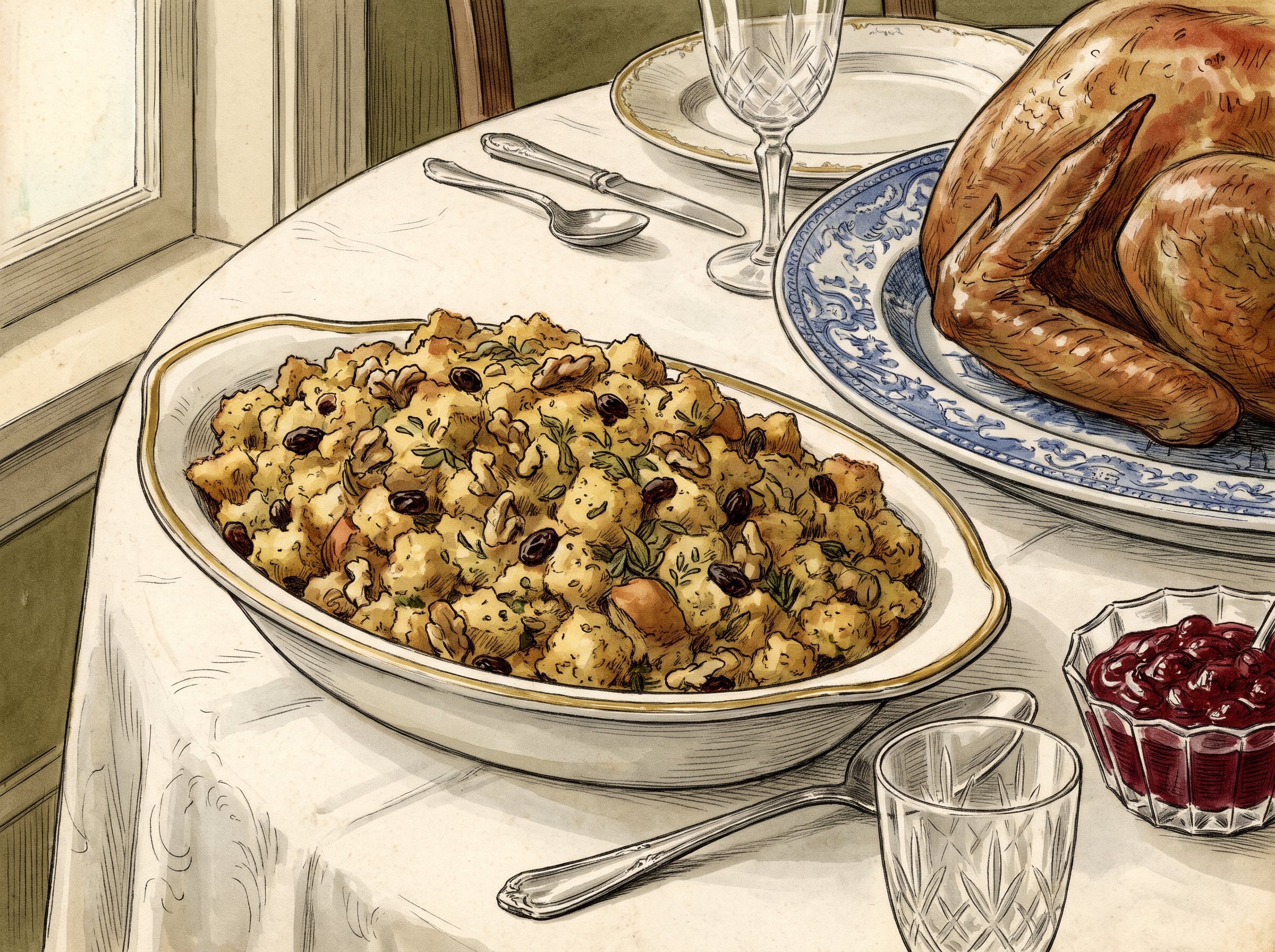
Tucked inside the roast turkey recipe of Fannie Farmer’s 1910 cookbook is a stuffing with a puzzle in its name. It calls for stale bread, a generous pour of melted butter, raisins and walnuts, and it is labeled "Swedish Style" without a word of explanation. Here is what we know about the woman who printed it, the Boston kitchen it came from, and the mystery we couldn’t solve.
Please note that some of the images in this article were created with the assistance of AI.
From The Boston Cooking-School Cook Book, 1910
The Story Behind This Recipe
The teacher who leveled the cup
At sixteen, Fannie Merritt Farmer was a student at Medford High School when a stroke paralyzed her right leg. College was off the table. The Boston-born girl, who arrived in 1857, took work as a mother’s helper and found she had a real gift for cooking. In 1887 she signed up at the Boston Cooking School, graduated two years later, stayed on as assistant and was running the place by 1894. Her cookbook followed in 1896. Little, Brown printed a cautious 3,000 copies, but because the book was more or less self-published, Farmer held the copyright, and it made her wealthy. Its big idea sounds modest now: level measurements for every teaspoon, tablespoon and cup.
In 1902 she left to open Miss Farmer’s School of Cookery, aimed at housewives rather than professional cooks, and from 1905 she and her sister wrote a column for the Woman’s Home Companion until her death in Boston in 1915. The 1910 edition we’re quoting bills itself as revised, with 125 new recipes. It is dedicated to Mrs. William B. Sewall, president of the Boston Cooking School, and its back pages advertise Farmer’s own school at 30 Huntington Avenue.
A stuffing with a name and no explanation
Stuffing goes back a very long time. The earliest written record is the Roman cookbook of Apicius, whose fillings used vegetables, herbs, nuts and spelt. English speakers have called the stuff farce, stuffing and forcemeat, and around 1850 Americans started saying "dressing." Dried fruit has been tumbling into the mix for ages.
So why "Swedish"? Farmer doesn’t say, and we couldn’t find anyone who does. The closest echo we found is Sweden’s St. Martin’s Eve goose, a medieval autumn feast that came north from France, with a bird traditionally stuffed with apples and prunes. A Stockholm innkeeper set down the now-classic menu in the 1850s. Any connection to Farmer is our guess, not a fact. What the book does make plain is how much this recipe stands apart from her other bird stuffings, which lean on cracker crumbs, butter, water and sage. This one has no onion, no liquid, plenty of melted butter, and sweet raisins and walnuts.
Ten pounds of turkey, basted every fifteen minutes
By 1910 Thanksgiving was firmly national. Sarah Josepha Hale had written about it as early as 1827 and campaigned for years, and Lincoln’s proclamation of October 3, 1863 is seen as the holiday’s national start. Farmer’s menu runs from oyster soup to roast turkey with cranberry jelly, mashed potatoes, onions in cream, squash and chicken pie, then mince, apple and squash pies. Her turkey weighs ten pounds, gets rubbed with butter and flour, and is basted every fifteen minutes for about three hours. Swedish Style is one of three stuffings she names for it, alongside chestnut and oyster. Planning to serve it cold? She suggests mixing in a beaten egg.
"Mix ingredients in the order given" assumes you’ve read the front of the book, where Farmer explains level measuring and stale crumbs. There she notes that old stoves were "but seldom used," replaced by portable ranges, and admits no oven thermometer had yet proved practical. Thrift was law: "All pieces of bread should be saved and utilized." The butter here, by her own table, comes to about a third of a pound. For thinner purses, she pointed to butterine and oleomargarine.
1910s
What Our Readers Say
- When Piaci Pizza readers loved a food photo and tapped a reason, comfort came out on top at 30%, with nostalgia and ingredients next at 17% each.
From Piaci Pizza reader polls and votes.
Notes From the Era
The recipe · 1910
Turkey Stuffing (Swedish Style)
From The Boston Cooking-School Cook Book by Fannie Merritt Farmer (1910). Every word of the recipe below is as printed.
Ingredients
- 2 cups stale bread crumbs
- ⅔ cup melted butter
- ½ cup raisins, seeded and cut in pieces
- ½ cup English walnut meats, broken in pieces
- Salt and pepper
- Sage
- If you cook the stuffing inside the turkey, the center of the stuffing must reach 165°F / 74°C.
Method
-
Mix the stuffing
Mix ingredients in the order given.
Our notes
Reading It Today
"Seeded" means the seeds come out. Many raisins of Farmer’s day still had seeds, and "seeded" tells the cook to remove them, then cut the raisins into pieces. Today’s seedless raisins skip that chore entirely, though chopping them would still match her intent.
English walnut meats. These are ordinary walnuts, the kind sold in any grocery store. "Meats" simply means the shelled kernels, broken into pieces.
How much butter is that?. Two-thirds of a cup is about 10⅔ tablespoons, or roughly a third of a pound. Her "stale bread crumbs" are soft stale bread with the crusts cut off and crumbled, not dry crumbs, which she treated as a separate thing.
What kind of stuffing to expect. With no broth or water, and no egg unless it’s to be served cold, the melted butter is the only moisture, so the crumbs would be coated rather than soaked. Judging from the ingredients, it would be loose, rich and lightly sweet, with chewy raisins, crunchy walnuts and sage. Unlike Farmer’s other stuffings, it has no onion, and like them it was made to go inside the bird.
Source: Fannie Merritt Farmer, The Boston Cooking-School Cook Book (Little, Brown, and Company, Boston, 1910). Read the 1910 book at Project Gutenberg.
Sources for the history
- Fannie Merritt Farmer, The Boston Cooking-School Cook Book (1910), Project Gutenberg — roast turkey
- Farmer, The Boston Cooking-School Cook Book (1910) — cookery chapter
- Farmer, The Boston Cooking-School Cook Book (1910) — baking of bread
- Farmer, The Boston Cooking-School Cook Book (1910) — uses for stale bread
- Encyclopaedia Britannica, "Fannie Farmer"
- Mass Moments (Mass Humanities), "Fannie Farmer Cookbook Published"
- Wikipedia, "Stuffing"
- Nordstjernan, "’Mårtens Afton’ Celebrate St. Martin’s Eve"
- National Park Service, "Lincoln and Thanksgiving"
- National Park Service, "Sarah Josepha Hale"
- CulinaryLore, "Did Raisins Used To Have Seeds?"
- California Walnuts, "History"
The original recipe text is from a work published in 1910 and is in the public domain in the United States. The history, notes and illustrations are Piaci Pizza’s own. Brand names that appear in historic recipes are mentioned as historical fact only. Illustrations are AI-generated in a vintage style. The recipe is shown exactly as it was published in 1910; we have not photographed a test batch.