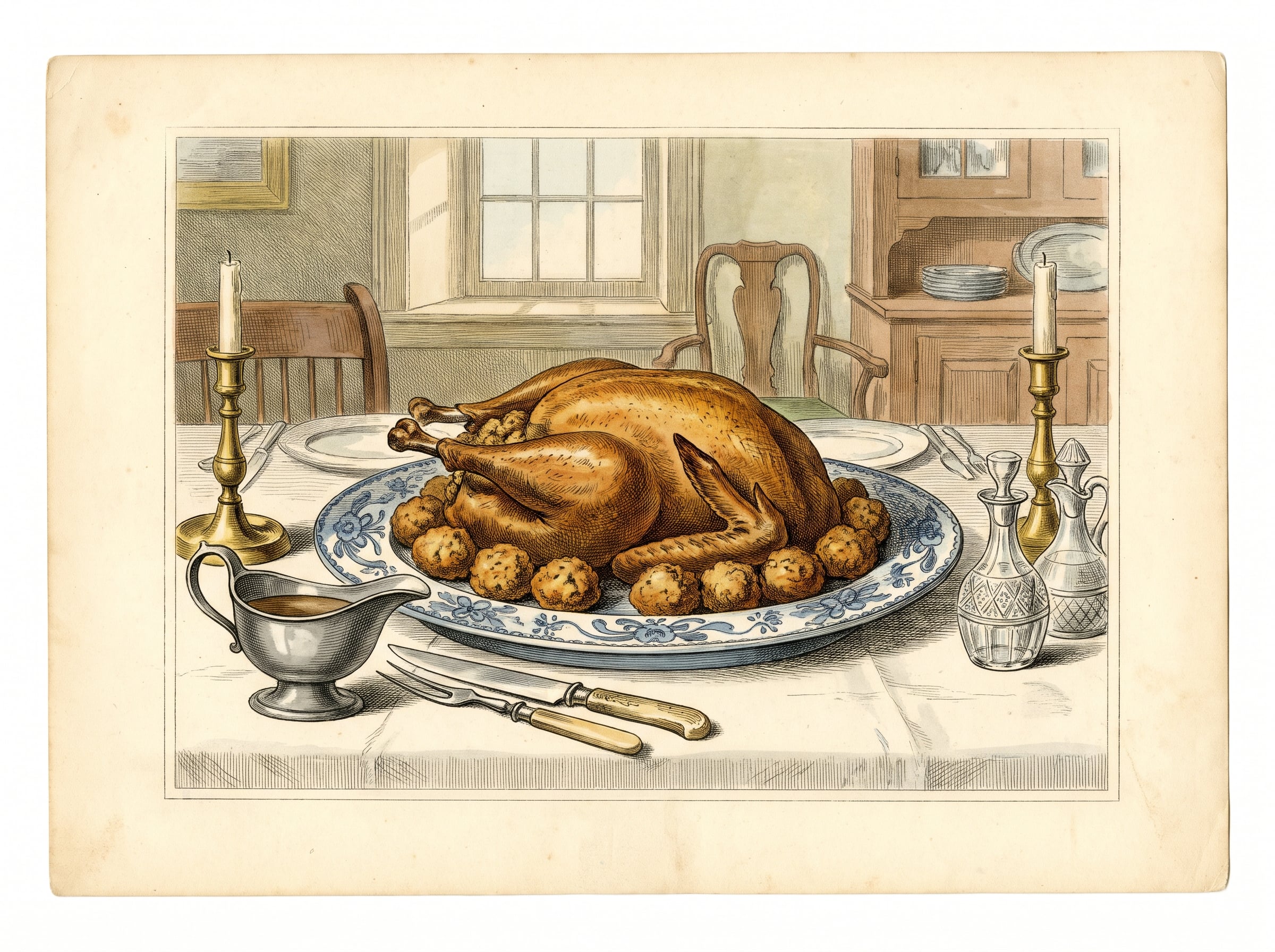
Eliza Leslie’s roast turkey has its stuffing tucked inside the roasting directions instead of on a page of its own: mix a force-meat, pack it into the bird, and fry whatever is left into little balls for the platter. Printed in Philadelphia in 1840, it catches the holiday turkey in an older form, before Americans said "dressing" and while the bird still roasted in front of an open fire.
Please note that some of the images in this article were created with the assistance of AI.
From Directions for Cookery, in Its Various Branches (tenth edition), 1840
The Story Behind This Recipe
The Philadelphia woman who never ran a kitchen
Eliza Leslie learned early what it takes to keep a houseful going. She was born in Philadelphia on November 15, 1787, the daughter of a watchmaker whose business failed around 1800. After he died in 1803, her mother took in boarders, and teenage Eliza helped keep the boardinghouse going. In the early 1820s she enrolled at Mrs. Goodfellow’s Cooking School in Philadelphia, which Mental Floss calls the first of its kind in the country. She took meticulous notes, and friends kept asking for copies. Those notes became her first book, Seventy-Five Receipts for Pastry, Cakes, and Sweetmeats, in 1828.
Directions for Cookery followed in 1837 and became the best-loved American cookbook of the century. By 1840, when this tenth edition appeared, forty thousand copies had sold, and it went through more than 60 printings by 1870. Here is the curious part: Leslie never ran a kitchen of her own. She spent her last decade living at Philadelphia’s United States Hotel, where she held court as something of a local celebrity.
Farce, forcemeat, stuffing, dressing
Nobody can say when cooks first stuffed a bird. The oldest written evidence is the Roman cookbook of Apicius, which stuffs chicken, hare, pig and even dormouse. Medieval English cooks called the filling "farce," from the French farcir, "to stuff." "Stuffing" reached print in 1538 and "forcemeat" by 1688. "Dressing" didn’t turn up in the United States until around 1850, a decade after this edition, so Leslie sticks with force-meat.
Her version starts with bread-crumbs bound with minced suet and egg yolk, then seasoned with sweet marjoram, grated lemon peel and nutmeg, plus some grated cold ham if you have it. The neck, liver and gizzard go to the gravy, not the filling. She also plans for extra. Make enough, she says, to roll into balls, fry them, and lay them around the turkey on the dish.
A holiday bird before the national holiday
Thanksgiving appears nowhere in Leslie’s directions. Even so, stuffed roast turkey was already a holiday centerpiece long before Lincoln made the day national in 1863. In Sarah Josepha Hale’s 1827 novel Northwood, the turkey takes the head of the Thanksgiving table, "sending forth the rich odour of its savoury stuffing." Hale became editor of Godey’s Lady’s Book in 1837 and spent years pressing for a fixed national day of thanks on the last Thursday of November. Leslie wrote for Godey’s too, and one of her prize-winning stories ran there. The two women were reaching many of the same readers while this recipe was in print.
Leslie insisted that American cooks needed American books. In her first one she grumbled that English and French recipes were hard to follow because of "the difference in the fuel, fire-places, and cooking utensils." This turkey shows what she meant. It roasts "before a clear brisk fire" for two to three hours, basted with cold lard, then is moved closer to the flames, floured lightly and finished with butter. Many hearth cooks did the job with a reflector oven, or "tin kitchen," a polished box open on one side that threw the fire’s heat back onto the meat.
1840s
Notes From the Era
The recipe · 1840
What Our Readers Say
- When Piaci Pizza readers loved a food photo and tapped a reason, comfort came first at 30%, with nostalgia close behind at 17%.
From Piaci Pizza reader polls and votes.
To Roast a Turkey
From Directions for Cookery, in Its Various Branches (tenth edition) by Eliza Leslie (1840). Every word of the recipe below is as printed.
Ingredients
- grated bread-crumbs
- minced suet
- sweet marjoram
- grated lemon-peel
- nutmeg
- pepper
- salt
- beaten yolk of egg
- some grated cold ham
- turkey
- flour
- cold lard
- butter
- Stuffing cooked inside the bird must reach 165°F / 74°C in its center, and the thickest part of the turkey must also reach 165°F / 74°C.
- Singeing with lit paper is a fire risk; use a kitchen torch or gas flame with care, away from anything flammable.
Method
-
Make the force-meat
Make a force-meat of grated bread-crumbs, minced suet, sweet marjoram, grated lemon-peel, nutmeg, pepper, salt, and beaten yolk of egg. You may add some grated cold ham.
-
Singe the turkey and save the giblets
Light some writing paper, and singe the hairs from the skin of the turkey. Reserve the neck, liver, and gizzard for the gravy.
-
Stuff the turkey and shape force-meat balls
Stuff the craw of the turkey with the force-meat, of which there should be enough made to form into balls for frying, laying them round the turkey when it is dished.
-
Flour and roast with lard
Dredge it with flour, and roast it before a clear brisk fire, basting it with cold lard.
-
Finish with flour and butter
Towards the last, set the turkey nearer to the fire, dredge it again very lightly with flour, and baste it with butter.
-
Roasting time
It will require, according to its size, from two to three hours roasting.
Our notes
Reading It Today
Force-meat and the craw. Force-meat is simply stuffing, the seasoned mixture that goes inside the bird. The craw is the crop, the pouch at the base of a bird’s neck, so Leslie is filling the neck end of the turkey rather than the main body cavity.
Singeing, dredging and basting. Lighting a sheet of writing paper and passing the flame over the skin burned off any fine hairs left after plucking. Turkeys sold today arrive already cleaned. To dredge is to dust with flour, and to baste is to spoon fat over the meat as it cooks. The flour and fat together help the skin brown.
No amounts, no thermometer. The recipe gives no quantities at all. You make "enough" force-meat to stuff the craw and still have some left for frying, and the roasting time of two to three hours depends on the size of the bird.
What the stuffing would be like. Judging from the ingredients, it would be rich and fairly firm. Suet and egg yolk bind the crumbs well enough to roll into balls and fry. Sweet marjoram adds a mild herbal note, lemon peel a bright one, and nutmeg some warmth, with ham adding salt if used. There is no onion, celery or sage, so it would taste quite different from a typical American stuffing today: more citrus and spice, less savory vegetable.
Source: Eliza Leslie, Directions for Cookery, in Its Various Branches (tenth edition) (E. L. Carey & A. Hart, Philadelphia, 1840). Read the 1840 book at Project Gutenberg.
Sources for the history
- Eliza Leslie, Directions for Cookery, in Its Various Branches (10th ed., 1840), Project Gutenberg
- Eliza Leslie: The Most Influential Cookbook Writer of the 19th Century (Mental Floss)
- Eliza Leslie (CooksInfo)
- Eliza Leslie (Women History Blog)
- Stuffing (Wikipedia)
- Reflector oven (Wikipedia)
- "Our National Thanksgiving" (Massachusetts Historical Society)
- How the ‘Mother of Thanksgiving’ Lobbied Abraham Lincoln to Proclaim the National Holiday (History.com)
- 25 Thanksgiving Traditions From the 1950s and ’60s That Faded or Disappeared (Genealogy Explained)
The original recipe text is from a work published in 1840 and is in the public domain in the United States. The history, notes and illustrations are Piaci Pizza’s own. Brand names that appear in historic recipes are mentioned as historical fact only. Illustrations are AI-generated in a vintage style. The recipe is shown exactly as it was published in 1840; we have not photographed a test batch.