
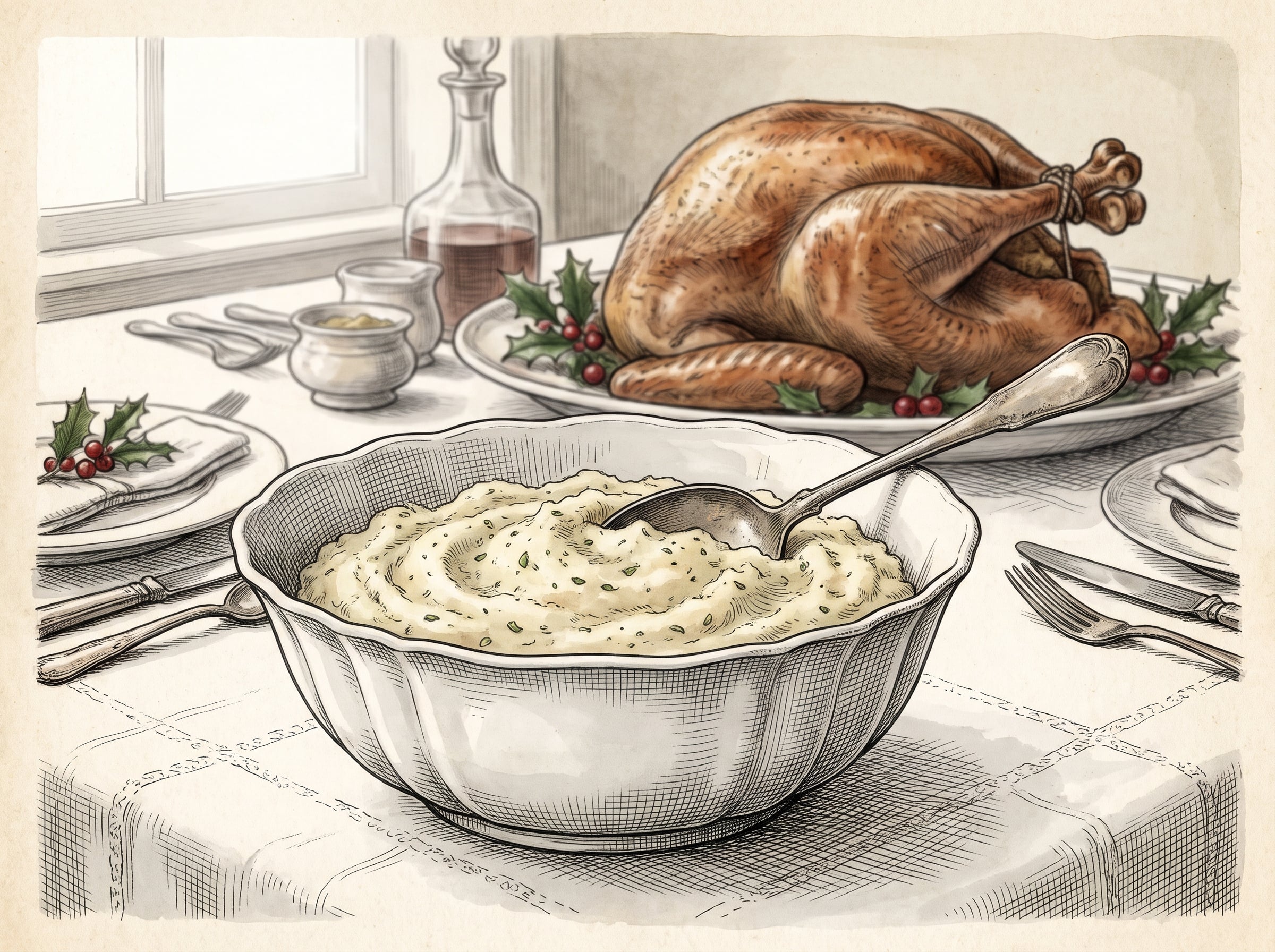
In 1836, a New England cook about to stuff a turkey had a choice to make: potatoes or bread. This recipe treats the two as equals, enriches either with a scrap of pork or butter, and leaves the herbs up to the cook, "if you like them." It comes from a time when Thanksgiving was still a Yankee holiday with no fixed date, a few decades before turkey and stuffing became the whole country’s dinner.
Please note that some of the images in this article were created with the assistance of AI.
From The New England Cook Book, or Young Housekeeper’s Guide, 1836
The Story Behind This Recipe
A book with two publishers and no author
Whoever wrote this recipe never put a name to it. The New England Cook Book, or Young Housekeeper’s Guide came off the presses in New Haven in 1836 with two publishers behind it, Hezekiah Howe & Co. and Herrick & Noyes, and no author at all. We looked for a reliable source that names the writer and came up empty, so the cook behind these pages stays anonymous.
What we do know is who the book was for. It spoke to a young housekeeper still learning the basics. The Henry Ford museum, which features it in its online historic recipe collection, credits its "simple, detailed directions" with teaching thrifty cooking that still tasted good, the sort "generally practiced by good notable Yankee housekeepers." American cookbooks were themselves a fairly new idea. The same museum counts Amelia Simmons’ American Cookery, published in 1796, as the first truly American cookbook, which puts this one just forty years behind it.
Older than the turkey dinner
Cooks have been tucking one food inside another for a very long time. The earliest recorded examples turn up in Apicius, a Roman recipe collection put together in the late 4th or early 5th century AD, where chickens, rabbits and pigs were filled with spelt, spices, herbs and vegetables.
The idea kept changing its name. In the 14th century it was "farce," by the 17th it was "forcemeat," and "dressing" arrived in the 19th. Our 1836 writer reaches for that newer word and calls the filling "a dressing," though the method is plain stuffing by today’s definition: pack it into the crop and the body, then sew the bird closed.
A Yankee feast before it was a national one
Read the ingredient list and you can see a thrifty household at work. The base is whatever was on hand, either boiled potatoes or bread soaked and squeezed dry, stretched with a little butter or chopped pork. Even the egg has a practical job, since it "makes it cut smoother." That suggests this dressing came to the table firm enough to slice, not loose enough to spoon. The book’s promise of economical cooking is right there in a single dish.
Nobody knows whether the 1621 harvest meal included stuffing. The records mention turkeys and waterfowl and say nothing about what, if anything, was inside them. By the 1800s, though, early Thanksgiving menus listed stuffed turkeys alongside hams. In 1836 the holiday still belonged mostly to New England, with New York joining in 1817, and each state picked its own date, anywhere from October to January. Nine years before this book appeared, the New Hampshire writer Sarah Josepha Hale described a New England Thanksgiving in her novel Northwood, and as the New England Historical Society tells it, the roasted turkey, stuffed and basted, was the centerpiece. Hale went on to edit Godey’s Lady’s Book, where she pressed for a national holiday in editorial after editorial. In 1863, when she was 74, Lincoln agreed, and her dinner of turkey, stuffing and pumpkin pie spread along with the holiday.
1830s
Notes From the Era
The recipe · 1836
What Our Readers Say
- When our readers loved a food photo and tapped a reason, comfort topped the list at 30%, and nostalgia came in at 17%.
From Piaci Pizza reader polls and votes.
Turkey
From The New England Cook Book, or Young Housekeeper’s Guide by Anonymous (1836). Every word of the recipe below is as printed.
Ingredients
- the turkey
- boiled potatoes mashed fine
- bread soaked in cold water
- a small piece of butter
- pork chopped fine
- pepper
- salt
- sweet herbs if you like them
- an egg
- a little salt and butter
- Today’s advice is not to wash raw poultry, because rinsing spreads bacteria around the kitchen.
- Stuffing cooked inside the bird must reach 165°F / 74°C in its center.
- The turkey itself must reach 165°F / 74°C in the thickest part of the thigh and breast.
Method
-
Clean the turkey
Take out the inwards and wash both the inside and outside of the turkey.
-
Make the dressing
Prepare a dressing of either boiled potatoes mashed fine or bread soaked in cold water, the water should be squeezed out of the bread, mash it fine, add a small piece of butter or pork chopped fine, put in pepper, salt, and sweet herbs if you like them, an egg mixed with the dressing makes it cut smoother.
-
Stuff, truss and season the bird
Fill the crop and body of the turkey with the dressing, sew it up, tie up the legs and wings rub on a little salt and butter.
-
Roast the turkey
Roast it from two to three hours according to the size; twenty five minutes for every pound is a good rule.
Our notes
Reading It Today
Inwards and the crop. "Inwards" are the innards, the internal organs taken out before cooking. The crop is the pouch at the base of a bird’s neck. The recipe fills both the crop and the body cavity, then sews them shut so the dressing stays put while the bird roasts.
Twenty-five minutes a pound. The book gives no oven temperature, only a rule of thumb. Two to three hours at twenty-five minutes per pound points to a bird of roughly five to seven pounds, much smaller than many supermarket turkeys today. Many cooks of the time would have roasted in front of an open fire, perhaps in a tin reflector oven, the "tin kitchen" of old probate inventories.
A smooth, firm filling. Judging from the ingredients, this dressing would be soft, dense and compact. Mashed bread or potato bound with egg is closer to a savory loaf than to a crumbly side dish, and it was meant to hold together when sliced. The flavor would be mild: salt, pepper, the richness of butter or pork, and "sweet herbs" only if the cook wanted them.
Not today’s stuffing. Bread stuffing is the norm today, usually made with dried bread cubes. This one’s bread is soaked in cold water and mashed fine rather than cubed, which would make a smooth, dense filling. It also treats mashed potatoes as an equally good base, which most stuffing recipes today do not.
Source: Anonymous, The New England Cook Book, or Young Housekeeper’s Guide (Hezekiah Howe & Co. and Herrick & Noyes, New Haven, 1836). Read the 1836 book at Project Gutenberg.
Sources for the history
- The New England Cook Book, or Young Housekeeper’s Guide (New Haven, 1836), recipe 17, Turkey
- The New England Cook Book, The Henry Ford
- Holiday Staples: The History of Stuffing, Yesterday’s America
- Sarah Josepha Hale, the Little Lady From NH Who Started Thanksgiving, New England Historical Society
- From the Collection: Tin Reflector Oven, Webb Deane Stevens Museum
The original recipe text is from a work published in 1836 and is in the public domain in the United States. The history, notes and illustrations are Piaci Pizza’s own. Brand names that appear in historic recipes are mentioned as historical fact only. Illustrations are AI-generated in a vintage style. The recipe is shown exactly as it was published in 1836; we have not photographed a test batch.