
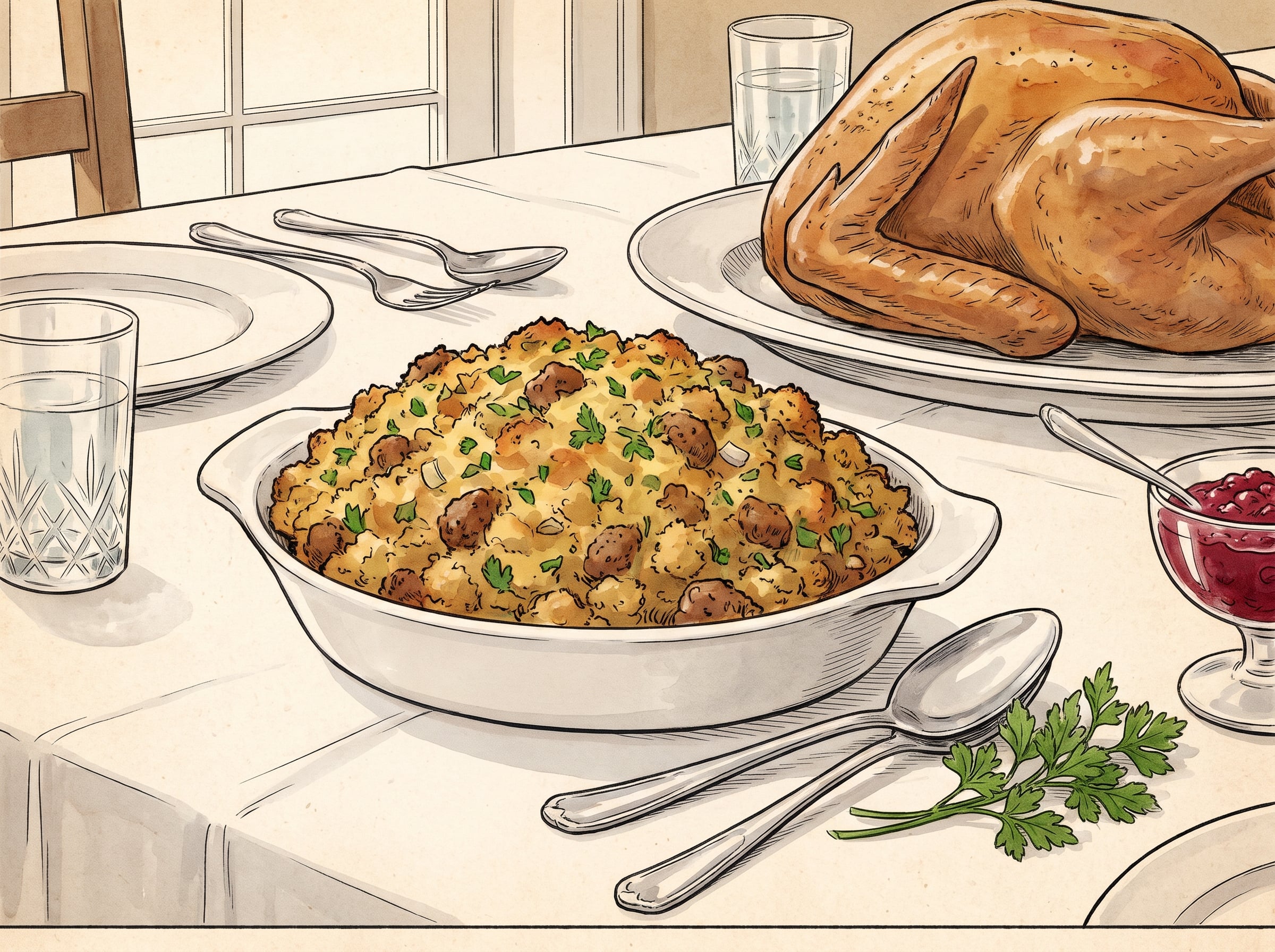
Right in the middle of this sausage stuffing sit four tablespoons of Crisco, in the spot where butter or lard used to go. The recipe comes from a 1922 printing of a cookbook published by the company that made Crisco. Its author was a Glasgow-trained cooking teacher who had died before this edition was printed. It is a small, lemony record of a factory product finding its place at the holiday table.
Please note that some of the images in this article were created with the assistance of AI.
From A Calendar of Dinners, with 615 Recipes, 1922
The Story Behind This Recipe
A Glasgow teacher and a fifty-cent book
Marion Harris Neil was born in Calton, Glasgow, in 1867 and trained at the city’s West End Training School of Cookery. After teaching in Scotland, she came to the United States in 1903 with her widowed mother and younger sister. She opened a cooking school in Philadelphia, with her sister Mary as her assistant, and went on to edit Table Talk and serve as cookery editor of the Ladies’ Home Journal and The Delineator. Food companies paid her to write cookbooks for their products: baking powder, California peaches, Crisco. She spent her last year running the Greenacres Inn and Tearoom in Oradell, New Jersey, and died there in November 1920. This 1922 Toronto printing went out without her.
Crisco had gone on sale in June 1911. It was the first shortening made entirely from vegetable oil, cottonseed at the start. Procter & Gamble gave away cookbooks in which every recipe used it, and A Calendar of Dinners was one of them, though it was sold too. One reader who owns a 1922 copy reports that it was the twenty-second edition, priced at fifty cents, with several introductory chapters, among them one called "The Story of Crisco." That reader suspects Neil supplied the recipes and someone else wrote the sales pitch. The pitch worked. The historian Helen Zoe Veit notes that Crisco tasted neutral where lard tasted of pork, and that it kept for years where butter did not. Within five years Americans were buying more than 60 million cans a year.
Farce, forcemeat, stuffing, dressing
People have been packing one food inside another for a very long time. The oldest written evidence is the Roman cookbook of Apicius, which fills chicken, hare and pig with vegetables, herbs, spices, nuts and spelt. English kept collecting words for the idea: "farce" around 1390, "stuffing" in 1538, "forcemeat" in 1688, and, in the United States, "dressing" from about 1850. A popular story says polite Victorians found "stuffing" a bit too blunt and switched to "dressing," and that the gentler word took hold in North America.
Neil’s heading just says "Stuffing." Her mixture keeps to the old formula of bread, onion, herbs and chopped meat. Here the meat is country sausage, bound with beaten egg. The lemon is the bright spot, rind and juice both. Fittingly, Neil had written "The Many Uses of the Lemon" for the Canadian Home Journal in 1918.
Crisco on the holiday table
Nobody knows whether stuffing was served at the Pilgrims’ 1621 harvest meal. By the 19th century, though, menus listed stuffed turkeys and hams as main dishes. The United States made Thanksgiving an annual national holiday in 1863. Canada held its first national Thanksgiving in the Province of Canada in 1859, and Nova Scotia had known the turkey, squash and pumpkin feast since the 1750s. When this Toronto edition appeared, Canadians marked Thanksgiving together with Armistice Day, on the Monday of the week containing November 11.
The fat is the real period detail. Families once rendered lard at home after the autumn pig slaughter, but by the late 1800s meat packers were making it on an industrial scale. In the early 1900s lard stayed expensive while cottonseed oil was cheap. Crisco’s ads talked about purity and avoided mentioning cottonseed at all. Those four tablespoons are why this recipe is in the book. Neil’s last line, "Be careful not to make stuffing too moist," makes the most sense for a mixture headed inside a bird, where it would soak up juices as it roasted.
1920s
What Our Readers Say
- When Piaci Pizza readers loved a food photo and tapped a reason, comfort came out on top at 30%, with nostalgia next at 17%.
From Piaci Pizza reader polls and votes.
Notes From the Era
The recipe · 1922
For Stuffing
From A Calendar of Dinners, with 615 Recipes by Marion Harris Neil (1922). Every word of the recipe below is as printed.
Ingredients
- 1 quart fine breadcrumbs
- 4 tablespoonfuls Crisco
- 1½ teaspoonfuls salt
- 2 tablespoonfuls chopped onion
- 1 lemon
- 1 tablespoonful chopped parsley
- ¼ teaspoonful powdered thyme
- ¼ teaspoonful white pepper
- 1 egg
- 1 cupful country sausage
- A little warm water
- This stuffing contains raw sausage and raw egg, so it must be fully cooked before eating and never served raw.
- Stuffing cooked inside a bird must reach 165°F / 74°C in its center.
- Stuff the bird just before roasting, not ahead of time, and refrigerate leftovers promptly.
Method
-
Combine and moisten the stuffing
Mix sausage with breadcrumbs, add egg well beaten, Crisco, seasonings, grated rind and strained juice of lemon, and moisten with a little hot water.
-
Check the texture
Be careful not to make stuffing too moist.
Our notes
Reading It Today
Spoonfuls and a quart. A "tablespoonful," "teaspoonful" and "cupful" are simply a tablespoon, a teaspoon and a cup. A quart of breadcrumbs is 4 cups. The list asks for warm water and the method says hot, but either way the point is to add only a little.
Country sausage. Today this usually means loose, seasoned pork sausage meat sold without casings, the kind you crumble rather than slice.
What it would be like. Judging from the ingredients, this would be a fairly compact, close-textured stuffing. Fine crumbs bound with egg hold together more than torn bread cubes do. A whole lemon’s rind and juice would make it bright and tart against the sausage, and white pepper gives heat without dark specks. The Crisco adds richness but no flavor of its own.
Compared with today’s stuffing. Many modern stuffings lean on celery, sage and broth. This one has no celery, uses thyme and parsley instead of sage, and is moistened with water rather than stock. The onion is modest, just 2 tablespoons. The lemon is the most unusual touch.
Source: Marion Harris Neil, A Calendar of Dinners, with 615 Recipes (The Procter & Gamble Distributing Co. of Canada, Toronto, 1922). Read the 1922 book at Project Gutenberg.
Sources for the history
- Marion Harris Neil, A Calendar of Dinners, with 615 Recipes (Procter & Gamble Distributing Co. of Canada, Toronto, 1922)
- Marion Harris Neil – Wikipedia
- Marketing Crisco – The Weston A. Price Foundation (Sushama Gokhale, 2013)
- Crisco – Wikipedia
- How Crisco Toppled Lard – And Made Americans Believers in Industrial Food (Helen Zoe Veit, via Lumen Learning)
- Stuffing – Wikipedia
- You say dressing, I say stuffing … – Glossophilia
- Differences Between Dressing and Stuffing – University of Wyoming Extension
- Thanksgiving in Canada – The Canadian Encyclopedia
The original recipe text is from a work published in 1922 and is in the public domain in the United States. The history, notes and illustrations are Piaci Pizza’s own. Brand names that appear in historic recipes are mentioned as historical fact only. Illustrations are AI-generated in a vintage style. The recipe is shown exactly as it was published in 1922; we have not photographed a test batch.