
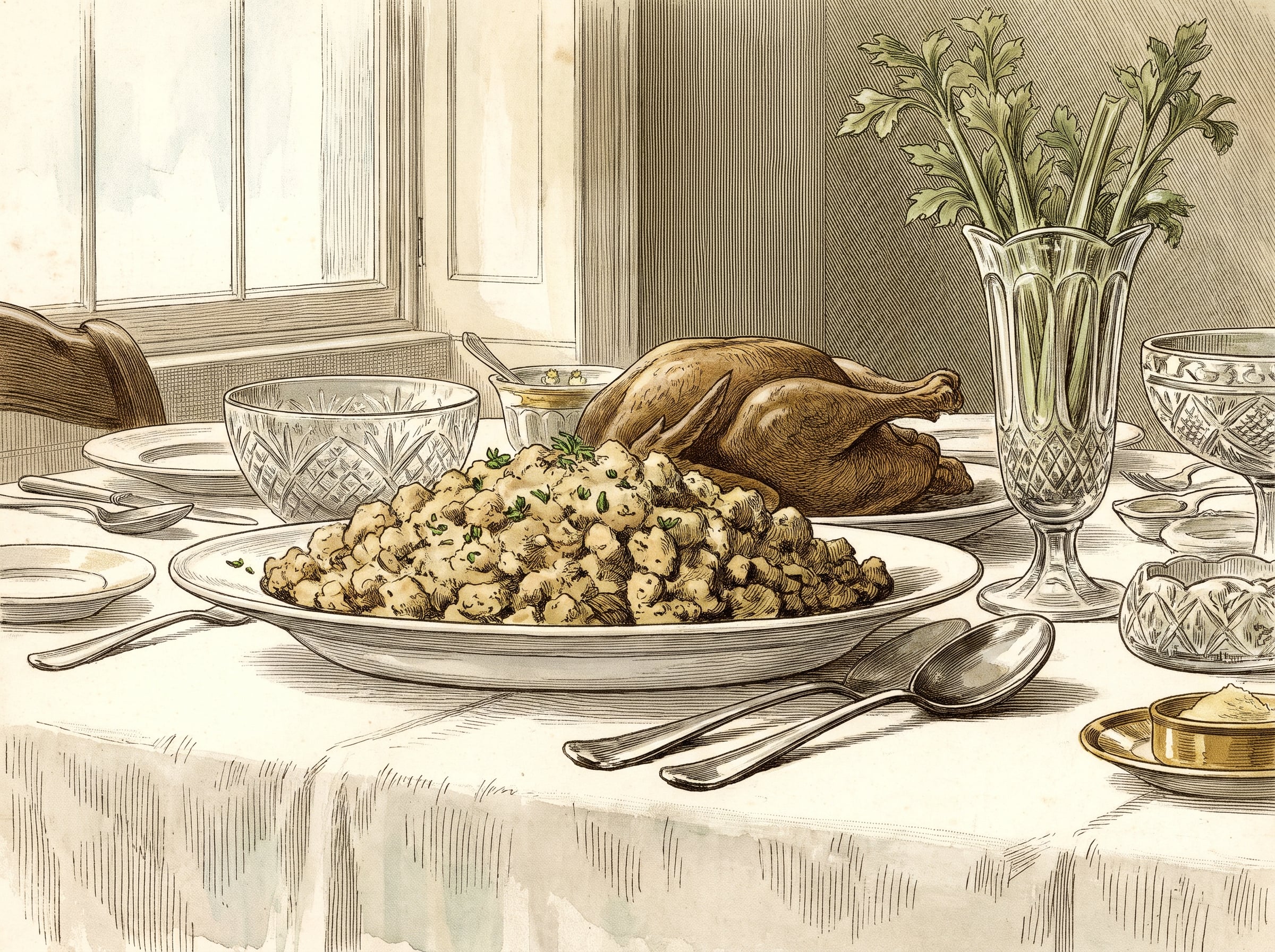
The White House Cook Book became America’s best-selling recipe collection, and its author had most likely never set foot in Washington. Her turkey dressing is just as unassuming: stale bread, butter, sage and summer savory. It also carries two small instructions that say a great deal about how a nineteenth-century cook worked.
Please note that some of the images in this article were created with the assistance of AI.
From The White House Cook Book, 1887
The Story Behind This Recipe
A Wisconsin cook with a Washington title
The cover promises an insider’s view, but Fanny Lemira Camp Gillette was a Wisconsin woman who never lived in the White House and probably never visited Washington, D.C. Her book revealed next to nothing about how the presidential kitchen actually ran. It didn’t need to. The Gibson House Museum in Boston describes a late-1800s publishing boom that crowded shelves with household manuals. They were bought by a growing middle class of women who had more free time and took their cues from high society. A White House label suited them nicely. The address became more honest later, when Hugo Ziemann, a former steward under Benjamin Harrison, worked with Gillette on an updated edition around the turn of the twentieth century. He added genuine White House recipes, and the book stayed in print for decades.
Recipes were only part of the bargain. The title page promised a cyclopedia for the home, with menus, table manners, care of the sick and ‘toilet recipes’ for things like lip salve and hair dye. Gillette did well by it. She died in 1926 at ninety-eight with a good sum earned from the book. The family’s most famous product, though, came from her son, King Camp Gillette, and his disposable razor blade.
Four names for one good idea
No one can say who first thought to fill a bird with something tasty. The oldest written evidence is the Roman cookbook attributed to Apicius, which stuffs chicken, hare and pig. English has been renaming the result ever since: ‘farce’ around 1390, ‘stuffing’ by 1538, ‘forcemeat’ in 1688 and, in the United States from about 1850, ‘dressing.’ Gillette’s title hedges its bets with both the old English word and the newer American one. Her note that the mixture suits ‘fowls, fish or meats’ keeps the older sense of stuffing as a filling for nearly anything.
The core of the recipe was already old. An anonymous early modern manuscript cookbook at the Folger Shakespeare Library fills its turkey with stale bread, eggs, herbs, spice and beef suet. It gives two versions, one with oysters and one without, which fits the Folger researchers’ view that the first Thanksgiving meals probably included both shellfish and wild turkey. Gillette kept the bread, egg, herbs and fat. She swapped the suet for butter and narrowed the seasoning to sage and summer savory.
A turkey, a coal fire and a steady hand
By about 1890, cast-iron cookstoves had been in American kitchens for more than half a century. Many, like the circa-1890 example at the Henry Ford Museum, burned coal, which lasted longer than wood and needed less tending. Less is relative. The cook still dumped the ashes, lit the fire and fed it, sometimes every ten minutes or so. With no thermometer, she judged the oven by putting her hand inside. That explains a gap in Gillette’s recipe. It gives no temperature or baking time because the dressing went inside the bird and cooked as long as the turkey roasted, at whatever heat the cook could keep up.
Ready-made help was available. William G. Bell of Newton, Massachusetts, had created Bell’s Seasoning from an old family recipe in 1867, and it became a familiar part of the New England Thanksgiving. Gillette sticks to separate herbs and leaves room for taste: a little chopped sausage in the turkey dressing for those who thought it an improvement, and a few slices of onion only for geese and ducks.
1880s
What Our Readers Say
- When Piaci Pizza readers love a food photo and tell us why, comfort is the top reason at 30%, with nostalgia and ingredients next at 17% each.
From Piaci Pizza reader polls and votes.
Notes From the Era
The recipe · 1887
Dressing or Stuffing for Fowls
From The White House Cook Book by F. L. Gillette and Hugo Ziemann (1887). Every word of the recipe below is as printed.
Ingredients
- stale bread
- tepid water
- pepper
- salt–about a teaspoonful
- a teaspoonful of powdered summer savory
- the same amount of sage, or the green herb minced fine
- half a cup of melted butter
- a beaten egg, or not
- A little chopped sausage
- a few slices of onion chopped fine
- Stuffing cooked inside a bird must reach 165°F / 74°C in its center.
- If adding the egg or sausage, make sure the stuffing is cooked through to 165°F / 74°C.
Method
-
Soak the bread
For an eight or ten pound turkey, cut the brown crust from slices or pieces of stale bread until you have as much as the inside of a pound loaf; put it into a suitable dish and pour tepid water (not warm, for that makes it heavy) over it; let it stand one minute, as it soaks very quickly.
-
Squeeze the bread dry
Now take up a handful at a time and squeeze it hard and dry with both hands, placing it, as you go along, in another dish; this process makes it very light.
-
Season and add butter
When all is pressed dry, toss it all up lightly through your fingers; now add pepper, salt–about a teaspoonful–also a teaspoonful of powdered summer savory, the same amount of sage, or the green herb minced fine; add half a cup of melted butter, and a beaten egg, or not.
-
Mix together
Work thoroughly all together, and it is ready for dressing either fowls, fish or meats.
-
Optional sausage
A little chopped sausage in turkey dressing is considered by some an improvement, when well incorporated with the other ingredients.
-
For geese and ducks
For geese and ducks the stuffing may be made the same as for turkey, with the addition of a few slices of onion chopped fine.
Our notes
Reading It Today
The inside of a pound loaf. Gillette measures bread by the loaf rather than by the cup. She wants as much stale bread as the soft interior of a one-pound loaf, with the brown crust cut away. A ‘teaspoonful’ is simply a teaspoon, and the butter is half a cup, melted.
Tepid water and a hard squeeze. Tepid means lukewarm. Gillette warns that warm water makes the dressing heavy, and she has the cook soak the bread for only a minute. Then the bread is squeezed dry one handful at a time and tossed loosely through the fingers. Judging from the method and the half cup of butter, the result would be soft, loose and moist rather than dense.
Powdered savory, sage dried or green. ‘Powdered summer savory’ means the dried herb ground fine. For the sage, the cook could use dried or fresh leaves ‘minced fine.’ With only pepper, salt, butter and these two herbs, the flavor would be gently herbal and buttery, with the savory adding a peppery note.
Plainer than today’s. A typical modern stuffing has onion, celery and often giblets. This one has no celery or giblets, and it uses onion only when the bird is a goose or duck. Even the egg is optional: ‘a beaten egg, or not.’
Source: F. L. Gillette and Hugo Ziemann, The White House Cook Book (Chicago, 1887). Read the 1887 book at Project Gutenberg.
Sources for the history
- F. L. Gillette and Hugo Ziemann, The White House Cook Book (Chicago, 1887)
- The Gibson Study (Gibson House Museum): Items from the Gibson House Collection: The White House Cook Book
- Stuffing (Wikipedia)
- Folger Shakespeare Library, Shakespeare & Beyond: Much Ado About Stuffing: Recreating an early modern stuffing recipe
- Yankee Magazine (New England Today): Bell’s Seasoning
- The Henry Ford: Cookstove, circa 1890
- Madison County Historical Society: Cooking with a Cast Iron Stove
The original recipe text is from a work published in 1887 and is in the public domain in the United States. The history, notes and illustrations are Piaci Pizza’s own. Brand names that appear in historic recipes are mentioned as historical fact only. Illustrations are AI-generated in a vintage style. The recipe is shown exactly as it was published in 1887; we have not photographed a test batch.