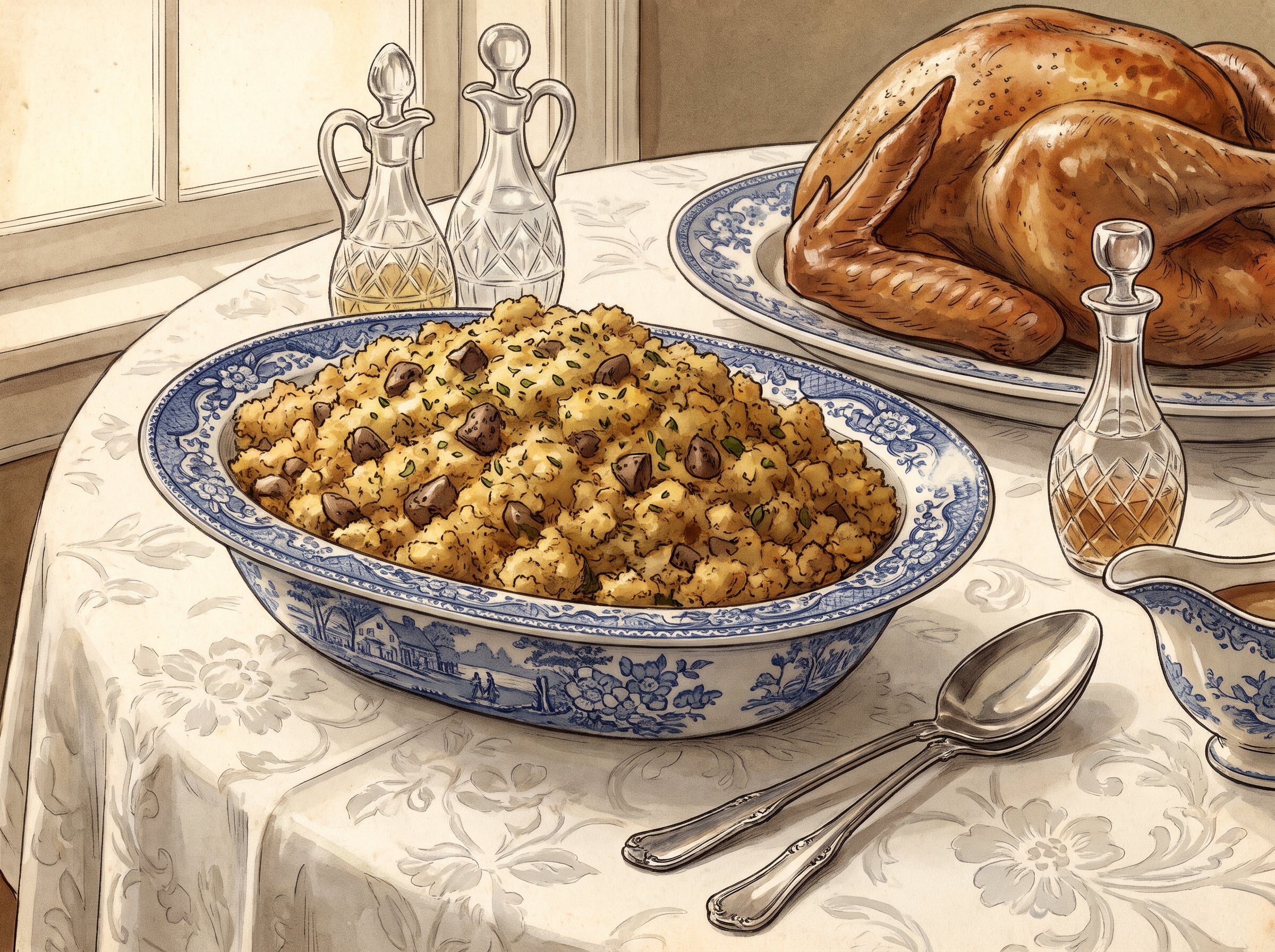
Rufus Estes cooked for presidents in a kitchen that ran on rails, and when he finally wrote his own cookbook, this thrifty little stuffing made the cut. Nothing goes to waste. The giblets are boiled tender, their water is saved for gravy, and the whole thing is browned in butter and finished with a glass of sherry or Madeira.
Please note that some of the images in this article were created with the assistance of AI.
From Good Things to Eat, as Suggested by Rufus, 1911
The Story Behind This Recipe
The chef from the private car
Rufus Estes introduces himself in the opening pages of his book, and he tells it plainly. He was born a slave in 1857, in what he called Murray County, Tennessee. By 1873 he was working in a Nashville restaurant, where he stayed five years. He moved to Chicago in 1881, and two years later he joined the Pullman private car service, cooking for VIP parties whose passengers included industry magnates and presidents.
He left Pullman in 1897, when the railroad president Arthur Stillwell hired him to run his private car. The car later passed to the John W. Gates syndicate, and Estes went with it, staying in charge until 1907. After that he cooked for the Chicago subsidiaries of U.S. Steel. In 1911 he published Good Things to Eat himself. It opens, very practically, with hints for kitchen maids, and it is counted among the first cookbooks by an African American author. Estes died in Los Angeles in 1939.
A very old way to fill a bird
Packing a bird with chopped innards goes back a very long way. The earliest written evidence is the Roman cookbook attributed to Apicius, whose stuffings often called for chopped liver and other organ meats. English kept adding names for the idea: farce around 1390, stuffing in 1538, forcemeat in 1688, and, on this side of the Atlantic, dressing by 1850.
Estes signs off by calling his mixture "force meat," a word older than it looks. It comes from a long-gone verb, force, meaning to stuff, a variant of farce, which goes back to the Latin farcire, to stuff or cram. The turkey had its own history by then. In her 1827 novel Northwood, Sarah Josepha Hale set a roast turkey at the head of the table, smelling of its savory stuffing. As editor of Godey’s Lady’s Book she pressed for a national Thanksgiving. Lincoln proclaimed one for November 26, 1863, and Hale wanted it every year.
Cups, glasses and a watchful eye
The measurements show a kitchen caught between two habits. Fannie Farmer had popularized standard level measures for American home cooks in 1896, but Estes still asks for two breakfast cups of crumbs and a wine glass of sherry. Those amounts depended on whichever cup and glass a household owned. The butter, at least, is given by weight. Saving the giblet water for gravy is a working chef’s reflex.
The method suits the stoves of the day. Gas ranges were spreading through American homes after 1900, but the first effective oven thermostat was still four years off. This stuffing never sees the oven before it goes into the bird. It browns in a frying pan, where the cook can watch it. The finishing splash belongs to its moment, too. Madeira had been an American favorite since colonial days, and in 1911, before Prohibition, a well-stocked kitchen could still reach for a bottle.
1910s
What Our Readers Say
- When Piaci Pizza readers loved a food photo and tapped a reason, comfort came out on top at 30%, with nostalgia next at 17%.
From Piaci Pizza reader polls and votes.
Notes From the Era
The recipe · 1911
Giblet Stuffing for Turkey
From Good Things to Eat, as Suggested by Rufus by Rufus Estes (1911). Every word of the recipe below is as printed.
Ingredients
- the giblets
- boiling water to cover
- a teaspoonful of salt
- a quarter of a teaspoonful of pepper
- four ounces of butter
- two breakfast cups of stale breadcrumbs
- a good seasoning of salt, pepper and any powdered sweet herbs except sage
- a wine glass of sherry or Madeira wine
- If you cook this stuffing inside the turkey, the center of the stuffing must reach 165°F / 74°C.
- Refrigerate the saved giblet water promptly if you are not making the gravy right away.
Method
-
Boil the giblets
Put the giblets in a saucepan over the fire with boiling water to cover, sprinkle over a teaspoonful of salt and a quarter of a teaspoonful of pepper and boil gently until tender.
-
Save the cooking water
Save the water in which the giblets were boiled to use for gravy.
-
Chop and fry with butter and crumbs
Chop the giblets quite fine, put them in a frying pan over the fire with four ounces of butter, two breakfast cups of stale breadcrumbs and a good seasoning of salt, pepper and any powdered sweet herbs except sage.
-
Brown and add the wine
Stir all these ingredients together until they are of a light brown, add a wine glass of sherry or Madeira wine, and the force meat is ready for use.
Our notes
Reading It Today
Breakfast cups and a wine glass. These are household measures, and their sizes varied from home to home. A breakfast cup was a roomier cup than a teacup. Older American measuring tables often counted a wineglass as about 2 fluid ounces, or a quarter cup. The four ounces of butter equal half a cup, or 8 tablespoons.
Powdered sweet herbs, but no sage. "Powdered" means dried herbs rubbed down to a fine powder. "Sweet herbs" was the old term for the gentle kitchen herbs, such as thyme, marjoram and savory. Estes deliberately rules out sage, the herb most cooks reach for first when they season poultry stuffing.
What it would be like. Going by the ingredients, we’d expect a loose, crumbly stuffing, not a soft, moist one. With no egg, no onion and no broth, it relies on butter, toasted crumbs and finely chopped giblets for richness. The fortified wine at the end would likely add a mellow, nutty note.
How it differs from stuffing today. A typical modern stuffing starts with onion and celery, leans on sage, is moistened with broth, is often bound with egg, and is usually baked in a dish. This one is pared down. It is prepared entirely on the stovetop, flavored with giblets and wine, and meant to go straight into the turkey.
Source: Rufus Estes, Good Things to Eat, as Suggested by Rufus (Published by the author, Chicago, 1911). Read the 1911 book at Project Gutenberg.
Sources for the history
- Good Things to Eat, as Suggested by Rufus (Project Gutenberg catalog page)
- Rufus Estes: Pullman Chef and Cookbook Author (CooksInfo)
- Rufus Estes 1857–19?? (Encyclopedia.com)
- Former Slave Rufus Estes Helped Teach America How To Cook (LAist)
- Rufus Estes (Wikipedia)
- Stuffing (Wikipedia)
- Farce: Etymology, Origin & Meaning (Online Etymology Dictionary)
- forcemeat (Oxford Learner’s Dictionaries)
- "Our National Thanksgiving" (Massachusetts Historical Society, The Beehive)
- Gas range history: How the kitchen stove went from coal-fired monster to mid-century showpiece (Click Americana)
- A Wine. A Country. And a Story… (Denise Gardner Winemaking)
The original recipe text is from a work published in 1911 and is in the public domain in the United States. The history, notes and illustrations are Piaci Pizza’s own. Brand names that appear in historic recipes are mentioned as historical fact only. Illustrations are AI-generated in a vintage style. The recipe is shown exactly as it was published in 1911; we have not photographed a test batch.