Would you like to save this?
Carbonated water hissed into a glass while a guy in a paper hat cracked wise and built your drink by hand—syrup, soda water, ice, and a stir while the fizz climbed the side. That was buying a drink at a neighborhood fountain in 1965, seated at a counter while someone worked the taps in full view.
Now you press a button, watch ice tumble into a disposable cup, and carry the drink away yourself. These 31 before and afters show what changed when the soda fountain gave way to screens, machines, packaging, and speed.
31. Hand-Mixed Sodas vs. Self-Serve Fountain Machines
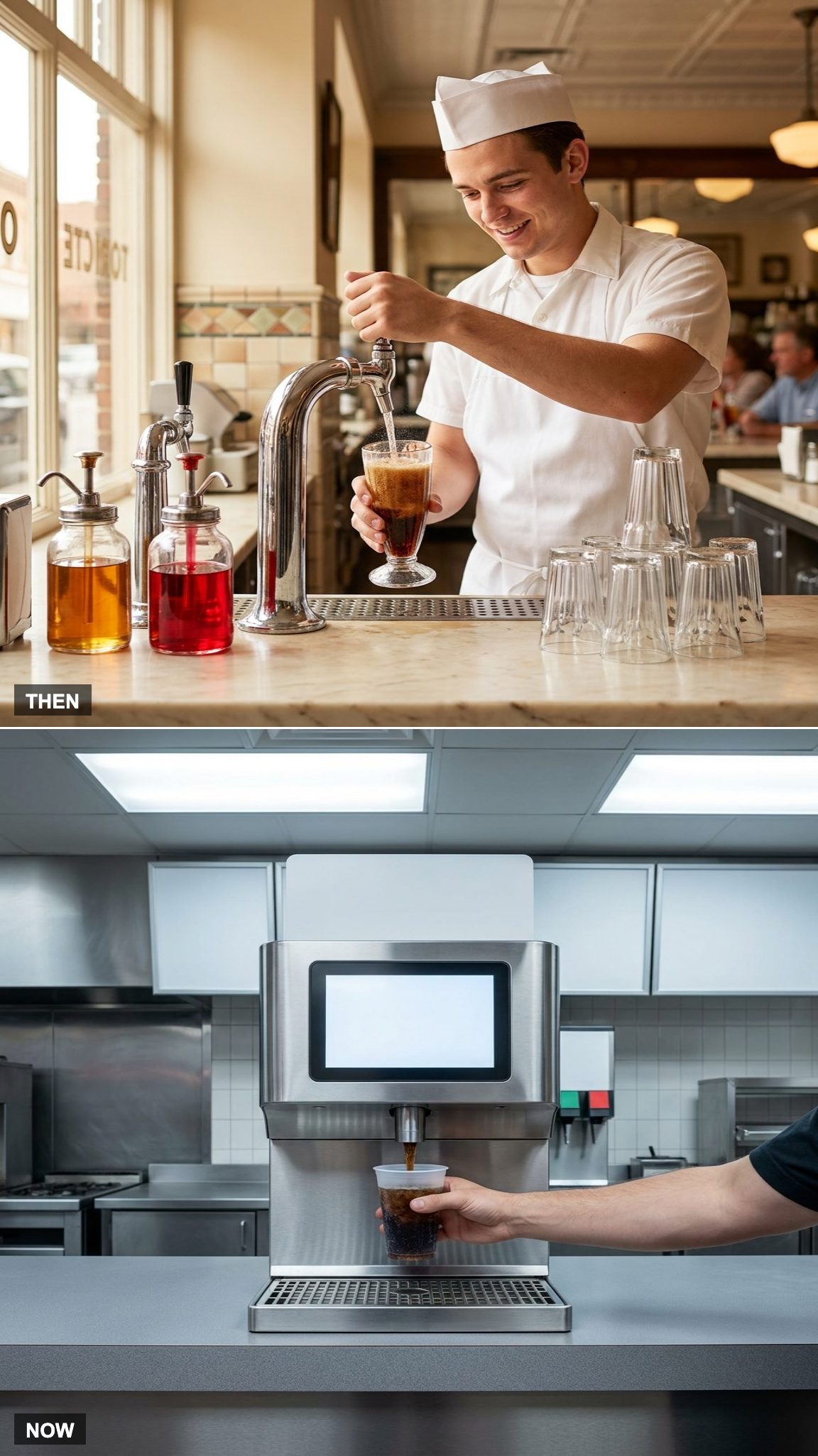
At a traditional fountain, flavored sodas could be assembled in front of you like small performances. Syrup went into the glass, carbonated water followed, and the person behind the counter stirred the mixture while the foam climbed.
The ratio could vary slightly from one counterman to the next, giving a cherry soda or lime rickey a character of its own. Cola service was already becoming more standardized by 1965, but the fountain still placed the drink-making process in full view.
Now you press a labeled button or a picture on a screen and the machine handles the mixture. The result is fast and consistent, but nobody is measuring or mixing anything where you can see it. Nobody watches the fizz rise except you.
30. The Man in the Bow Tie vs. the Kid in the Headset
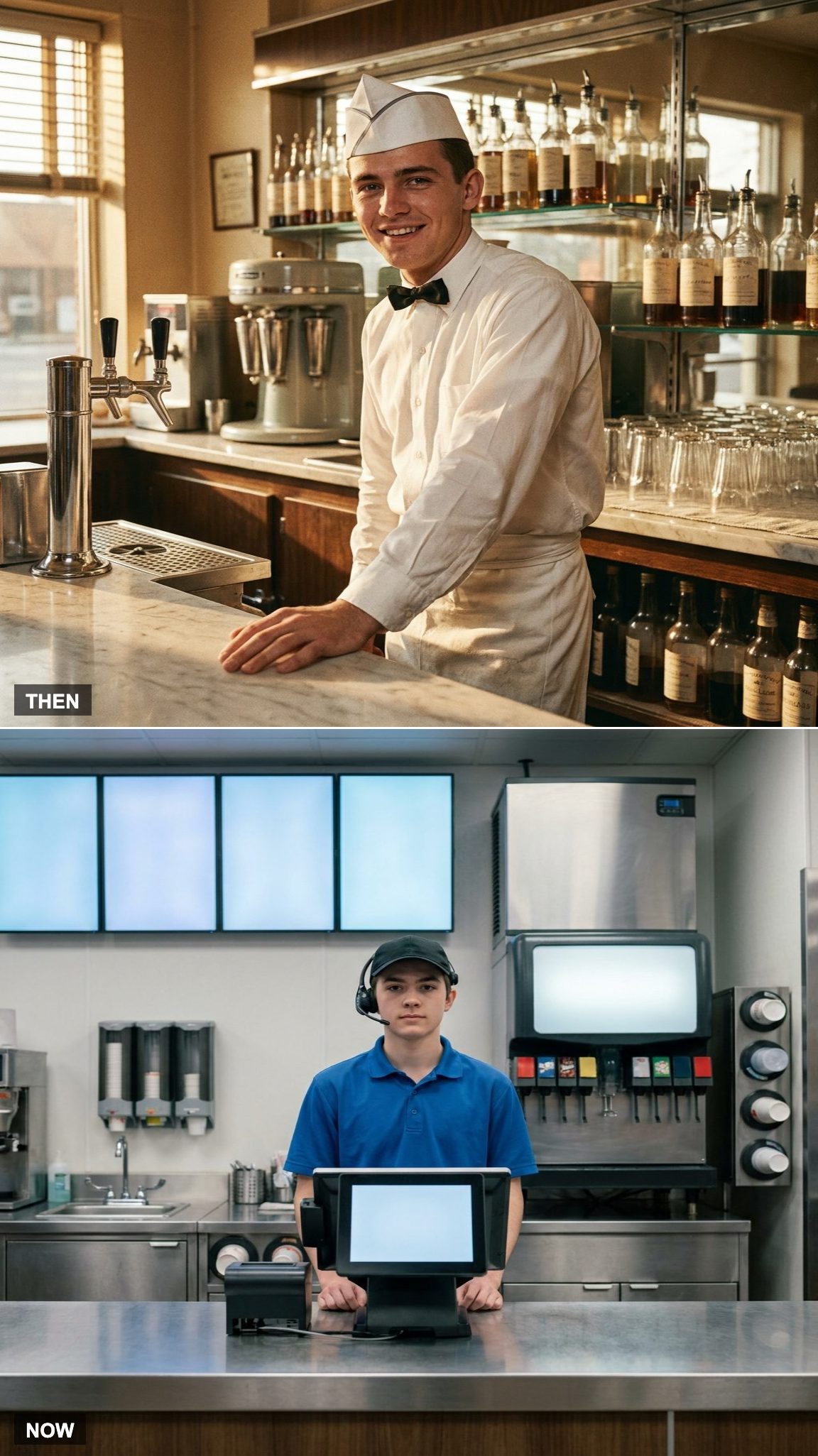
In 1965, the person behind the counter had a title people said with a grin: soda jerk. The name came from the sharp pulling motion used to operate fountain handles, and a skilled counterman could wear it like a badge.
Bow tie straight and paper hat in place, he treated the counter like a stage. He memorized regular orders, kept a joke moving down the line, and talked to four people at once while assembling a banana split without appearing to look down.
The modern counter worker runs on a screen, a headset, and a queue that has to keep moving. Nothing is wrong with fast service, and some of those old soda jerks were probably insufferable show-offs. But much of the patter left when the performance did. Now the entertainment is watching your order number light up.
29. Marble Soda Counters vs. Plastic Drink Stations
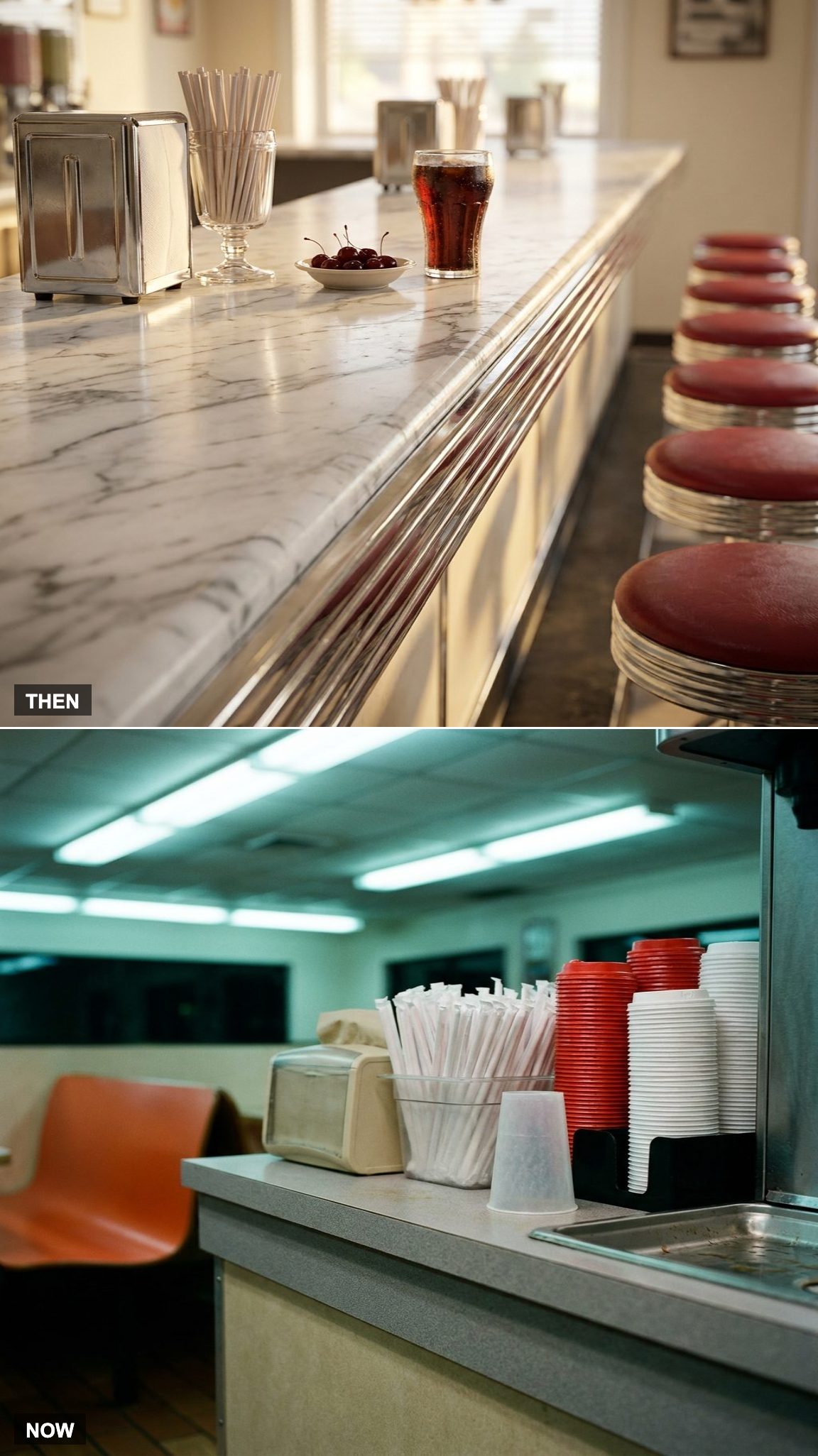
Some of the grander fountains had marble counters that remained cool beneath your forearms even in July. Others used terrazzo, tile, stainless steel, or laminate, but many were organized around face-to-face counter service.
The modern drink station is more likely to be laminate over particleboard, with a plastic dispenser, a stack of cups, and a drip tray that never seems completely dry. It performs the same basic job without asking anyone to sit down.
28. The Spinning Red Stool vs. the Bolted Plastic Bench
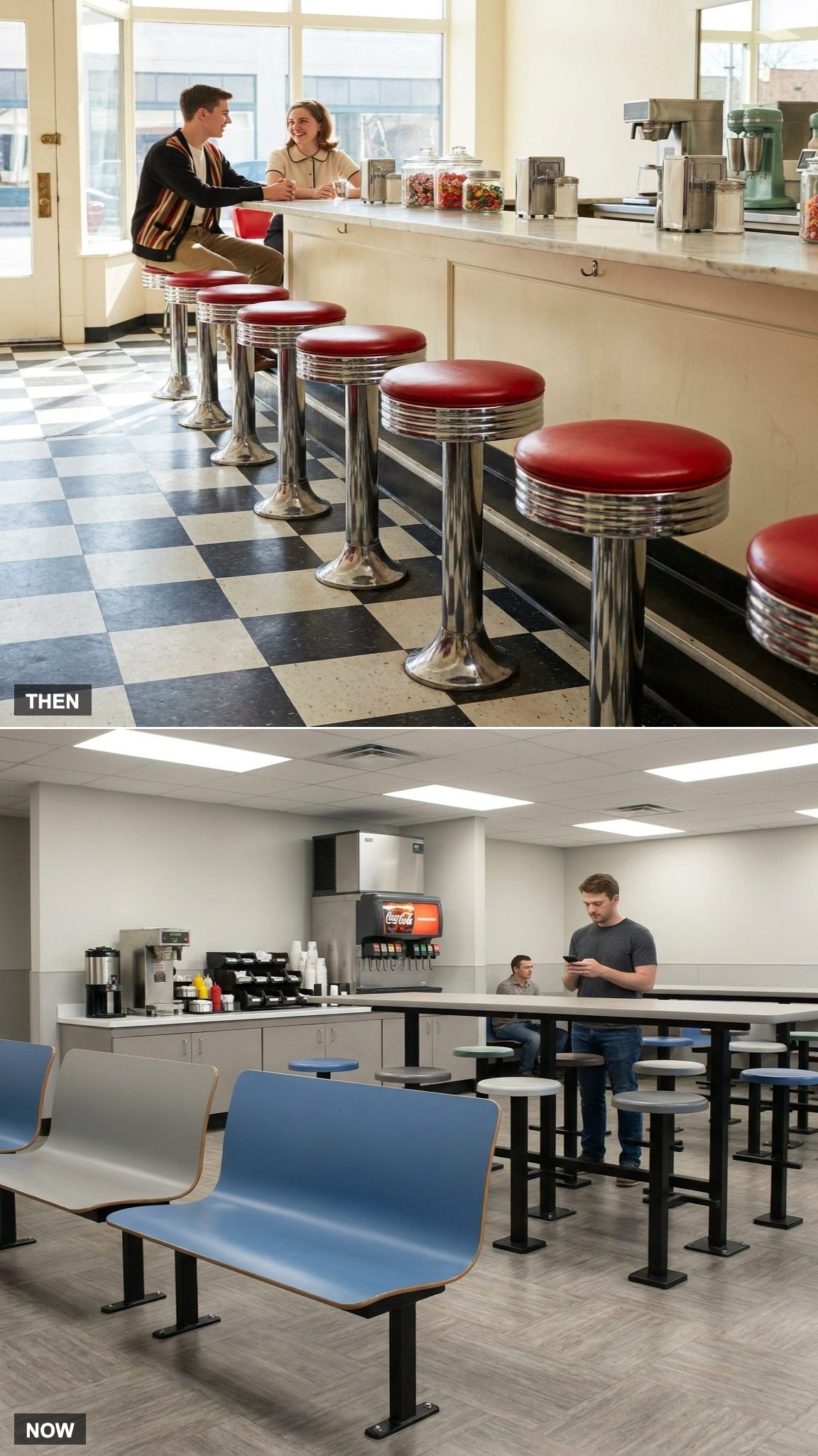
A fountain stool was built for a kid with time to kill. Red vinyl seat, chrome pedestal, and that quarter-turn squeak when you spun around to see who had walked through the door.
It was bolted to the floor and technically belonged to the store, but it felt like yours from the moment you climbed onto it until your mother called you home for supper.
Modern quick-service seating is often harder, lighter, and arranged around shorter visits. The effect is less about joining the room and more about finishing the order before the next customer needs the table.
27. Glass Soda Glasses vs. Disposable Cups
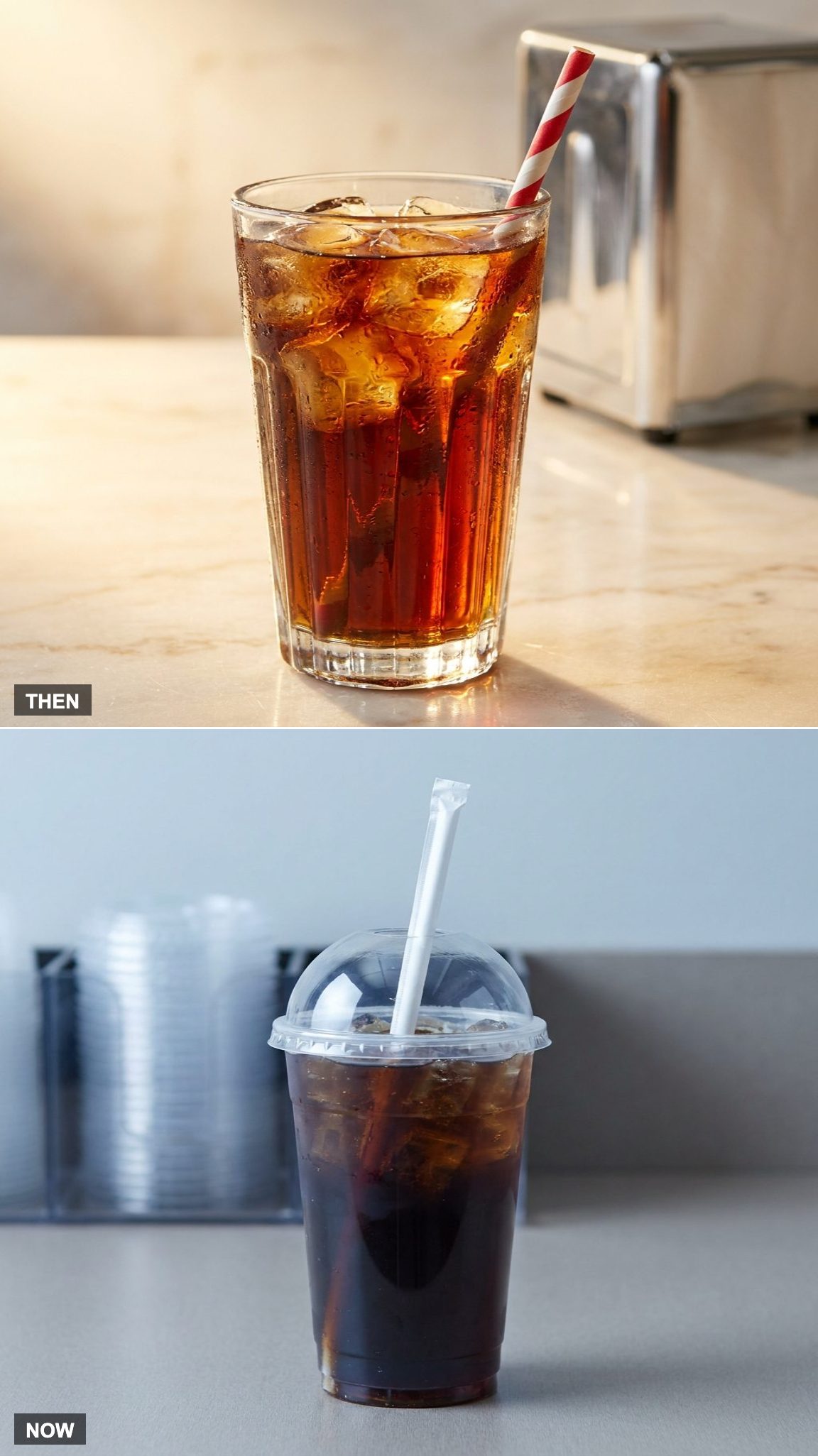
That fluted glass had heft. You noticed the flared rim, the small foot, and the condensation pooling beneath it on the counter.
When you finished, the glass went back to the sink, got washed, and returned for the next customer. Nobody thought twice about it.
Now the drink arrives in a coated paper or plastic cup with a lid and straw, often headed for the trash or recycling before you reach home.
26. The Ice Cream Soda vs. the Frozen Dome of Slush
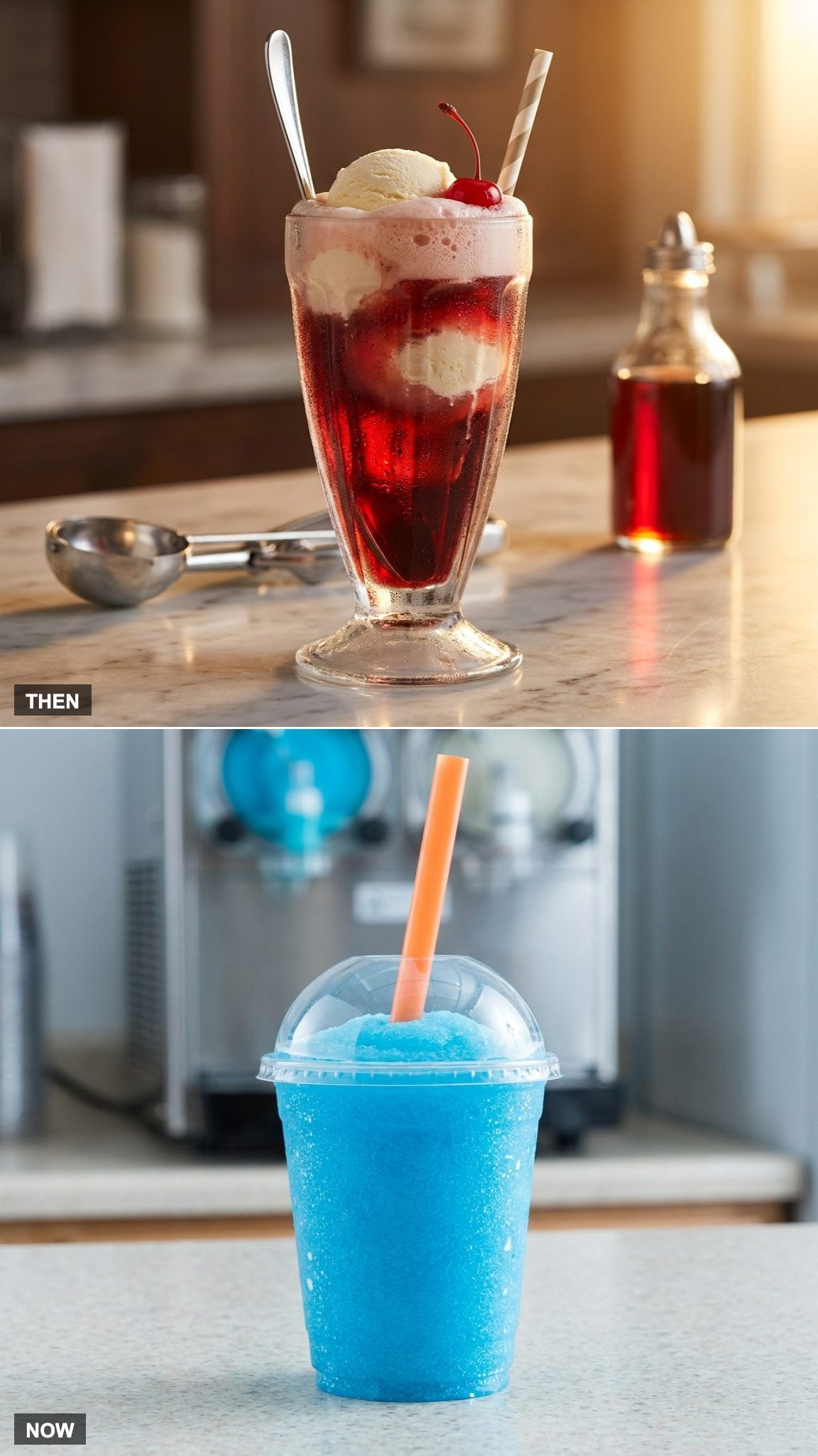
Building an ice cream soda was a two-handed operation, though the exact order varied by fountain. Syrup and soda water created the flavored base, then ice cream went in and pushed the foam toward the rim.
You approached it with a spoon in one hand and a straw in the other. The last sip was usually melted ice cream pooled at the bottom of the glass.
A frozen slush is a different drink rather than a direct replacement, but it now occupies much of the same childhood territory. Pull the lever, catch the colored ice beneath a domed lid, and push a wide straw through the center.
Kids love them, and nobody can blame them. Still, nothing floats in there. No long spoon chases a melting scoop through the fizz.
25. Root Beer Floats vs. Bottled Craft Sodas
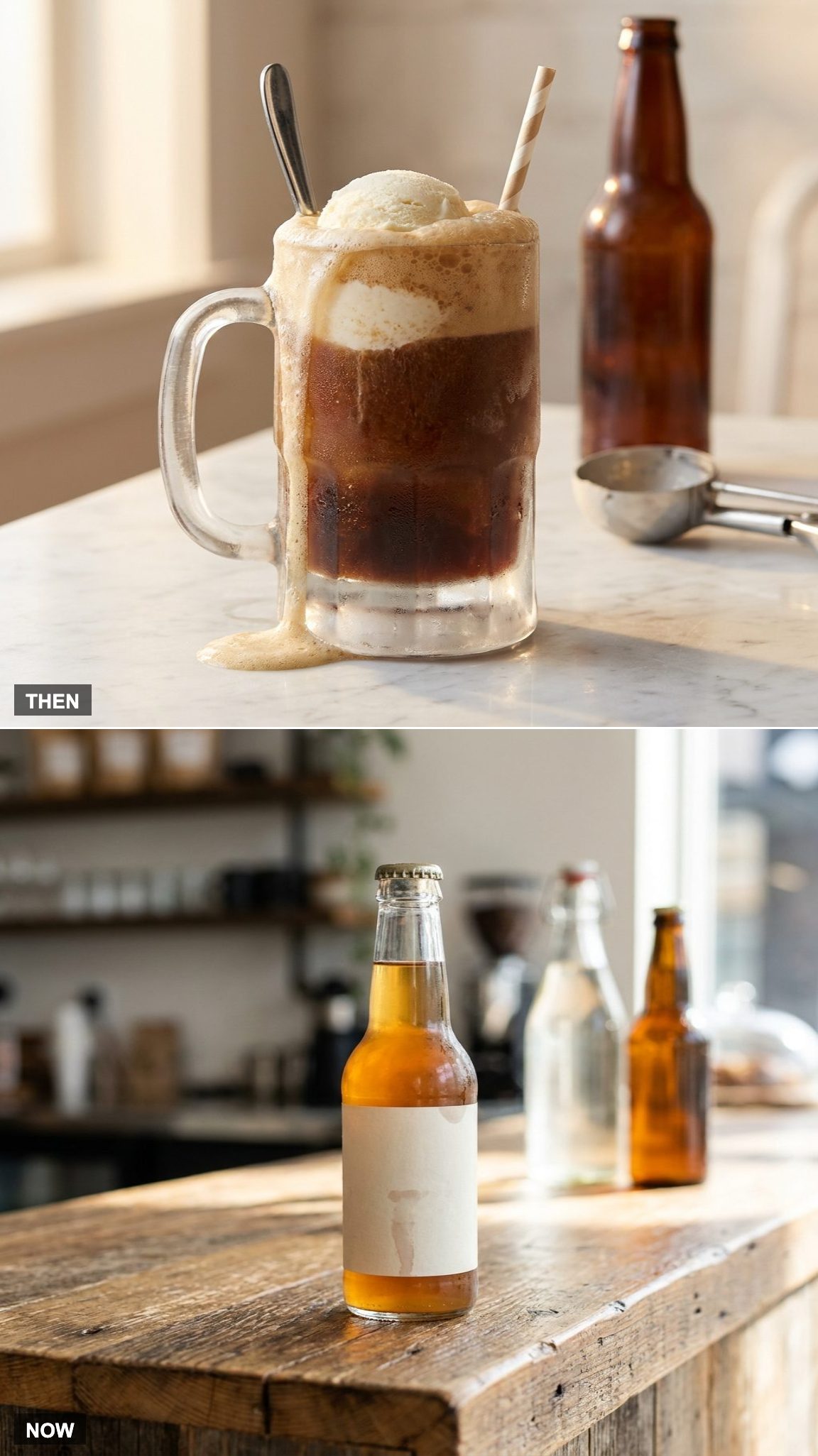
The float was democratic. Root beer, a scoop of vanilla, and a heavy mug were enough. Kids ordered it, grandparents ordered it, and everyone eventually encountered the same plug of ice cream blocking the straw.
The bottled craft soda on the refrigerated shelf now comes with cane sugar, a carefully drawn label, and a story about the company that made it. Some are genuinely good, but the experience is different from watching ice cream rise through a mug of foam at the counter.
24. The Cherry Phosphate vs. the Neon Energy Drink
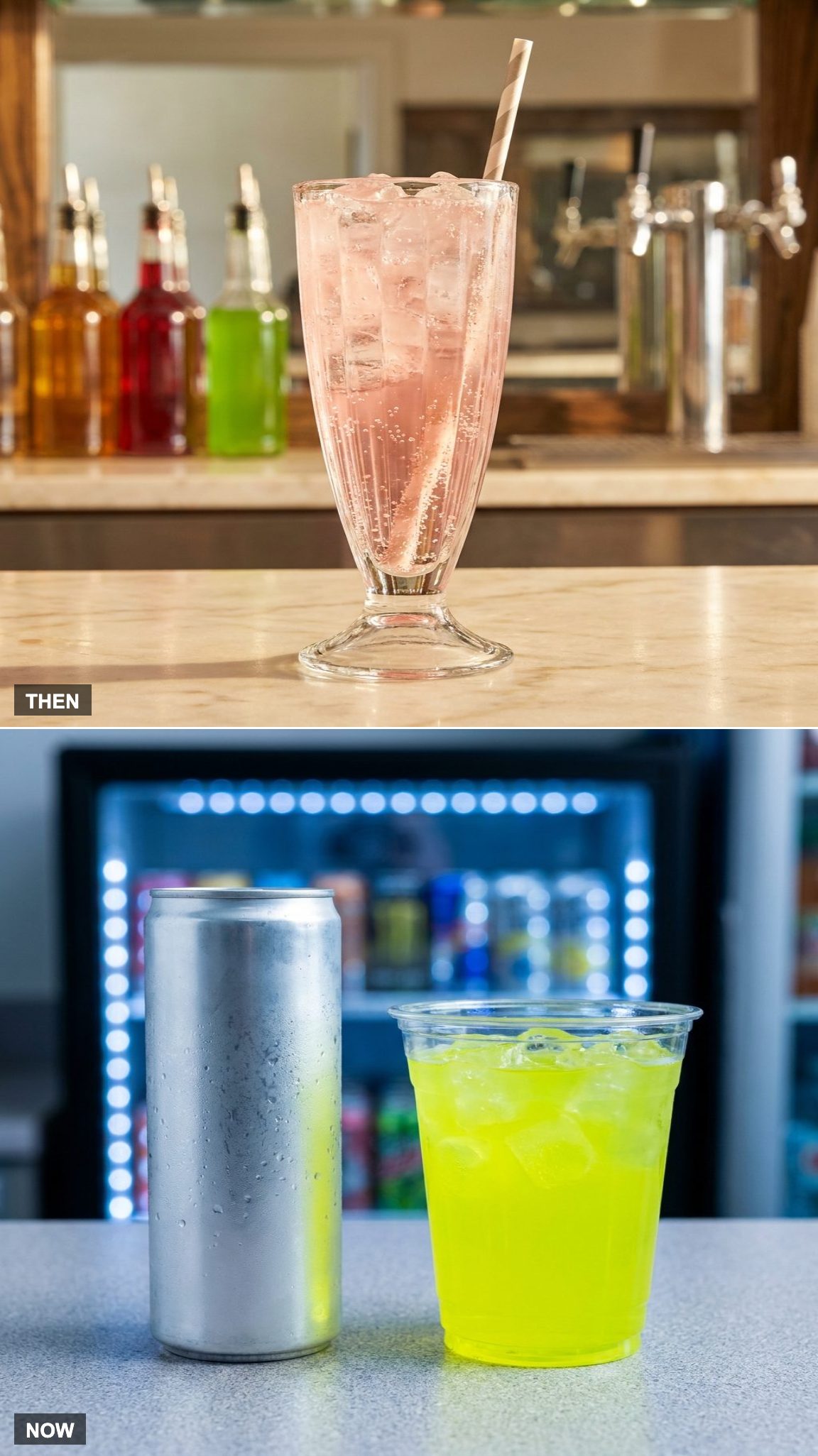
Acid phosphate was the secret. The fountain worker added a small amount to fruit syrup and carbonated water, producing a drink with a tart edge that made your mouth pay attention. Cherry was a favorite, with lemon and lime close behind.
Phosphate drinks were already becoming old-fashioned by 1965, but some traditional fountains continued serving them after bottled and premixed sodas had taken over much of the market.
The modern jolt is more likely to live in a tall aluminum can with a bright label and enough caffeine to drag someone through a double shift. It works, though the experience is far removed from ordering a flavor by name and watching someone build it across the counter.
23. Egg Creams vs. Specialty Coffee Drinks
Would you like to save this?
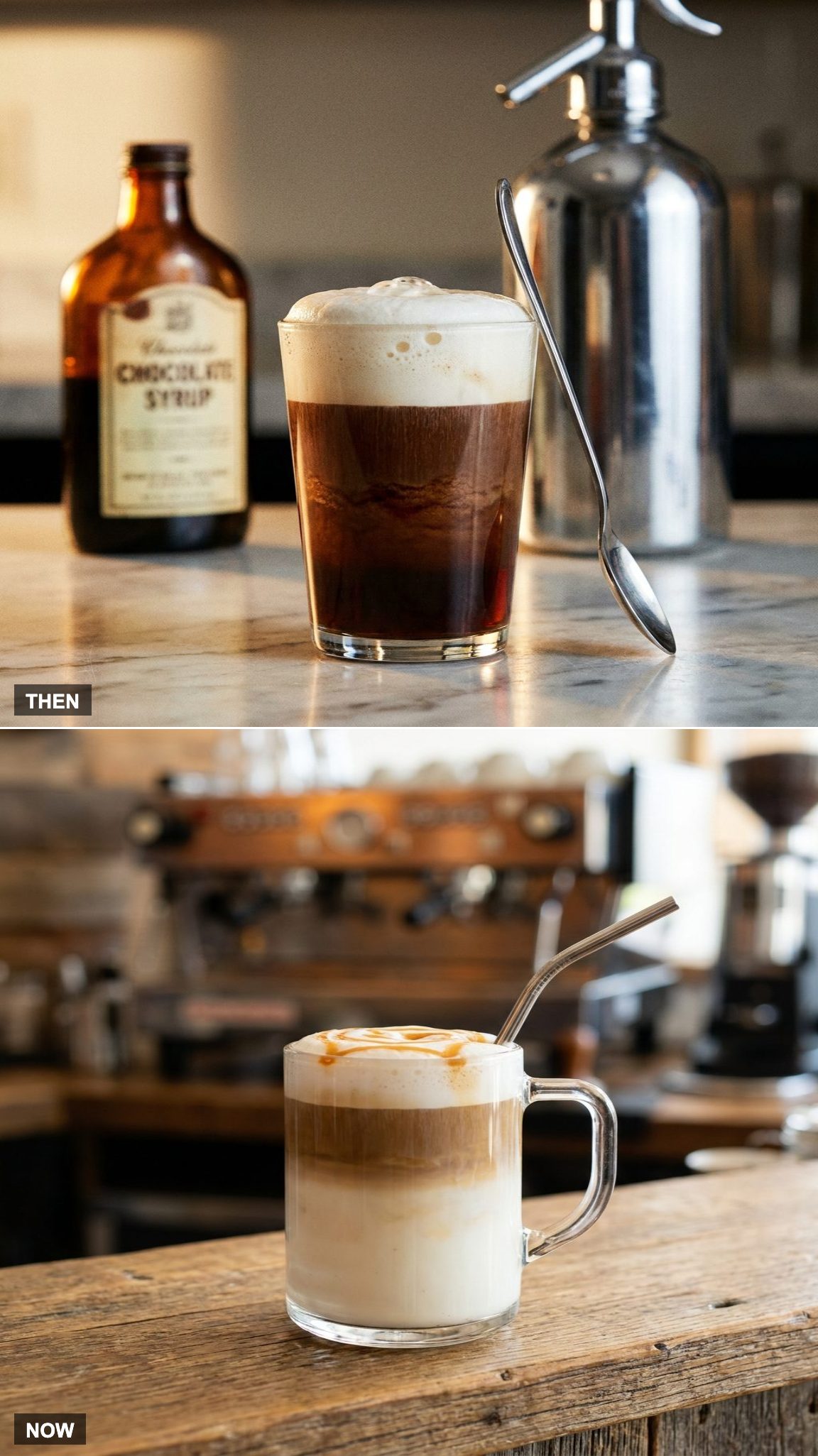
An egg cream contains no egg and no cream, which is still the first thing anyone tells you about it. Chocolate syrup, milk, and seltzer combine to produce a dark drink beneath a pale cap of foam.
The egg cream was especially associated with New York luncheonettes and Jewish neighborhoods rather than every American fountain. Where it was served, the exact balance of syrup, milk, and fizz could inspire arguments.
The elaborate coffee drink fills some of that treat-drink territory now, arriving with espresso, flavored syrups, foam, and a name written on the side. The preparation is more complicated, but nobody ever bragged that an egg cream contained no espresso.
22. Hand-Dipped Milkshakes vs. Machine-Made Shakes
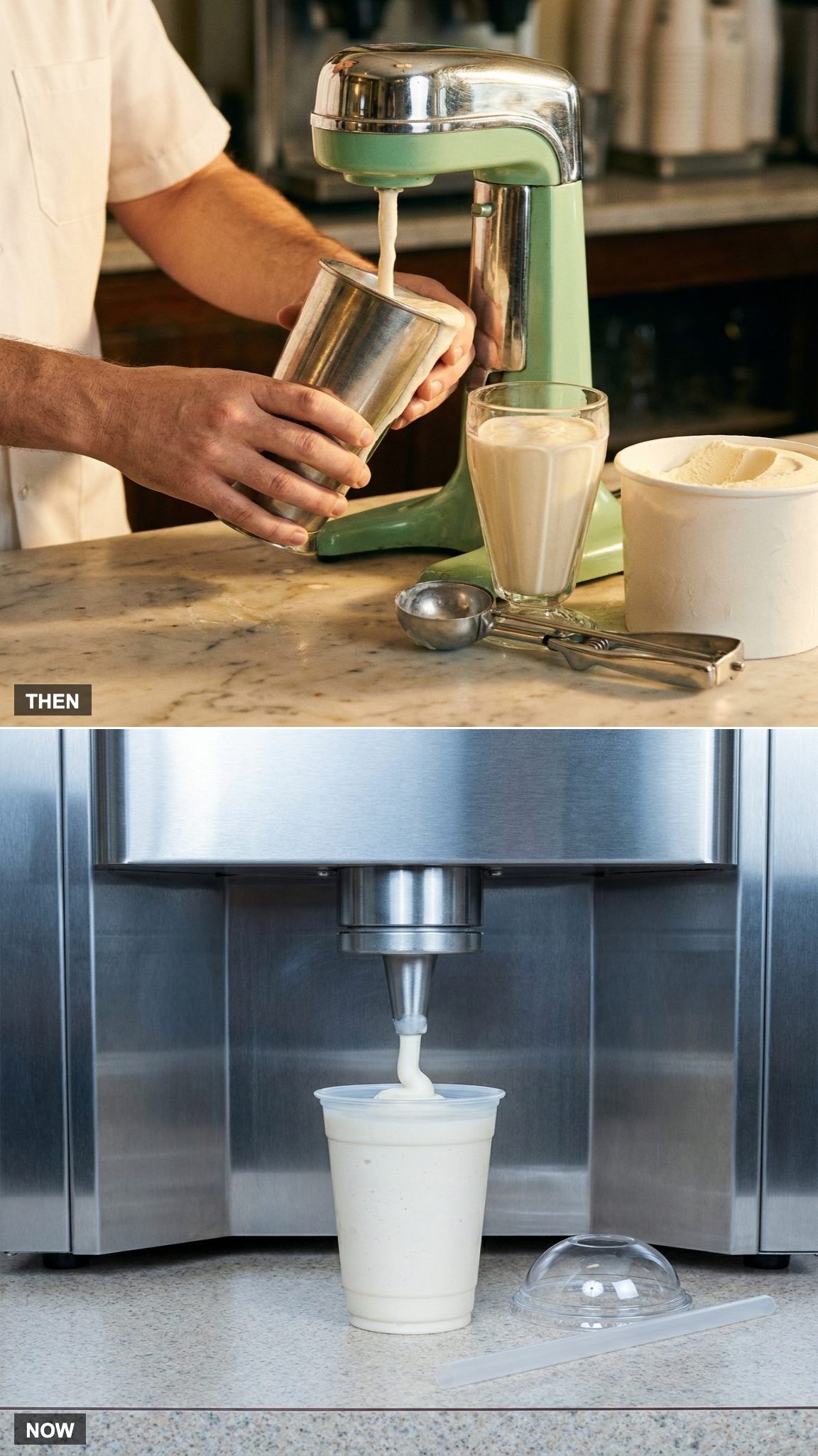
You could hear a traditional milkshake being made. The spindle mixer whirred, the metal cup rattled against it, and the process took long enough that you watched.
The worker scooped real ice cream, added milk and flavoring, then adjusted the mixture until the shake reached the intended thickness. Some were dense enough to challenge a straw; others were made thinner according to local taste.
Many modern quick-service shakes come from automated machines using prepared base. They are fast and consistent, but the mixing happens out of sight and leaves no metal cup rattling on the counter.
The old shake announced itself before it arrived. You heard the mixer working and knew somebody was making yours.
21. Banana Splits vs. Premium Sundaes
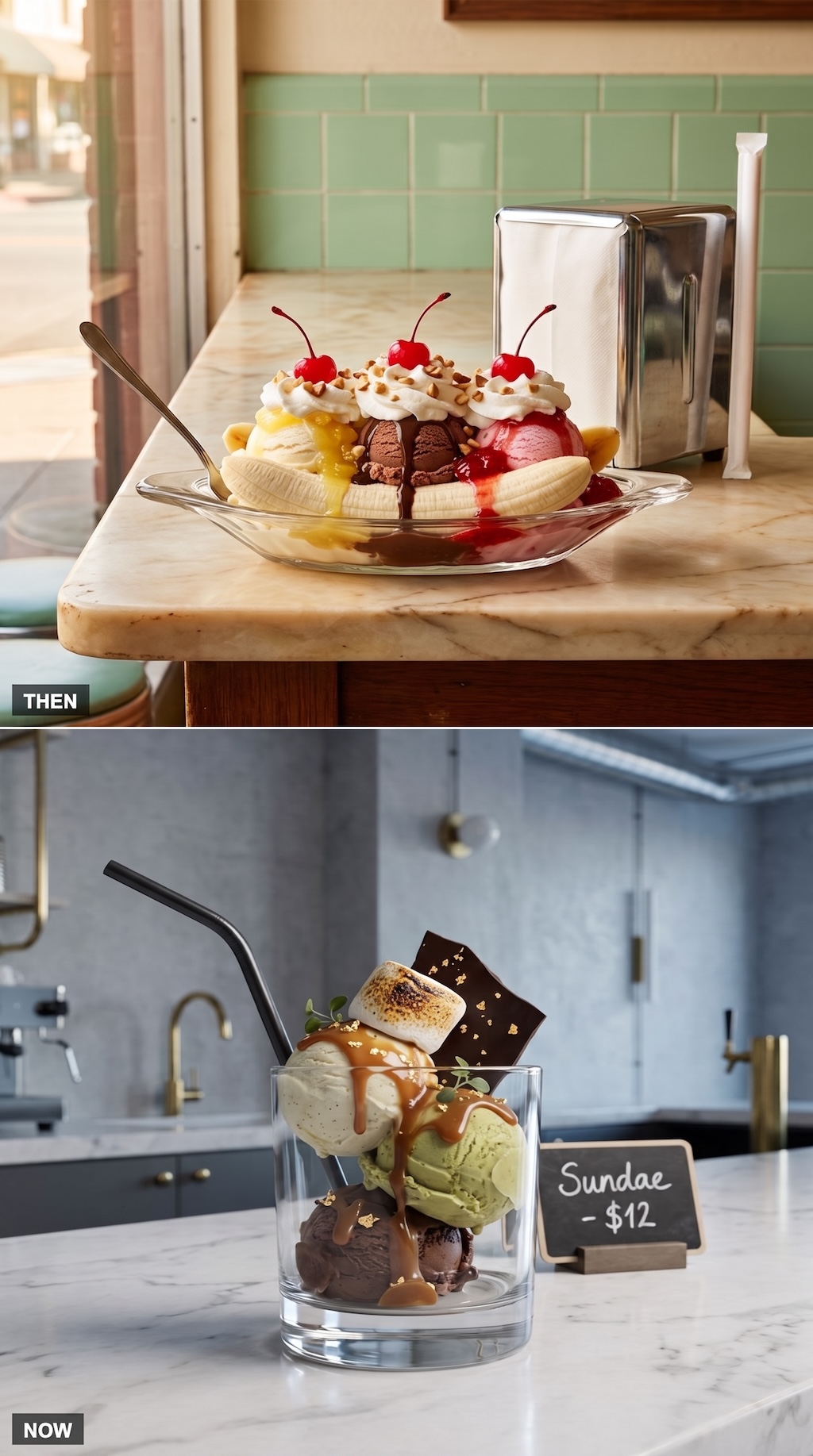
The 1965 banana split arrived like a parade float. A banana was cut lengthwise around three scoops of ice cream, followed by sauces, whipped cream, nuts, and cherries according to the fountain’s preferred arrangement.
It came in a long glass boat and looked large enough to share. Plenty of customers ignored that suggestion.
A premium sundae now may appear in a smaller glass with carefully arranged toppings, toasted marshmallow, specialty chocolate, or a dramatic finishing touch intended for the camera.
The result can be impressive. It just does not occupy the plate with the swagger of a banana split waiting in a glass boat.
20. The Hot Fudge Sundae Somebody Ladled vs. the One That Peels Open
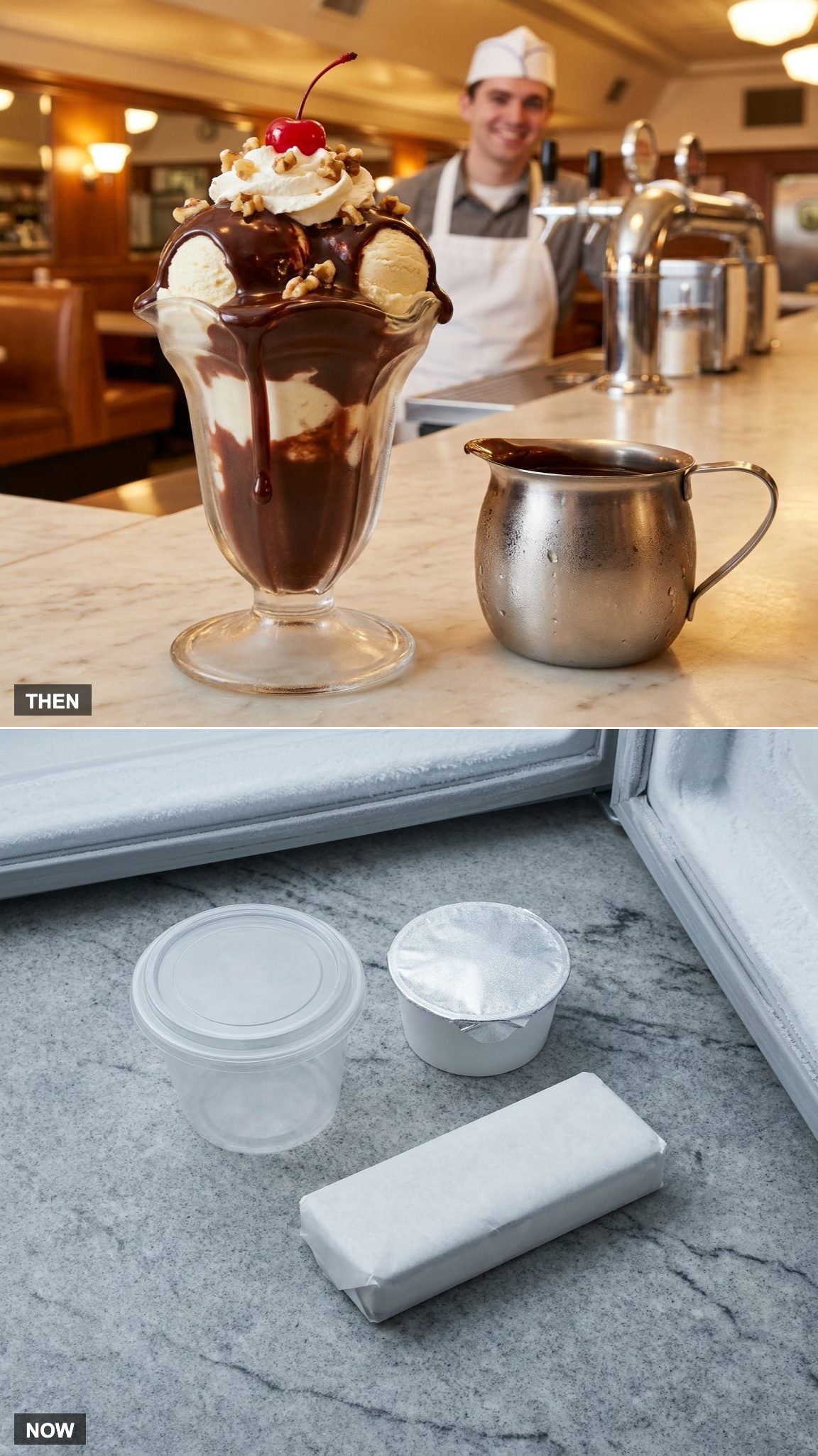
The fudge lived in a heated container behind the counter, kept warm enough to pour and thick enough to cling to the spoon. The soda jerk ladled it over vanilla ice cream while you watched the hot topping soften the cold surface.
Whipped cream or nuts might follow, with the cherry landing last. The whole construction took less than a minute, but the process created anticipation.
The convenience-store or freezer-case version comes sealed beneath a foil or plastic lid. It is portioned, frozen, and designed to taste the same from one store to another. The hot-and-cold contrast disappears when the entire dessert arrives at one temperature.
19. Fresh Whipped Cream vs. Aerosol Toppings
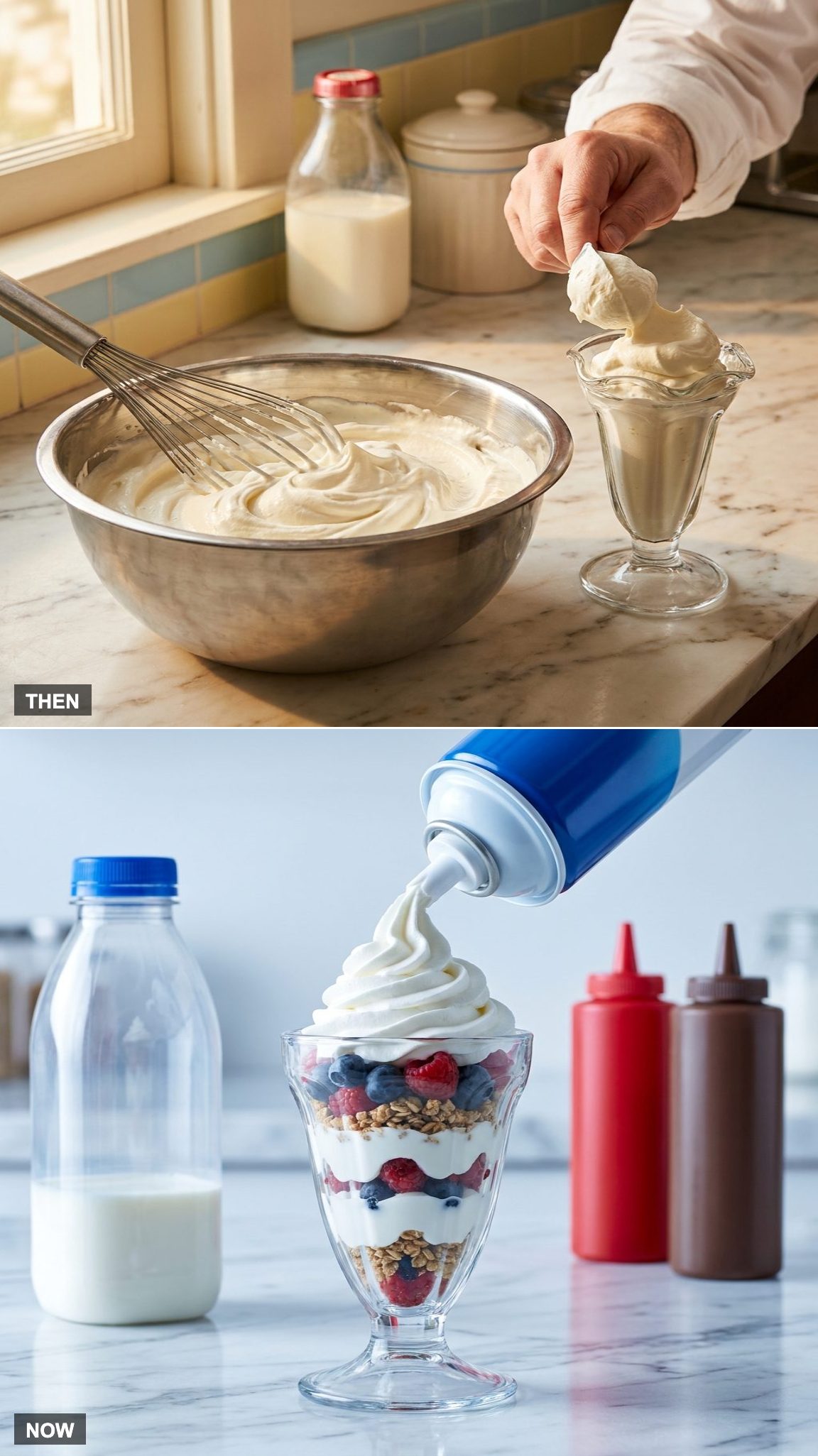
Some fountains still whipped cream in-house, producing dense, irregular spoonfuls that tasted primarily of cream and sugar. Others had already moved to pressurized dispensers or prepared toppings by the middle of the 1960s.
The aerosol can made the job nearly instantaneous. Press the nozzle and a uniform spiral appears without a bowl, whisk, or tired arm.
Convenience won for obvious reasons. The trade-off was texture: freshly whipped cream held its body differently and tasted more substantial than many packaged toppings.
18. The Twenty-Minute Fountain Lunch vs. the Combo Meal in a Bag
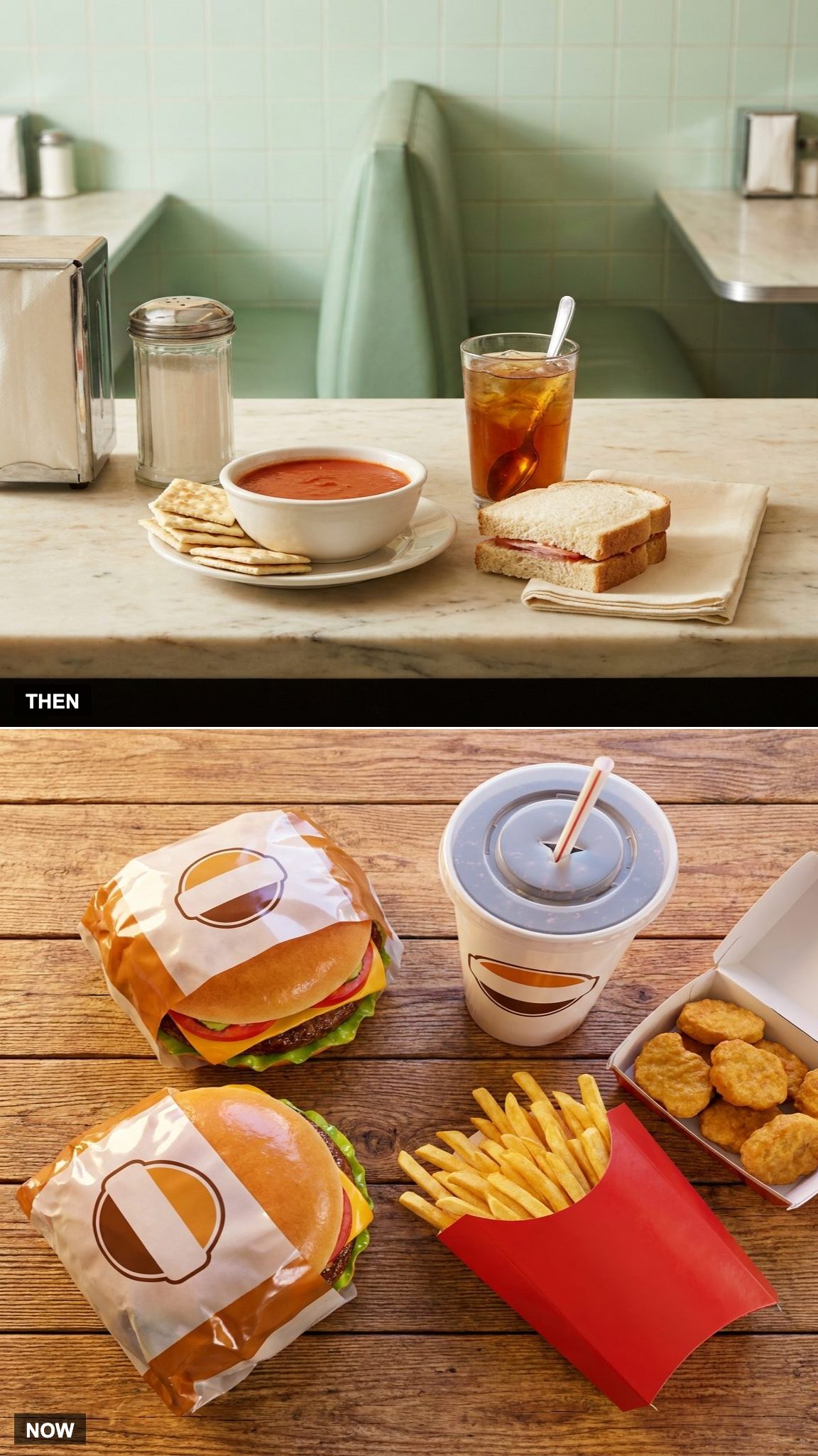
A fountain lunch did not have to be elaborate. Soup, half a sandwich, a pickle, crackers, and coffee could arrive on real dishes and still leave enough time to walk back to work.
The menu varied by counter, but the portions were often assembled as a small meal rather than sold as a numbered package. You ate from a plate while the person behind the counter refilled coffee and kept track of who had ordered what.
The modern combo travels in a paper bag: burger, fries, drink, and perhaps something boxed on the side. It is easier to carry and faster to distribute, with the entire meal packaged around leaving.
17. Grilled Cheese Sandwiches vs. Gourmet Sandwiches
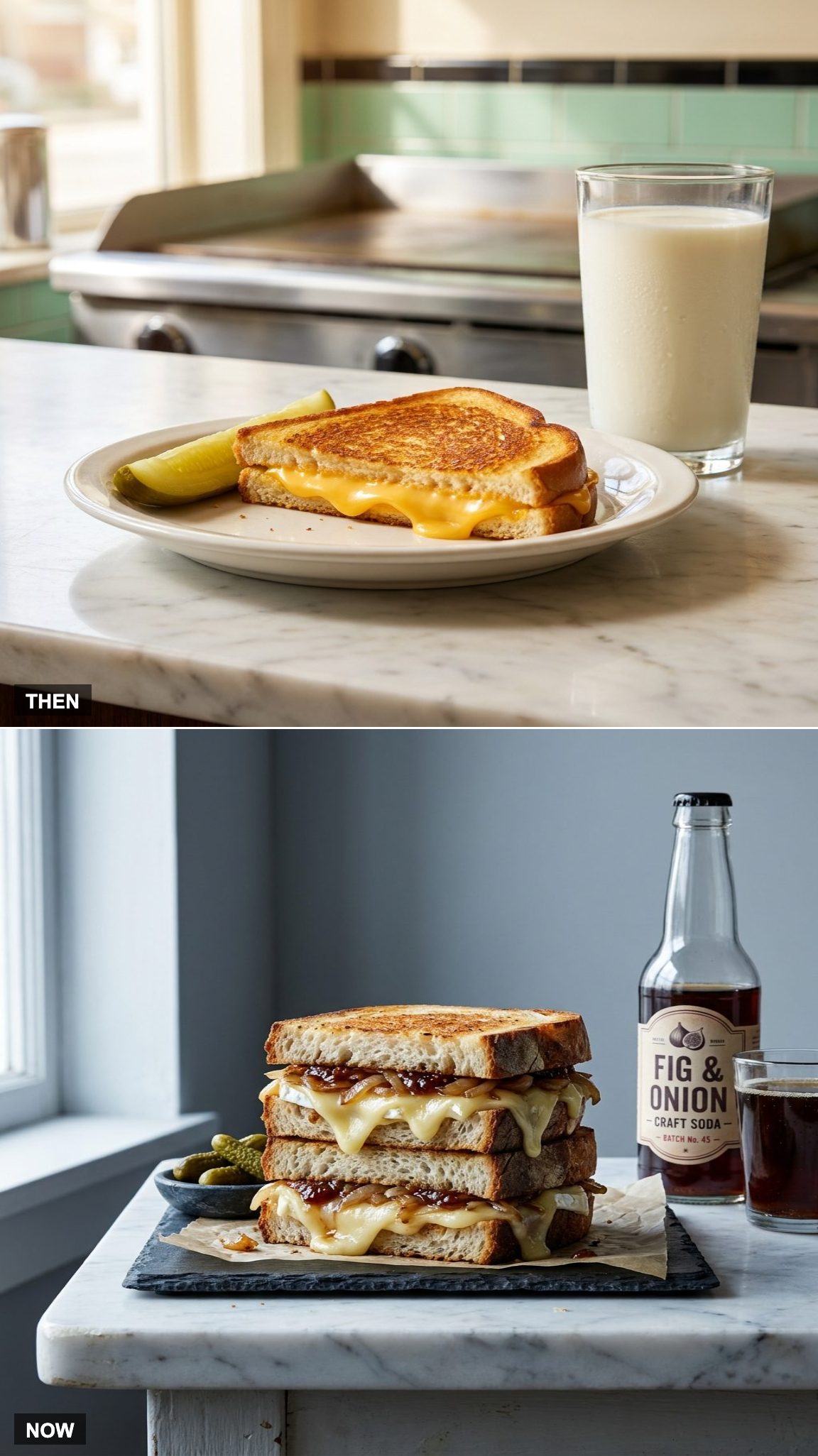
Two slices of white bread, butter, American cheese, and a hot griddle. That was the basic fountain grilled cheese, cut diagonally and served with a pickle or a glass of milk.
Its modern descendant may arrive on sourdough with Gruyère, brie, caramelized onions, tomato jam, or whatever else the kitchen believes can improve melted cheese between bread.
Many of those versions are excellent. Some days, though, you want the uncomplicated sandwich that arrives crisp outside, molten inside, and completely free of ideas.
16. The Triple-Decker Club vs. the Rolled-Up Wrap
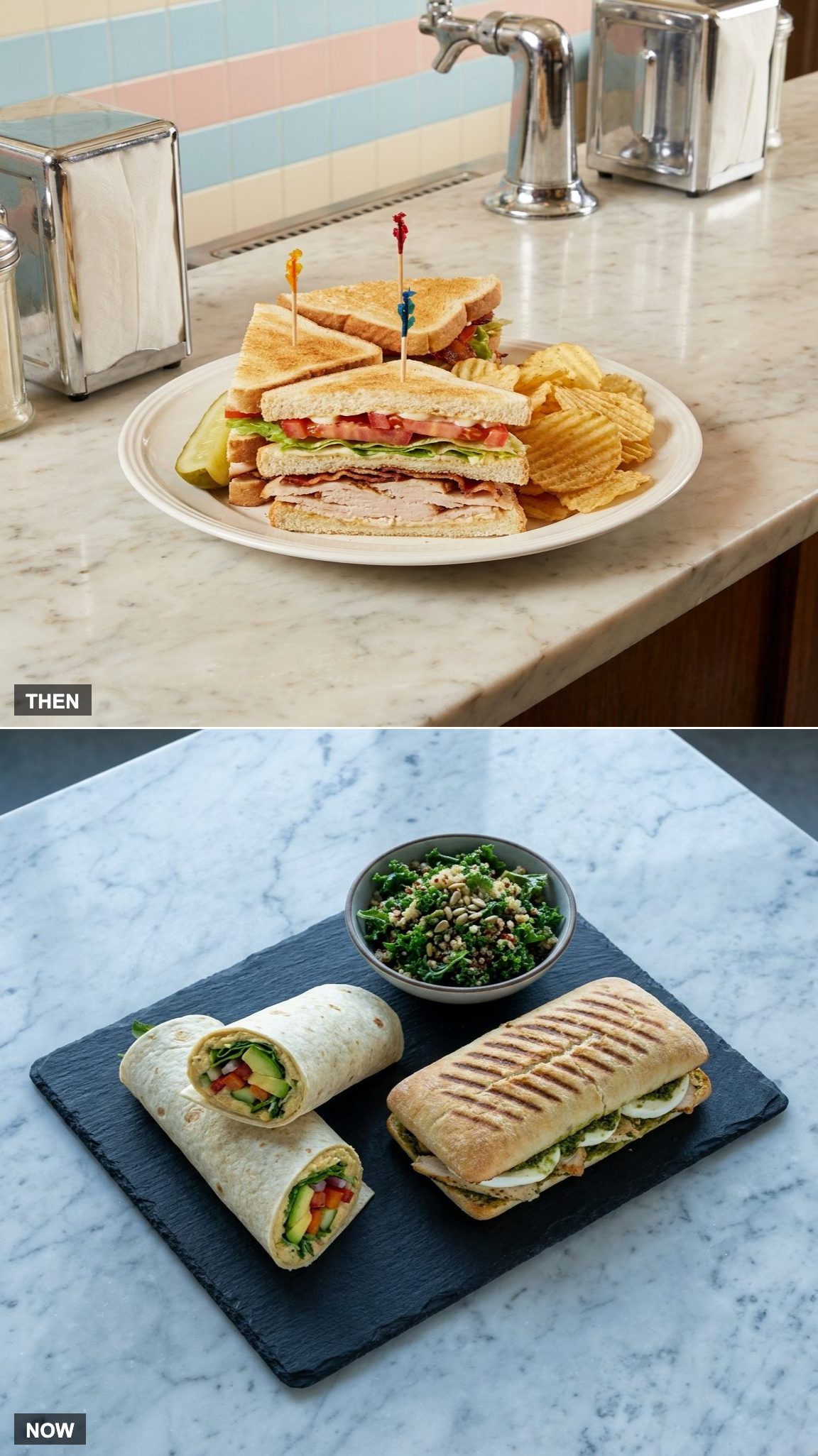
Three slices of toast gave the club sandwich its height. Turkey or chicken, bacon, lettuce, tomato, and mayonnaise were layered according to the kitchen’s preferred version, then cut into triangles and pinned together with frilled toothpicks.
You removed those toothpicks one at a time and stacked them beside the pickle spear while deciding which corner to attack first.
The wrap takes many of the same fillings and rolls them into a tortilla. It is easier to carry, simpler to eat, and less likely to collapse across the plate.
The club asked to be admired before anyone touched it. It stood tall and waited for a compliment.
15. Coca-Cola in Glass Bottles vs. Plastic Bottles
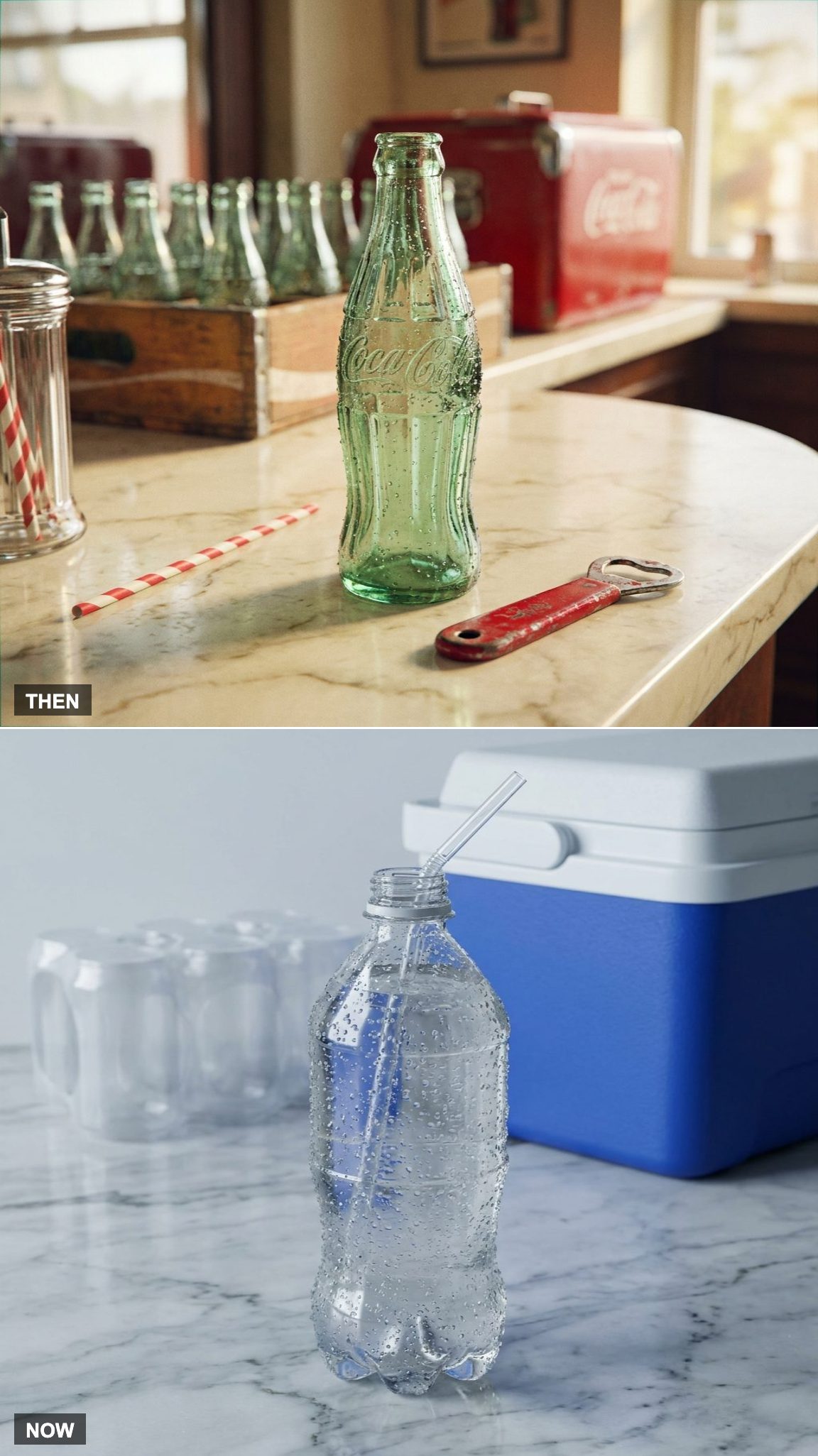
The glass bottle had weight. You felt the cold contour curves against your fingers, with condensation running toward the base.
The cap came off against an opener attached to the cooler or wall, releasing a quick hiss. Returnable bottles were collected, washed, refilled, and sent back into circulation.
The plastic bottle is lighter, resealable, and easier to ship. It twists open, crinkles as it empties, and enters the recycling stream when the drink is gone.
Practical advantages aside, it never sits in the hand quite like the cold glass contour bottle did.
14. Hand-Scooped Ice Cream vs. Soft-Serve Machines
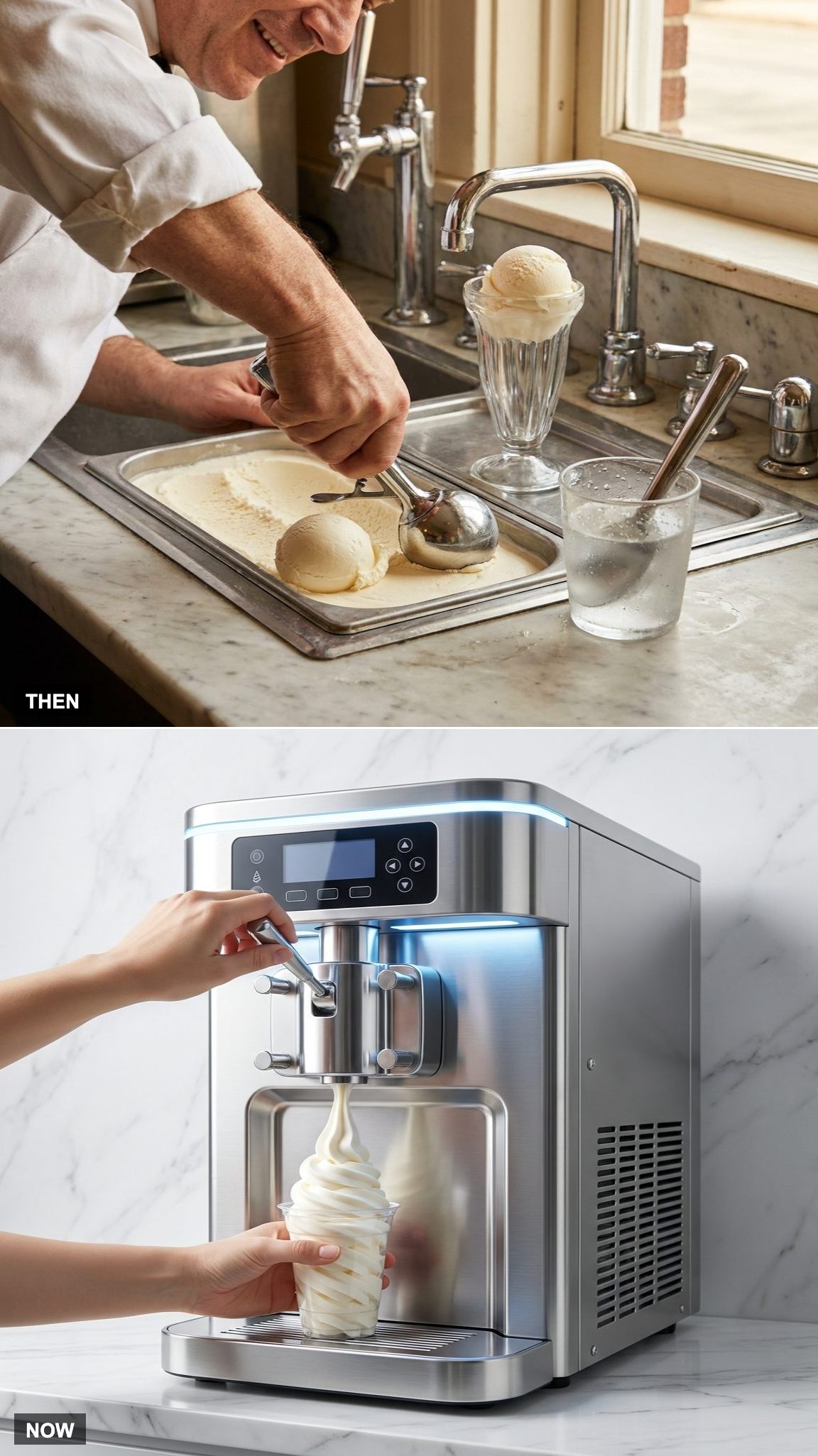
Scooping hard ice cream was a skill you could see. The metal scoop was rinsed or dampened, then pressed and twisted into the tub until a rounded portion released into the dish.
Some fountain workers made the motion look effortless. Others left ridges and uneven edges that disappeared as soon as the customer took the first bite.
Soft-serve is a different product, but its dispenser represents the modern preference for speed and uniformity. Pull the lever and a spiral emerges with little variation from one serving to the next.
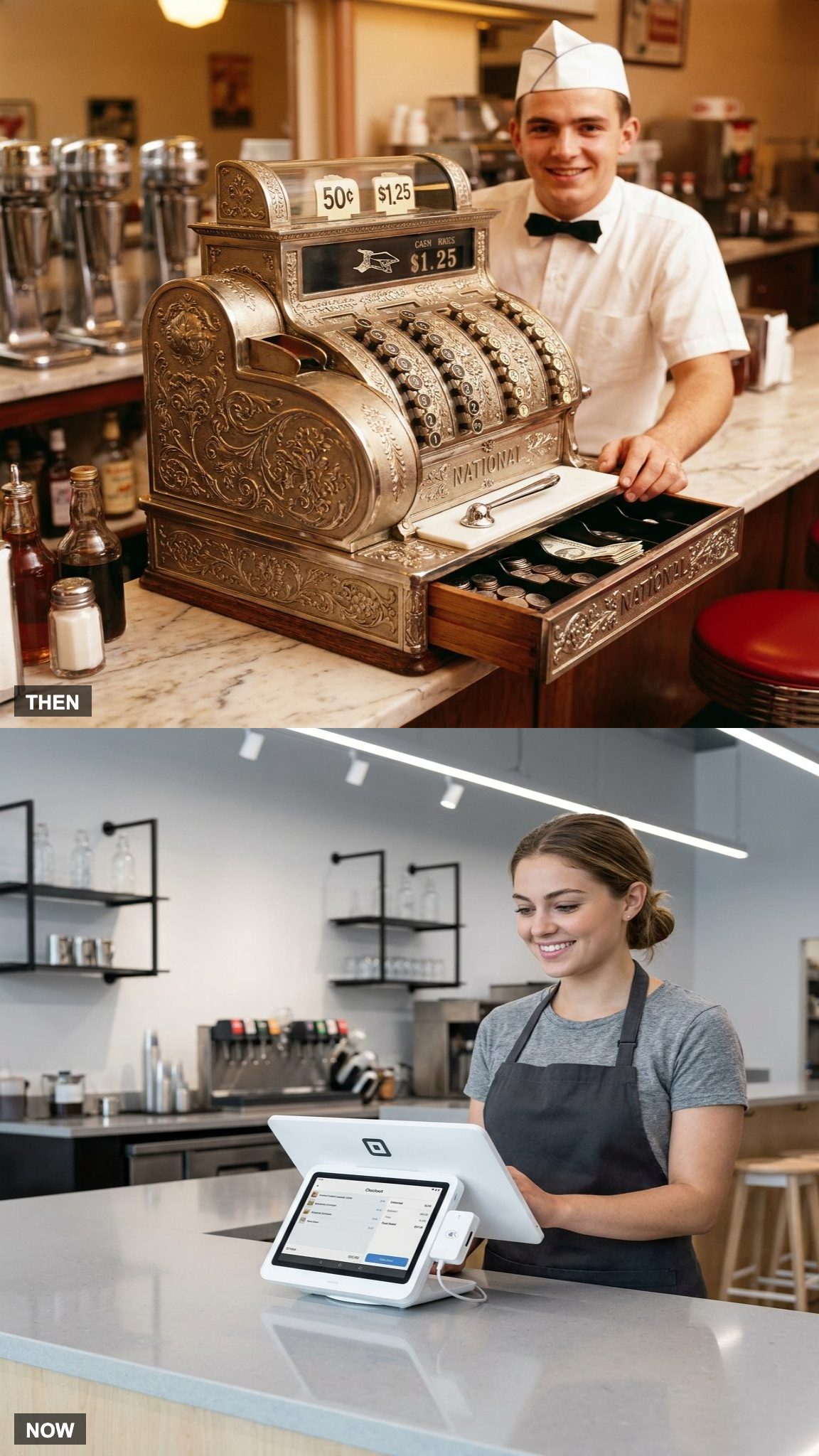
13. Cash Registers vs. Digital POS Systems
Would you like to save this?
The old register had heft. Depending on its age, a sale might produce a mechanical clatter, a drawer snapping open, and numbered tabs appearing behind glass.
By 1965, many counters still used substantial mechanical or electromechanical registers. An experienced worker could operate one without searching for each key.
The modern version is a touchscreen or tablet that tracks orders, sends instructions to the kitchen, processes cards, and turns toward the customer when it is time to approve the total.
The new system does far more. The old one simply made every completed sale audible.
12. The Green-Lined Order Pad vs. the Kiosk You Argue With
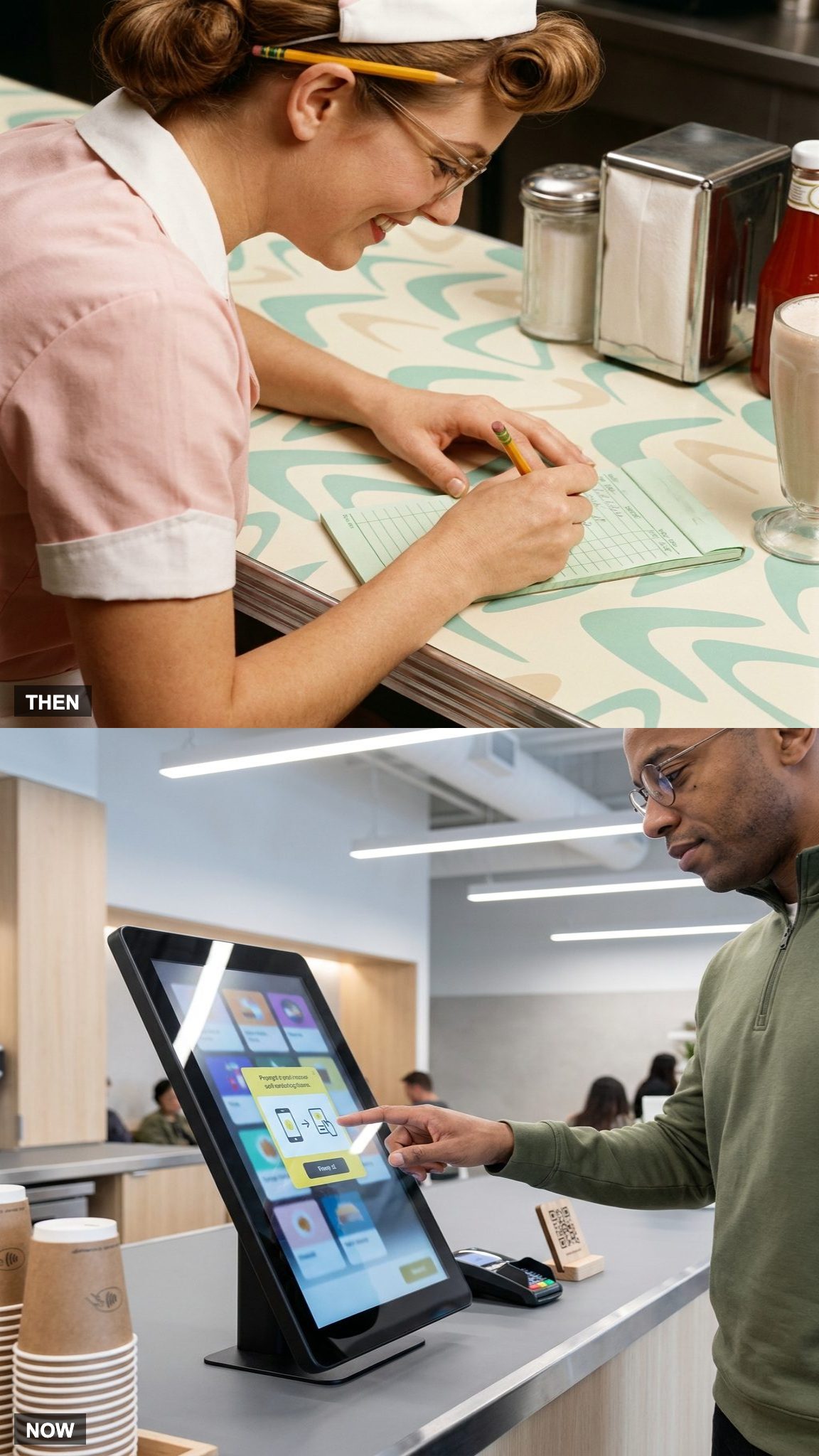
Your order lived in somebody’s head first, then landed on a green-lined pad in shorthand that made sense only to the people behind the counter.
Two egg creams, one thick malt, hold the cherry. A regular’s order might be underway before the pencil touched the paper.
Now a screen greets you at chest height while you move through nested menus, reject suggested additions, and confirm the order yourself. The kiosk may reduce some misunderstandings, but it can also turn ordering lunch into a small administrative task.
It does not remember that you always skip the cherry. Accuracy is useful, but recognition used to be part of the service too.
11. Cash Payments vs. Mobile Wallets
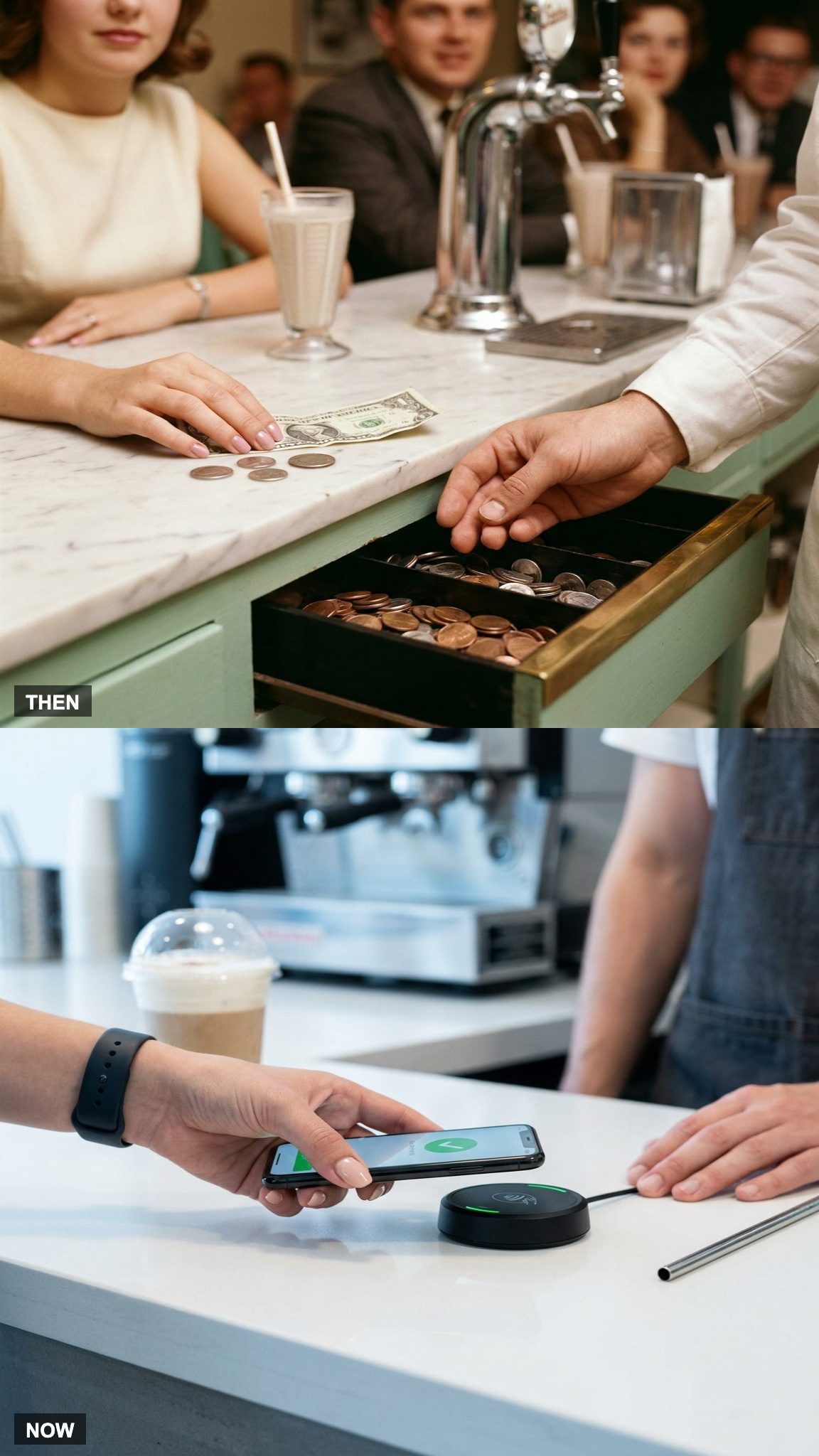
A fountain order was paid with coins and bills laid directly on the counter. Change came back from a drawer filled with nickels, dimes, and quarters, and the entire exchange produced its own soundtrack.
Prices varied by city, portion, and establishment, but a drink or small treat was often inexpensive enough for children to count out the cost from pocket money.
Today you hold a phone or card near a reader and wait for a chime. The transaction is cleaner and quicker, but it leaves no coins on the stone and no change warming in your palm.
10. Drugstore Soda Fountains vs. Standalone Coffee Chains
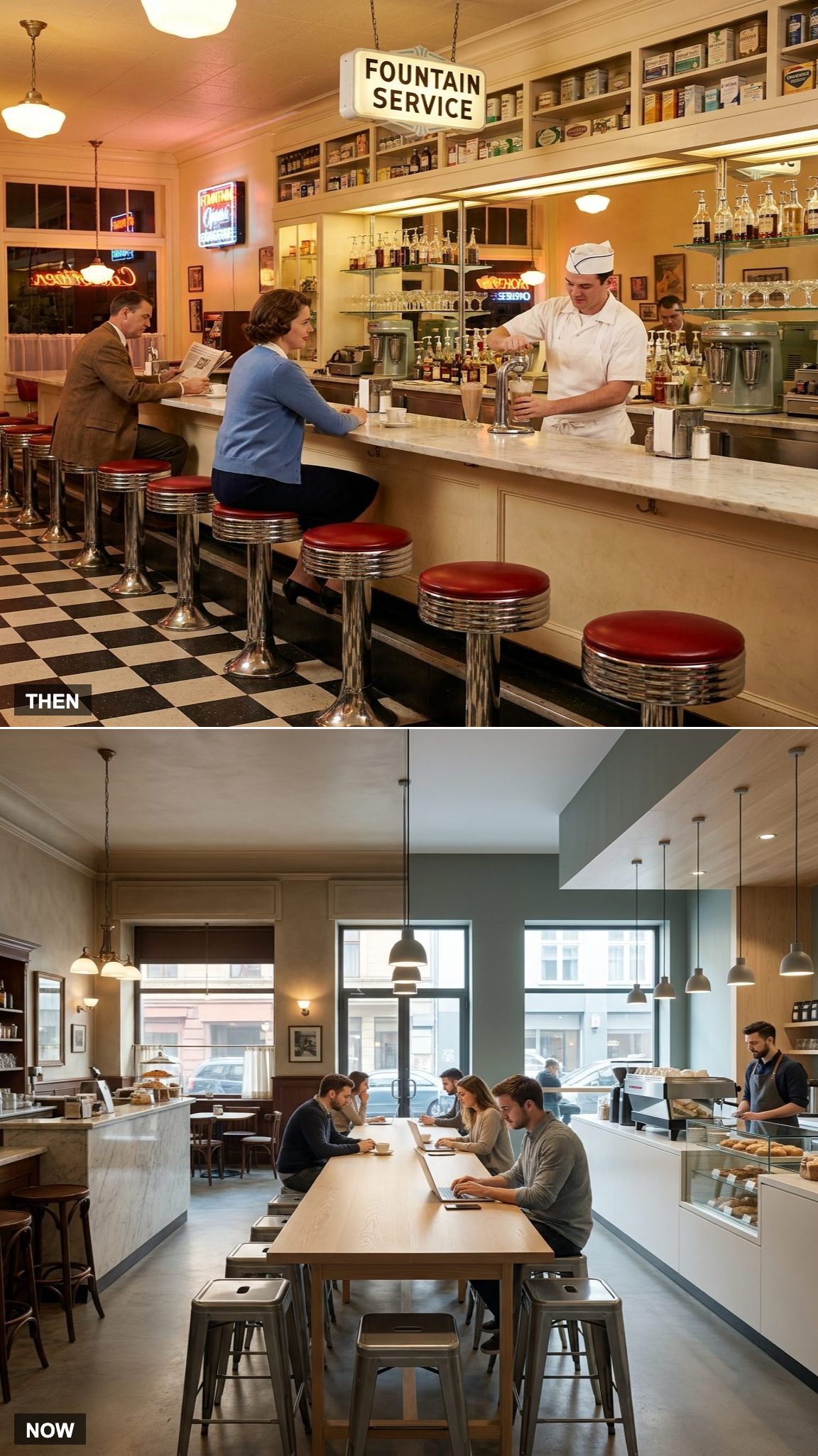
The soda fountain often lived inside a drugstore, beyond the greeting cards, toiletries, and pharmacy counter. One trip could include a prescription, a magazine, and a lime rickey.
That mixture of retail, medicine, lunch, and neighborhood conversation seems peculiar now, but it made the fountain part of a place people already visited for other reasons.
The modern coffee chain separates the drink from the pharmacy. The menu hangs overhead, the espresso equipment fills the back counter, and many seats are occupied by laptops.
The broad social purpose remains recognizable, but the smell has changed. Malt syrup and fountain fizz gave way to espresso, steamed milk, and toasted oat.
9. Neighborhood Regulars vs. Mobile Ordering
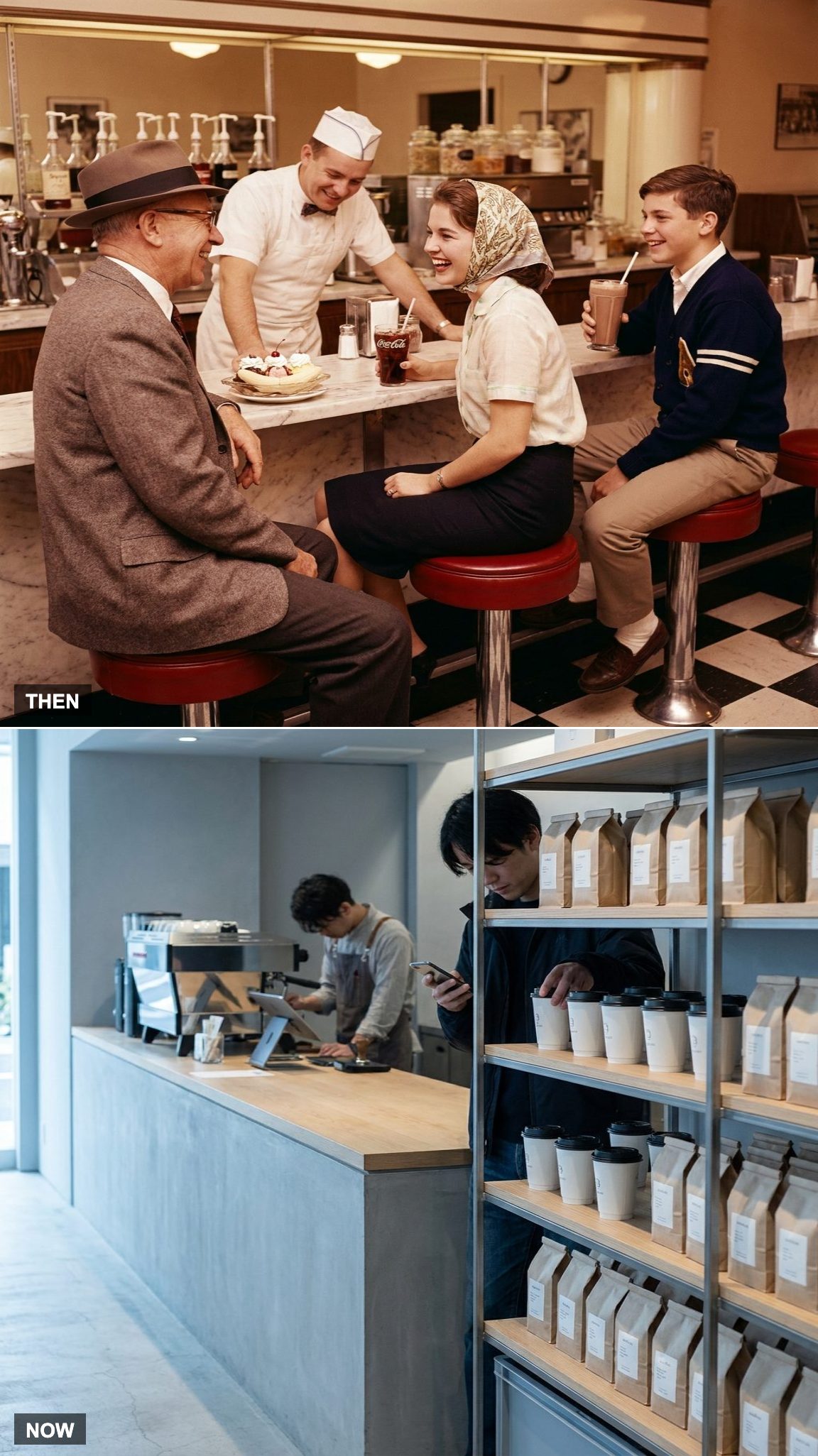
Certain stools seemed to belong to particular people, even if nobody had assigned them. A regular came through the door at roughly the same time, sat in roughly the same place, and often received coffee or a soda before asking.
Now a shelf holds labeled cups for customers who placed orders through an app. They can enter, collect the drink, and leave without joining the line or speaking to anyone.
That efficiency is useful. It also removes the small moment when someone behind the counter recognizes who has arrived.
A regular was not a loyalty tier. A regular was someone whose absence got noticed.
8. Conversation at the Counter vs. Looking at Smartphones
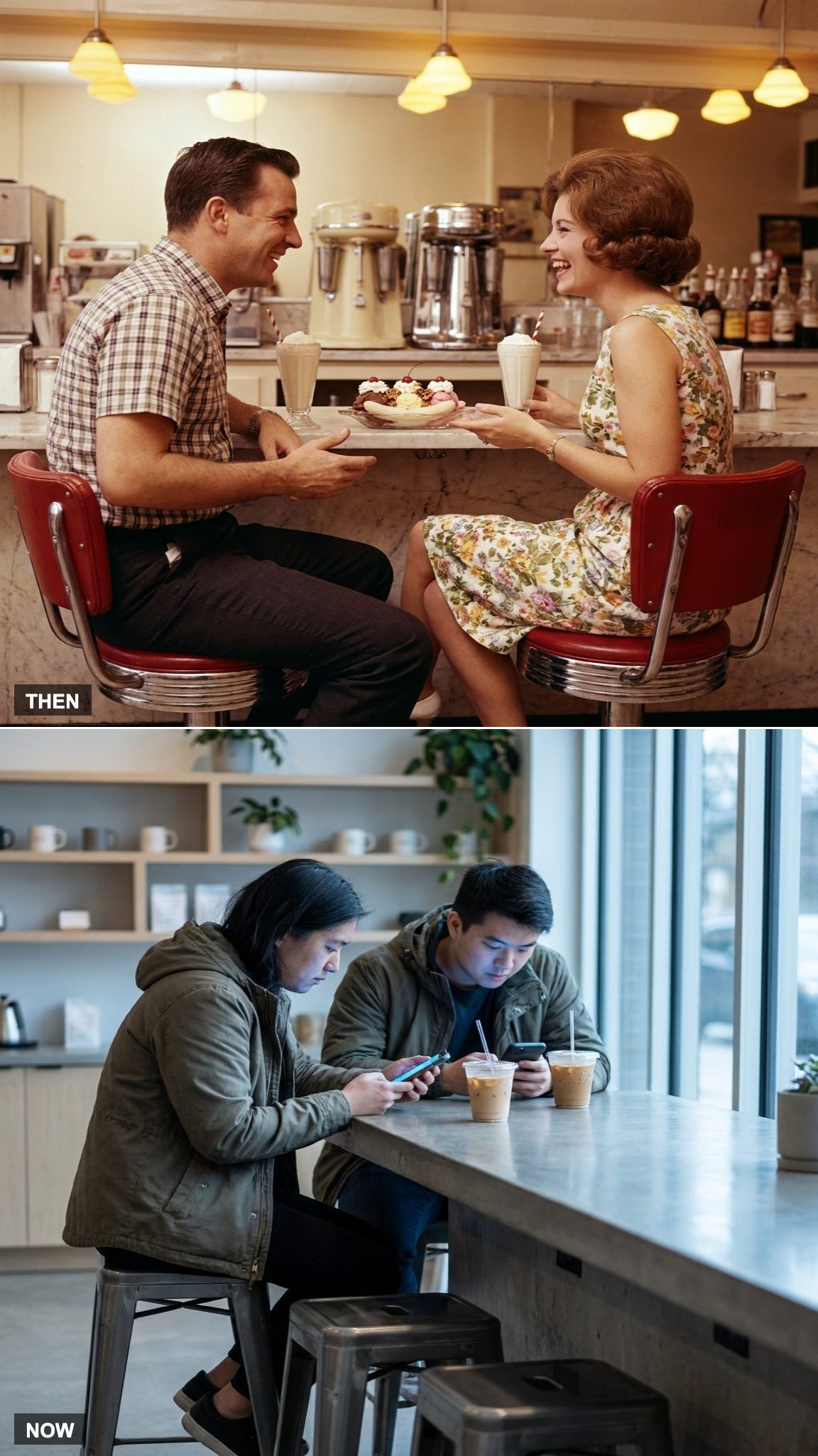
The counter gave people reasons to talk. Stools sat close together, the person making the drinks remained within conversation range, and customers occupied their hands with a straw, spoon, newspaper, or coffee cup.
Mirrors behind many counters reflected the room and made the space feel broader and busier. You could notice someone arriving without turning around.
Two people can sit a foot apart at a modern coffee bar and spend forty minutes looking at separate screens. I will not pretend to be above it. Still, there is a reason an old fountain could feel full with fewer people in the room.
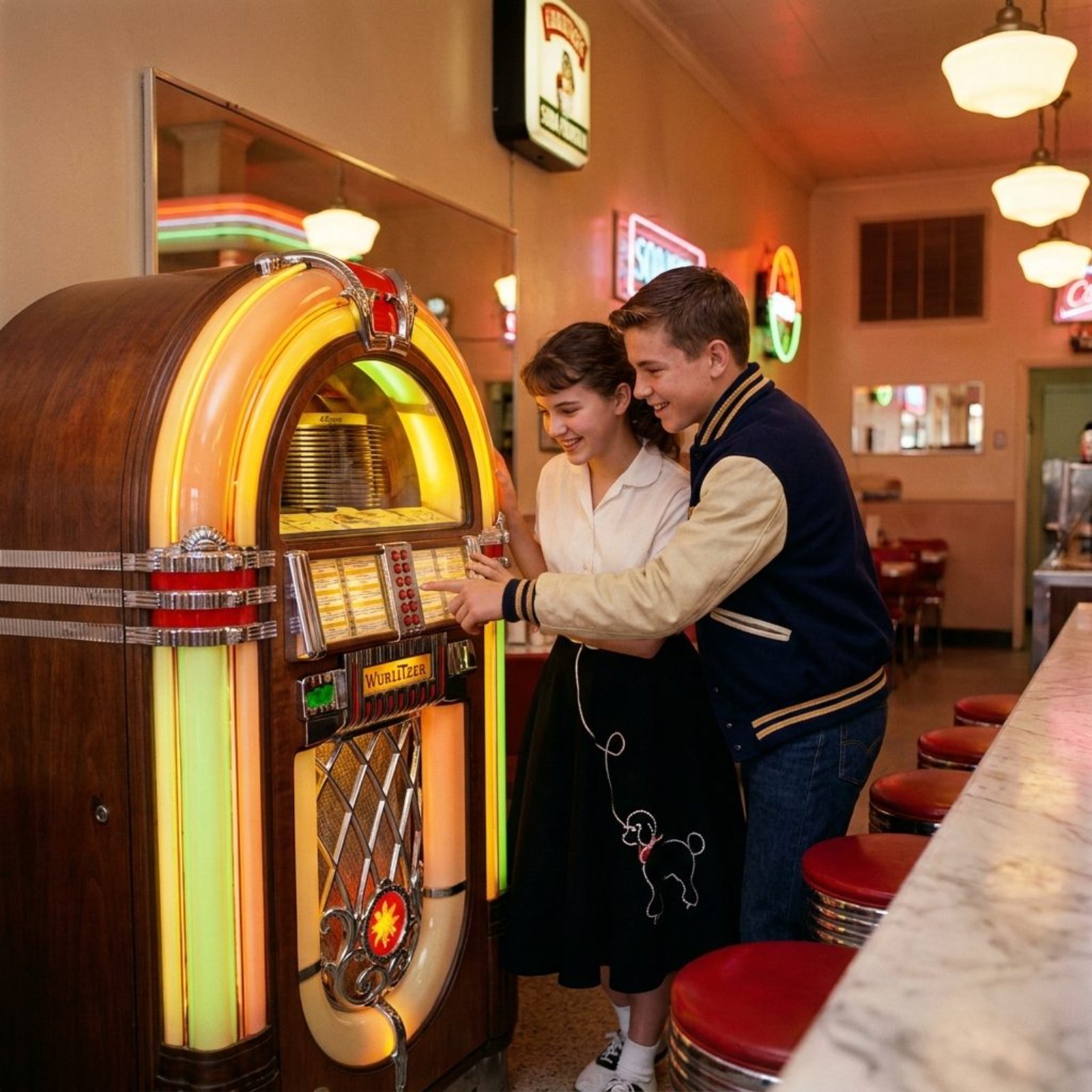
7. Jukebox Music vs. Streaming Playlists
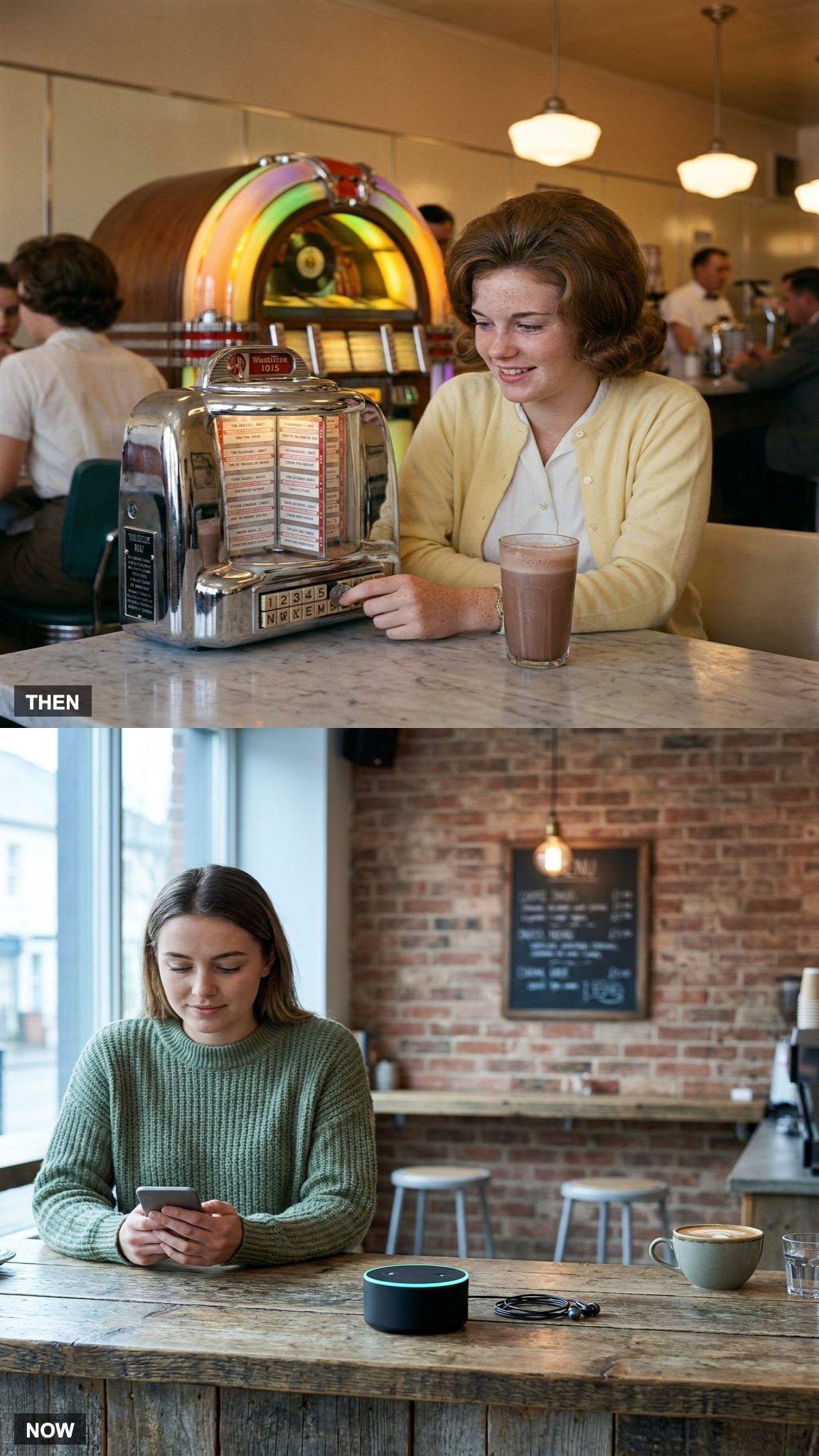
Choosing music required a coin and a small public declaration of taste. You scanned the titles, pressed a letter-and-number combination, and waited for the mechanism to move a record into place.
The price per selection varied by machine and year, but the result was the same: everyone in the room heard what you had chosen.
The modern soundtrack is an endless playlist streamed through hidden speakers. It never runs out, requires no one in the room to choose, and creates no nervous moment while you wonder whether the person three stools away likes the same song.
6. Paper Straws vs. Plastic—and Back Again
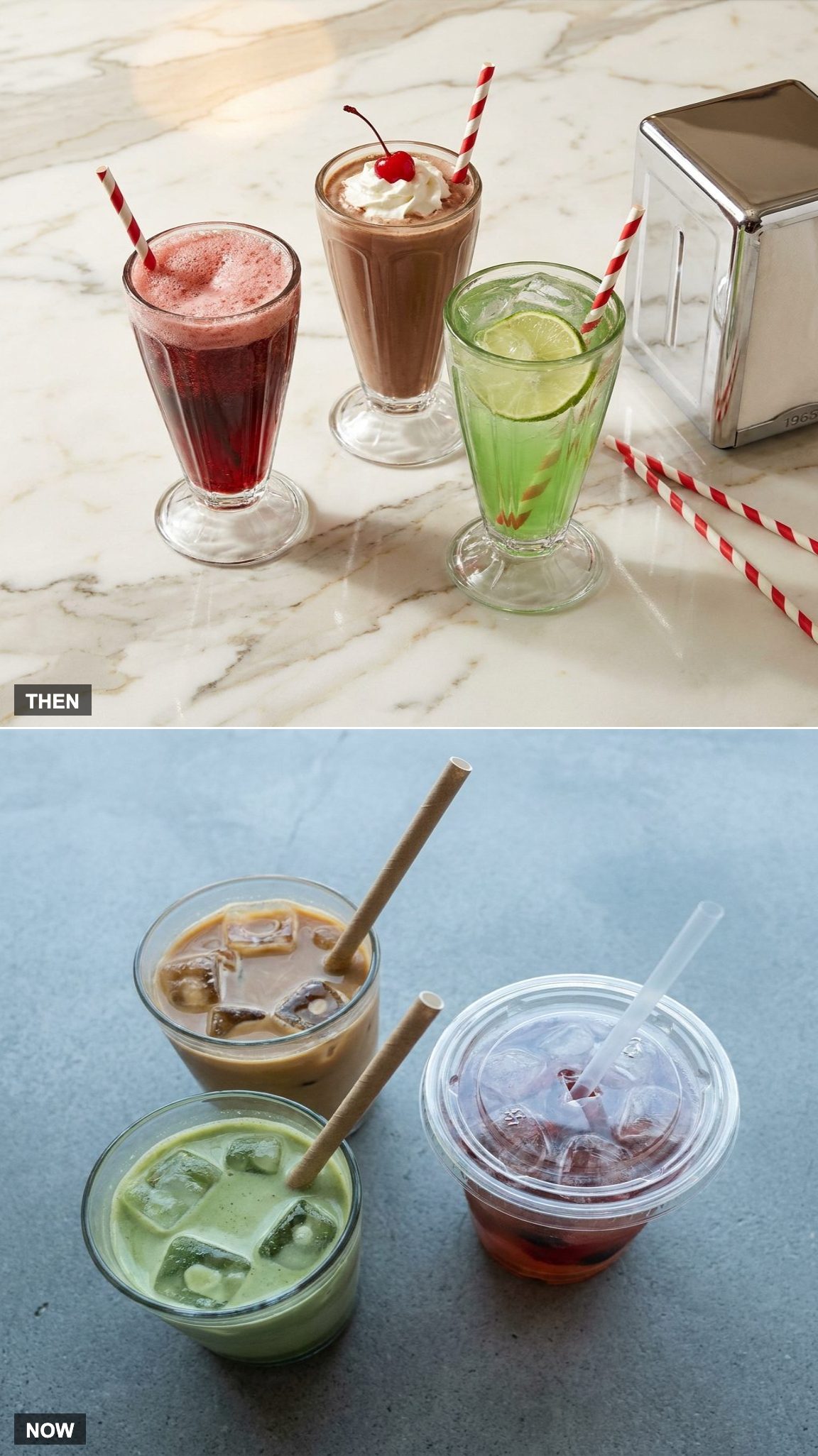
Paper straws were common in the 1960s, often striped and individually wrapped. Leave one in a thick malt too long and the end began to soften.
Plastic straws spread because they remained rigid, cost little, and could sit in a drink without changing texture. For decades, they became the unremarkable default.
Now many businesses have returned to paper or other alternatives. The old fountain straw came back in a plainer color and immediately became a subject of complaint.
5. Ceramic Coffee Mugs vs. Disposable Coffee Cups
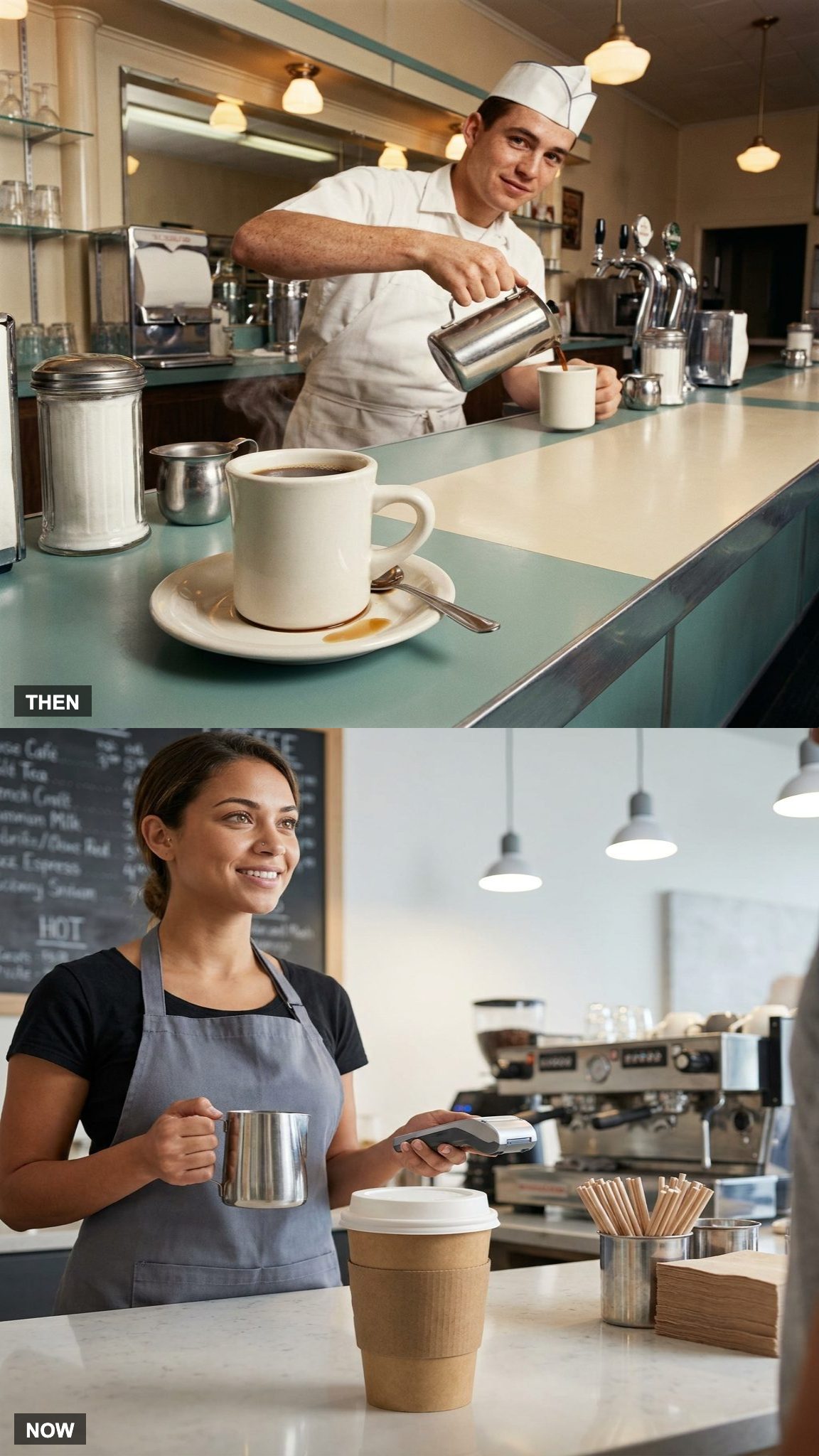
Coffee arrived in a mug you could feel. Thick white ceramic, a broad handle, a saucer underneath, and a counter attendant carrying a metal pot for refills.
The mug expected you to remain seated. It stayed on the counter when you left and returned to service after washing.
The modern cup is made for motion. Paper walls, plastic lid, cardboard sleeve, and a shape designed to fit the cupholder in your car.
One object belonged to the room. The other is packaging for whatever comes next.
4. Daily Pie Selection vs. Prepackaged Desserts
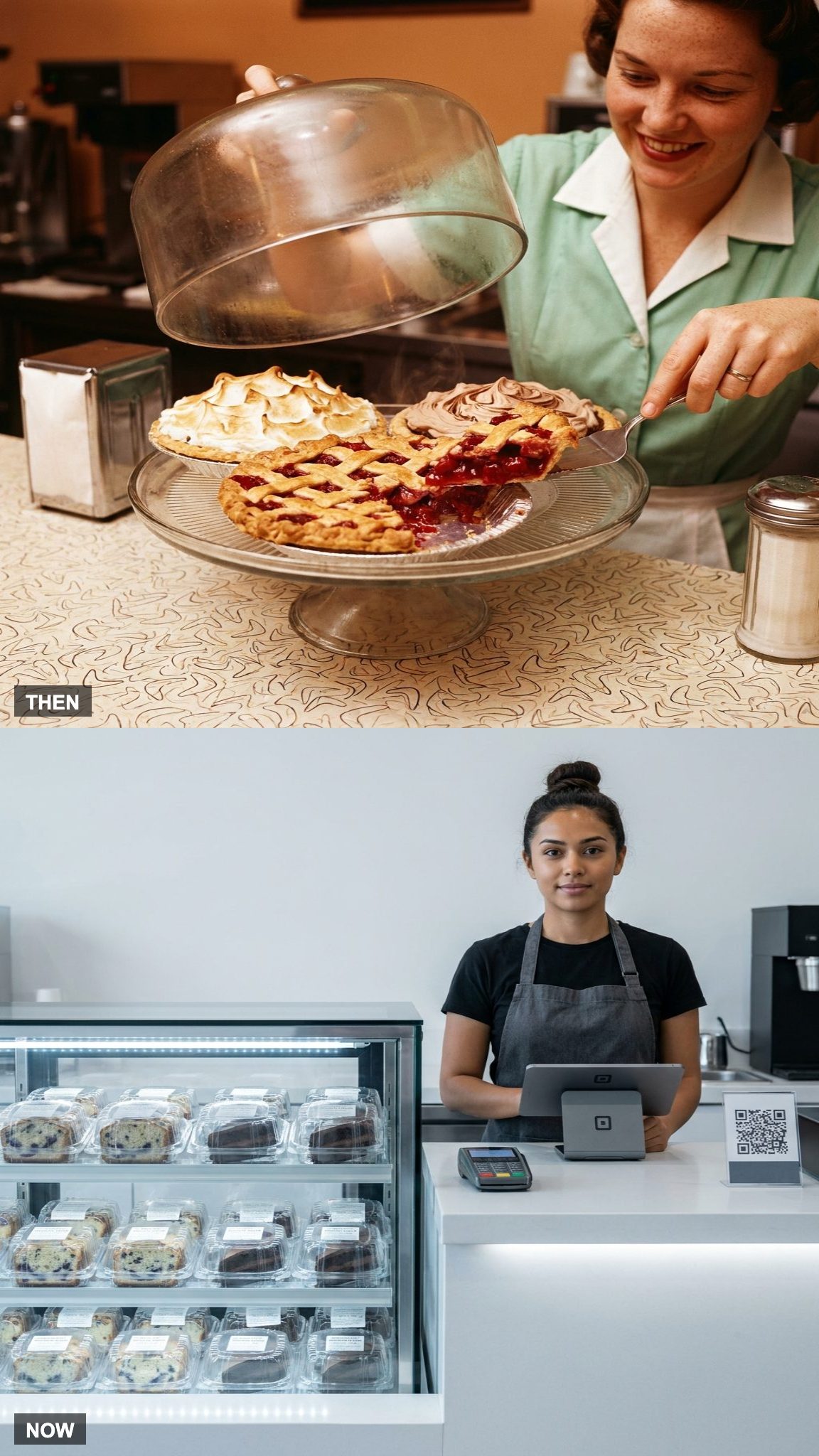
Under the glass dome sat the day’s selection: cherry, apple, lemon meringue, chocolate cream, or whatever had arrived from the bakery or been prepared in the kitchen.
The server lifted the dome and cut the slice in front of you. Pieces varied slightly because pies do not divide themselves into perfect factory measurements.
The dome has often been replaced by a refrigerated shelf of desserts sealed inside clear containers. Portions are consistent, labels are complete, and the product can travel without falling apart.
Nobody ever drove across town because a plastic clamshell looked especially promising.
3. Penny Candy by the Register vs. Shrink-Wrapped Checkout Snacks
Would you like to save this?
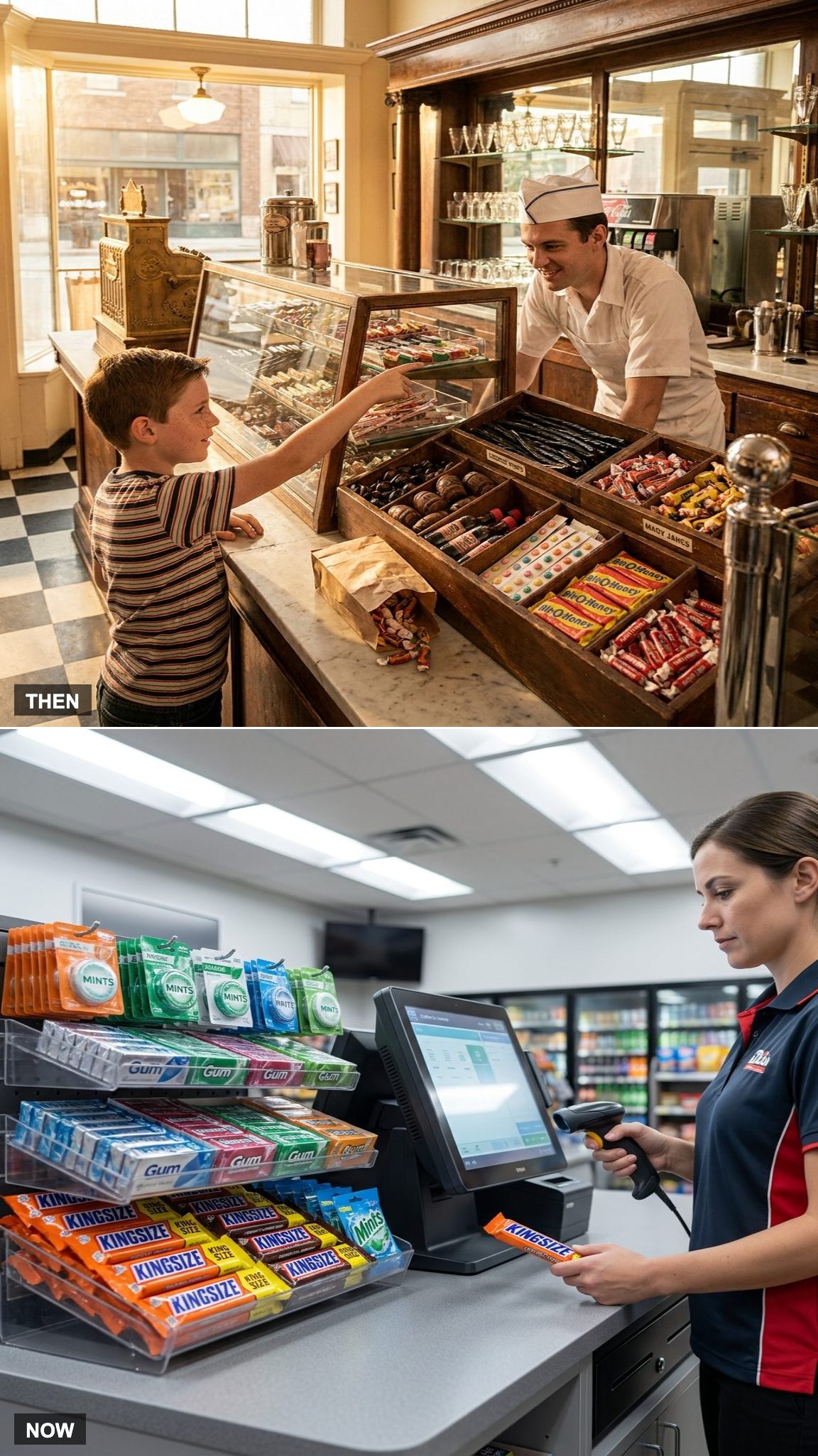
A few coins bought a small paper bag filled with candies selected one piece at a time. Depending on the store, the clerk used a scoop or tongs, or retrieved pieces from trays while a child deliberated over root beer barrels and wax bottles.
The candy was loose, visible, and sold as individual decisions rather than one sealed bar.
Modern checkout racks hold packaged snacks in standardized sizes, each with a barcode and a price printed or scanned at the register. The products are sealed, labeled, and easier to manage.
What disappeared was the small ceremony of building a bag one piece at a time.
2. The Family Name Over the Door vs. the National Logo
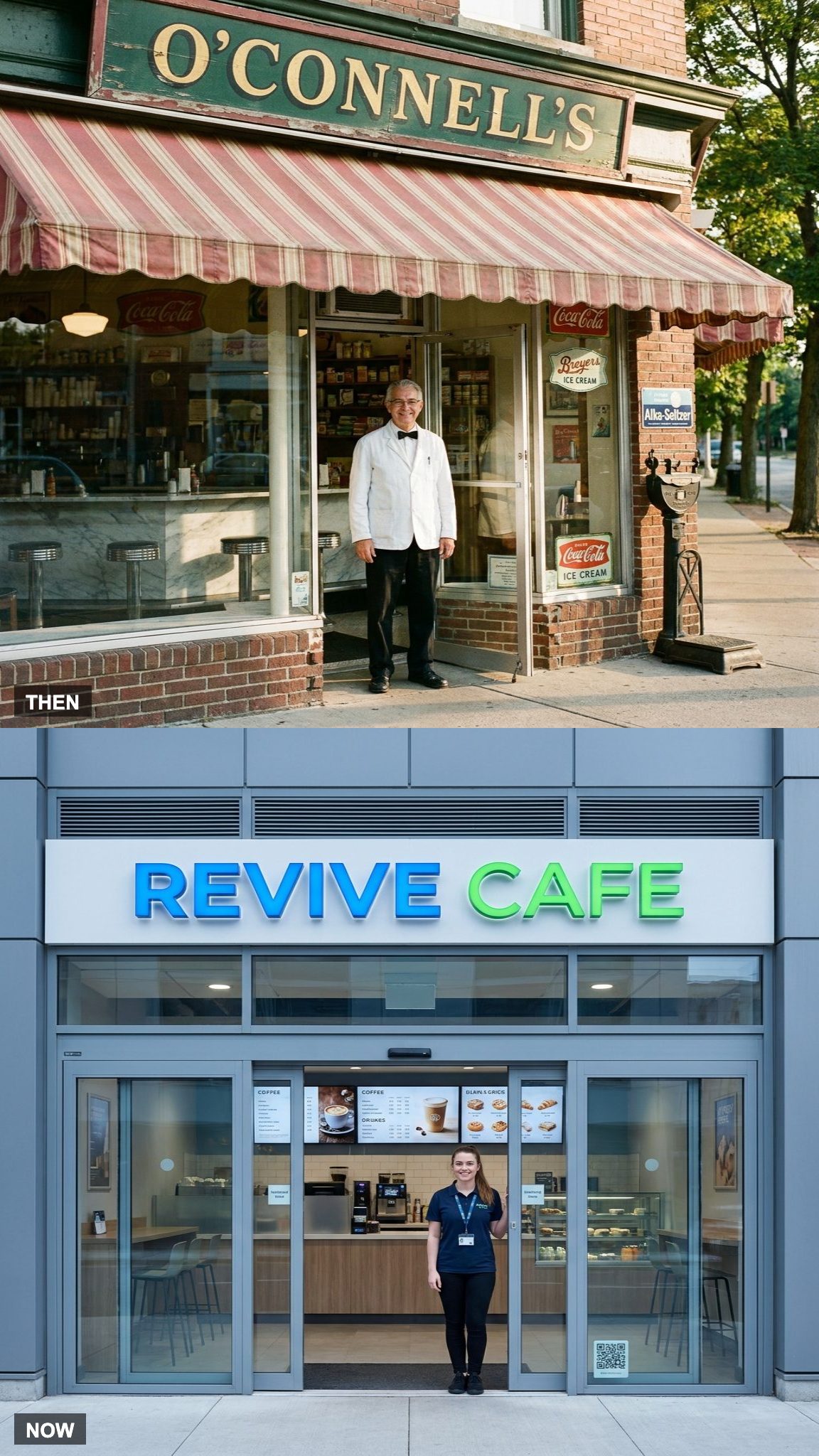
Many neighborhood fountains operated under a family name, pharmacy name, partnership, or local business identity. The sign belonged to a particular place, and complaints or compliments often reached the owner directly.
Not every fountain was independent, and chains already existed, but the local counter remained closely tied to the people running that location.
The national logo promises a familiar menu and a consistent product across thousands of towns. The person behind the counter follows systems developed far from the neighborhood where the drink is sold.
Reliability improved. What became harder to find was the counter whose name meant only one address.
1. The Town’s Living Room vs. the Quick Convenience Stop
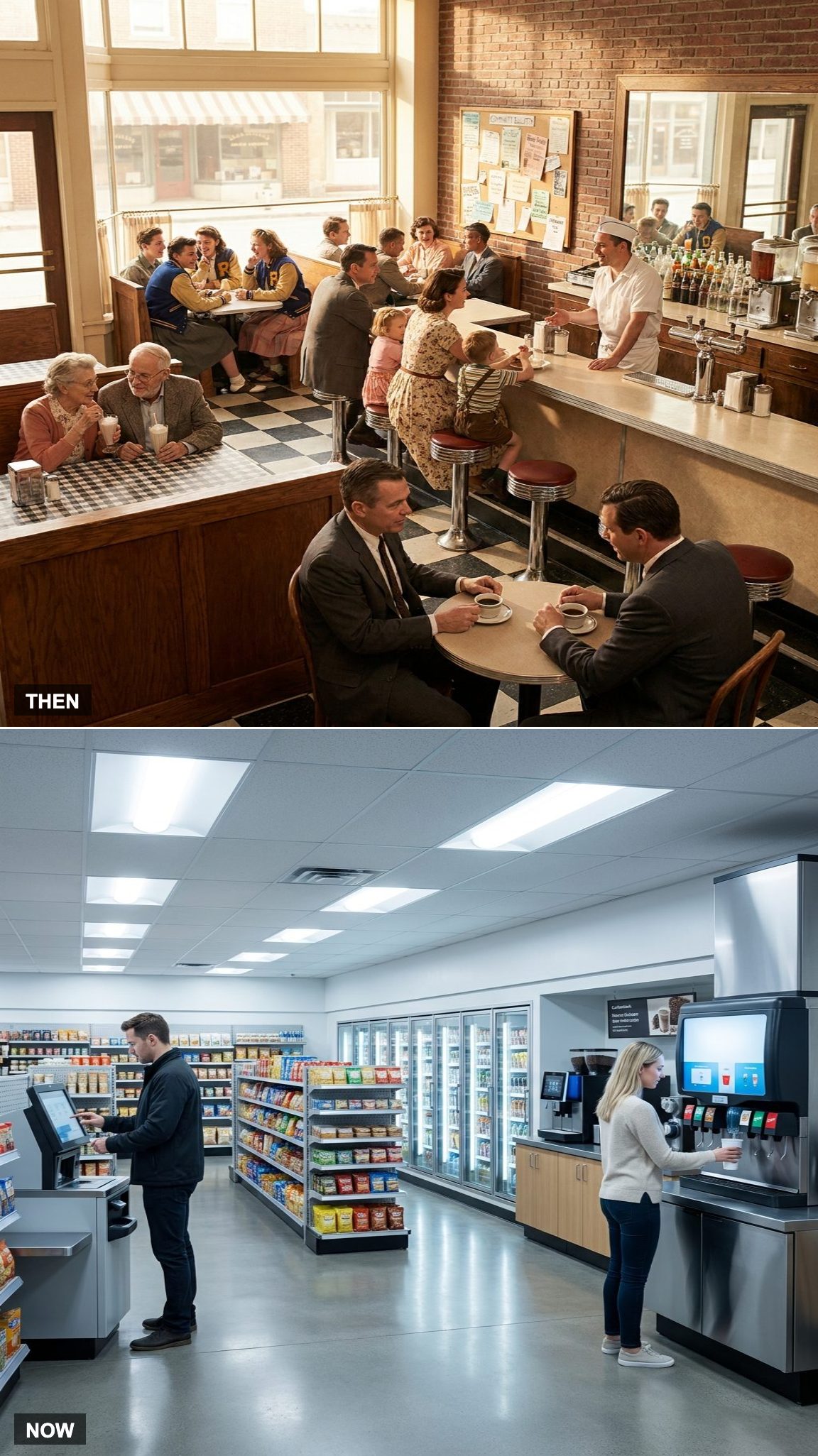
Before malls became the default teenage gathering place, and decades before social media competed for every spare minute, the local fountain could function as the town’s living room.
People caught up on gossip at the counter, read notices pinned near the door, and encountered neighbors without arranging the meeting in advance. Teenagers, workers, families, and retirees occupied the same room at different hours.
The fountain did not hold every town together, and plenty of communities gathered elsewhere. But for a long stretch of American life, the drugstore counter gave people somewhere informal to sit without needing a reservation or a special reason.
The same footprint may now hold retail shelving, refrigerated drinks, and a coffee kiosk designed for a brief stop. The new arrangement is convenient beyond argument. What it rarely does is persuade strangers to remain in the same room long enough to become familiar.