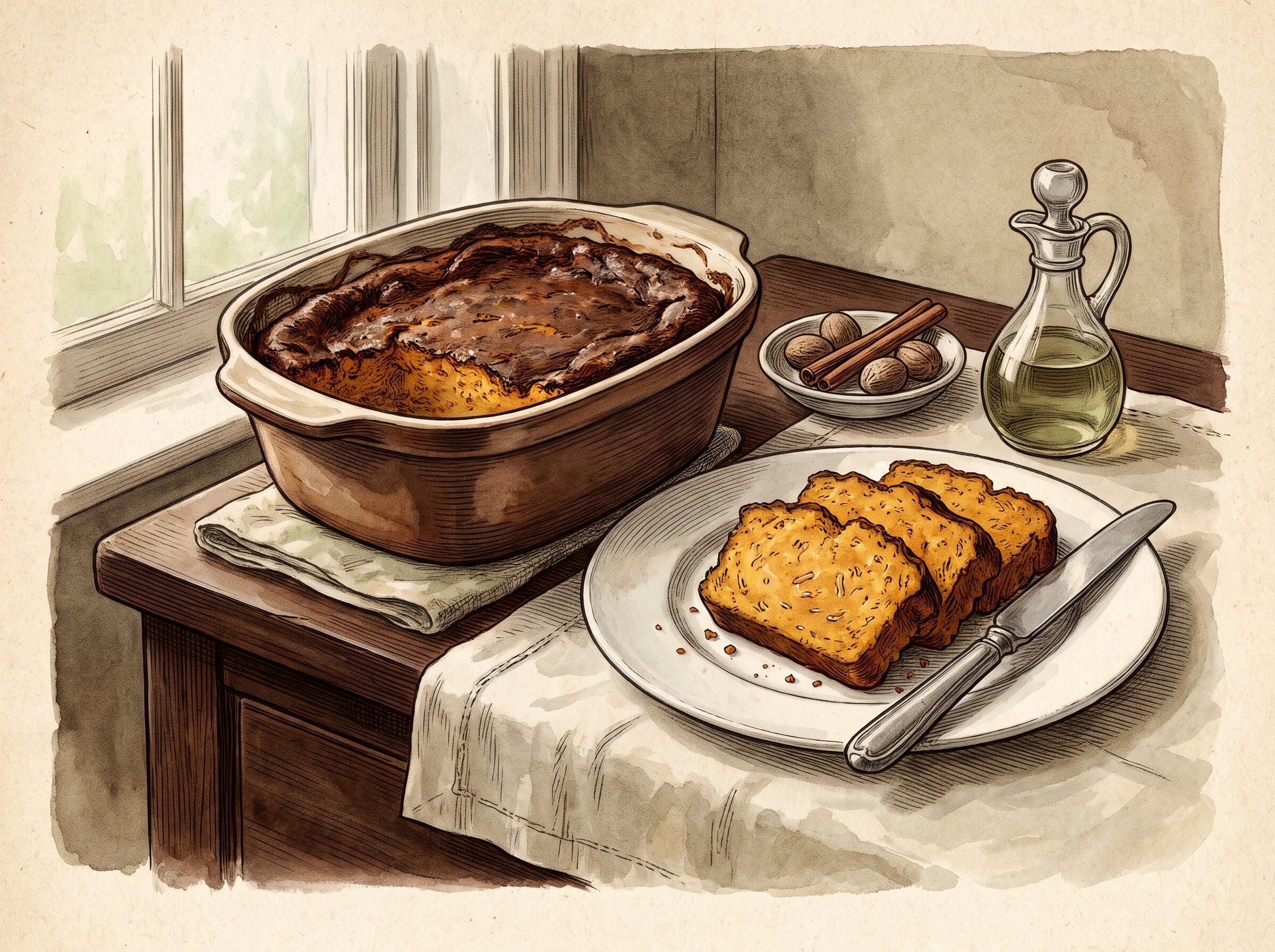
Three pounds of grated sweet potato, two pounds of sugar and a full dozen eggs go into this pone. It then spends two hours in the oven and is eaten cold, like cake. The recipe comes from the 1859 edition of a household manual by a minister’s widow who believed a well-kept kitchen was good for body and soul, but the dish’s name is far older than her book.
Please note that some of the images in this article were created with the assistance of AI.
From The Young Housekeeper’s Friend (Revised and Enlarged), 1859
The Story Behind This Recipe
A widow, a pen name and "The Best Cookbook"
Mary Ann Hooker was born on April 17, 1796, in Goshen, Connecticut, with a family name that carried weight. She descended from Thomas Hooker, the Puritan minister who founded the Connecticut colony, and her father was the Rev. Asahel Hooker. She studied at the Litchfield Female Academy in 1810, and in 1818 she married Elias Cornelius, another minister. They had six children. He was often away on missionary travels, and when he died in 1832 she was left to raise the children. Before she wrote about food, she wrote religious tracts, including Letters on Christian Education for the American Tract Society, and signed it simply "A Mother."
Later, living in Andover, Massachusetts, she wrote The Young Housekeeper’s Friend for newly married women who, in her view, had been let down by older receipt books. She gave beginners plain technical instructions and, as one modern bookseller notes, "many exact measurements." In 1849 the Boston Evening Transcript praised it under the headline "The Best Cookbook." It was still being revised and reprinted in 1859, decades before Fannie Farmer’s Boston Cooking School Cook Book of 1896. She died in Newton, Massachusetts, in 1880.
From "potato" to pone
For a long stretch of history, a recipe calling for "potatoes" might have meant sweet ones. The plant comes from the Americas and was grown in ancient Peru. Europeans called it just the potato, and American colonists only started saying "sweet potato" after the 1740s, to tell it apart from the white kind. That is why we often can’t tell which potato Amelia Simmons meant in the potato puddings of American Cookery (1796), the first American cookbook.
"Pone" probably came into English from Algonquian words meaning "baked." In the colonies it meant a plain bread, often made of corn, that was eaten cold. In time cooks made pones of sweet potato, apple and pumpkin as well. Sweetening a root vegetable this way owes more to old European carrot puddings than to West African cooking. Sweet potato pie and pone later became soul-food favorites, appearing in the recipe pages of Black newspapers such as the Afro-American. Mrs. Cornelius’s version is the fancy Northern cousin. Some pones leaned on molasses, but hers calls for sugar, lemon, butter, rose-water and twelve eggs.
A deep pan for the feast day
Kitchens were changing while Cornelius wrote. Between the book’s first edition and its revision, coal ovens were replacing brick ovens fired with wood. She kept her directions for building and using a brick oven while admitting that fashion was moving on. She still explained how long to roast meat before a fire in winter versus summer. A two-hour bake in deep pans would have suited either oven.
Her measuring mixes old and new in the same way. The potato and sugar are weighed, the milk counted in pints and the butter given by the quarter pound. Then come "a nutmeg," a "little" cinnamon and mace, and "a little more than three pints" of milk, all left to the cook’s judgment. Sweet potatoes later became a Thanksgiving fixture, and the pone traveled as far as Liberia. That country was settled by Black Americans in the 1800s, and sweet potato pone is still eaten at its own Thanksgiving. A dish meant to be served cold can be baked ahead, which suits any feast.
1850s
Notes From the Era
The recipe · 1859
Sweet Potato Pone
From The Young Housekeeper’s Friend (Revised and Enlarged) by Mary Hooker Cornelius (1859). Every word of the recipe below is as printed.
Ingredients
- several sweet potatoes
- three pounds of grated potato
- two of sugar
- twelve eggs
- a little more than three pints of milk
- the juice and grated rind of a lemon
- a quarter of a pound of butter (melted)
- a table-spoonful of rose-water
- a nutmeg
- a little cinnamon and mace
- a teaspoonful of salt
Method
-
Grate the potatoes and add the other ingredients
Pare and grate several sweet potatoes, and to three pounds of grated potato add two of sugar, twelve eggs, a little more than three pints of milk, the juice and grated rind of a lemon, a quarter of a pound of butter (melted), a table-spoonful of rose-water, a nutmeg, a little cinnamon and mace, a teaspoonful of salt.
-
Mix and bake
Mix thoroughly together and bake in deep pans two hours.
-
Serve cold
It is usually eaten cold, as cake.
Our notes
Reading It Today
The measures. Three pints of milk is 6 cups, so "a little more" means just over that. A quarter pound of butter is one stick (½ cup). Two pounds of granulated sugar is roughly 4½ cups. "A nutmeg" means one whole nutmeg, grated, which is a generous amount of spice.
Rose-water and mace. Rose-water is a fragrant distillate of rose petals, still sold in many grocery stores. A tablespoon gives a floral note. Mace is the lacy outer covering of the nutmeg seed. It tastes like a softer, slightly peppery nutmeg.
What it would be like. Raw grated potato bound with this much milk and so many eggs points to a dense, custardy pudding rather than a fluffy cake, set firm by the long bake. It would likely slice well once cold. The flavor would be sweet and warmly spiced, brightened by lemon and perfumed with rose.
How it differs from today. Most modern sweet potato pies and casseroles start with cooked, mashed potato. This one starts with raw, grated potato and cooks it slowly in a custard. It has no crust, uses lemon and rose-water where today’s recipes usually lean on vanilla, and is served cold in slices rather than warm from the oven.
Source: Mary Hooker Cornelius, The Young Housekeeper’s Friend (Revised and Enlarged) (Taggard and Thompson, Boston, 1859). Read the 1859 book at Project Gutenberg.
Sources for the history
- The Young Housekeeper’s Friend (Revised and Enlarged), Mary Hooker Cornelius, 1859 (recipe text)
- Mary Ann Hooker Cornelius – Litchfield Ledger, Litchfield Historical Society
- Mrs. Cornelius’ New York Ginger Snaps (1849) – Erin E. Moulton
- OP: The Young Housekeeper’s Friend – Kitchen Arts & Letters
- A Sweet Potato History – Inside Adams, Library of Congress
- Pone (food) – Wikipedia
- Sweet Potato Pone, Jane Dotson – Old Line Plate
The original recipe text is from a work published in 1859 and is in the public domain in the United States. The history, notes and illustrations are Piaci Pizza’s own. Brand names that appear in historic recipes are mentioned as historical fact only. Illustrations are AI-generated in a vintage style. The recipe is shown exactly as it was published in 1859; we have not photographed a test batch.