
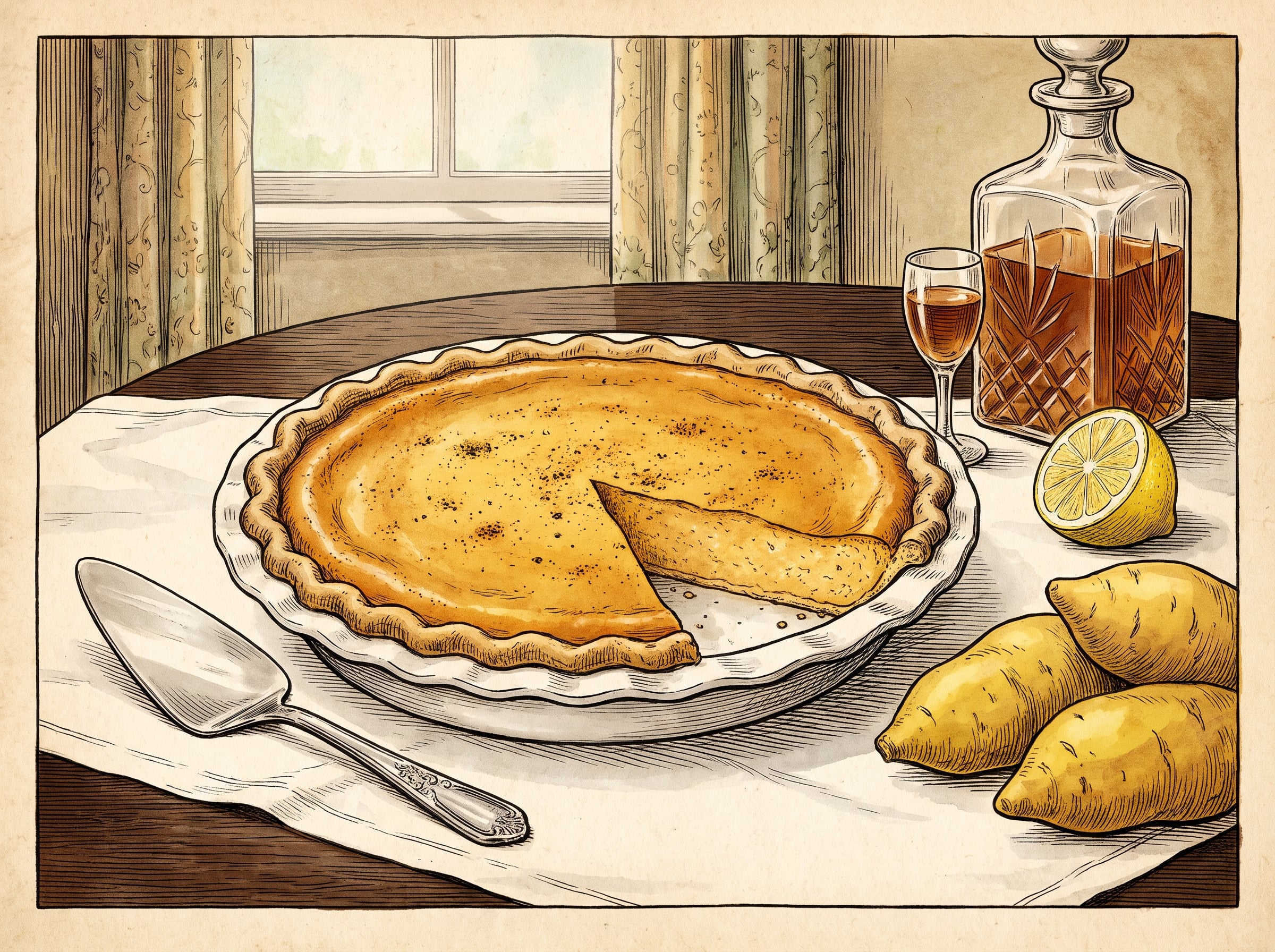
In 1859 a famous young novelist moved to Newark, New Jersey, and discovered she had never actually run a kitchen. A dozen years later she published a household manual that sold more than a million copies. This sweet potato pie comes from that book, and it still carries a glass of brandy and a squeeze of lemon from older Virginia puddings.
Please note that some of the images in this article were created with the assistance of AI.
From Common Sense in the Household: A Manual of Practical Housewifery, 1880
The Story Behind This Recipe
A novelist learns to keep house
Mary Virginia Hawes was already a celebrity when she married. Born in 1830 in Dennisville, Amelia County, Virginia, and raised in Richmond from her early teens, she published her first novel, Alone, in 1854 under the name Marion Harland, and it was an immediate hit. Two years later she married Edward Payson Terhune, a Presbyterian minister. In 1859 his new church took them north to Newark, and for the first time she was the one doing the cooking and cleaning.
Those first months convinced her that young wives needed detailed, practical instructions. The cookbooks she could find were not much help, so she collected recipes she had tested herself. Charles Scribner published the result in 1871 as Common Sense in the Household. It went through at least ten printings by 1892, sold more than a million copies and stayed in print for about fifty years. Alongside the recipes it offered household fixes, including stopping a bleeding cut with cobwebs and brown sugar. Our recipe comes from an 1880 printing. Harland went on to write newspaper columns for women and many more books about the home, and she died in New York in 1922.
A pudding that moved into a crust
The sweet potato is native to the Americas, and cooking it in Southern and African American kitchens goes back to Native American cooking. Enslaved Africans probably used it in place of the yam they knew from home. One food historian suggests early settlers may have been trying to recreate a European carrot pie. When sweet potato pie first appeared in printed cookbooks in the 1700s, it was grouped with the savory vegetable dishes. By the 1800s it was more often treated as dessert.
Harland’s pie has a close relative in Mary Randolph’s The Virginia Housewife (1827). Randolph’s version is a pound of sweet potatoes with eggs, sugar, butter, nutmeg, lemon peel and a glass of brandy, baked in a pastry-lined dish, and she called it a pudding. Colonial Williamsburg’s foodways staff say the Southern sweet potato pie grew out of puddings like this one. Harland kept the pound of potatoes, the lemon, the brandy and the pastry. She added cinnamon and milk and separated the eggs so the beaten whites could go in last. Her closing note says that if you leave out the pastry, you have a pudding again. In 1880 the two dishes were still almost the same thing.
Coal, cups and cold potatoes
The baking instructions are a single word: bake. Many cooks of the time used a cast-iron coal stove. The whole stove had to be heated before the oven was usable, the cook judged the temperature by putting her hand inside, and the fire might need more coal about every ten minutes. The measurements were changing too. Randolph weighed everything, including three-quarters of a pound each of sugar and butter. Harland weighs only the potatoes and measures the butter, sugar, milk and spices in cups and spoons. Randolph rubbed her potatoes through a colander while they were hot. Harland wants them grated only when they are quite cold, because hot potatoes turn ‘sticky and heavy.’
The recipe does not mention any holiday. Today sweet potato pie is a Thanksgiving and Christmas staple, especially in the South, where it takes the place pumpkin pie holds elsewhere. St. Louis Public Radio calls it ‘a significant touchstone of African American culture, especially around Thanksgiving.’ Like Harland’s, today’s pie is usually baked open-faced. Harland was a Virginian writing from New Jersey for readers all over the country, so her book sent a Southern pie into kitchens far from the South.
1880s
Notes From the Era
The recipe · 1880
What Our Readers Say
- When Piaci Pizza readers loved a food photo and told us why, comfort was the top reason at 30%, with nostalgia close behind at 16%.
From Piaci Pizza reader polls and votes.
Sweet Potato Pie
From Common Sense in the Household: A Manual of Practical Housewifery by Marion Harland (1880). Every word of the recipe below is as printed.
Ingredients
- 1 lb. mealy sweet potatoes. The firm yellow ones are best.
- ½ cup butter.
- ¾ cup white sugar.
- 1 tablespoonful cinnamon.
- 1 teaspoonful nutmeg.
- 4 eggs—whites and yolks beaten separately.
- 1 cup of milk.
- 1 lemon, juice and rind, and glass of brandy.
Method
-
Parboil and grate the potatoes
Parboil the potatoes, and grate them when quite cold. If grated hot, they are sticky and heavy.
-
Mix the filling
Cream the butter and sugar; add the yolk, the spice, and lemon; beat the potato in by degrees and until all is light; then the milk, then the brandy, and stir in the whites.
-
Bake in pastry
Bake in dishes lined with good paste—without cover.
-
Pudding variation and serving
You may make a pudding of this by baking in a deep dish—well buttered, without paste. Cool before eating.
Our notes
Reading It Today
Mealy, parboiled, paste. ‘Mealy’ sweet potatoes are dry and floury when cooked, not wet and stringy. To ‘parboil’ is to boil only partway, so the potatoes are firm enough to grate. ‘Paste’ is pastry dough, and ‘without cover’ means no top crust.
A glass of brandy. Harland does not say how big the glass is. It was a loose household measure, and the brandy here adds flavor along with the lemon juice and rind. It is not meant to be the main taste.
What the filling would be like. Grated cold potatoes, creamed butter and sugar, and beaten egg whites folded in at the end point to a filling lighter and airier than a dense mashed custard. A full tablespoon of cinnamon, plus nutmeg, lemon and brandy, suggests it would be warmly spiced with a bright, slightly boozy edge.
How it differs from today’s pie. Many modern sweet potato pies use evaporated milk and spices only. This one uses fresh milk, separated eggs, lemon and brandy. It also doubles as a crustless pudding baked in a buttered dish and served cool.
Source: Marion Harland, Common Sense in the Household: A Manual of Practical Housewifery (Charles Scribner’s Sons, New York, 1880). Read the 1880 book at Project Gutenberg.
Sources for the history
- Marion Harland, Common Sense in the Household: A Manual of Practical Housewifery (Charles Scribner’s Sons, 1880), via Project Gutenberg
- Marion Harland (1830–1922), Encyclopedia Virginia (Virginia Humanities)
- Mary Virginia Hawes Terhune, Encyclopaedia Britannica
- Mary Virginia Terhune, Wikipedia
- Common Sense in the Household, Feeding America: The Historic American Cookbook Project (Michigan State University Libraries)
- Sweet potato pie, Wikipedia
- Sweet Potato Pudding, Colonial Williamsburg (Historic Foodways)
- Cooking with a Cast Iron Stove, Madison County Historical Society
- Do you eat pumpkin or sweet potato pie at Thanksgiving? Here’s the rich history behind both, St. Louis Public Radio (2023)
The original recipe text is from a work published in 1880 and is in the public domain in the United States. The history, notes and illustrations are Piaci Pizza’s own. Brand names that appear in historic recipes are mentioned as historical fact only. Illustrations are AI-generated in a vintage style. The recipe is shown exactly as it was published in 1880; we have not photographed a test batch.