Mary Randolph’s recipe for Sweet Potato Buns is one short paragraph long, and it never gives an exact amount for anything. It trusts the cook to know bread dough by touch, to keep yeast on hand (very likely homemade), and to have a sweet potato in the kitchen. That root has a longer and harder history than these cheerful little breakfast rolls let on.
Please note that some of the images in this article were created with the assistance of AI.
From The Virginia Housewife; or, Methodical Cook, 1860
The Story Behind This Recipe
Jefferson’s schoolmate writes a cookbook
Mary Randolph learned her letters in a one-room schoolhouse at Tuckahoe, the Virginia estate where she grew up, alongside young Thomas Jefferson and a crowd of his siblings and cousins. She was born in 1762 at Ampthill, her family’s plantation in Chesterfield County, and in 1780 she married her cousin David Meade Randolph. Their Richmond house, Moldavia, became a hub of Federalist society, and Mary became famous as a hostess. Then her old schoolmate became president and removed David from office. With money running low, Mary opened a boarding house in Richmond, and her reputation as a cook only grew. By 1819 the family had moved to Washington, where she finished The Virginia House-Wife. It came out in 1824.
The Library of Virginia calls it the first American regional cookbook, and it sold right away. It was reprinted at least nineteen times before the Civil War, which explains how a Philadelphia printing from 1860 carries recipes by a woman who died in 1828. The historian Cynthia Kierner saw the book as a Virginian model offered to Southern readers. It was built on Virginia produce and shaped by African, American Indian and European cooking. Most of the actual work in Randolph’s kitchen was done by Black women.
A garden root goes to the tea table
In the American South, the sweet potato sat at the center of African American cooking, while white Americans long treated it as a lesser food. Enslaved people grew it in their own gardens and provision grounds. Randolph’s recipe takes that everyday root and turns it into something for the household’s breakfast or tea table: a yeast roll, spiced and sweetened, finished with butter and served hot with more butter.
The recipe is plain about its star ingredient. The heading says ‘Sweet Potato Buns,’ and the instructions just say ‘a potato.’ That potato may not have looked like the one in today’s grocery bin. The bright orange variety sold as a ‘yam’ didn’t arrive until the 1930s, when Louisiana growers began marketing it.
Yeast from hops, heat from coals
The ‘spoonful of yeast’ is a small phrase that hides a lot of work. In the 1850s, city cooks could sometimes buy brewer’s yeast, but many households kept starters of their own, made from hops, potatoes and even peach leaves. The Fleischmann brothers didn’t open their compressed-cake yeast business in Cincinnati until 1868. The baking took watching, too. A cook might set a cast-iron bake kettle in the coals of an open hearth and keep an eye on the fire, not a dial. Butter shows up twice in the recipe, and Randolph’s book even explained how to build a refrigerator at home.
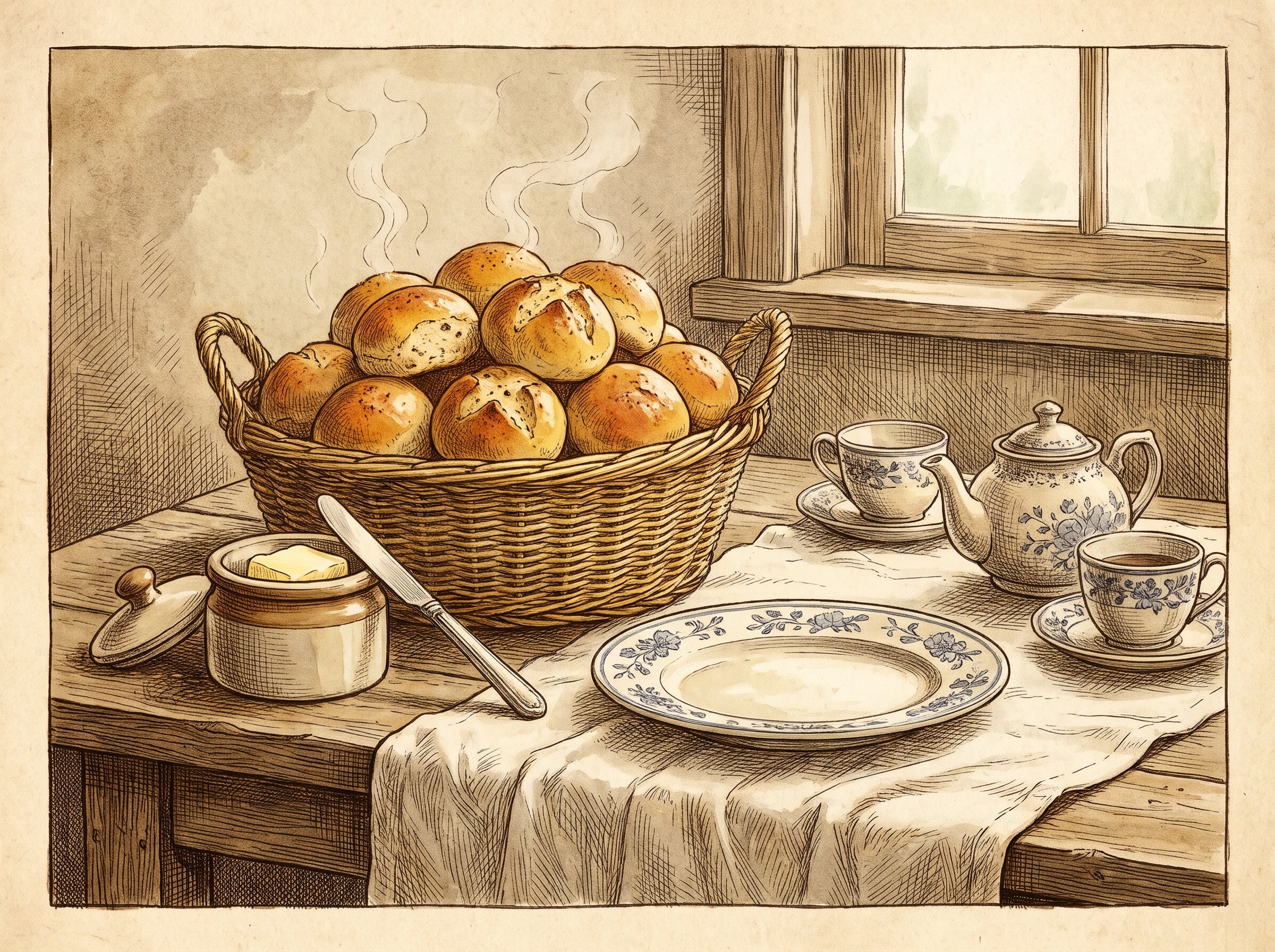
Nothing here mentions a holiday. In Randolph’s book these are everyday rolls, eaten ‘either for breakfast or tea.’ By the 1970s and ’80s, the sweet potato had become a fixture of holiday dinners. A basket of these buns on a holiday table brings an old breakfast roll to a newer kind of feast, and that’s a perfectly good place for it.
1860s
Notes From the Era
The recipe · 1860
Sweet Potato Buns
From The Virginia Housewife; or, Methodical Cook by Mary Randolph (1860). Every word of the recipe below is as printed.
Ingredients
- a potato
- as much flour as will make it like bread
- spice and sugar to your taste
- a spoonful of yeast
- a piece of butter
Method
-
Make the dough, let it rise, then bake
Boil and mash a potato, rub into it as much flour as will make it like bread–add spice and sugar to your taste, with a spoonful of yeast; when it has risen well, work in a piece of butter, bake it in small rolls, to be eaten hot with butter, either for breakfast or tea.
Our notes
Reading It Today
"As much flour as will make it like bread". This is all the recipe says about the flour. It means adding flour to the mashed potato until the mixture behaves like ordinary bread dough, soft and workable rather than sticky. The exact amount depends on how moist the potato is.
"A spoonful of yeast". Randolph’s readers would have reached for a homemade liquid yeast or starter, not a packet. Because those starters varied, the phrase isn’t a precise measure, and a modern baker will need to work out how much packaged yeast to use.
What to expect. Judging from the ingredients, these should be small, soft rolls with a moist crumb from the potato, sweetened and spiced however the cook chose. The butter worked in after rising would make them richer and more tender than plain bread.
Not today’s sweet potato side. This isn’t a casserole or a pie. It’s a bread, meant to be split and buttered. The potato supplies moisture and flavor rather than standing alone, and depending on the variety it may be paler than the deep orange kind common today.
Source: Mary Randolph, The Virginia Housewife; or, Methodical Cook (E. H. Butler & Co., Philadelphia, 1860). Read the 1860 book at Project Gutenberg.
Sources for the history
- Mary Randolph, The Virginia Housewife; or, Methodical Cook (E. H. Butler & Co., Philadelphia, 1860), Project Gutenberg
- Mary Randolph (1762 – 1828) · Virginia Changemakers, Library of Virginia
- Mary Randolph, Wikipedia
- The Virginia House-Wife, Wikipedia
- Mary Randolph, Cvillepedia
- The Deep and Twisted Roots of the American Yam, The Ringer
- The American yam’s complicated and painful racial legacy, The Counter
- What’s Cooking – Breads and Leavenings, Living History Farms
- DIY Yeast in Victorian America, Kristin Holt
The original recipe text is from a work published in 1860 and is in the public domain in the United States. The history, notes and illustrations are Piaci Pizza’s own. Brand names that appear in historic recipes are mentioned as historical fact only. Illustrations are AI-generated in a vintage style. The recipe is shown exactly as it was published in 1860; we have not photographed a test batch.