
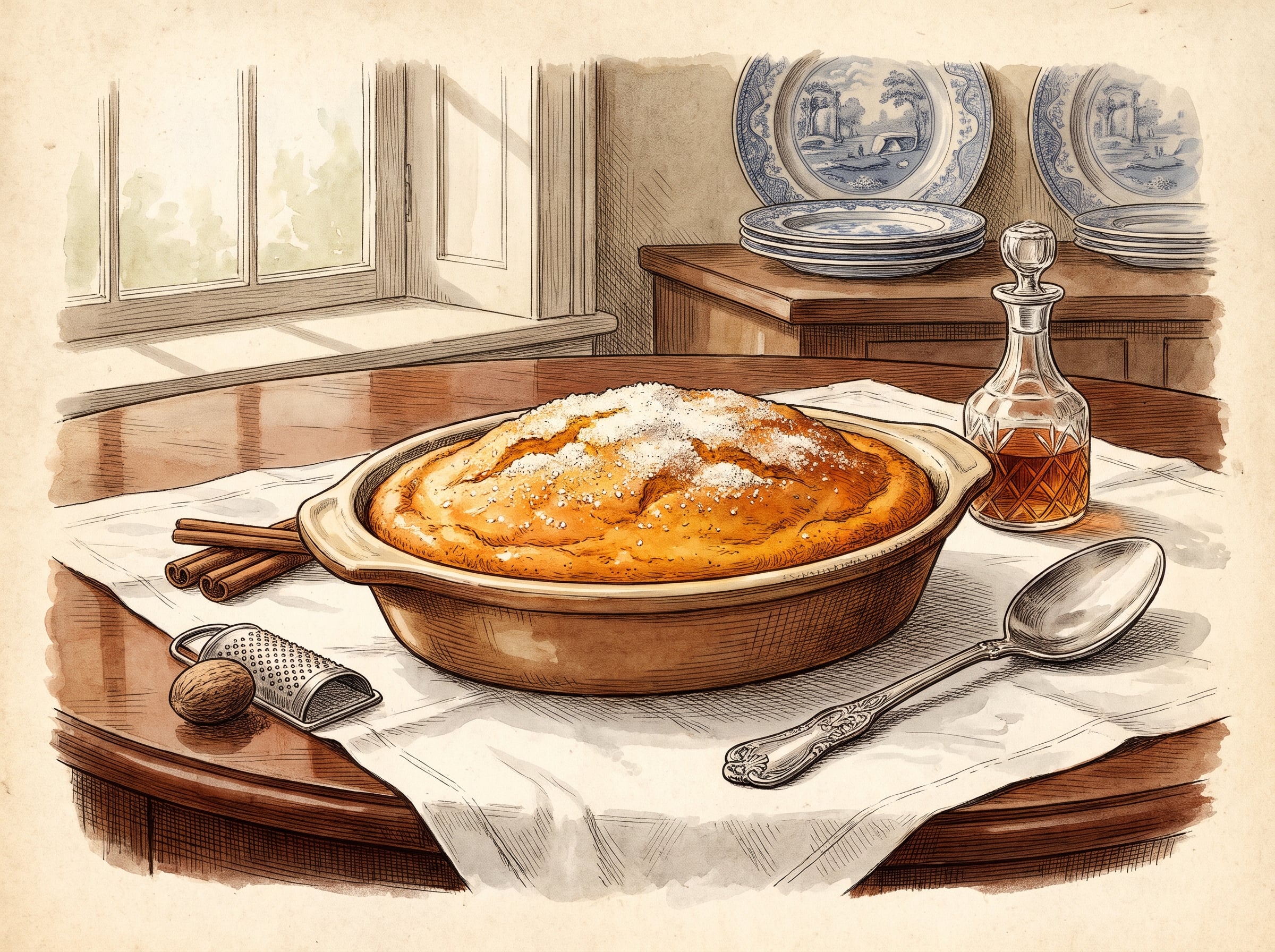
In 1840 a Philadelphia cook could open the book that would become the most popular American cookbook of its century and find a pudding made from "yam" that was almost certainly a sweet potato, perfumed with rose water and laced with wine. Eliza Leslie gave it one short paragraph. The story behind it takes in a boarding-house kitchen, a pioneering cooking school, and a word that crossed an ocean.
Please note that some of the images in this article were created with the assistance of AI.
From Directions for Cookery, in Its Various Branches (tenth edition), 1840
The Story Behind This Recipe
Miss Leslie of Philadelphia
Eliza Leslie learned to cook the practical way, with a house full of boarders waiting to be fed. She was born in Philadelphia in 1787, the eldest of five children of a clock and watchmaker. When her father died in 1803, her mother kept the family going by running a series of boarding houses, and Eliza worked beside her in the kitchen. She wanted more than on-the-job training, so she enrolled at Mrs. Goodfellow’s Cooking School in Philadelphia, said to be the first school of its kind in the United States. Her first book, Seventy-Five Receipts for Pastry, Cakes, and Sweetmeats (1828), drew on the notes she took there.
She also wrote fiction and contributed to Godey’s Lady’s Book and the Saturday Evening Post, but her real hit came in 1837 with Directions for Cookery, in Its Various Branches. It was meant for any household, in town or country, in any part of the country, and it sold at least 150,000 copies. It was republished 60 times by 1870 and was still in print in the 1890s. Long afterward, the food historians John and Karen Hess named it one of the two best American cookbooks ever written, crediting its exact directions and frank advice. Our pudding comes from the tenth edition, printed in Philadelphia in 1840 by E. L. Carey & A. Hart.
A yam by any other name
Here is the twist hiding in the title: true yams and sweet potatoes are not related at all. Yams come from Africa and Asia, while the sweet potato comes from South America. One explanation for the American mix-up is that enslaved Africans called sweet potatoes "yams" because they resembled roots they knew from home. The word itself may trace back to West African words for "eat" or "taste," such as "nyam" in Serer and Wolof.
The habit stuck so firmly that by the late 1800s a Texas horticulture professor asked Americans to stop calling sweet potatoes yams. Nobody listened. When Leslie wrote "yam," she was almost certainly speaking this American dialect of the kitchen. In her day the country grew two main kinds of sweet potato: dry ones from northern farms and moist ones associated with the South.
A pudding with company
The method is short. Roast the root, mash it smooth, stir in sugar, cream or butter, spices, rose water and wine, and let it cool. Then add beaten eggs and bake for half an hour. That rose water deserves a second look. Leslie wanted a whole wine glass of it, and in the 19th century American Shakers made a double-distilled rose water flavoring nearly as popular as vanilla is today.
Leslie was not the only one baking sweet potatoes into puddings. Black American cooks later printed their own versions, and Malinda Russell’s 1866 A Domestic Cookbook includes a sweet potato "baked pudding" with eggs, sugar, butter, cream and nutmeg. We could not find where a pudding like this sat on an 1840s holiday table. We do know where the sweet potato landed later: candied "yams" had become a Thanksgiving staple by the 1970s and ’80s, and today Americans eat tens of millions of pounds of sweet potatoes at that one meal.
1840s
Notes From the Era
The recipe · 1840
What Our Readers Say
- When Piaci Pizza readers loved a food photo and tapped a reason, comfort came first at 30%, and 16% chose nostalgic, a sign that old-fashioned dishes still pull at people.
From Piaci Pizza reader polls and votes.
Yam Pudding
From Directions for Cookery, in Its Various Branches (tenth edition) by Eliza Leslie (1840). Every word of the recipe below is as printed.
Ingredients
- one pound of roasted yam
- half a pound of white sugar
- a pint of cream or half a pound of butter
- a tea-spoonful of powdered cinnamon
- a grated nutmeg
- a wine glass of rose water
- one of wine
- six eggs
- sugar
Method
-
Sieve the roasted yam
Take one pound of roasted yam, and rub it through a cullender.
-
Mix in the sugar, cream, spices and flavourings
Mix with it half a pound of white sugar, a pint of cream or half a pound of butter, a tea-spoonful of powdered cinnamon, a grated nutmeg, and a wine glass of rose water, and one of wine.
-
Let it cool
Set it away to get cold.
-
Beat and add the eggs
Then beat six eggs very light. Stir them into the mixture.
-
Bake
Put it into a buttered dish and bake it half an hour.
-
Finish with sugar
Grate sugar over it when cold.
Our notes
Reading It Today
Yam means sweet potato. When Leslie says "roasted yam," read "roasted sweet potato." A true yam is a different plant altogether. A cullender is simply an old spelling of colander; pressing the cooked flesh through it was the hand-powered way to get a smooth, string-free mash.
Wine glasses and tea-spoons. A wine glass in old recipes is usually reckoned at about 2 fluid ounces, or a quarter cup, so the pudding takes roughly a quarter cup each of rose water and wine. A pint is 2 cups, and a tea-spoon is our teaspoon. A "grated nutmeg" means one whole nutmeg, which is a generous amount by modern standards.
What it would be like. Judging from the ingredients, this is a custard pudding more than a mash. Six eggs beaten "very light" would set the sweet potato into something rich and fairly smooth, with the eggs adding lift. Expect warm spice from the cinnamon and plenty of nutmeg, a floral note from the rose water, and a little depth from the wine. Sugar goes on top only after it cools.
Not your casserole. Candied "yams" became a Thanksgiving staple only in the 1970s and ’80s. Leslie’s version is something else: flavored with rose water and wine where we would reach for vanilla, finished with a simple grating of sugar once cold, and served as a sweet pudding.
Source: Eliza Leslie, Directions for Cookery, in Its Various Branches (tenth edition) (E. L. Carey & A. Hart, Philadelphia, 1840). Read the 1840 book at Project Gutenberg.
Sources for the history
- Eliza Leslie, Directions for Cookery, in Its Various Branches (10th ed., 1840), Project Gutenberg
- Eliza Leslie – Wikipedia
- Eliza Leslie: The Most Influential Cookbook Writer of the 19th Century – Mental Floss
- The Deep and Twisted Roots of the American Yam – The Ringer
- Why a Yam Is Not a Sweet Potato – Smithsonian Magazine
- Rose Water—An Age-Old Flavoring for Dinner and Dessert – Brooklyn Botanic Garden
The original recipe text is from a work published in 1840 and is in the public domain in the United States. The history, notes and illustrations are Piaci Pizza’s own. Brand names that appear in historic recipes are mentioned as historical fact only. Illustrations are AI-generated in a vintage style. The recipe is shown exactly as it was published in 1840; we have not photographed a test batch.