
The photo, the prompt, the list
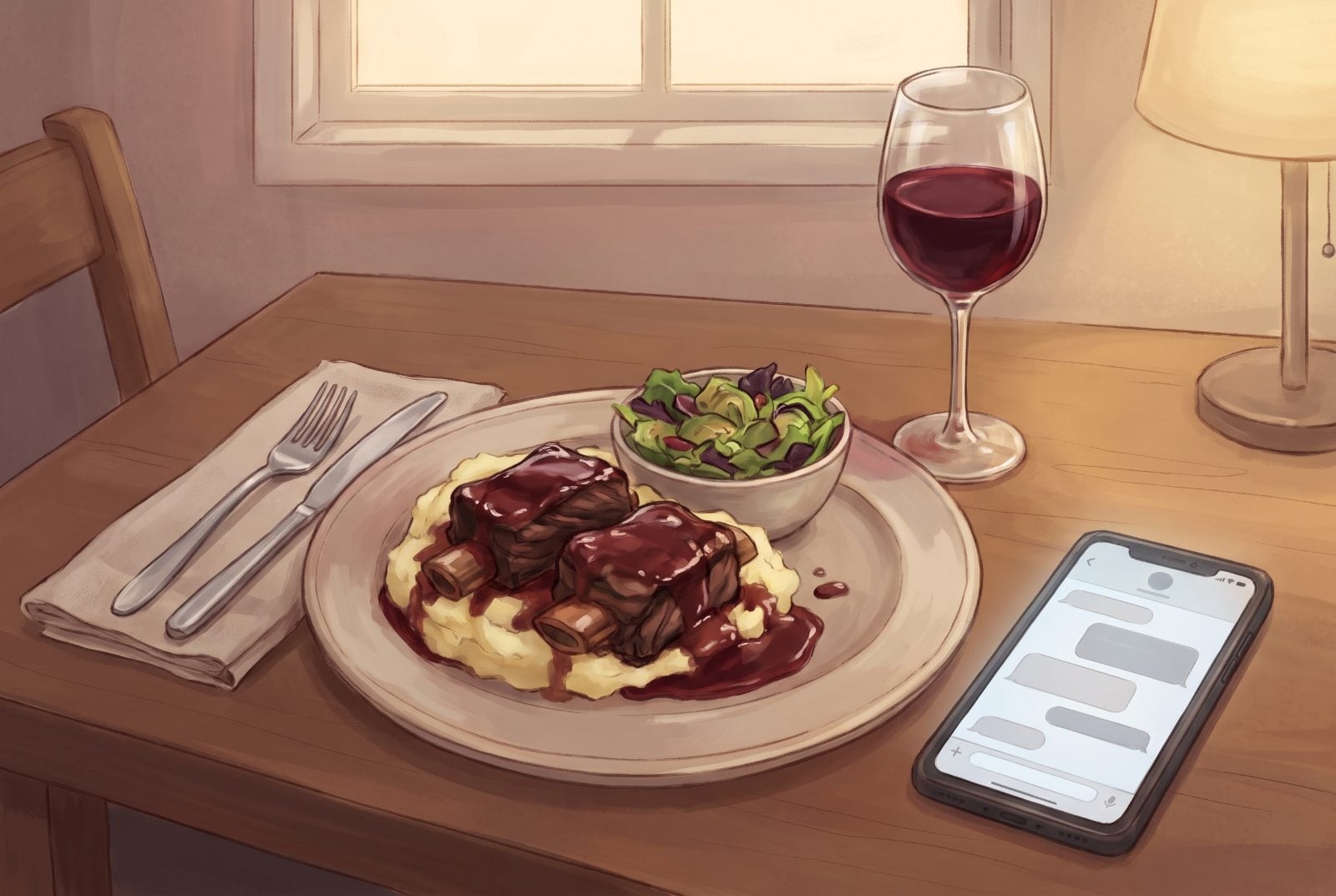
Short ribs. You started them at three. Browned in batches, onions softened, wine reduced, into the oven low and slow. Mashed potatoes by hand because the ricer broke. A salad with the dressing you finally got right.
Please note that some of the images in this article were created with the assistance of AI.
You plate it. You sit down. Your spouse takes a bite, says “mm, good,” and then takes a photo.
You assume it’s for Instagram. It isn’t.
A few minutes later, scrolling, they say it brightly, like they’re sharing a fun fact: “I asked ChatGPT how to make this even better. It says a gremolata on top would cut the richness. And you could brown the meat in smaller batches for a deeper crust.”
You did brown it in smaller batches. For forty minutes.
You put your fork down. Something in your chest goes very still.
If you’ve felt that, you’re not being oversensitive. And your spouse probably isn’t a monster either. Two different things are happening at that table, and only one of them is about short ribs.
Dinner isn't just dinner
A home-cooked meal is food, but it’s also time, planning, and a small daily act of looking after someone. Most people who cook for a family know that, even if they’d never say it out loud.
By the numbers
The time adds up, and it doesn’t fall evenly. In the U.S. government’s American Time Use Survey for 2025, women averaged about 55 minutes a day on food preparation and cleanup, and men about 31.1 That’s an average across everyone aged 15 and over, including people who didn’t cook at all that day. In plenty of homes the split is very different, in either direction. But for a lot of households, one person carries most of the cooking.
So when that person puts three hours on a plate, what they’re hoping to hear back isn’t a review. It’s closer to I see what you did for me.
What the research says about being appreciated
Psychologists Amie Gordon, Emily Impett and colleagues published a series of studies in 2012 on gratitude between romantic partners. Their title was “To Have and to Hold.” They found that:2
The appreciation loop
- People who felt appreciated by their partners tended to be more appreciative of their partners in return.
- People who were more appreciative were more responsive to their partner’s needs.
- Appreciation predicted stronger commitment and a greater chance of still being together later on.
- In the lab, outside observers rated appreciative partners as more responsive and committed. That seemed to be one way appreciation passed from one person to the other.2
In plain terms, appreciation works like a loop. When you feel seen, you’re more likely to see your partner, and they’re more likely to see you back.
Now look at what happened at the table. The cook was waiting for appreciation and got a list of improvements instead. The loop didn’t just fail to start. Something went the other way.
What Our Readers Say
- When Piaci Pizza readers loved a food photo and tapped a reason, the top answer was comfort, ahead of ingredients or simply looking good.
- Photos showing cooking in progress got more hearts from our readers than the other images in the same articles, 86% versus 79%.
From Piaci Pizza reader polls and votes.
Advice nobody asked for, delivered by a robot
The problem isn’t the advice. It’s that nobody asked for it.
The gremolata idea might even be good. That’s what makes this so frustrating. The problem isn’t the advice. It’s that nobody asked for it.
People distrust advice they didn't ask for
In a 2021 paper in the Journal of Applied Psychology, researchers Blaine Landis, Colin Fisher and Jochen Menges studied nearly 900 workers across three studies. People trusted advice they had asked for and assumed the adviser meant well. Advice they hadn’t asked for, they distrusted, and they tended to assume the adviser had self-serving motives.3
The surprising part was that being friends didn’t fix it. None of the factors they tested, including friendship and shared contacts, reduced the suspicion.3 Those studies were done in workplaces, not kitchens, so treat this as a pattern rather than a rule for marriages. But anyone who has been “helped” at the stove will recognize it.
Giving advice makes the giver feel powerful
A 2018 paper by Michael Schaerer and colleagues found something less flattering about the people who give advice. Across four studies, giving advice raised the adviser’s sense of power, and it did so whether or not the advice had been requested. In two of the studies, people who wanted more power also tended to give more advice.4
That doesn’t mean your spouse is on a power trip. Most aren’t. It may help explain why unrequested tips can feel like someone quietly taking the head of the table.
And the AI makes it worse, in two ways
First, it’s outsourced. Your spouse didn’t taste the dish and offer a thought. They handed your cooking to a third party for grading, at the dinner table. Even a fair critique hits differently when it’s run past an outside judge.
Second, the AI answered the question it was given. “How can I make this better?” assumes the dish needs improving. Chatbots tend to work with the framing they’re handed. A 2026 Stanford study in Science found leading AI models sided with users about 49% more often than humans did when giving personal advice.5 Ask a chatbot how to improve something and it will almost always come up with improvements. That doesn’t mean the dish needed any.
Was it thoughtless, or something more?

Most of the time, this is a clumsy moment and not a sign of something worse. But not always.
The generous reading. Your spouse enjoys food and gadgets, and thought it was interesting. They genuinely liked dinner, and “how could this be even better?” felt like a compliment to them, like saying the dish was worth leveling up. They had no idea the forty minutes of browning had already happened, because they weren’t in the kitchen. They didn’t mean to grade you. They meant to join in.
The less generous reading. This is a pattern. Nothing you make is quite finished in their eyes. There’s always a tweak, a better way, a “next time.” The AI isn’t the problem. It’s just the newest tool for a habit that was already there.
A quick self-check
Tick what honestly applies. Then look at which list fills up.
Probably just clumsy
- ☐ They thanked you or said it was good before the AI came out
- ☐ They’re curious about food in general and ask AI about everything
- ☐ They also cook sometimes, and you swap tips both ways
- ☐ When you told them it stung, they got it quickly
- ☐ This is the first time it’s happened
Possibly a pattern
- ☐ You can’t remember the last meal they praised without a “but”
- ☐ They rarely cook, but often critique
- ☐ The tips come in front of other people
- ☐ When you push back, they say you’re “too sensitive”
- ☐ You’ve started dreading their first bite
If the second list sounds familiar, the conversation you need isn’t about gremolata. It’s about how you’re treated when you put effort into something for them.
What to say next
If you're the cook
You don’t have to swallow it, and you don’t have to throw the short ribs. Some options, from mild to direct:
What you can say
- In the moment, lightly: “I’ll take the gremolata idea. Right now I’d just love to hear what you liked.”
- Later, plainly: “When you asked ChatGPT to fix dinner while we were eating it, it felt like I was being graded. I’m happy to get ideas. Just not at the table, and not instead of a thank-you.”
- Set a simple rule: Feedback is welcome when you ask for it. “Any thoughts for next time?” makes it advice you requested, and that kind is much easier to hear.
That last one is worth taking seriously. Remember the workplace research: advice people ask for is trusted, and advice they don’t ask for is suspected.3 You can use that. Ask, now and then, on your own terms. It puts you back in charge of your own kitchen.
If you're the one who asked the AI
A few things that will help more than any gremolata:
- Thank first, and be specific. “The crust on these is amazing” beats “mm, good.” Specific praise shows you noticed the work.
- Never critique a meal while you’re eating it. Save ideas for another day, and only if the cook seems interested.
- Ask before you advise. “Want to play around with this next time?” invites them in. A list of fixes shuts them out.
- Keep the phone face down at dinner. The photo-then-prompt routine says the meal is content to analyze. It should be a moment you’re sharing.
- Cook something yourself. Nothing builds respect for three hours of short ribs like spending three hours making them.
If you both love food tech

Some couples really enjoy this, and that’s great. Make it a shared game rather than a verdict. Cook something together, ask the AI for a twist, try it, and judge the AI’s idea instead of each other’s cooking. Same tools, very different feeling.
The dish was never the point
A chatbot can tell you how to make short ribs better. It can’t tell you that the person across the table spent the afternoon on them, for you, because they wanted dinner to feel like something.
Look up, say thank you, and say what you loved.
The best response to a meal someone made for you is still the oldest one. Look up, say thank you, and say what you loved. Save the gremolata for next week.
Has this happened at your table? Did you say something, or let it go?
Notes
- U.S. Bureau of Labor Statistics (2026). “Average hours per day spent in selected household activities, 2025 annual averages” (food preparation and cleanup: women 0.91 hours, men 0.51 hours; persons 15 and over). American Time Use Survey. https://www.bls.gov/charts/american-time-use/activity-by-hldh.htm. ↩
- Gordon, A. M., Impett, E. A., Kogan, A., Oveis, C., & Keltner, D. (2012). “To have and to hold: Gratitude promotes relationship maintenance in intimate bonds.” Journal of Personality and Social Psychology, 103(2), 257 to 274. https://doi.org/10.1037/a0028723. ↩
- Landis, B., Fisher, C. M., & Menges, J. I. (2021, online; print 2022). “How employees react to unsolicited and solicited advice in the workplace: Implications for using advice, learning, and performance.” Journal of Applied Psychology, 107(3), 408 to 424. https://doi.org/10.1037/apl0000876. Summary: Cambridge Judge Business School. ↩
- Schaerer, M., Tost, L. P., Huang, L., Gino, F., & Larrick, R. (2018). “Advice Giving: A Subtle Pathway to Power.” Personality and Social Psychology Bulletin, 44(5), 746 to 761. https://doi.org/10.1177/0146167217746341. Summary: INSEAD Knowledge. ↩
- Cheng, M., Lee, C., Khadpe, P., Yu, S., Han, D., & Jurafsky, D. (2026). “Sycophantic AI decreases prosocial intentions and promotes dependence.” Science, 391(6792), eaec8352. https://doi.org/10.1126/science.aec8352. Summary: Stanford Report, "AI overly affirms users asking for personal advice". ↩