
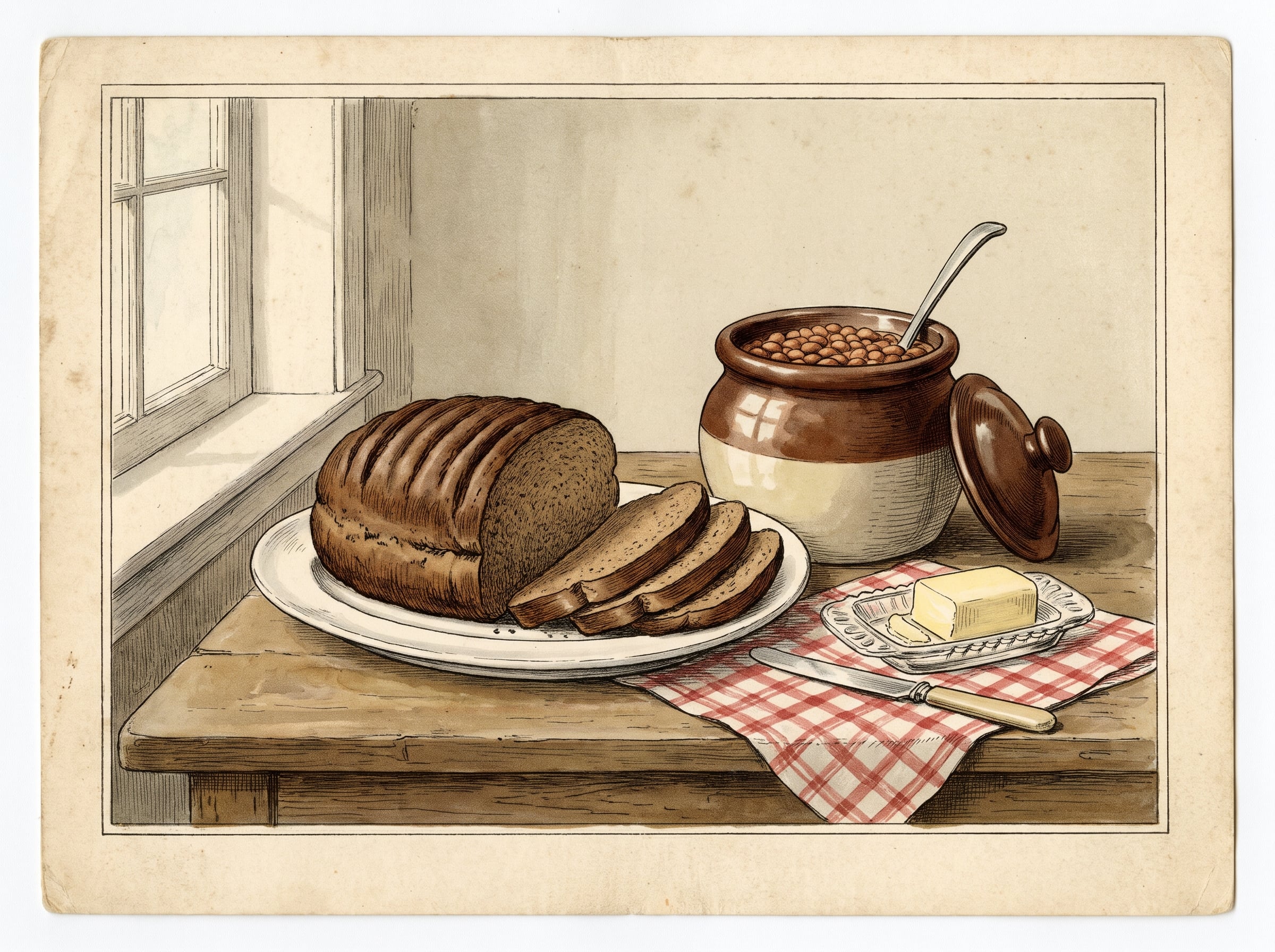
Fannie Farmer’s Boston Brown Bread rises in a tin with its lid tied down, so the loaf can’t push the cover off. Her book says a five-pound lard pail will do for the tin. Behind that practical advice is a bread nearly as old as New England, set down in this 1905 printing in the exact, level-spoon language that made Farmer famous.
Please note that some of the images in this article were created with the assistance of AI.
From The Boston Cooking-School Cook Book, 1905
The Story Behind This Recipe
Miss Farmer and her level cup
Fannie Merritt Farmer was born in Boston in 1857. At sixteen, while she was a student at Medford High School, a paralytic stroke left her unable to walk for several years. She spent that time learning to cook, and her mother’s boarding house became known for its meals. At thirty she enrolled in the Boston Cooking School. She graduated in 1889, stayed on as the director’s assistant, and was running the place as principal by 1891.
Her Boston Cooking-School Cook Book appeared in 1896. Little, Brown had so little faith in it that the first edition was capped at 3,000 copies, paid for by the author. Those copies became the start of the book generations of cooks simply called ‘Fannie Farmer.’ By this 1905 printing she had left the school to open Miss Farmer’s School of Cookery, and the book had grown by four hundred extra recipes. Her preface hoped readers would see it as more than a pile of reliable recipes, and would come away curious about the science of eating. The rule that did the most work was a simple one: a cupful is measured level.
From Ryaninjun to a bread in a tin
The first New England colonists found rye and Indian corn far easier to grow than wheat, so their everyday loaf was ‘Rye and Indian.’ People said it fast enough that it came out as Ryaninjun. That bread was yeasted and baked right on the oven floor. In the earliest printed recipes, from 1829 on, it went by ‘brown bread’ just as often. By the mid-1800s wheat bread was easier to come by, and the old loaf turned into something people missed. Cooks poured the rye-and-cornmeal batter into a tin pudding container in place of a cloth pudding bag, and steamed Boston Brown Bread was born. Outside New England it carried the city’s name. At home it was just brown bread.
Farmer printed both versions. A yeasted ‘Third Bread’ of rye, cornmeal and white flour sits one page before this steamed, soda-raised one. Brown bread also had a regular partner. The Puritans are said to have kept the Sabbath free of work by baking beans for Saturday supper and serving them with brown bread. Historians argue over parts of that story, but Bostonians still serve the two together. Farmer’s own bean recipe even mentions good beans cooked in a five-pound lard pail after the bean-pot broke.
A kitchen in the middle of a change
Several details in this recipe point to a kitchen that was changing. ‘Soda’ meant bicarbonate of soda. Sour milk was simply milk that had gone off on its own, and Farmer explains that a germ floating in the air turns some of the milk sugar into lactic acid. That acid, along with the molasses, makes the soda give off gas, faster than cream of tartar would. That is why the lid gets tied down. Her moulds came off the pantry shelf: empty baking-powder boxes, the same tins she suggests for packing leftover breakfast mush to slice and fry. A melon mould was the dressier choice.
Three and a half hours of steaming was no trouble on a coal range, where a kettle could sit for hours and be topped up with boiling water. Measuring that ¾ tablespoon of soda meant leveling the spoon, splitting it lengthwise, then crosswise. Nothing went to waste afterward. The 1905 book turns leftover brown bread into milk toast, sandwiches, brewis softened in milk and water, and even ice cream.
1900s
Notes From the Era
The recipe · 1905
Boston Brown Bread
From The Boston Cooking-School Cook Book by Fannie Merritt Farmer (1905). Every word of the recipe below is as printed.
Ingredients
- 1 cup rye-meal.
- 1 cup granulated corn-meal.
- 1 cup Graham flour.
- ¾ tablespoon soda.
- 1 teaspoon salt.
- ¾ cup molasses.
- 2 cups sour milk, or 1¾ cups sweet milk or water.
- Old baking-powder boxes and lard pails weren’t made for steaming food today, so steam it in a food-safe pudding mould or a clean, unlined metal can.
- Today’s pasteurized milk spoils rather than souring the old-fashioned way, so use cultured buttermilk where the recipe says sour milk.
Method
-
Mix the batter and steam
Mix and sift dry ingredients, add molasses and milk, stir until well mixed, turn into a well-buttered mould, and steam three and one-half hours.
-
Butter and tie down the cover
The cover should be buttered before being placed on mould, and then tied down with string; otherwise the bread in rising might force off cover. Mould should never be filled more than two-thirds full.
-
Choose a mould
A melon-mould or one-pound baking-powder boxes make the most attractive-shaped loaves, but a five-pound lard pail answers the purpose.
-
Set up the steamer
For steaming, place mould on a trivet in kettle containing boiling water, allowing water to come half-way up around mould, cover closely, and steam, adding, as needed, more boiling water.
Our notes
Reading It Today
Soda, sour milk and that ¾ tablespoon. ‘Soda’ is baking soda (bicarbonate of soda), not baking powder. A level ¾ tablespoon equals 2¼ teaspoons. Sour milk supplies the acid that makes the soda work. Buttermilk is the usual stand-in today. Her ‘sweet milk or water’ option relies on the molasses alone for acid.
Three coarse meals. Rye meal is coarser than ordinary rye flour. ‘Granulated’ corn-meal means a gritty, granular cornmeal. Graham flour is a coarse whole-wheat flour. Farmer warned elsewhere that Graham flour could be padded with coarse bran, which is worth keeping in mind at the sifting step. All three are measured level, the way she insisted.
What to expect from the loaf. Judging by the ingredients, we’d expect this to be dark, dense and moist, with a coarse crumb. It should taste of molasses and grain, with a slight tang from the sour milk. Because it is steamed in a closed tin rather than baked, it should have no crisp crust. Expect something closer to a pudding than a sandwich loaf.
How it differs from bread today. There is no yeast, no white flour, no kneading and no oven. The batter is just stirred, poured into a buttered mould no more than two-thirds full, and steamed in a covered pot. The water should come halfway up the mould. Farmer thought a melon mould or one-pound baking-powder boxes made the most attractive-shaped loaves.
Source: Fannie Merritt Farmer, The Boston Cooking-School Cook Book (Little, Brown, and Company, Boston, 1905), p. 60. Read the 1905 book at the Internet Archive.
Sources for the history
- Fannie Merritt Farmer, The Boston Cooking-School Cook Book (Little, Brown, 1905), p. 60 — Internet Archive scan (Library of Congress)
- Farmer, The Boston Cooking-School Cook Book (1905), full text — measuring
- Farmer, The Boston Cooking-School Cook Book (1905), full text — soda and acids
- Farmer, The Boston Cooking-School Cook Book (1905), full text — Boston Baked Beans
- Farmer, The Boston Cooking-School Cook Book (1905), full text — preface
- Farmer, The Boston Cooking-School Cook Book (1905), full text — stoves
- Fannie Farmer — Wikipedia
- Fannie Farmer — Freedom’s Way National Heritage Area
- The Food Timeline: history notes — bread (Boston brown bread; Rye & Indian)
- New England Historical Society, A Brief, Mostly Nonmusical History of Baked Beans
The original recipe text is from a work published in 1905 and is in the public domain in the United States. The history, notes and illustrations are Piaci Pizza’s own. Brand names that appear in historic recipes are mentioned as historical fact only. Illustrations are AI-generated in a vintage style. The recipe is shown exactly as it was published in 1905; we have not photographed a test batch.