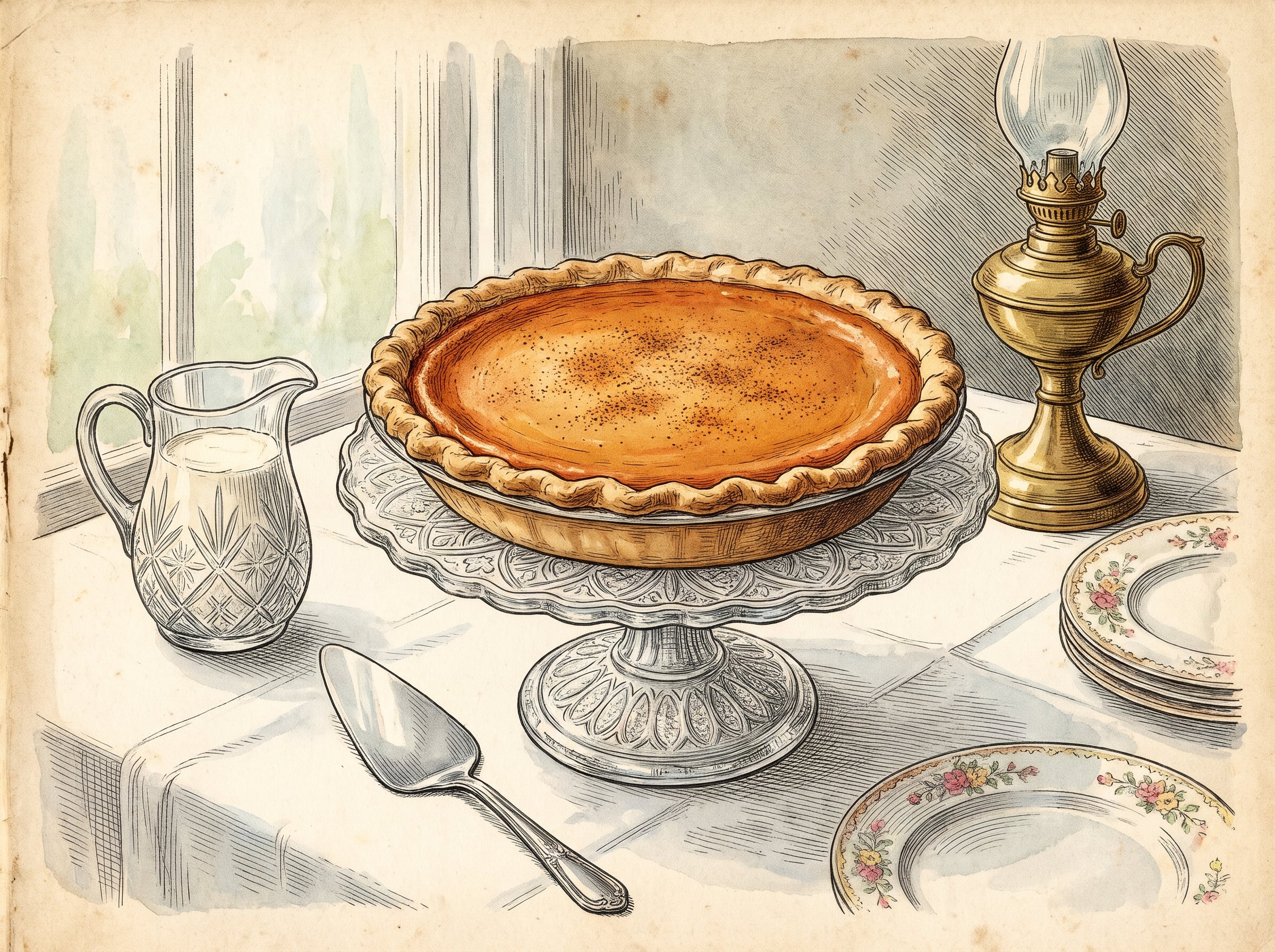
The recipe for this sweet potato pie runs only a few lines, and it closes with a single word of approval: "Fine." It comes from a Chicago cookbook with "White House" in its title and remarkably little White House between its covers. The pie has a longer and deeper story, and that story starts in Southern kitchens.
Please note that some of the images in this article were created with the assistance of AI.
From The White House Cook Book, 1887
The Story Behind This Recipe
A White House book with very little White House in it
Fanny Lemira Gillette was in her late fifties when The White House Cook Book came out in Chicago in 1887, which makes her a late bloomer by any measure. Born in 1828, she went on to publish more cookbooks and lived to 98. Her book’s title suggested the presidential kitchen. What it delivered was a sturdy household manual and guide to practical housekeeping. The food historian Juneisy Hawkins went looking for the White House inside it and found little beyond some pictures of First Ladies and a dedication to them. None of them wrote a word of it. In modern terms, she says, the title is clickbait.
The co-author named in this edition, Hugo Ziemann, did have a real White House job. As steward, he greeted the guests and visitors who came to see the president, and the publisher’s preface adds that he had once catered for "that Prince Napoleon." Hawkins notes that he was added as a contributor in later editions and that his part covered etiquette, seating and the order of service, not recipes. Readers didn’t seem to mind. By the early 1900s the book was a favorite gift for newly married women, and new editions were still appearing in 1996.
A Southern pie with deep roots
Baking a creamy vegetable filling into a crust is an old idea, and cooks in medieval Europe were already doing it. This particular pie, though, belongs to the American South, where it shows up from the early colonial years. The sweet potato is native to the Americas, and Native American cooks were using it long before anyone put it in pastry. The pie brings European pie-making to an American vegetable.
The Jim Crow Museum at Ferris State University tells the rest. Enslaved Africans brought to the South found in the sweet potato something close to the yams, cassava and plantains of West and Central African cooking. Working from memory and skill, enslaved cooks turned it into puddings, mashes and baked desserts, and those grew into the pie we know. Practical reasons helped too. Sweet potatoes thrived in the Southern climate and were easier to raise, store and cook than the sugar pumpkins European settlers preferred.
Sugar, cream and one word of praise
When sweet potato pie first appeared in printed cookbooks in the 1700s, it was filed with the savory vegetable dishes. By the 1800s it was more often treated as dessert, and this recipe leaves no doubt about which side it is on: two cups of sugar for a pound of potatoes, plus a cup of cream and half a cup of butter. It gives no oven temperature and no baking time, just "bake in pastry shell," trusting that every reader already knew how to bake a pie. Then comes the verdict: "Fine."
Its place in a Chicago household manual shows how far the dish had spread by the 1880s from the Southern kitchens where it began, much of that cooking done by enslaved Black cooks. Today it holds the holiday spot in the South that pumpkin pie holds elsewhere. The Jim Crow Museum points out that pumpkin was tied to Northern European cooking and white American holiday customs. As pumpkin pie became the national symbol of Thanksgiving, sweet potato pie stayed at the center of Black Sunday dinners, holidays and community gatherings, with family recipes handed down as heirlooms.
1880s
What Our Readers Say
- When Piaci Pizza readers loved a food photo and tapped a reason, comfort came out on top at 30%, with nostalgia picked 16% of the time.
From Piaci Pizza reader polls and votes.
Notes From the Era
The recipe · 1887
Sweet Potato Pie
From The White House Cook Book by F. L. Gillette and Hugo Ziemann (1887). Every word of the recipe below is as printed.
Ingredients
- One pound of steamed sweet potatoes finely mashed
- two cups sugar
- one cup cream
- one-half cup butter
- three well-beaten eggs
- lemon or nutmeg
- pastry shell
- Bake until the egg-and-cream filling is set in the center (160°F / 71°C), and refrigerate the pie once it has cooled.
Method
-
Mix the filling and bake in a pastry shell
One pound of steamed sweet potatoes finely mashed,-two cups sugar, one cup cream, one-half cup butter, three well-beaten eggs, flavor with lemon or nutmeg and bake in pastry shell. Fine.
Our notes
Reading It Today
A pound, then cups. The potatoes are measured by weight. One pound is about 450 grams, weighed after steaming and mashing. Everything else is in cups, and the half cup of butter is one standard stick (8 tablespoons). The eggs are simply counted and "well-beaten," meaning beaten thoroughly until smooth and even.
"Bake in pastry shell". This suggests a single open crust with no top, which is still the usual way to make this pie. The recipe gives no temperature or time, because 1887 readers were expected to know how to bake a custard-style pie. A modern cook would fill that gap from familiar pie-baking practice.
What the filling would be like. Judging from the ingredients, it would be a smooth, rich custard. Finely mashed potato, cream, butter and eggs point to a silky texture, and two cups of sugar point to a very sweet pie. Lemon would give it a brighter flavor, while nutmeg would make it warmer and more familiar.
How it differs from today’s pie. Many modern sweet potato pies use evaporated milk and a blend of cinnamon, ginger and nutmeg. This one relies on fresh cream and butter for its richness and uses a single flavoring, so it is plainer in spice and fuller in dairy.
Source: F. L. Gillette and Hugo Ziemann, The White House Cook Book (Chicago, 1887). Read the 1887 book at Project Gutenberg.
Sources for the history
- The White House Cook Book, F. L. Gillette and Hugo Ziemann (Chicago, 1887), Project Gutenberg
- The White House Cook Book and The Struggles of Making Historical Recipes (Historical Foodways, Juneisy Hawkins)
- Sweet potato pie (Wikipedia)
- Sweet Potato Pie (Jim Crow Museum, Ferris State University)
- Pumpkin pie vs. sweet potato pie for Thanksgiving? Both are part of American history (KCUR / Harvest Public Media)
The original recipe text is from a work published in 1887 and is in the public domain in the United States. The history, notes and illustrations are Piaci Pizza’s own. Brand names that appear in historic recipes are mentioned as historical fact only. Illustrations are AI-generated in a vintage style. The recipe is shown exactly as it was published in 1887; we have not photographed a test batch.