
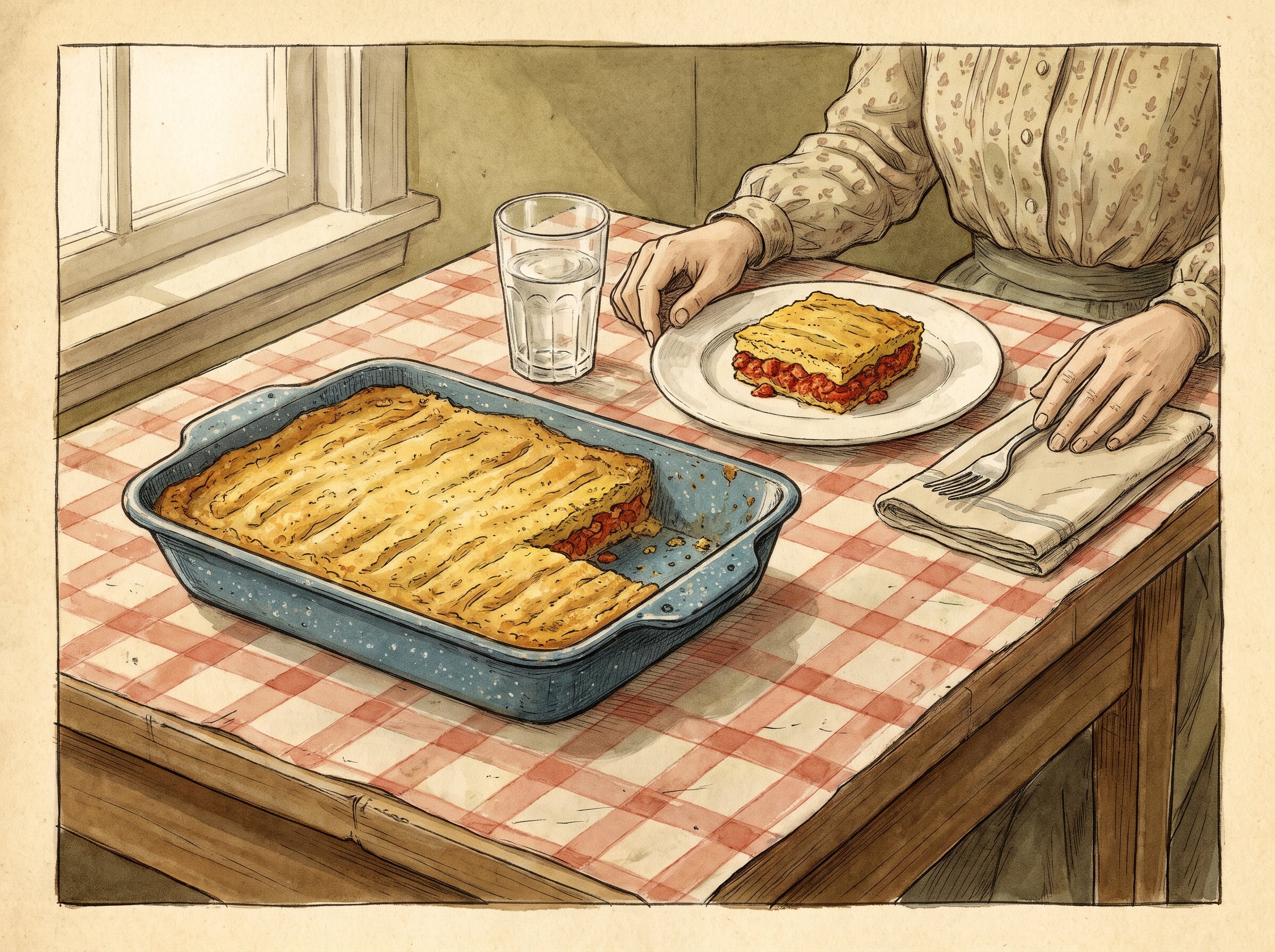
In 1918 a New York couple asked American housekeepers to make supper out of cornmeal, a little meat and a sense of national duty. Their tamale pie has no flour, no pastry and not much meat, and like every recipe in their book it carried the federal government’s approval. Here we follow how a street snack ended up in a wartime manual about saving wheat.
Please note that some of the images in this article were created with the assistance of AI.
From Foods That Will Win the War and How to Cook Them, 1918
The Story Behind This Recipe
The publisher and the cooking-school director
The scanned copy of Foods That Will Win the War and How to Cook Them in the Wellcome Library ends with two blank pages headed ‘Favorite family recipes.’ Whoever bought it was expected to keep using it and to add to it. The book came from a married couple. C. Houston Goudiss was born in Russia in 1880, arrived in New York as a boy in 1889 and grew up to run The Forecast Publishing Company. Alberta M. Goudiss was born in Philadelphia in 1876. She edited The Forecast and directed its School of Modern Cookery, which held free classes. They had married in 1902.
According to the book, the recipes were developed under Grace E. Frysinger, a domestic science graduate of Drexel Institute and the University of Chicago with nine years of teaching behind her. Every recipe was endorsed by the U.S. Food Administration, the agency Herbert Hoover had headed since August 1917. The magazine also knew a good bundle when it saw one: $1.50 bought a year’s subscription and a copy of the book.
A tamale without the wrapping
By the 1890s new railways had made Mexico an easy trip for American tourists, and tamales turned up on American streets, sold fresh or in cans. Wrapping and steaming each one is slow work. Tamale pie skips that step. You layer the parts in a dish and bake it. The dish is a U.S. invention, and it took a few tries to settle into shape. An 1899 cookbook from Austin, Texas, had a similar pot pie under a wheat-flour crust. A 1905 Los Angeles Times cookbook put cornmeal crusts above and below. Food historian Mark H. Zanger dates the first recipe actually called ‘tamale pie’ to 1911.
For its first few decades the standard version was seasoned beef or chicken between two layers of cornmeal mush. That is essentially what the Goudisses printed, though they left the choice of meat to the cook. The name always promised a little more than the dish delivered. Tamale pie never caught on in Mexican-American kitchens.
Corn for the Allies
The authors walked their readers through the arithmetic. The Allies wanted 450,000,000 bushels of wheat, the U.S. and Canada had about 300,000,000 to spare, and the gap would have to close in North American kitchens. By their reckoning, one wheatless meal a day in every family would save 90,000,000 bushels. Hoover mostly asked rather than ordered. Families signed pledge cards, and wheatless and meatless days soon followed.
That is why this pie appears in the ‘Save Wheat’ section, in a chapter called ‘The Use of Corn,’ between Indian pudding and eggless corn bread. The authors treated it as a corn dish first. Cornmeal makes the bottom, the top and most of the bulk, and two cups of meat are spread through the pan for flavor, as the meat chapter advised. A plainer tamale pie, with no onion or tomato, appears again near the back of the book under ‘All-in-one-dish Meals.’ Printing it twice suggests the authors saw it as an ordinary weeknight supper rather than a novelty.
1910s
Notes From the Era
The recipe · 1918
Tamale Pie
From Foods That Will Win the War and How to Cook Them by C. Houston Goudiss and Alberta M. Goudiss (1918). Every word of the recipe below is as printed.
Ingredients
- 2 cups cornmeal
- 5 cups water (boiling)
- 2 tablespoons fat
- 1 teaspoon salt
- 1 onion
- 2 cups tomatoes
- 2 cups cooked or raw meat cut in small pieces
- ¼ cup green peppers
Method
-
Cook the cornmeal mush
To the cornmeal and 1 teaspoon salt, add boiling water. Cook one-half hour.
-
Brown the onion and add the meat
Brown onion in fat, add meat.
-
Season the meat
Add salt, ⅛ teaspoon cayenne, the tomatoes and green peppers.
-
Layer the mush and meat
Grease baking dish, put in layer of cornmeal mush, add seasoned meat, and cover with mush.
-
Bake
Bake one-half hour.
Our notes
Reading It Today
"Fat" means drippings. ‘Brown onion in fat’ isn’t asking for butter. The book tells cooks, under Food Administration rules, to use drippings whenever fat is called for, and it explains how to render scraps of meat fat at home. Bacon or beef drippings would give the onion a savory, meaty start.
Thick mush, top and bottom. Two cups of cornmeal cooked for half an hour in five cups of water makes a stiff mush, much thicker than soft polenta. The way we read the recipe, it sets firm in the oven, so the ‘crust’ here is a dense corn layer. It is nothing like a pastry or a crisp cornbread lid.
Mild by modern standards. The only heat is ⅛ teaspoon of cayenne. The rest of the seasoning is onion, tomato and a quarter cup of green pepper. There’s no chili powder, cumin or cheese, so we’d expect a gentle, tomatoey filling. The corn is the main flavor, which matches where the book filed the recipe.
No oven setting, and what came later. ‘Bake one-half hour’ gives no temperature because many home ovens had no reliable dial. To check a bread oven, the book suggests putting a piece of paper on the center shelf. Later cooks changed the dish a good deal. They swapped in canned tomato soup in the 1920s, added olives, cheese and corn, and by the 1950s often topped it with cornmeal batter instead of mush.
Source: C. Houston Goudiss and Alberta M. Goudiss, Foods That Will Win the War and How to Cook Them (World Syndicate Company, New York, 1918), p. 19. Read the 1918 book at the Internet Archive.
Sources for the history
- Foods that will win the war and how to cook them (Internet Archive scan, Wellcome Library copy)
- Full text of "Foods that will win the war and how to cook them" (Internet Archive)
- Cooking with Rare Books: Stretching Food during WWI (Kennesaw State University, Bentley Rare Book Museum)
- Tamale pie (Wikipedia)
- Sow the Seeds of Victory! Posters from the Food Administration During World War I (U.S. National Archives)
The original recipe text is from a work published in 1918 and is in the public domain in the United States. The history, notes and illustrations are Piaci Pizza’s own. Brand names that appear in historic recipes are mentioned as historical fact only. Illustrations are AI-generated in a vintage style. The recipe is shown exactly as it was published in 1918; we have not photographed a test batch.