
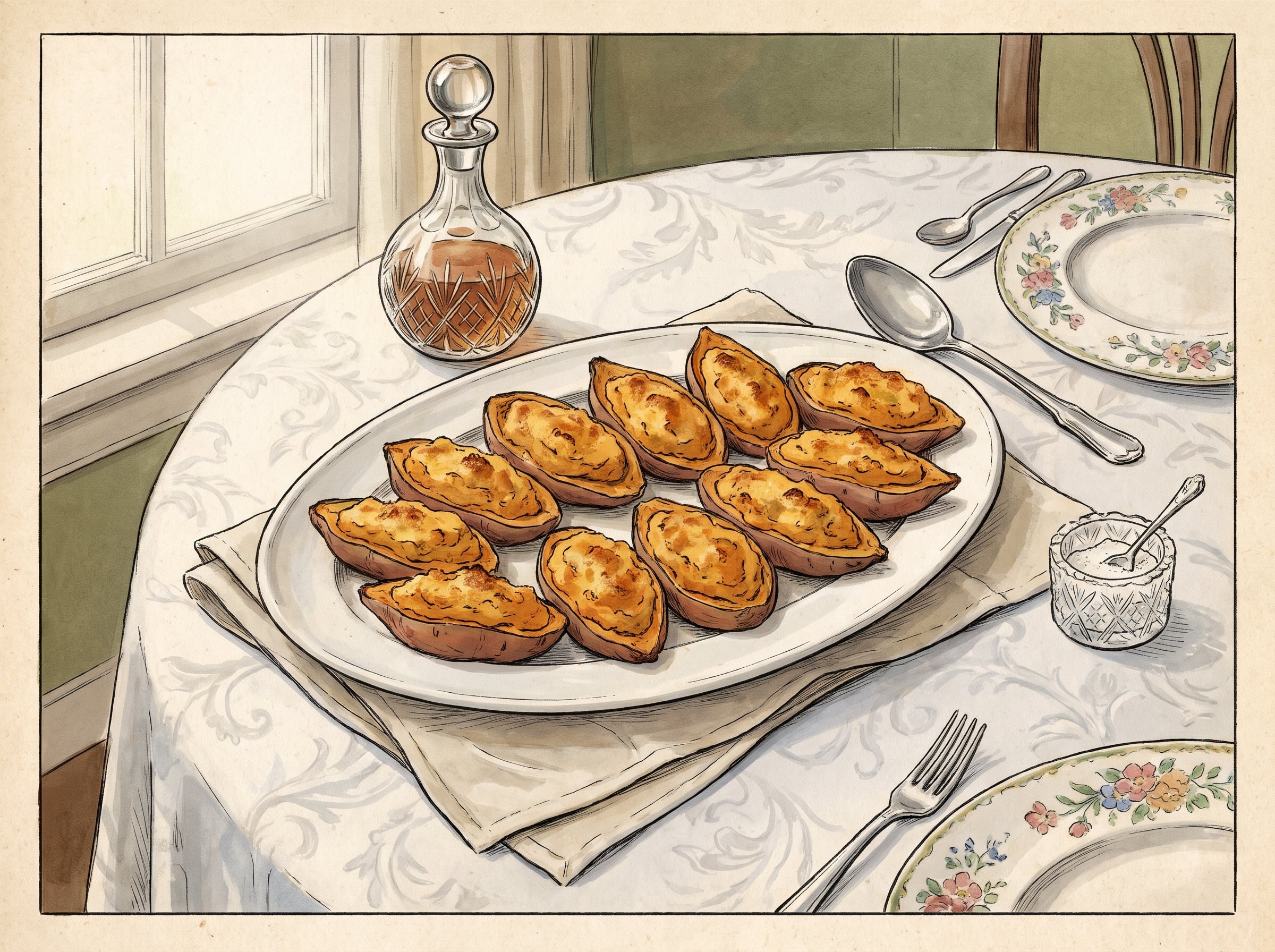
Tucked into the pages of a famous Boston cookbook is a four-sentence recipe that sends a warm-weather crop north with butter, cream and a splash of Sherry. Its author was Fannie Farmer, the woman who taught America to level off its spoons. Those few lines hold a stroke of bad luck, a gamble on self-publishing and a vegetable that traveled a very long way to reach a New England table.
Please note that some of the images in this article were created with the assistance of AI.
From The Boston Cooking-School Cook Book, 1910
The Story Behind This Recipe
Miss Farmer and her level spoons
Long before she was Boston’s best-known cook, Fannie Merritt Farmer was a high-school student whose education stopped cold. Born in Boston in 1857 and raised there and in Medford, she suffered a paralytic stroke as a teenager, and her formal schooling ended there. She recovered enough to work as a mother’s helper and discovered she had a gift for cooking and a real affection for it. Restaurant kitchens asked too much of her body, so she cooked for a family instead. Her employer, Mrs. Shaw, pushed her toward the Boston Cooking School, which trained working-class women to cook in middle- and upper-class homes. Farmer graduated in 1889, stayed on as assistant director and was running the place by 1894.
Her cookbook appeared in 1896, though not because publishers were eager for it. They hesitated, so Farmer paid for the first printing herself and held on to the copyright. All 3,000 copies sold quickly. The book treated cooking as serious, nearly scientific work, and its lasting gift was the level measurement. A Massachusetts history project credits it with popularizing the standard teaspoon, tablespoon and cup. Farmer went on to open her own school for housewives in 1902, lectured at Harvard Medical School, wrote a magazine column with her sister Cora Farmer Perkins for a decade, and kept lecturing from a wheelchair until shortly before her death in 1915. The 1910 edition holding this recipe was one she saw printed.
A Southern crop in a Boston book
The sweet potato had covered a lot of ground before it reached Farmer’s pages. It was domesticated thousands of years ago in tropical Central or South America, and Columbus is credited with carrying it to Spain around 1500. By 1648 it was growing in Virginia. From there it moved both north and south, but it flourished in the South, where the warm weather suited it. It became a staple for enslaved African Americans and poor white farmers, and Southern cooks baked sweet potato pie where Northern cooks reached for pumpkin. To a Boston reader, then, "Southern Style" pointed straight at a vegetable that belonged to warmer places.
Farmer’s version isn’t a pie at all. The potatoes bake whole, get split lengthwise and hollowed out, and the insides are mashed with butter and cream, seasoned with salt and Sherry, and spooned back into their skins for a quick second trip to the oven. Each diner gets a tidy little boat of their own.
Precise butter, trusted instincts
Here the "Mother of Level Measurements," as Mount Auburn Cemetery calls her, asks for exactly two tablespoons of butter. Then she turns the rest over to the cook. The cream goes in "to moisten," the salt and Sherry have no amounts, and the oven is simply "hot." Her book’s chapter on cookery explained cooking terms and even how to build a fire, a sign that many readers were managing the heat of their own stoves.
The dish also suits the kind of household the book imagined, one with chapters on formal entertaining, managing servants and etiquette. Farmer never ties it to a holiday, and sweet potatoes probably weren’t on the menu at the 1621 feast. Nobody knows when they joined the Thanksgiving table, though Sarah Josepha Hale, who campaigned for the national holiday and later published a sweet potato pie recipe, often gets a share of the credit. Still, butter, cream, Sherry and a refilled skin for every guest make a fine fit for a dressed-up dinner.
1910s
Notes From the Era
The recipe · 1910
What Our Readers Say
- When Piaci Pizza readers loved a food photo and tapped a reason, comfort was the top pick at 30%, and nostalgia accounted for another 16%.
From Piaci Pizza reader polls and votes.
Sweet Potatoes, Southern Style
From The Boston Cooking-School Cook Book by Fannie Merritt Farmer (1910). Every word of the recipe below is as printed.
Ingredients
- six medium-sized sweet potatoes
- two tablespoons butter
- cream to moisten
- salt
- Sherry wine
Method
-
Bake and scoop the potatoes
Bake six medium-sized sweet potatoes, remove from oven, cut in halves lengthwise, and scoop out inside.
-
Mash with butter and cream
Mash, add two tablespoons butter, and cream to moisten.
-
Season the filling
Season with salt and Sherry wine.
-
Refill and bake again
Refill skins and bake five minutes in a hot oven.
Our notes
Reading It Today
"Cream to moisten". Farmer gives no amount and doesn’t say heavy or light. The idea is to add it a little at a time until the mash turns soft and smooth but still holds its shape when piled back into the skins.
A "hot oven". Cooks of the time judged their oven heat rather than setting a dial. A "hot oven" is usually understood as roughly 400 to 450°F. The five minutes here only reheats the filling and lightly firms the top.
What it would be like. Judging from the ingredients, the filling would be rich and velvety, with the potato’s own sweetness out front. Salt keeps it savory, and Sherry adds a nutty, faintly winey note. With no sugar or spice, it reads more like a side dish than a dessert.
Not today’s casserole. Many modern holiday sweet potatoes come in one baking dish, topped with brown sugar, marshmallows or pecans. This recipe skips the added sugar entirely and serves each portion in its own skin, closer to a twice-baked potato than a sweet casserole.
Source: Fannie Merritt Farmer, The Boston Cooking-School Cook Book (Little, Brown, and Company, Boston, 1910). Read the 1910 book at Project Gutenberg.
Sources for the history
- The Boston Cooking-School Cook Book (1910), Fannie Merritt Farmer
- Fannie Farmer: Boston’s Cooking Icon (Boston Public Library)
- Fannie Farmer, Encyclopaedia Britannica
- Fannie Farmer Cookbook Published (Mass Moments, Mass Humanities)
- Fannie Merritt Farmer (1857-1915), Mount Auburn Cemetery
- How the sweet potato became a staple on Southern holiday tables (Dallas Morning News)
- Sweet potato a recent guest at Thanksgiving (Hannibal Courier-Post, University of Missouri Extension)
The original recipe text is from a work published in 1910 and is in the public domain in the United States. The history, notes and illustrations are Piaci Pizza’s own. Brand names that appear in historic recipes are mentioned as historical fact only. Illustrations are AI-generated in a vintage style. The recipe is shown exactly as it was published in 1910; we have not photographed a test batch.