This recipe has two ingredients, no temperatures, and a trick at the end: drop the slices into very hot fat and they puff up like little balloons. It was written down in 1889 by a chef who spent more than 25 years at Delmonico’s in New York, and who has since been mostly forgotten.
Please note that some of the images in this article were created with the assistance of AI.
From The Table: How to Buy Food, How to Cook It, and How to Serve It, 1889
The Story Behind This Recipe
The other chef at Delmonico’s
Delmonico’s started small. Italian-Swiss immigrants opened it in 1827 as a modest cafe and pastry shop, and it went on to become what is widely recognized as America’s first fine dining restaurant. Alessandro Filippini, a Swiss immigrant born in 1849, cooked in the Delmonico’s restaurants for more than 25 years.
History has not been generous to him. Most of the credit for the dishes that made Delmonico’s famous goes to the French chef Charles Ranhofer, and Filippini, who died in 1917, is now mostly forgotten. He did get one thing in first, though. In 1889 he published the very first Delmonico cookbook, The Table: How to Buy Food, How to Cook It, and How to Serve It, and this recipe comes from its pages.
A potato with a railway legend
Every famous dish needs an origin story, and pommes soufflées have a good one. The usual telling says they were discovered by accident in 1837, at the opening of a new railway line from Paris to Saint-Germain-en-Laye. The name usually attached to them is Jean-Louis-François Collinet, a French chef credited with several well-known inventions of the 1830s. Béarnaise sauce is one of them, which makes for a productive decade.
For all the ceremony, the French name only means "puffed potatoes." Underneath it is a kind of French fried potato, and the ingredient list could hardly be shorter: potatoes, and the fat they fry in. Everything else is technique.
Two fryings and a folded napkin
Filippini’s method is the same two-step routine cooks still use. Oval slices a quarter inch thick go into moderately hot fat for eight minutes. They come out to rest "for a few moments" and are then plunged into "boiling hot fat," where they "swell considerably." Modern descriptions put numbers on both stages: about 325 °F for the first frying and 375 °F for the second, once the slices have drained and cooled. Filippini gives no numbers at all. His readers judged the heat of the fat by experience.
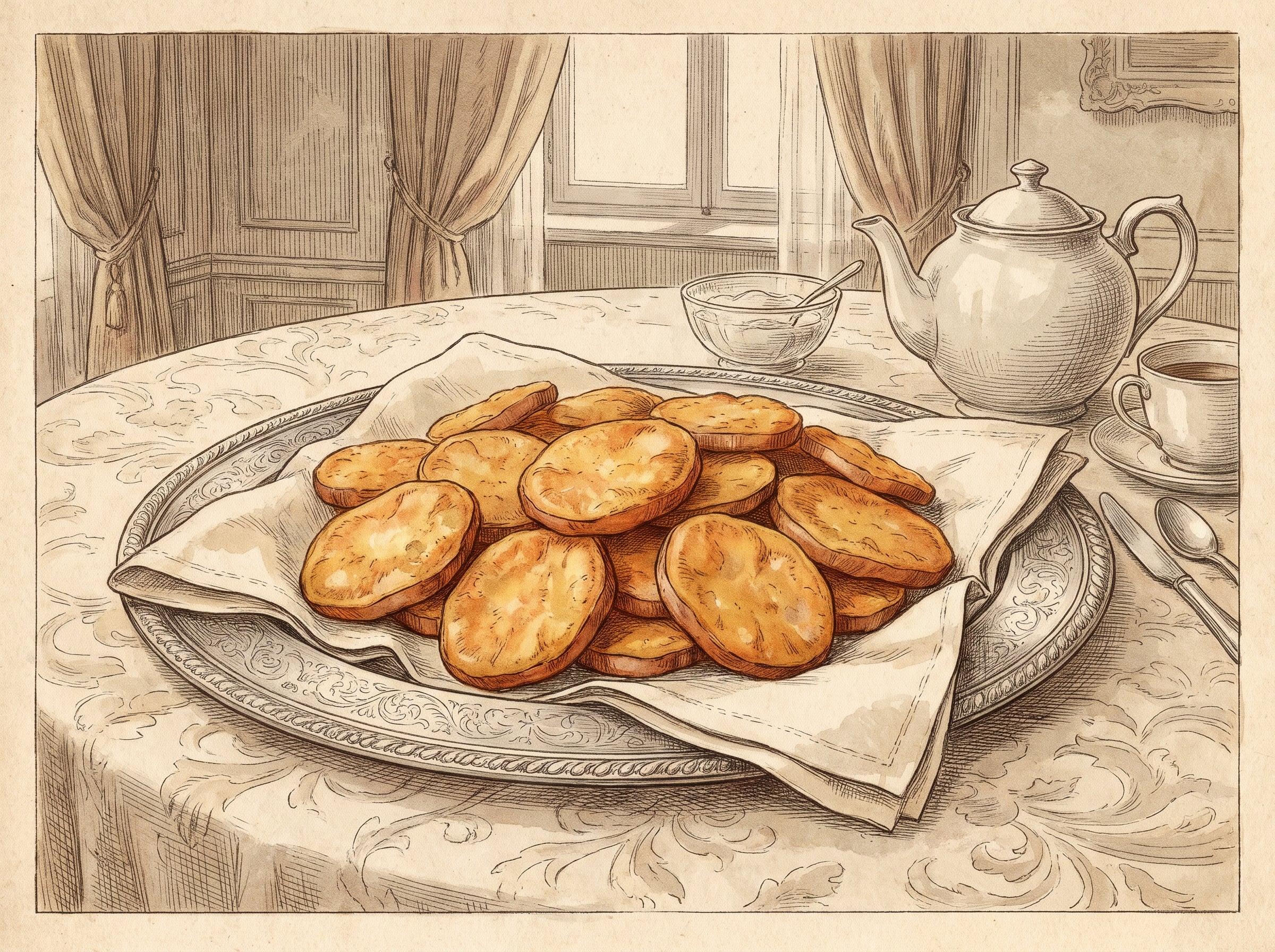
The potatoes’ last instruction is about presentation. They are drained and served "on a dish with a folded napkin." That fits the book’s long title, which promises to teach readers how to serve food as well as how to buy and cook it. Filippini was bringing a Delmonico’s chef’s methods, and his ideas about the table, into home kitchens. A final line adds that sweet potatoes can be done "the same way." We found no source tying this dish to holiday dinners, so we won’t call it a tradition. It is the kind of showpiece a cook might save for a special meal.
1880s
Notes From the Era
The recipe · 1889
What Our Readers Say
- When Piaci Pizza readers loved a food photo and tapped a reason, comfort topped the list at 30%, ahead of ingredients, good looks and nostalgia at 15%.
From Piaci Pizza reader polls and votes.
Potatoes Soufflées
From The Table: How to Buy Food, How to Cook It, and How to Serve It by Alessandro Filippini (1889). Every word of the recipe below is as printed.
Ingredients
- eight good, mealy potatoes
- fat
- Sweet potatoes
Method
-
Peel and cut the potatoes
Peel eight good, mealy potatoes, and cut them into even pieces a quarter of an inch in thickness, shaping them as oval as possible.
-
Fry twice to puff
Fry them in moderately heated fat for eight minutes; then lift them out, and lay them aside for a few moments; plunge them into boiling hot fat, and the potatoes will swell considerably.
-
Drain and serve
Drain, and serve them on a dish with a folded napkin.
-
Sweet potato variation
Sweet potatoes soufflées are prepared the same way.
Our notes
Reading It Today
Mealy potatoes. "Mealy" means floury, starchy potatoes that cook up dry and fluffy, such as russets. The opposite is waxy potatoes like red-skinned or new potatoes, which hold firm. Filippini asks for eight of them and gives no weight, so the size is up to the cook.
"Moderately heated" and "boiling hot" fat. These are the two frying temperatures, judged by eye. Modern versions call for about 325 °F (163 °C) for the first frying and 375 °F (190 °C) for the second. "Boiling hot" is an old way of saying very hot. Filippini doesn’t name the fat, but lard was a staple in American kitchens of his day.
The measurements that are there. The recipe gives only two exact numbers. Slices are a quarter of an inch thick, about 6 mm. The first frying lasts eight minutes. Shaping the slices "as oval as possible" changes how they look, not the amount of food.
The sweet potato version. Going by the ingredients, the sweet potato version would be crisp, golden slices with a natural sweetness and nothing added to them. That is very different from most sweet potato dishes today, which tend to be mashed, baked or candied with butter, brown sugar, spices or marshmallows. This one has no sugar, no butter and no seasoning in the recipe, only sweet potato and fat.
Source: Alessandro Filippini, The Table: How to Buy Food, How to Cook It, and How to Serve It (New York, 1889). Read the 1889 book at Project Gutenberg.
Sources for the history
- Alessandro Filippini, The Table: How to Buy Food, How to Cook It, and How to Serve It (New York, 1889)
- The Forgotten Chef at Delmonico’s: Alessandro Filippini (1849-1917), Digest: A Journal of Foodways and Culture
- Alessandro Filippini – CooksInfo
- The Delmonico Way – Culinary Historians of New York
- Pommes soufflées – Wikipedia
- Jean-Louis-François Collinet – Wikipedia
- Pommes Souffles – Facts and Trivia, FoodReference.com
- Lard: A Fat History – Conrad N. Hilton Library, Culinary Institute of America
The original recipe text is from a work published in 1889 and is in the public domain in the United States. The history, notes and illustrations are Piaci Pizza’s own. Brand names that appear in historic recipes are mentioned as historical fact only. Illustrations are AI-generated in a vintage style. The recipe is shown exactly as it was published in 1889; we have not photographed a test batch.