
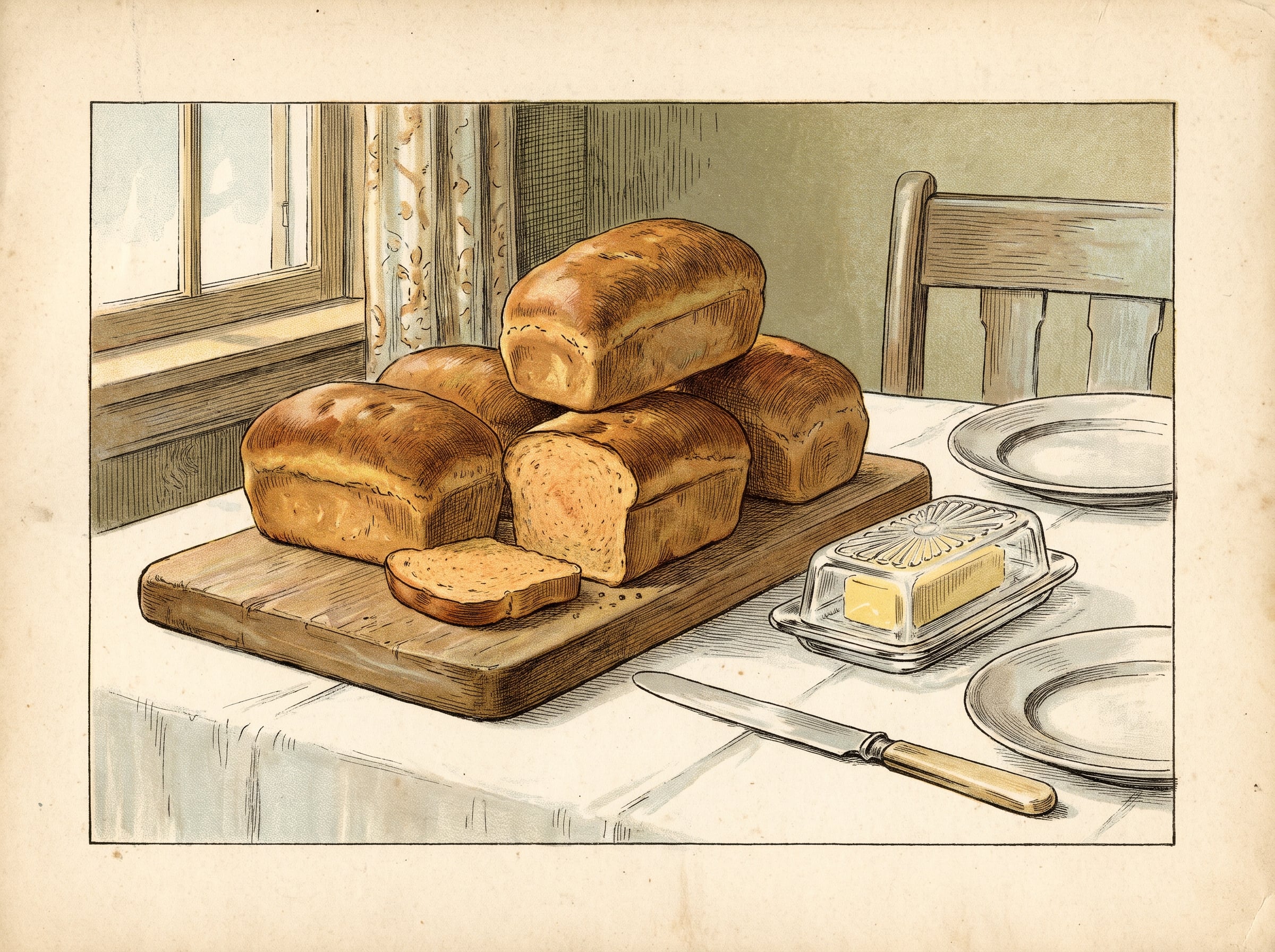
Marion Harland tucked two short sentences under this recipe, and they say more than most cookbook footnotes. One plants the loaf firmly in Virginia, and the other quietly offers readers elsewhere a way out. Between them sits a soft, lightly sweet bread built on roasted sweet potato and a kind of yeast that was still fairly new to home kitchens.
Please note that some of the images in this article were created with the assistance of AI.
From Marion Harland’s Complete Cook Book, 1906
The Story Behind This Recipe
The novelist who had to learn to cook
Few cookbook authors have a better origin story. Mary Virginia Hawes was born in 1830 into a merchant family in Amelia County, Virginia. She was taught by hired tutors and then, after the family moved to Richmond in the mid-1840s, at a Presbyterian girls’ school. Her first novel, Alone, was a hit the moment it appeared in 1854, and she would become famous under the pen name Marion Harland. Two years later she married a Presbyterian minister, Edward Payson Terhune, and in 1859 the couple settled in Newark, New Jersey.
That is where the novelist met the kitchen. Running a household for the first time, and finding it hard going, she decided that housewives deserved manuals that actually explained things. Common Sense in the Household came out in 1871, sold more than a million copies and stayed in print for half a century. More than seventy-five books and a newspaper column that ran more than eighteen years later, her name on a cover was its own recommendation. Her Complete Cook Book first appeared in 1903, and this recipe comes from a 1906 printing.
A Virginia recipe, by way of the tropics
The sweet potato took the long way to Virginia. It was domesticated thousands of years ago in tropical America and carried around the globe by European voyagers. It was being planted in what is now Virginia by 1648, and by the 1700s Native Americans in the region were growing it widely. Long, warm Southern summers suited it perfectly. It became a staple for enslaved African Americans and for poor white farmers.
So Harland’s note, "This is also a Virginia recipe," carries some weight. It also leaves a question open. Much of the cooking in nineteenth-century Virginia was done by Black cooks. Many were enslaved before the Civil War and later worked for wages in other people’s kitchens, and printed cookbooks rarely recorded their names. This bread comes out of that world, and our sources don’t tell us who first baked it. Her second note, that Irish potatoes will do, reads like a courtesy to readers outside the South.
One cake of yeast, one warm corner
The words "one cake of compressed yeast" would have puzzled a baker of the 1860s. America then had almost no commercial yeast business. Home bakers caught wild yeast from the air, traded starters or skimmed foam from brewing beer, and took their chances. In Cincinnati the Fleischmann brothers and James Gaff began making yeast and patented a compressed cake. Then the brothers showed off their Viennese breads at Philadelphia’s Centennial Exposition in 1876, and the name stuck in American kitchens. By 1906 Harland didn’t need to explain.
Other parts of the recipe still run on judgment. The milk is scalded, then cooled to "blood-warm," a temperature checked by touch rather than with a thermometer, in an era when fresh milk was worth asking for by name. Flour goes in until the dough feels soft, and the oven is simply "brisk." Even so, this is precise next to older Virginia recipes. An 1877 sweet potato pie asks for a "teacup of sweet milk." The cloth over the bowl and the warm spot for rising belong to the last stretch of home baking, before store-bought loaves took over much of the job in the early twentieth century.
1900s
What Our Readers Say
- When Piaci Pizza readers loved a food photo and told us why, comfort was the top reason, ahead of ingredients and nostalgia.
From Piaci Pizza reader polls and votes.
Notes From the Era
The recipe · 1906
Sweet Potato Bread
From Marion Harland’s Complete Cook Book by Marion Harland (1906). Every word of the recipe below is as printed.
Ingredients
- one cake of compressed yeast
- one-fourth cup of lukewarm water
- one cup of scalded milk (blood-warm)
- one tablespoonful of salt
- one-half cup of sugar
- one full cup of sweet potato, roasted, scraped from the skins
- three tablespoonfuls of melted butter
- flour to make a soft dough
Method
-
Mix the yeast, milk and sweet potato
Dissolve one cake of compressed yeast in one-fourth cup of lukewarm water, add one cup of scalded milk (blood-warm), one tablespoonful of salt, one-half cup of sugar and one full cup of sweet potato, roasted, scraped from the skins, worked to a cream with three tablespoonfuls of melted butter, then allowed to cool.
-
Beat and add the flour
Beat all together until light, and stir in with a wooden spoon flour to make a soft dough.
-
Let the dough rise
Throw a cloth over the bread-bowl and set in a warm place until well risen.
-
Shape, rise again and bake
Make into small loaves; let them rise for an hour, and bake in a brisk oven.
-
A note on the recipe
This is also a Virginia recipe. You may substitute Irish for sweet potatoes if you like.
Our notes
Reading It Today
A cake of compressed yeast. This is fresh yeast pressed into a small moist block. The standard modern equivalent of one 0.6-ounce cake is one packet (2¼ teaspoons) of active dry yeast. Fresh cake yeast is still sold in some stores.
Scalded, blood-warm and brisk. To scald milk is to heat it until it is just below a boil. "Blood-warm" means body temperature, about 98°F, so it should feel neither warm nor cool on the wrist. A "brisk" oven is a hot one. Modern readers usually take it to mean somewhere around 400°F.
"Irish" potatoes. Harland means ordinary white potatoes, which were often called Irish potatoes to tell them apart from sweet ones. Judging from the ingredients, the swap would give a paler, plainer loaf with less natural sweetness.
Not the sweet potato bread you may know. Today "sweet potato bread" usually means a quick bread raised with baking soda, spiced with cinnamon or nutmeg and often studded with nuts, closer to cake. This is a yeast dough enriched with milk, butter, sugar and roasted sweet potato and made into small loaves. From the ingredients, expect a soft, tender crumb, a golden tint and mild sweetness without spice. It is nearer a dinner roll than a dessert.
Source: Marion Harland, Marion Harland’s Complete Cook Book (The Bobbs-Merrill Company, Indianapolis, 1906). Read the 1906 book at Project Gutenberg.
Sources for the history
- Marion Harland, Marion Harland’s Complete Cook Book (Bobbs-Merrill, 1906), "Sweet potato bread"
- Marion Harland (1830–1922) – Encyclopedia Virginia
- Mary Virginia Hawes Terhune – Virginia Changemakers, Library of Virginia
- Marion Cabell Tyree and Mrs. T’s Sweet Potato Pie – Uncommonwealth, Library of Virginia
- A Brief History of the Sweet Potato – Baker Creek Heirloom Seeds
- How the sweet potato became a staple on Southern holiday tables – Dallas Morning News
- The Healing Power of Compressed Yeast – Science History Institute
- Our History – Fleischmann’s Yeast
The original recipe text is from a work published in 1906 and is in the public domain in the United States. The history, notes and illustrations are Piaci Pizza’s own. Brand names that appear in historic recipes are mentioned as historical fact only. Illustrations are AI-generated in a vintage style. The recipe is shown exactly as it was published in 1906; we have not photographed a test batch.