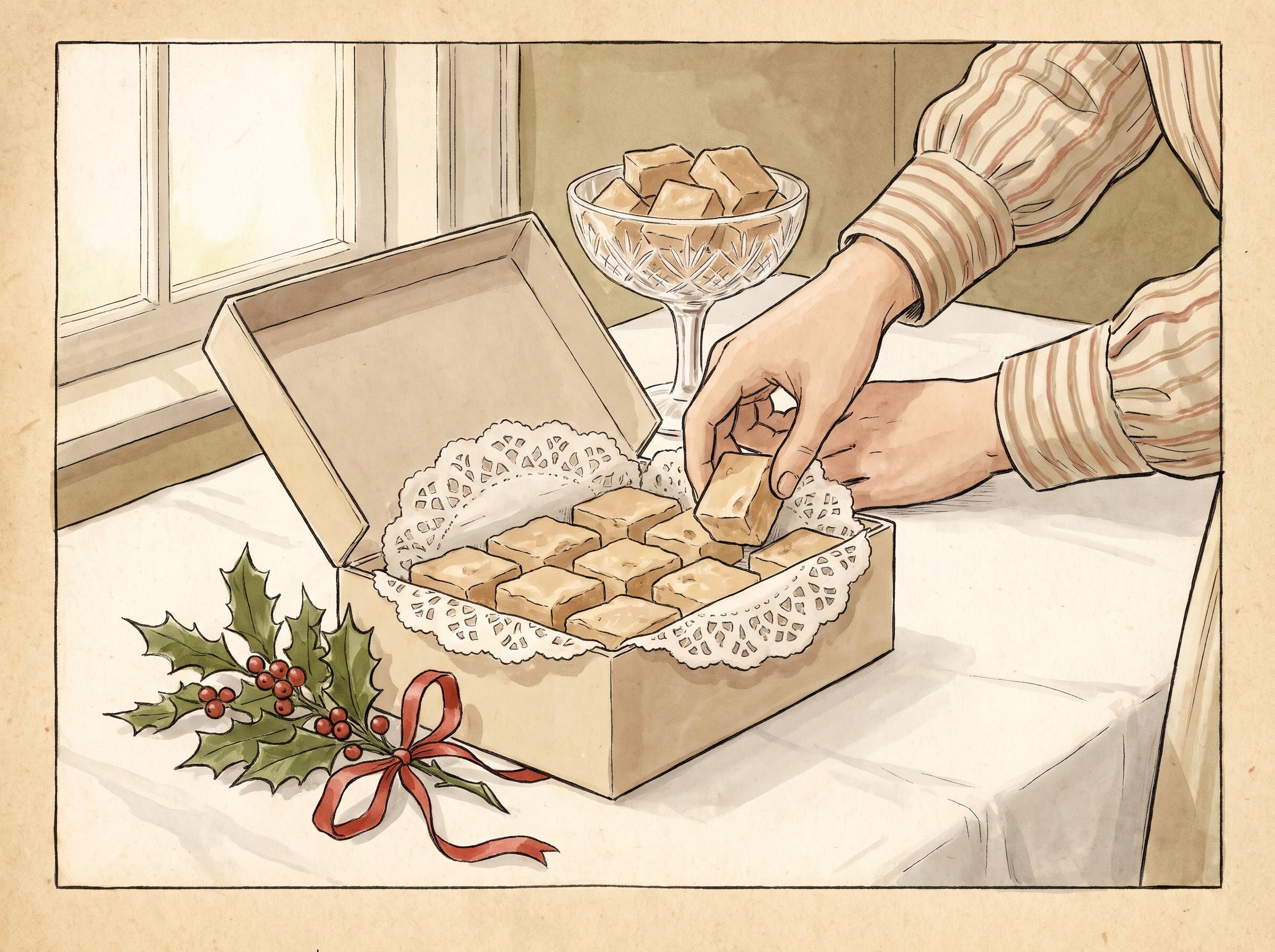
In 1915 divinity was such a new candy that cooks had not yet agreed on what went into it. Mary M. Wright’s version, from a little Philadelphia candy book, whips brown sugar, golden corn syrup and walnuts into two egg whites. The result would have come out tan, not the snowy white most of us picture.
Please note that some of the images in this article were created with the assistance of AI.
From Candy-Making at Home, 1915
The Story Behind This Recipe
Two hundred candies from a small book
Candy-Making at Home is small enough to tuck into a kitchen drawer: 188 pages, 15 centimeters tall. The Penn Publishing Company of Philadelphia brought it out in 1915. Its author was Mary Mason Wright, born in 1870, and her title page made a confident promise of ‘two hundred ways to make candy with home flavor and professional finish.’
Her opening pitch is practical. Most candies, she says, need nothing more than ordinary kitchen tools and a few extras, and homemade candy is ‘pure and clean’ while costing no more than the cheaper grades sold in shops. Then come the fudges, caramels, nut and fruit candies, fondant bonbons, taffies and egg-white ‘sea foams,’ with popcorn sweets, macaroons and little cakes at the back. Her Preserving and Pickling, for the same publisher in 1918, also advertised two hundred recipes.
A candy with a name but no birth certificate
Nobody knows who first called this candy ‘divinity.’ The usual explanation is that it tasted divine, which is hard to argue with. Food historians treat it as an American invention of the early 1900s and tie it to corn syrup. Karo, the best-known brand, arrived in 1902 from the Corn Products Refining Company, and the Food Timeline notes that divinity recipes in early Karo brochures were no coincidence.
The name settled before the recipe did. A 1905 Los Angeles Times cookbook printed a ‘Divinity Candy’ of syrup, milk and walnuts. In 1907 the New York Times described a ‘new Divinity Fudge’ made with milk and no eggs. By 1910 a reader writing to the Boston Daily Globe was already using the same basic method Wright prints: sugar, water and corn syrup boiled, poured over stiff egg whites, with walnuts beaten in. Fudge itself was a college-girl craze, and a Vassar recipe had reached print in 1896.
Brown, nutty and a little touchy
Wright’s divinity runs darker than the snow-white candy most of us picture. In 1917 a Chicago Tribune cooking columnist observed that many people made it with a colored corn syrup, though plain glucose gave a whiter candy. Wright also stirs her walnuts and vanilla into the hot syrup before it meets the egg whites. The other early egg-white versions quoted by the Food Timeline add the nuts afterward. Her own book shows the family resemblance. Her Nut Taffy starts with nearly the same syrup but gets pulled, and her Vanilla Sea Foam beats brown sugar syrup into egg whites without corn syrup and drops it from a spoon.
Corn syrup appears all through the book for a reason. Confectioners used glucose to stop sugar turning grainy, and Wright points out that corn syrup ‘is composed largely of glucose’ and was easy to buy at the grocery. Rigby’s Reliable Candy Teacher, a trade manual from around 1916, called it a ‘doctor’ for that same job. Wright put divinity to work elsewhere in the book, too: a Strawberry Divinity Fudge, a fruit-and-nut ‘Divinity Hash’ (‘a hash, but a delicious one’), and a suggested layer of divinity sandwiched between two layers of chocolate fudge. It was always a fussy candy, though. Bill Neal later quoted a community cookbook warning that it would not set unless the barometer read 30 inches or more.
1910s
Notes From the Era
The recipe · 1915
Divinity Fudge
From Candy-Making at Home by Mary M. Wright (1915). Every word of the recipe below is as printed.
Ingredients
- two cupfuls of light brown sugar
- one-half cupful of golden corn syrup
- one-half cupful of water
- one cupful of chopped walnut meats
- one teaspoonful of vanilla
- the stiffly beaten whites of two eggs
- Beating hot syrup into egg whites is a long-standing safe candy method, but for young children, pregnant people, older adults or anyone with weakened immunity, use pasteurized eggs.
- Hard-ball sugar syrup is extremely hot and can cause severe burns, so pour it slowly and keep children away.
Method
-
Combine the sugar, syrup and water
Take two cupfuls of light brown sugar, add one-half cupful of golden corn syrup, and one-half cupful of water.
-
Boil to the hard-ball stage
Boil to the hard ball stage.
-
Add walnuts and vanilla, pour over the whites
Add one cupful of chopped walnut meats, and one teaspoonful of vanilla; and then pour over the stiffly beaten whites of two eggs.
-
Beat until light and foamy
Beat up until light and foamy.
-
Pour into pans and mark into squares
Pour into buttered pans, and when cool mark off into squares.
Our notes
Reading It Today
Cupfuls and walnut meats. A cupful is a standard cup of 8 fluid ounces, and a teaspoonful is a teaspoon. So the recipe uses two cups of light brown sugar, half a cup each of corn syrup and water, one cup of chopped nuts and a teaspoon of vanilla. ‘Walnut meats’ simply means shelled walnuts.
The hard ball stage. Wright’s own table puts the hard ball stage at 250 to 255 degrees Fahrenheit. Without a thermometer, cooks dropped a little syrup into cold water. It was ready when it formed a firm ball between the fingers.
Golden versus white syrup. Wright separates ‘golden’ corn syrup from ‘white’ in her recipes. Together with the brown sugar, the golden kind would have tinted this candy a light caramel color. Plain glucose gave a whiter candy, as the 1917 Chicago Tribune columnist pointed out.
What to expect. Going by the ingredients, this should be a light, foamy candy that firms up enough to cut into squares. It would taste of brown sugar and vanilla, with walnuts all the way through. It differs from today’s familiar snow-white divinity in its tan color, and from other early egg-white versions in having the nuts go into the hot syrup first.
Source: Mary M. Wright, Candy-Making at Home (The Penn Publishing Company, Philadelphia, 1915), p. 48–49. Read the 1915 book at the Internet Archive.
Sources for the history
- Candy-making at home, Mary M. Wright (Penn Publishing, 1915), Internet Archive scan, Library of Congress copy
- Candy-making at home, full text (title page, general directions, recipes)
- Candy-making at home, full text: Ingredients section
- Candy-making at home, full text: Divinity Hash
- The Food Timeline: history notes on candy (divinity, fudge, corn syrup)
- The Food Timeline: divinity (quoting Bill Neal, Biscuits, Spoonbread, and Sweet Potato Pie)
- The Online Books Page: Canning and preserving (lists Wright’s Preserving and Pickling, 1918)
The original recipe text is from a work published in 1915 and is in the public domain in the United States. The history, notes and illustrations are Piaci Pizza’s own. Brand names that appear in historic recipes are mentioned as historical fact only. Illustrations are AI-generated in a vintage style. The recipe is shown exactly as it was published in 1915; we have not photographed a test batch.