
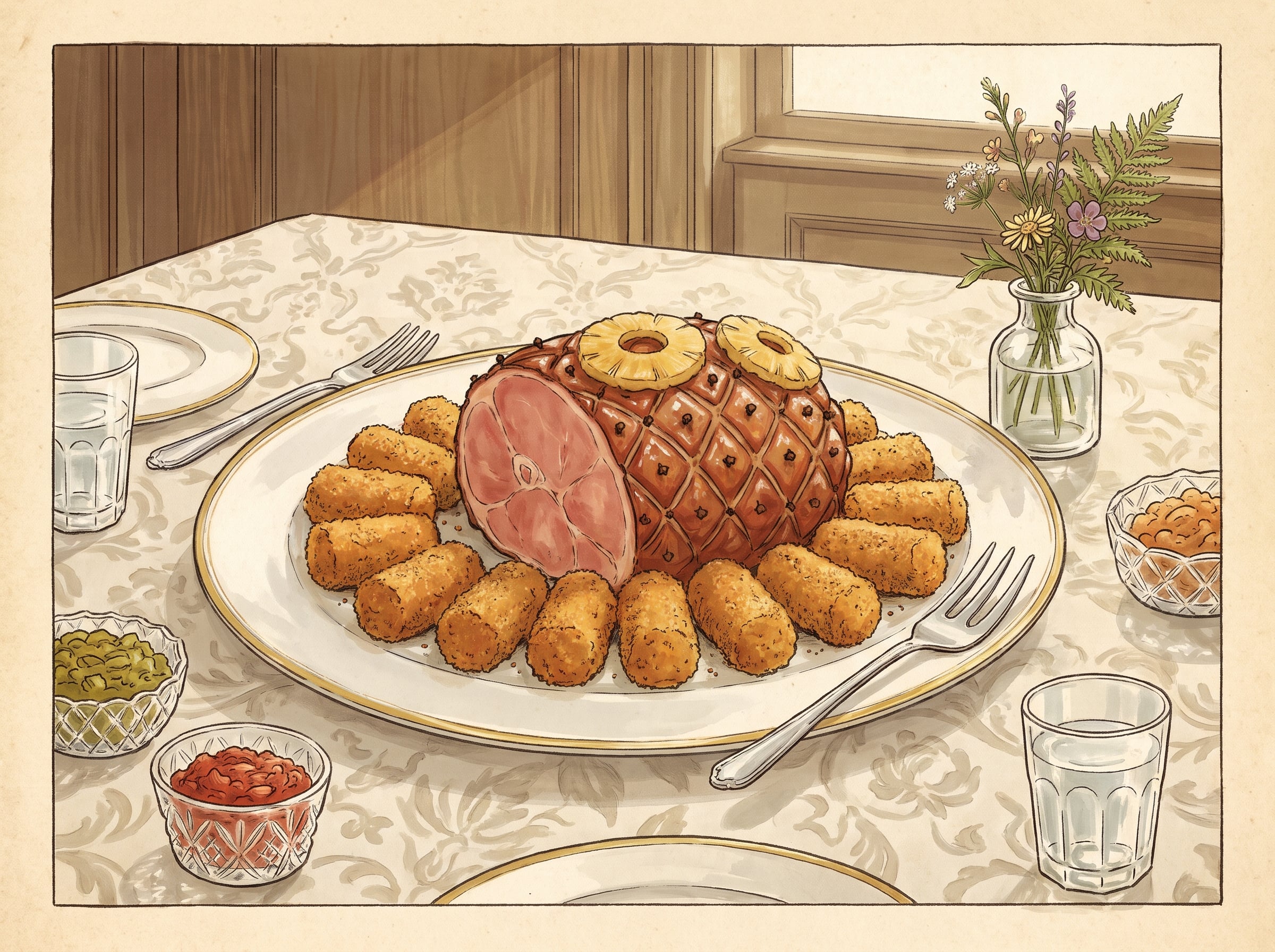
In 1913 a Chicago company that made frying fat put out a cookbook, and tucked inside its fifty-two Sunday dinners is a ring of sweet potato croquettes circling a baked ham. The recipe runs to six ingredients. The story around it takes in a well-known cooking teacher, a magazine contest she lost to Fannie Farmer, and a shortening that wanted its name printed right in the method.
Please note that some of the images in this article were created with the assistance of AI.
From Fifty-two Sunday Dinners, 1913
The Story Behind This Recipe
A teacher, a contest and a shortening
In 1905 the Women’s Home Companion went looking for a new columnist and put six well-known cooks up against one another to choose one. Elizabeth O. Hiller was among them. She lost to Fannie Farmer, which is about as respectable a way to lose as there was. Hiller had trained at the Pratt Institute in Brooklyn and at the Boston Cooking School, finishing with the class of 1898. She went on to run the Chicago Domestic Training School at 53 Dearborn Street. Her recipes for the Chicago Tribune were picked up by papers around the country, and she spoke at expositions, to clubs and societies, and on the radio. She also took part in advertising for products that included gas ranges. Born around 1856, she lived to about 85 and died in Park Ridge, Illinois, in 1941.
Fifty-two Sunday Dinners came out under the name of the N. K. Fairbank Company of Chicago, maker of Cottolene, a shortening of beef tallow and cottonseed oil. The Science History Institute notes that many cookbooks were written to promote it, and this one makes no secret of its job. The croquettes are not fried in just any fat. They go into "deep hot Cottolene," brand name and all.
A crunchy word with a long pedigree
Croquette comes from the French croquer, "to crunch," and English writers of the 1700s usually spelled it "croquet," like the lawn game. A 17th-century recipe from François Massialot was far grander than Hiller’s. He bound meat, truffles, marrow, breadcrumbs and cheese with egg, then breaded the mixture and fried it in lard. His croquettes ran anywhere from egg-sized down to walnut-sized and appeared as an hors d’oeuvre or a garnish.
The thick-bound croquette we would recognize turns up in an 1822 English cookbook by the French cook Louis Eustache Ude. By the 1800s croquettes were hugely popular in cookbooks and at big catered affairs, with chicken the favorite filling. Today mashed potato is the usual choice. Hiller’s version lands neatly between the two. The mashed sweet potato is both base and binder, an egg holds it together, and the whole thing is breaded and fried just like the old meat croquettes.
A crisp border for the Sunday ham
Sweet potato croquettes had already earned a seat at the holiday table before this book appeared. An 1897 Ladies’ Home Journal menu placed them on Christmas dinner. Hiller wrote hers as one piece of a complete meal. The croquettes are drained on brown paper, then set around a baked ham, a crisp border for the centerpiece. That is the croquette doing the same job Massialot gave it more than two hundred years earlier, dressed down for a Chicago Sunday. The smooth mash came from a ricer, the brand-name fat came from the publisher, and the last bit of judgment came from the cook. Hot milk went in only "if mixture is too dry."
1910s
What Our Readers Say
- When Piaci Pizza readers loved a food photo and tapped a reason, “comfort” topped the list at 30%, followed by “ingredients” at 18% and “nostalgic” at 16%.
From Piaci Pizza reader polls and votes.
Notes From the Era
The recipe · 1913
Sweet Potato Croquettes
From Fifty-two Sunday Dinners by Elizabeth O. Hiller (1913). Every word of the recipe below is as printed.
Ingredients
- 2 cups hot riced sweet potatoes.
- 3 tablespoons butter.
- 1/2 teaspoon salt.
- Few grains pepper.
- 1/2 cup chopped walnut meats.
- 1 egg well beaten.
- Deep-frying fat can catch fire, so use a deep, heavy pot no more than half full and keep the oil at about 350–375°F / 175–190°C.
- Brown paper isn’t made for food contact, so drain the croquettes on paper towels or a rack instead.
Method
-
Mix the ingredients
PROCESS: Mix ingredients in the order given. If mixture is too dry add hot milk.
-
Shape, coat and fry
Mold in cork-shape croquettes, roll in crumbs, then in egg, again in crumbs, and fry in deep hot Cottolene.
-
Drain and serve
Drain on brown paper and arrange around Baked Ham.
Our notes
Reading It Today
"Hot riced" and "walnut meats". Riced sweet potatoes are cooked sweet potatoes pressed through a ricer, a tool with small holes about the size of rice grains. It gives a light, fluffy mash rather than a gluey one. Walnut meats are simply shelled walnut kernels.
What Cottolene was. Cottolene was a shortening of beef tallow and cottonseed oil, made into the mid-1900s and no longer on store shelves. The recipe calls for enough of it for deep frying, meaning the croquettes would be fully submerged in hot fat.
Cork-shaped and double-crumbed. "Cork-shape" means short, stubby cylinders. They are rolled in crumbs, then egg, then crumbs again. That double coat suggests a thick, crunchy shell around a soft center.
Sweet, but not dessert. Judging from the ingredients, these would taste of the sweet potato itself, rounded out by butter, with only salt and a few grains of pepper and some crunch from the walnuts. There is no sugar, sweet spice or marshmallow, so they lean toward the savory side.
Source: Elizabeth O. Hiller, Fifty-two Sunday Dinners (The N. K. Fairbank Company, Chicago, 1913). Read the 1913 book at Project Gutenberg.
Sources for the history
- Elizabeth O. Hiller, Fifty-two Sunday Dinners (The N. K. Fairbank Company, Chicago, 1913), Project Gutenberg
- Elizabeth O. Hiller – Wikipedia
- Home Helps – Science History Institute Digital Collections
- Chicken Croquettes – Ebenezer Maxwell Mansion (Becky Diamond)
- Croquette – Wikipedia
- Potato ricer – Wikipedia
The original recipe text is from a work published in 1913 and is in the public domain in the United States. The history, notes and illustrations are Piaci Pizza’s own. Brand names that appear in historic recipes are mentioned as historical fact only. Illustrations are AI-generated in a vintage style. The recipe is shown exactly as it was published in 1913; we have not photographed a test batch.