
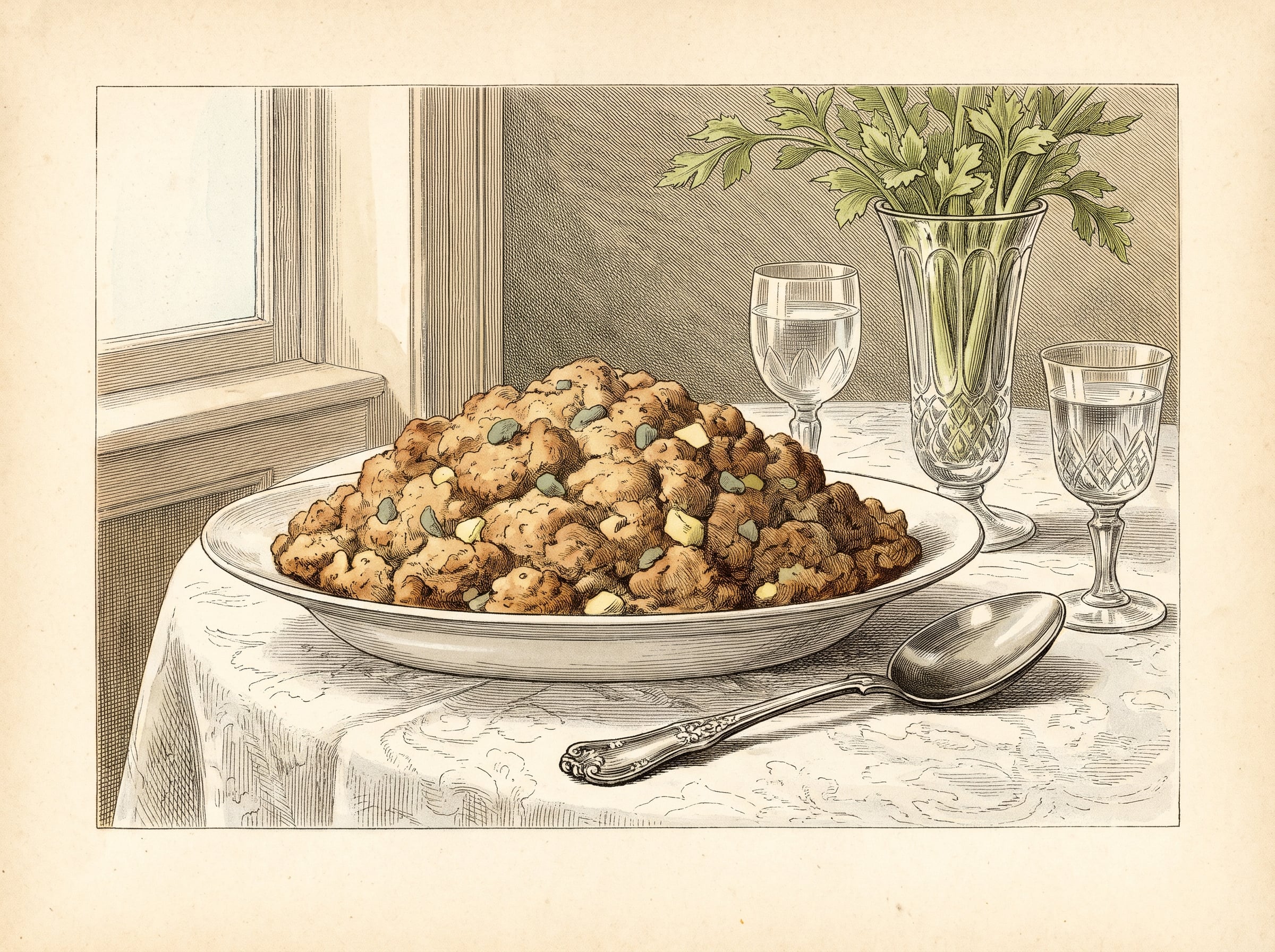
Most stuffing recipes start with what to put in. This one, from the kitchen of the Battle Creek Sanitarium, starts by wondering whether you need it at all. What follows is a dressing with no meat, no butter, no drippings and no pepper, and a revealing look at a time when dinner was a question of right and wrong as much as of taste.
Please note that some of the images in this article were created with the assistance of AI.
From Science in the Kitchen, 1893
The Story Behind This Recipe
The teacher who ended up running the kitchen
Ella Ervilla Eaton was a schoolteacher when a visit to Battle Creek changed her course. When typhoid broke out locally, she stepped in as a nurse, then enrolled in the Sanitarium School of Hygiene and took a job as an editorial assistant on Good Health magazine. School was familiar ground. Born in Alfred, New York, in 1853, she graduated from Alfred University at nineteen, and an 1893 profile called her the youngest pupil ever to win equal honors there. In February 1879 she married Dr. John Harvey Kellogg, the Sanitarium’s superintendent.
Meals at the Sanitarium followed the Kelloggs’ rules: no meat, no spices, and refined sugar only rarely. John admitted that new patients were usually unhappy with what was left on the plate. Around 1883–84 Ella turned a kitchen into something close to a laboratory, the Sanitarium Experimental Kitchen, and tested recipes until they were healthful and still pleasant to eat. The results became Science in the Kitchen, first published in 1892 (some sources say 1893, the edition quoted here). It opens with a long lesson on digestion and kitchen cleanliness, and, unusually for its day, it breaks recipes down into protein, fat and carbohydrate. John later called her menus her greatest single achievement, and in 1920 he wrote that hundreds of her dishes had made their way into newer cookbooks and newspaper household columns.
Farce, forcemeat, stuffing, dressing
Nobody knows who first stuffed a bird, but the Romans left the oldest written trail. The cookbook of Apicius fills chickens, hares and pigs with mixtures of vegetables, herbs, nuts and spelt. English has never quite settled on a name for the stuff. It was ‘farce’ around 1390, ‘stuffing’ by 1538 and ‘forcemeat’ by 1688, and Americans started calling it ‘dressing’ around 1850. The usual explanation is practical. An emptied bird held its shape better when filled, and over time stale bread and chopped vegetables became the filling of choice, soaking up the meat juices as they cooked.
Thanksgiving as a national holiday is younger than all of those words. It became a national holiday only in 1863. Before that it was an irregular feast kept mostly in New England.
Dressing, if you must
That opening, ‘if a dressing is considered necessary,’ is the most Battle Creek line in the recipe, and everything after it follows the house rules. The base is the familiar American one of stale bread, sage, celery and egg. But with meat and butter off the menu, there were no drippings to soak the crumbs. Cream takes their place, as it does all through Science in the Kitchen. It was one of the few rich ingredients Ella allowed, and she poured it over almost everything.
Salt is the only seasoning besides the sage. The Kelloggs ruled out every condiment except salt and blamed spices for leading people to drink, so pepper never got near this bowl. The recipe doesn’t say what the dressing was meant to go with, or even how to cook it. The most we can say is that it fits easily beside a meatless Thanksgiving dinner.
1890s
Notes From the Era
The recipe · 1893
What Our Readers Say
- When our readers loved a food photo and tapped a reason, comfort came first at 30%, with nostalgia and ingredients each picked 17% of the time.
- When Piaci Pizza readers disliked a food photo, the top reason was simply “not for me” at 39%, followed by the ingredients at 29%.
From Piaci Pizza reader polls and votes.
Dressing
From Science in the Kitchen by Ella Eaton Kellogg (1893). Every word of the recipe below is as printed.
Ingredients
- a quart of crumbs of rather stale whole-wheat bread
- cream
- a small handful of powdered and sifted sage leaves which have been dried in the oven until crisp
- salt as desired
- a well-beaten egg
- a little chopped celery
- The dressing contains raw egg, so cook it until it reaches 165°F / 74°C in the center.
- If the dressing is cooked inside a bird, the dressing itself must reach 165°F / 74°C.
Method
-
Moisten the crumbs and add the sage
If a dressing is considered necessary, it may be made of a quart of crumbs of rather stale whole-wheat bread, moistened with cream, to which add a small handful of powdered and sifted sage leaves which have been dried in the oven until crisp.
-
Season and bind
Add salt as desired, a well-beaten egg, and a little chopped celery.
Our notes
Reading It Today
A quart of crumbs. A quart is 4 cups by volume, so the recipe calls for about 4 cups of crumbs. ‘Rather stale’ bread is a little dried out, which helps it take up the cream without turning to paste.
A small handful of sage. There is no standard equivalent for a handful. It means roughly what fits in a cupped hand, so the amount depends on the cook. Drying the leaves until crisp, then powdering and sifting them, gives a fine powder that spreads evenly through the crumbs.
What to expect. Judging from the ingredients, cream and a beaten egg would bind the crumbs into something soft and rich, more cohesive than a loose, crumbly stuffing. Whole-wheat bread makes a heartier, nuttier base than white. Sage and salt lead the flavor, with celery adding a little freshness.
How it differs from today’s. Most modern dressings are moistened with stock or butter. This one uses cream and egg instead and has no meat, no butter and no pepper. It also gives no cooking time or temperature, so the printed recipe leaves the baking entirely to the cook.
Source: Ella Eaton Kellogg, Science in the Kitchen (Health Publishing Company, Battle Creek, 1893). Read the 1893 book at Project Gutenberg.
Sources for the history
- Ella Eaton Kellogg, Science in the Kitchen (1893), Project Gutenberg
- Ella Eaton Kellogg – Wikipedia
- The Other Kellogg: Ella Eaton, by Edward White – The Paris Review
- Science in the Kitchen: Kellogg, Meat & Morality – Shelf Life, Conrad N. Hilton Library (Culinary Institute of America)
- Stuffing – Wikipedia
- Differences Between Dressing and Stuffing – University of Wyoming Extension
The original recipe text is from a work published in 1893 and is in the public domain in the United States. The history, notes and illustrations are Piaci Pizza’s own. Brand names that appear in historic recipes are mentioned as historical fact only. Illustrations are AI-generated in a vintage style. The recipe is shown exactly as it was published in 1893; we have not photographed a test batch.